The best event production software for 2026, compared

Event production software connects people, timelines, and technical setups into a single workflow. Here's how the leading platforms compare so you can choose one that works best for your requirements.

Most events don't fall apart in obvious ways. They drift quietly—timelines drift, last-minute changes don't propagate, crew work off outdated run sheets, and small gaps compound into visible breakdowns. As costs rise and expectations tighten, that margin for error is shrinking. As Thomas Bryson, a director at Meeting Professionals International (MPI) puts it, "you can't afford autopilot anymore."

That shift—from autopilot to intentional orchestration—happens at the event production layer. It means every cue, dependency, and update is tracked, shared, and adjusted in real time, not left to manual coordination or static plans. Event production software enables that level of control by connecting schedules, crew, AV, and communication into a single system.

This guide breaks down what event production software actually does, how to evaluate it based on scale and complexity, and how platforms like Zoho Backstage, Cvent, and Bizzabo compare in practice.

Best event production software compared

6 best event production software for end-to-end event execution

Where does event production software sit in your tech stack?

Event production software sits at the control layer of your stack. It's not responsible for running the show technically. Rather, it's responsible for making sure everything that needs to happen, happens in the right order, with the right people, at the right time.

That includes pre-event scheduling, crew coordination, run-of-show management, on-site execution, and post-event reporting. Think of it as the orchestration layer. It sits above specialist tools (live switching, streaming, lighting, presentation systems) and connects them through a shared operational timeline.

There are two distinct layers here:

  • Pure production tools like OBS Studio, vMix, ProPresenter, and Showbiz Budgeting handle the technical side of the show—video switching, graphics, audio, and stage output.
  • Event production platforms like Zoho Backstage, Cvent, and Bizzabo manage the operational layer—timelines, crew workflows, communication, and cross-team dependencies.

For complex events, these layers work together. The production tools execute each part of the show, but the event production platform keeps those parts in sync.

What event production software does: Must-have features

At a minimum, your event production software has to support the full production lifecycle—before, during, and after the event—without breaking continuity between teams or tools.

This includes:

  • Pre-production scheduling and planning: Run-of-show documents, session scheduling, speaker onboarding, content curation, and crew assignments—all structured in a way that teams can actually act on.
  • AV and technical coordination: Connecting the operational plan to technical requirements: session timings, room setups, equipment needs, and technical rehearsals.
  • On-site execution and real-time updates: Check-in, session management, live announcements, capacity tracking, and last-minute changes pushed to attendees and crew at the same time.
  • Crew and team coordination: Role-based access, internal communication, task management, and tools for staff and volunteers to stay aligned.
  • Hybrid production layer: Managing in-person and virtual components together—live streaming, remote speakers, and virtual attendee access.
  • Post-event reporting: Session performance, attendance data, engagement metrics, and lead capture tied back to the event.
The 6 best event production software platforms in 2026

Choosing the right platform comes down to how well it handles real execution—not just planning. The tools below are built to manage production workflows at different levels of scale and complexity.

Here's how the leading event production platforms compare in 2026, starting with a quick overview of the platforms we'll be covering:

  • Zoho Backstage: Teams that need practical, end-to-end production coordination without enterprise complexity
  • Bizzabo: Large, session-driven events where engagement shapes execution
  • EventsAir: Academic and association events with abstract workflows and structured program management
  • Whova: Simple, repeatable events where production is minimal and setup speed matters
  • vFairs: Expos and trade shows where production is distributed across exhibitor booths
  • Cvent: Enterprise events focused on logistics, venues, and large-scale coordination

1. Zoho Backstage

  • Best for: In-house event teams that want solid production coverage without moving into enterprise tooling.
  • G2 rating: 4.3/5

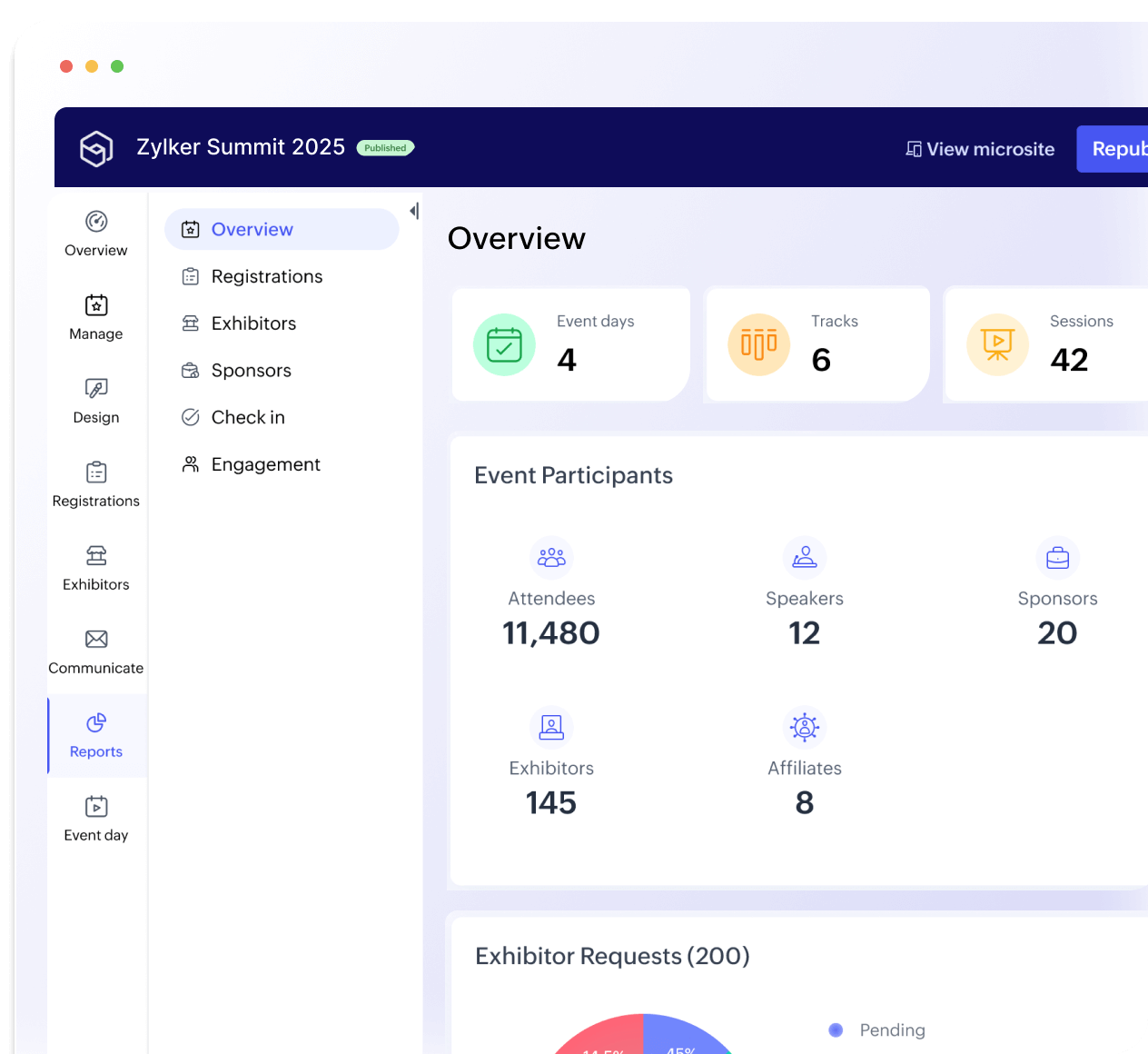
Zoho Backstage is built for teams that need to manage production across sessions, attendees, and on-site execution—without moving into heavy, enterprise-grade systems. It doesn't try to compete on deep AV control or complex production tooling. Instead, it focuses on covering the operational layer cleanly, so events don't break down at the coordination level.

Where it stands out is in how much of that workflow is usable out of the box. Session scheduling, speaker management, attendee access, and on-site execution all sit in one system, and here's what that means for you:

  • Session scheduling, speaker coordination, and attendee registration are tightly connected, so managing multi-track events doesn't require separate systems
  • Check-in, session tracking, and attendee movement are built into the same workflow, reducing handoffs during live execution
  • Hybrid events run through the same setup with OnAir, so virtual sessions and remote speakers don't require a separate production layer

The advantage here is coverage. Zoho Backstage handles the core production layer well enough that most small to mid-sized teams don't need to add more tools.

Zoho Backstage key features

  • Multi-track agenda management: Plan and manage parallel sessions, tracks, and speaker schedules without separate tools.
  • Integrated check-in and session tracking: Monitor attendee entry and session participation in real time from the same system.
  • Speaker and content coordination: Collect speaker details, session info, and presentations in one place to avoid scattered workflows.
  • Hybrid event execution (OnAir): Run virtual sessions, remote speakers, and live streaming alongside in-person events without duplicating setup.
  • Real-time schedule updates: Push session changes instantly across event pages, apps, and attendee schedules.
  • Session-level access control: Control who can attend specific sessions, workshops, or tracks based on registration or ticket type.
  • Private internal discussion channels: Let production teams coordinate in real time within the platform instead of relying on external chat tools.
  • Role-based access and audit logs: Control who can view or edit different parts of the event and track changes for accountability during execution.
  • Custom automations and integrations: Connect with project management tools, AV systems, and other software to extend workflows without manual intervention.

Zoho Backstage pricing

Zoho Backstage offers a free plan for smaller events, with paid plans starting at $99/month and a pay-per-event option from $299 depending on event size and requirements.

2. Bizzabo

  • Best for: Large, content-heavy events where attendee experience and session delivery matter more than granular production control
  • G2 rating: 4.3/5

Bizzabo handles event production well at the session and attendee layer—agendas, speakers, and live delivery are tightly integrated with what attendees see and interact with. In other words, it's designed around sessions and attendee flow, not around managing crews, backstage operations, or tightly controlled production timelines.

This makes Bizzabo a strong fit for teams prioritizing audience experience and session delivery over backend coordination. Not so much when production requires tight crew-level workflows or backstage control across multiple teams.

For events with complex AV setups or broadcast-style production needs, it typically needs to be paired with more specialized tools.

Bizzabo key features

  • Multi-track session management: Plan and run parallel sessions with integrated speaker and content workflows.
  • Hybrid session delivery: Manage virtual sessions, streaming, and remote speakers within the same system.
  • Real-time session updates: Reflect schedule changes across attendee-facing touchpoints without manual coordination.
  • Built-in check-in and on-site tools: Handle attendee entry and session participation tracking during live events.
  • Speaker management workflows: Centralize speaker data, session details, and content coordination.

Bizzabo pricing

Bizzabo uses custom pricing based on event size, features, and scale, typically positioning it at the higher end of the market.

3. EventsAir

  • Best for: Academic, association, and government events that rely on abstract submissions, speaker workflows, and structured program management
  • G2 rating: 4.5/5

EventsAir is designed for events where production is driven by process-heavy workflows—like call-for-papers, abstract reviews, and speaker approvals. Instead of focusing on stage execution or AV coordination, it's built to manage how content is collected, evaluated, and scheduled before it ever reaches the stage.

That means production is less about live show control and more about upstream coordination. Abstract submissions, review cycles, speaker onboarding, and session allocation all occur within structured workflows, making it easier to manage large academic or association events with hundreds of contributors.

The system is also more rigid and setup-heavy, which works for standardized programs but can slow down teams running fast-moving or less structured events.

EventsAir key features

  • End-to-end workflow management: Handle registration, abstracts, accommodation, and on-site logistics within one system.
  • Abstract and speaker management: Manage call-for-papers, submissions, reviews, and speaker coordination in structured workflows.
  • Workflow automation: Automate communications, approvals, and operational steps to reduce manual work.
  • Hybrid event support: Manage virtual sessions and hybrid formats alongside in-person events.
  • Team collaboration tools: Allow multiple team members to work on different parts of the event simultaneously.

EventsAir pricing

Custom pricing based on event size, modules, and requirements. Better suited for larger organizations rather than small teams.

4. Whova

  • Best for: Teams running frequent micro events (webinars, workshops, small meetups) that need fast setup and repeatable workflows.
  • G2 rating: 4.8/5

Whova is an event management platform centered around its mobile app, which acts as the main interface for schedules, attendee communication, and session access. It combines registration, event apps, check-in, and basic virtual-event support into a single system, with a focus on simplifying setup and keeping attendees informed.

Whova also uses standardized workflows to reduce setup time for smaller or repeatable events. From a production standpoint, that means less configuration, but also less control. You get scheduling, attendee communication, and basic session handling out of the box. What you don't get is depth.

It's perfect when production is simple. It breaks when production needs control.

Whova key features

  • App-first event execution: Manage schedules, updates, and session access directly through the event app.
  • Personalized attendee agendas: Let attendees build schedules that reflect session capacity and preferences.
  • Session engagement tools: Enable Q&A, polls, and in-session interaction via the app.
  • Hybrid event support: Deliver virtual sessions and content alongside in-person events.

Whova pricing

Custom pricing based on event size and requirements.

5. vFairs

  • Best for: Trade shows, expos, and job fairs where attendee–exhibitor interaction is central.
  • G2 rating: 4.7/5

vFairs is designed around exhibit halls and booths, not just sessions. Its core strength is handling events where production is distributed across multiple exhibitors—each with their own content, interactions, and goals.

Production, here, is structured around the expo floor—though it has the baseline speaker and session management capabilities. But the focus is on managing a network of parallel micro-experiences (booths).

vFairs key features

  • Virtual exhibit halls: Create 2D/3D expo environments with navigable booths and exhibitor listings.
  • Custom exhibitor booths: Let exhibitors design branded booths with videos, demos, and downloadable content.
  • Interactive floor maps: Help attendees navigate booths and sessions in large events.
  • Hybrid expo support: Combine in-person booths with virtual access and engagement layers.

vFairs pricing

Custom pricing based on event size and requirements.

6. Cvent

  • Best for: Large enterprises managing complex event programs across venues, budgets, and multiple stakeholders.
  • G2 rating: 4.3/5

Cvent is structured to manage the operational complexity of events—venues, registration, budgets, and compliance—rather than the execution layer itself. It's strongest before and after the event, where scale and coordination across stakeholders matter most.

From a production standpoint, that creates a gap. Cvent handles scheduling, attendee management, and on-site logistics reliably, but it doesn't extend into real-time execution. Production is managed indirectly through structured data and processes rather than through live operational tools.

That tradeoff works for enterprise teams running standardized events across locations. But if your focus is active production control, Cvent usually ends up being one part of a larger setup, not the system that drives execution.

Cvent key features

  • Venue sourcing and management: Find, compare, and book venues with integrated sourcing tools.
  • Event diagramming and seating: Plan room layouts and attendee flow with spatial design tools.
  • Registration and attendee management: Capture attendee data, manage approvals, and process payments at scale.
  • Session tracking and access control: Monitor attendance and control entry across sessions.

Cvent pricing

Custom enterprise pricing based on modules, scale, and usage.

3 things to consider when evaluating event production software

Not every event needs the same level of production control. The right platform depends on your event budget, the complexity of your event, how your team operates, and how many moving parts need to stay in sync.

Instead of comparing features in isolation, we suggest you evaluate tools based on the type of execution they need to support.

Event scale and production complexity

A single-track event with a basic AV setup has very different needs compared to a multi-track conference with parallel sessions and broadcast-level production. As scale increases, so does the number of dependencies—stages, speakers, equipment, and timing—all of which need tighter coordination.

This is also where the boundary becomes clear: event production platforms handle orchestration, while specialist tools handle technical execution.

Team structure and coordination needs

Any solo event organizer can manage with simpler workflows, but larger events involve dedicated roles across production, AV, content, and operations. At that point, role-based access, task management, and real-time communication become essential. The platform needs to reflect how your team actually works, rather than forcing everything into a single layer of control.

⚠️This is also where audit logs and permission controls start to matter. When multiple teams are making changes in parallel, you need visibility into who changed what, when, and why. This resolves issues quickly and maintains accountability during live execution.

Hybrid requirements and integrations

If your events will regularly include a virtual component, the question is whether it's an add-on or a fully integrated experience. Managing live streams, remote speakers, and virtual audiences alongside in-person execution requires a unified system.

At the same time, the platform should connect cleanly with your existing stack—CRM, streaming tools, AV systems, and analytics—so data and workflows don't fragment.

💡Pro tip: If you host multiple events or have a long-term event strategy, it might help to look for event production software with low-code automation builders. That way, you can build your own custom integrations and automations without having to invest in implementation or engineering teams.

Manage your entire event production workflow in Zoho Backstage

Event production gets messy when everything lives in different places—schedules in one tool, speakers in another, updates buried in chats. Zoho Backstage brings all of that into one place, so you're not constantly stitching things together while trying to run the event.

That becomes even more important once you're dealing with hybrid formats. With OnAir, Backstage handles virtual and in-person streaming, remote speakers, and attendee access—without forcing you into a separate workflow. It's the same system, just extended to cover both sides of the event.

And the best part: Zoho Backstage goes beyond production. Ticketing, registration, check-in, event apps, and post-event data all sit within the same platform, so you're not handing off between systems as the event moves from planning to execution to follow-up.

The benefit is straightforward: less coordination overhead, fewer gaps between teams, and a clearer handle on what's happening at any given moment.

FAQ

Event production software aligns AV requirements—such as timing, room setups, equipment, and rehearsals—with the run of the show. The actual execution still occurs in specialised tools, such as switching or lighting systems.

During the event, it acts as the control layer. It keeps schedules up to date, pushes changes in real time, and ensures that crew, speakers, and attendees stay aligned as things shift on the ground.

It connects the full lifecycle—planning, coordination, execution, and reporting—within a single system. Instead of handing off between tools, you're working from a shared timeline that carries through the entire event.

Start with your event's complexity. Look for strong agenda and session management, real-time updates, role-based access, and integrations with your AV and CRM tools. If you run hybrid events, built-in virtual support is also a must.