
The $685 billion opportunity: A step-by-step roadmap for SME AI adoption

The world hasn't been the same since November 30, 2022—the day OpenAI released ChatGPT. Almost overnight, artificial intelligence (AI) went from a theoretical entity to a tangible utility, and businesses saw how it could transform productivity and operational efficiency the way the internet transformed information access and communication.
While large enterprises around the world rapidly deployed dedicated AI teams and custom solutions, small and medium enterprises (SMEs) lagged behind in AI adoption, given the latter's constraints in financial and technical resources.
In India, for instance, micro, small, and medium enterprises contribute to 30% of the nation's gross domestic product and employ over 230 million people. However, they face significant challenges in AI adoption, such as inefficiencies in data collection and storage, limited technical expertise, and a lack of access to affordable AI solutions, according to an August 2025 analysis by the Indian government's Ministry of Electronics and Information Technology.
What's more, if these challenges are addressed effectively, India's SMEs could potentially unlock $685 billion in value by adopting AI technologies, the report highlights.
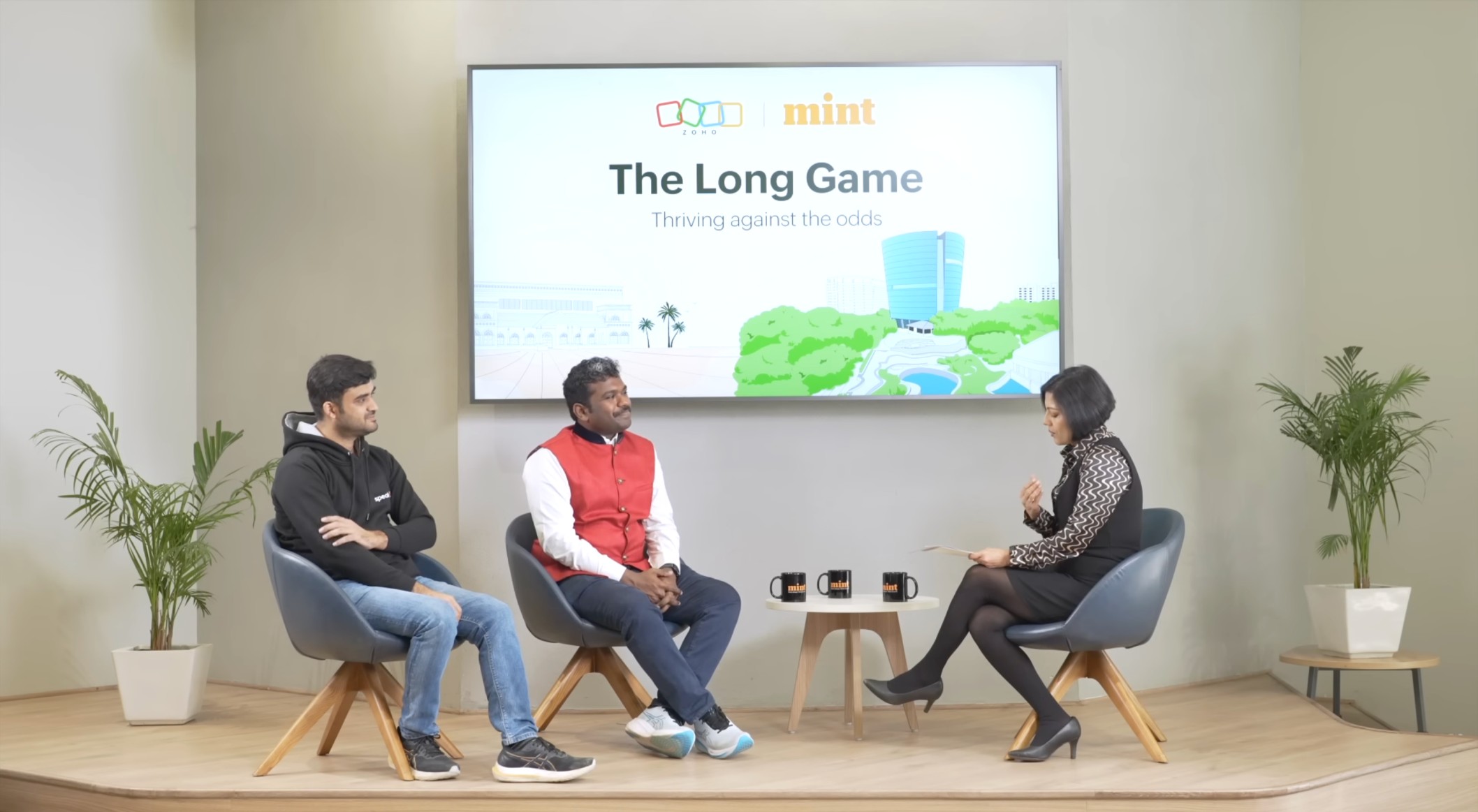
So how can SMEs, both in India and the rest of the world, tap into the power of AI to unlock this transformative opportunity? To understand this, The Long Game Dialogues brought two experts on board:
Ramprakash Ramamoorthy, Director of AI Research, Zoho Corporation
Arpit Mittal, CEO and Founder, SpeakX.ai
In this chat, they unpack how many of the concerns that SMEs have about AI aren't built on solid ground, and why SMEs actually have an edge over large corporations in AI adoption.
Debunking AI myths that hold SMEs back
Myth #1: AI is suitable for large enterprises, not for SMEs
One common perception is that AI is suitable only for large corporations, given their immensity of data and scale of operations. However, Ramprakash argues that SMEs are placed better than large enterprises to adopt AI. "SMEs are able to get faster ROI from their AI stack when compared to enterprises because enterprises operate in silos, but SMEs have limited infrastructure, limited data, and it's easy for them to get started with AI and also have measurable KPIs," he explains.
Myth #2: AI is too expensive for SMEs to invest in
Ramprakash points out that leading AI tools on the market, like Mistral and Llama, come with a pay-as-you-go pricing model, meaning users will be billed based on the extent of their usage. This means that implementation costs are affordable enough for SMEs and startups to invest and see returns in a matter of weeks.
Myth #3: Businesses can unlock 10x productivity with AI
While AI can indeed automate repetitive tasks to help users be more productive in their tasks, Ramprakash observes that even the most digitally mature of Zoho's SME customers have reported only between 10% and 30% productivity gain after deploying AI. "The AI marketing is ahead of the actual technology growth," he remarks, emphasizing the need to "de-hype" AI so that it's not seen as some kind of silver bullet that can be applied to all use cases.
Myth #4: AI is a standalone technology
For SMEs, AI can seem like a disruptive technology that will upend their business operations. But Ramprakash says that AI is only a part of the digital transformation process that companies of all sizes have been undergoing for the past three decades. In another five to six years, AI will be integrated in all the tools that SMEs use, he predicts. "This is a key technology, but again, don't worry too much about it. Don't get into the fear of missing out."
If I were an SME, I would definitely not worry about the technology that goes into my back end, but my customer satisfaction, my competitiveness, my quality, my customer feedback—these would be the things that I would actually be worried about.
— Ramprakash Ramamoorthy, Director of AI Research, Zoho Corporation
The sustainable AI playbook for SMEs
Having debunked some key AI myths, the question remains: how exactly can SMEs go about adopting AI? Drawn from the conversation with Ramprakash and Arpit, here's an AI adoption roadmap that SMEs can use to incorporate AI sustainably in their everyday operations:
Step 1: Get the technology stack right
Before even bringing in an AI tool, it's important for SMEs and startups to first understand that AI can only be as good as the data it's trained on. When your business data is scattered across spreadsheets and siloed in separate tools, the AI that's deployed on top of such fragmented data can't provide reliable, actionable insights.
Ramprakash stresses that, before greenlighting AI adoption, SMEs must first ensure their technology stack—their collection of software and platforms—is mature enough to ensure the business data is connected and accessible across the entire organization.
"Streamlining your data and streamlining your processes becomes all the more important to get on the AI bandwagon. It's not just about buying an AI tool. It's about setting the right platform," he elaborates.
More on this topic: The intersection of technology and economics
Step 2: Restrict AI to the 80% problems first
Having deployed AI onto a mature tech stack, SMEs must resist the temptation to automate all manual tasks in the initial phase, given how AI's output can never be 100% reliable.
Ramprakash suggests that, in the initial stages, SMEs should deploy AI to solve their "80% problems," which are tasks that aren't mission-critical and can tolerate execution with 80% accuracy.
An example would be assigning support tickets to human agents, where even if the AI system assigns to the wrong agent 20% of the time, it can be corrected through human intervention without much disruption to the overall customer experience. This way, SMEs can understand the strengths and limitations of AI for their specific business context while minimizing risks, enabling them to build a more effective long-term AI strategy.
Step 3: Monitor continuously
As SMEs gradually expand their use of AI, they shouldn't rush into it. Arpit notes that SMEs must roll out AI in a phased manner to facilitate continuous monitoring. "Unless and until you monitor the ROI on your investment, it's all going to be one big leap of faith," he warns.
SMEs can track tangible metrics, like customer satisfaction scores or cost savings, to measure the effectiveness of AI deployment in small, iterative cycles. This helps in quickly gathering feedback, making necessary improvements, and then redeploying until the AI's performance is satisfactory.
Step 4: Prioritize privacy and security
Privacy and security risks have always been a part of digital transformation, but it's more pronounced with AI, given its appetite for data. As the AI rollout expands in a business, employees might indulge in "oversharing"—submitting sensitive business and customer information to AI—and inadvertently create potential vulnerabilities.
Ramprakash suggests SMEs to educate employees on the new risks associated with AI tools periodically, through awareness campaigns like "Privacy Week", and strengthen data handling accordingly.
Step 5: Keep the human touch intact
As noted earlier, even the most advanced AI systems can never be 100% accurate at all times. So deploying AI to automate complex tasks, like resolving customer complaints or closing high-value deals that require human judgment and emotional intelligence, can end up becoming a costly mistake.
SMEs must ensure that humans are always in the loop in all functions where AI is deployed. "I believe AI at large is here to assist and not to replace. The human touch is important," Arpit notes.
The first touch point or major touch point of your company's products, both for your customers and for your employees, is via digital channels. So make the digital experience right. That will help in employee retention and in customer retention.
— Ramprakash Ramamoorthy, Director of AI Research, Zoho Corporation
Watch the full conversation here: AI Demystified: Practical tips for successful adoption


