
New products fail at a rate that should make any business leader pause before committing budget to a launch. While the actual belief is that around 90% of new products fail, new research suggests that the real number may be close to 40%. Still, that's a high number!
Generally, the reasons cited most consistently are misinterpreted market research, overestimated market size, and incorrect positioning. Now, these are all the problems that occur before a single unit is manufactured.
A concept testing survey is a tool designed specifically to catch these problems while they are still cheap to fix. Rather than discovering that a product idea doesn't resonate after the factory line is running and the marketing budget is spent, concept testing surfaces that information at the idea stage. At this stage, the only cost of being wrong is a revised slide deck.
What is concept testing in marketing
Concept testing is the process of presenting a new product or service idea to a representative sample of the target market and measuring their reaction before any significant development investment occurs. The product can be presented in a verbal, visual, or prototype form.
It is distinct from market testing, which evaluates an already-built product in a live or simulated market, and from brand or advertising testing, which evaluates messaging and creative execution rather than the underlying product idea itself.
Concept testing examples across industries
Concept testing applies across virtually every product category, though the specific format adapts to the nature of the offering.
In consumer packaged goods, concept testing typically involves a written concept board describing a new product variant (like a new flavor, formulation, or packaging format) alongside an image, tested against a representative sample of category buyers. This can help measure purchase intent and uniqueness before formulation and packaging investment begins.
In software and SaaS, concept testing often takes the form of a clickable prototype or a feature description tested with existing customers or target buyer personas, measuring whether a proposed feature addresses a real pain point and whether it would influence a purchase or upgrade decision before any engineering resources are allocated.
One of the most widely discussed concept testing examples came from Tesla in 2016. Before committing to full-scale manufacturing of the Model 3, Tesla launched a pre-order campaign requiring a refundable $1,000 deposit. Rather than building first and hoping demand existed, the company used reservations to validate market interest.
The deposit filtered out casual interest while visible queues and growing reservation numbers created social proof. Within days, Tesla accumulated hundreds of thousands of reservations, effectively confirming demand before scaling production and reducing the risk of investing heavily in a concept customers did not want.
In each of these contexts, the underlying logic is identical: validate before you build, using the lightest-weight version of the concept that still generates a reliable signal.
Using surveys for concept testing
Surveys are one of the most efficient and scalable ways to run concept tests because they capture structured feedback before resources are committed to development, production, or launch. Instead of relying on internal opinions or small focus groups, surveys allow businesses to validate concepts directly with their intended audience.
A well-designed concept testing survey presents respondents with the concept in a controlled format and measures the variables that matter most: purchase intent, uniqueness, relevance, clarity, perceived value, and preference versus alternatives. Depending on the concept, surveys can include visuals, mockups, descriptions, pricing scenarios, or side-by-side comparisons.
Most importantly, surveys transform reactions into measurable signals, helping teams decide whether to launch, refine, reposition, or abandon an idea before making expensive commitments.
How to conduct a concept testing survey
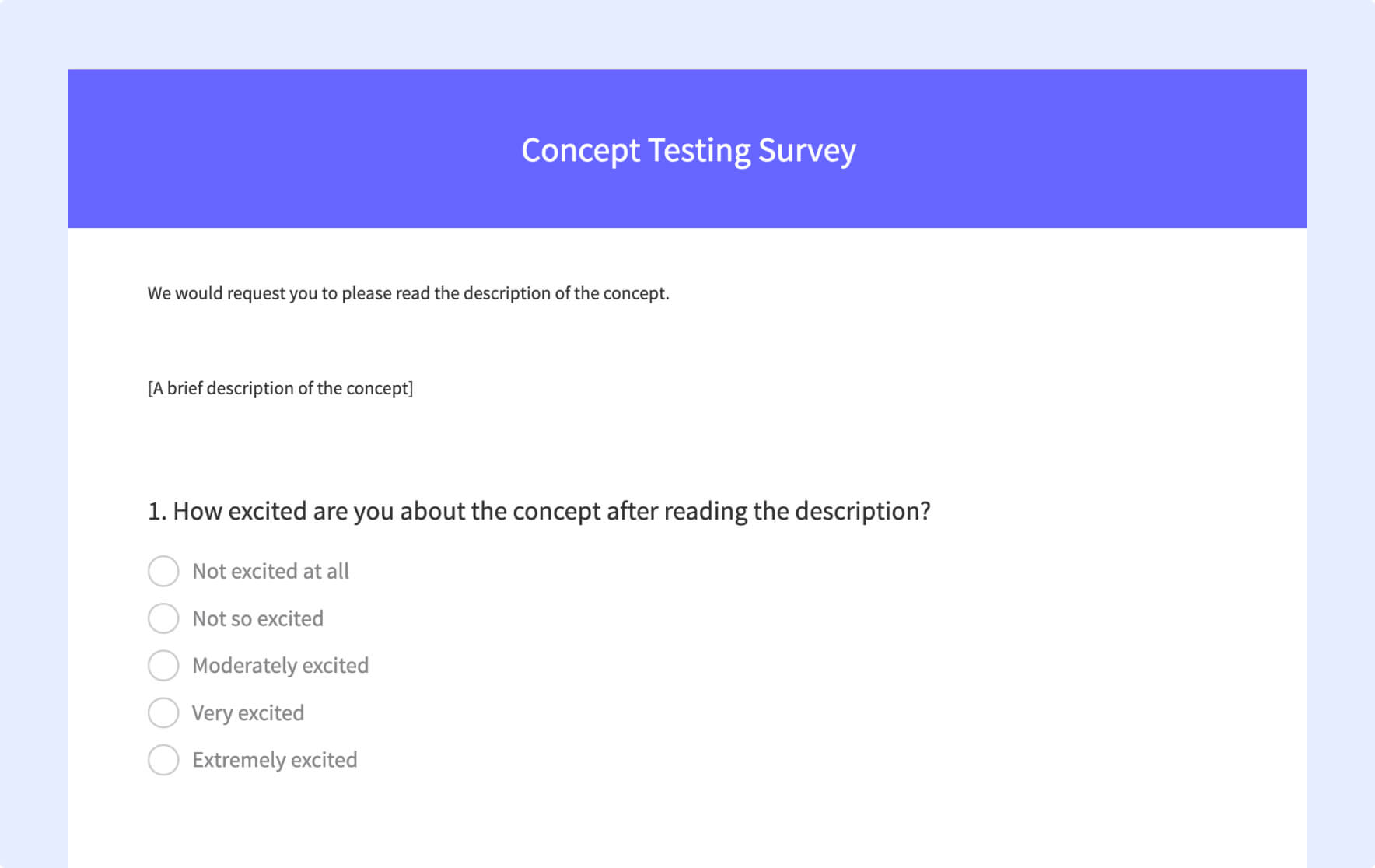
Concept testing surveys can be carried out in five easy steps. Each step builds on the previous one to ensure the feedback you collect is structured, comparable, and capable of informing confident product decisions rather than subjective interpretation.
Step 1: Define the concept clearly and consistently
Before writing survey questions, the concept itself needs to be articulated in a consistent format. This is typically done in a concept statement describing the product, its core benefit, and how it differs from existing alternatives. Visual concepts (a sketch, rendering, or mockup) should accompany the written description wherever the product has a meaningful visual or physical dimension, since visual fidelity improves the reliability of resulting feedback.
Step 2: Identify the right respondent sample
Concept testing surveys should be directed at people who represent the actual target market for the product and not a generic consumer panel. So, for a B2B software concept, this means reaching the specific buyer persona and decision-making role the product is designed for. Similarly, for a consumer product, demographic and behavioral targeting should reflect the intended customer profile as closely as possible.
Step 3: Design the survey to measure the right dimensions
A concept testing survey should measure purchase intent, uniqueness or differentiation, relevance to the respondent's needs, clarity of understanding, and perceived value relative to price. These dimensions, taken together, predict market viability far more reliably than a single "Do you like this?" question.
Step 4: Test multiple concepts where possible
If more than one concept variation exists, testing them within the same survey (ideally with random rotation to avoid order bias) allows direct comparison and identifies which specific elements of a concept are driving positive or negative reaction.
Step 5: Analyze results against a benchmark, not in isolation
A concept's purchase intent score is most useful when compared against benchmark data from past concept tests. This can be either the organization's own historical data or industry norms. A concept that scores well in isolation may still underperform relative to what a successful launch typically requires.
Concept testing survey questions to ask
The following concept testing questions are organized by the dimension they are designed to measure.
Initial reaction and appeal
- What is your overall reaction to this product concept?
- How appealing do you find this idea? (1–5 scale, Not at all appealing to Extremely appealing)
- What do you like most about this concept?
- What concerns or hesitations do you have about this concept?
Clarity and comprehension
- In your own words, what does this product do?
- Is there anything about this concept that is unclear or confusing?
- What problem do you believe this product is designed to solve?
Uniqueness and differentiation
- How different is this concept from products you currently use?
- What existing products or services would you compare this to?
- What does this concept offer that alternatives do not?
Purchase intent and likelihood to buy
- How likely would you be to purchase this product if it were available today? (1–5 scale, Definitely would not buy to Definitely would buy)
- At what price would you consider this product a good value?
- At what price would this product feel too expensive to consider?
- How soon after launch would you likely try this product?
Relevance and fit
- How relevant is this product to your current needs or routines?
- Who else in your life or organization would benefit from this product?
- Would this product change how you currently do [relevant task or activity]?
Open-ended questions
- What would make this product significantly more appealing to you?
- Is there anything missing from this concept that you expected to see?
- If you could change one thing about this concept, what would it be?
Using Zoho Survey for concept testing
Zoho Survey offers a ready-made concept testing template designed to measure customer attitudes toward a product idea using both qualitative and quantitative methods. This enables teams to gauge how a product is likely to be received before committing to production.
For projects that need a broader respondent pool than an existing contact list can provide, Zoho Survey's Buy Responses feature connects teams with research panels segmented by demographic, economic, and geographic attributes, making it possible to reach the right target audience even without an existing customer base to draw from.
The platform's logic and personalization tools route respondents through relevant question paths, while real-time reporting collects and visualizes customer responses as they come in rather than after the survey closes.
For teams testing competing ideas, this combination of templates, panels, and live reporting makes it possible to compare concepts directly and understand why customers prefer one iteration over another. To know more about how Zoho Survey can help with concept testing surveys, click here.
Key takeaways
The gap between products that succeed and the 40% that fail is rarely a problem in execution. It is a gap in validation based on internal conviction rather than confirmed customer demand.
A concept testing survey, conducted early, designed around the right dimensions, and benchmarked consistently over time, is the most cost-effective insurance a product team can buy against that failure rate. The investment is measured in days and a modest research budget.
The alternative is discovering the same information after the product has already been launched. At this stage, the cost of being wrong is no longer measured in days but in the budget, time, and credibility already spent. The choice is yours to make!