
In 2024, the USDA's annual Household Food Security in the United States report (first published in 1997 and the nation's primary instrument for monitoring hunger) was announced as the last of its kind. The USDA has since confirmed it will no longer produce the report going forward, leaving the country without a federally coordinated national food security measurement system for the first time in nearly three decades. The implications are serious.
According to the 2024 report's final findings, 13.7% of U.S. households, or about 18.3 million families, were food insecure at some point during the year. Without ongoing federal data, state and local government agencies are now the last line of measurement between food insecurity and invisibility.
The food insecurity survey is no longer just a policy tool. But, for many communities, it is the only remaining mechanism for knowing the scale of the problem at all.
What food insecurity means and why measuring it matters
Food security, as defined by the USDA, means access by all people at all times to enough food for an active, healthy life. So, food insecurity is the absence of that condition. It can be defined as a state in which households are uncertain of having, or unable to acquire, enough food to meet the needs of all their members due to a lack of money or other resources.
The distinction between low food security and very low food security is important for policy purposes. Low food security households manage to avoid substantially disrupted eating patterns by using coping strategies. For example, eating less varied diets, relying on food banks, or participating in federal assistance programs. Very low food security households cannot fully compensate, and the food intake of one or more household members is actually reduced and disrupted.
Understanding which condition a household is experiencing, and why, determines what kind of government intervention is appropriate. A food survey that distinguishes between these two states and identifies the structural drivers behind them gives policymakers the specificity needed to allocate resources effectively rather than treating all food-insecure households as a single, undifferentiated group.
Food insecurity survey questions: what to ask and why
The following food insecurity survey questions are drawn from or consistent with the USDA Household Food Security Survey Module framework. They are organized by severity tier and accompanied by the rationale for each item.
Anxiety and uncertainty about food access
- In the last 12 months, did you worry that your household's food would run out before you got money to buy more?
- In the last 12 months, was the food that your household bought just not enough?
These two questions form the 2-item HFSSM (Household Food Security Survey Module) short form, which has been validated as an effective screening tool for identifying households at risk of food insecurity and is the most efficient entry point for rapid community assessment.
Reduced quality of diet
- In the last 12 months, were you or other adults in your household not able to eat balanced meals?
- Did your household rely on only a few kinds of low-cost food to feed your children because you were running out of money to buy food?
- In the last 12 months, did you or other adults cut the size of your meals or skip meals because there wasn't enough money for food?
Reduced food intake (adults)
- Did you ever eat less than you felt you should because there wasn't enough money for food?
- Were you ever hungry but didn't eat because there wasn't enough money for food?
- Did you lose weight because there wasn't enough money for food?
Reduced food intake (children)

- Were the children in your household not eating enough because you just couldn't afford enough food?
- Did any of the children in your household skip a meal because there wasn't enough money for food?
Access and structural barriers
- How far do you typically travel to access a grocery store or food market?
- Do you have reliable transportation to reach food retail locations?
- Are you currently enrolled in any federal food assistance program (SNAP, WIC, school meals)?
- What is the primary reason your household has difficulty obtaining enough food?
Open-ended questions for depth
- What types of support would most improve your household's ability to access adequate food?
- Are there specific foods or nutritional needs your household is regularly unable to meet?
Designing an effective government food insecurity survey
A government food insecurity survey designed to inform policy and resource allocation should follow a set of design principles that balance rigor, accessibility, and operational practicality.
Use validated instruments as the foundation
The Household Food Security Survey Module (HFSSM) and Food Insecurity Experience Scale (FIES) provide validated, benchmarked baselines that enable consistent comparison over time and across geographies. Agencies designing custom food surveys should incorporate these validated items rather than replacing them with unvalidated alternatives, which would undermine the ability to benchmark findings against national or international data.
Oversample high-risk subgroups
Random sampling alone will under-represent small but high-need subgroups. These include households below the poverty line, rural residents, children, and elderly individuals whose food insecurity rates are substantially above the national average. Stratified or cluster sampling with deliberate oversampling of these groups produces the statistical precision needed for targeted program design.
Ensure accessibility and linguistic diversity
Food insecurity is disproportionately concentrated in communities where English may not be the primary language. Surveys should be available in the primary languages of the communities being assessed, with question wording reviewed by community liaisons to ensure cultural appropriateness alongside linguistic accuracy.
Include structural and barrier questions
Questions about food access barriers (transportation, store availability, economic constraints, awareness of assistance programs) generate the programmatic intelligence that food security severity scores alone cannot provide. Understanding that a community is food insecure is the first step; understanding that the primary driver is a lack of transportation access to the nearest grocery store, rather than income alone, is what informs the appropriate intervention.
Protect respondent privacy
Food insecurity survey data is sensitive. Respondents may fear stigma or program eligibility consequences from honest disclosure. Survey protocols should clearly communicate that responses are confidential, that individual data will not be shared with benefits-administering agencies, and that participation is voluntary.
Using Zoho Survey for government food security surveys
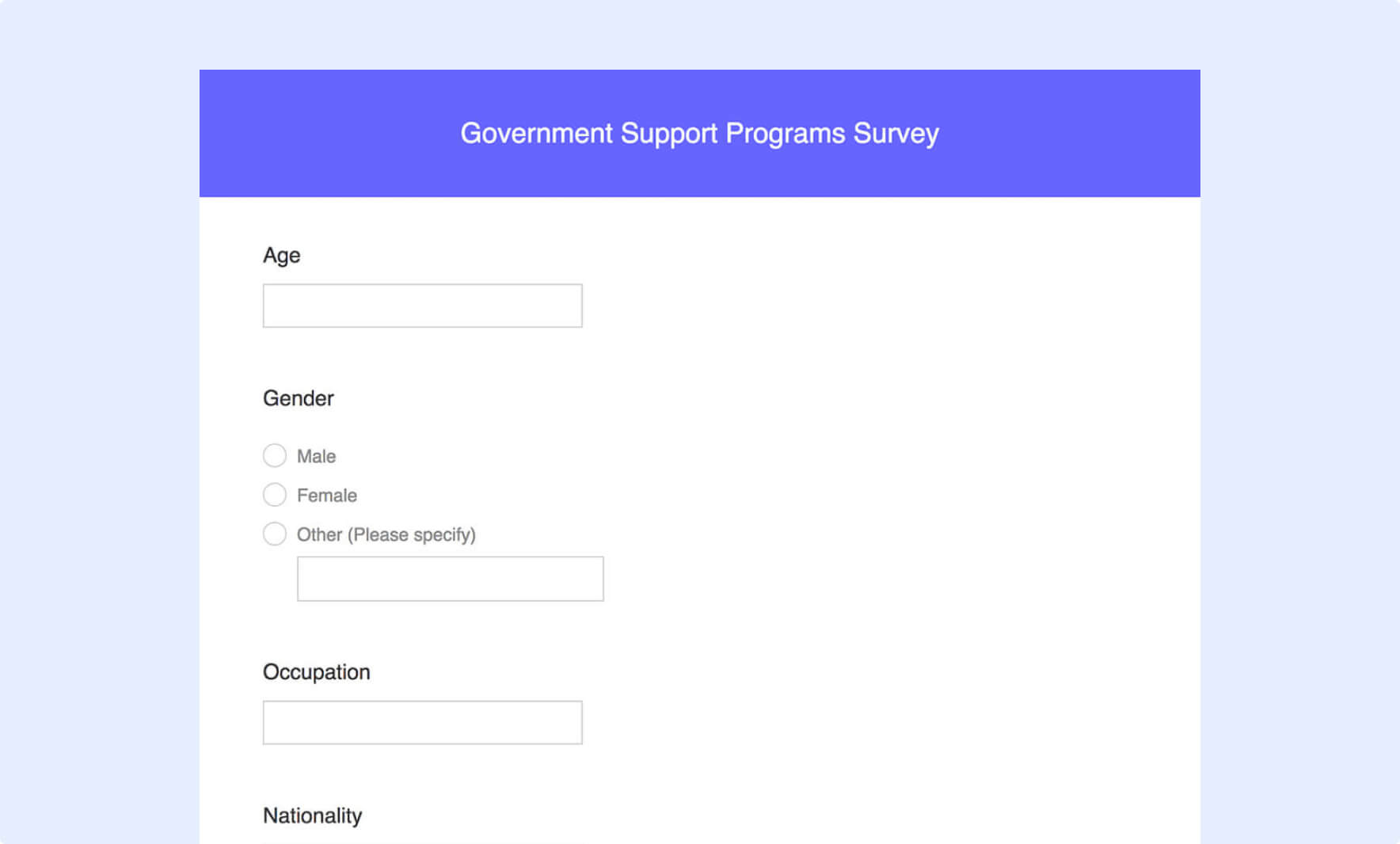
Zoho Survey offers a dedicated library of government and political survey templates designed to help agencies collect reliable, actionable data from the public. These templates are built to support the kinds of structured, large-scale data collection exercises that food security monitoring requires, with question frameworks that can be adapted to the HFSSM or other validated food security instruments.
For government agencies, Zoho Survey's multi-language support enables survey deployment across linguistically diverse communities. This is a critical requirement for food security research that aims to reach the highest-need populations. Offline survey capability allows field workers to collect responses in rural or low-connectivity environments, with automatic data sync when connectivity is restored.
The platform's research panel feature enables demographic-specific outreach. This helps agencies target low-income households, households with children, or elderly residents. It's especially useful for agencies that need to oversample specific at-risk groups, since this level of targeting is often required to achieve the statistical precision needed for program planning. In addition, real-time reporting translates incoming responses into dashboards that allow program administrators to monitor food insecurity prevalence by community, demographic segment, or geographic area as data arrives.
Zoho Survey is now available with a 7-day credit card-free Enterprise trial! This gives government agencies full access to all the features and capabilities needed to build, distribute, and analyze food security surveys from day one.
Turning food insecurity survey data into policy action
Survey data on food insecurity has direct policy utility only when it is analyzed with sufficient geographic and demographic specificity to support resource allocation decisions, and when it is reviewed by the program administrators who have the authority and budget to act on it.
At the federal level, the survey data informs the targeting and budgeting of programs including SNAP, WIC, the National School Lunch Program, and the Emergency Food Assistance Program.
At the state and local level, food survey data collected by health departments, municipal social services agencies, and community organizations supports decisions about food bank placement, mobile food distribution routes, SNAP outreach priorities, and the allocation of emergency food assistance funding.
For ending food insecurity at the community level, the most critical use of survey data is gap analysis. This involves identifying where the population of food-insecure households is largest, where program participation rates among food-insecure households are lowest, and where the structural barriers to food access are most acute.
This three-part analysis – need, program reach, and barrier; is what transforms a food insecurity survey from a measurement exercise into a policy planning tool.
The bottom line
Food insecurity is a measurable, addressable policy problem. But only if government agencies invest in measuring it with the rigor and specificity that effective response requires. A well-designed food insecurity survey, built on validated instruments, deployed with appropriate sampling methods, and followed through with policy analysis and program action, is one of the most direct contributions a government agency can make toward ending food insecurity in the communities it serves. The data already tells us who is going without. The survey is how we find out why. And, most importantly, what to do about it.