
Most companies collect customer feedback. But few ask the right question at the right moment. A post-purchase survey can't explain a cart abandonment from last week, and a support rating can't tell you if a customer will actually renew. Every stage of the journey raises a different question, and one survey format rarely works for all of them.
This guide breaks down how to map the customer journey, choose the right metric and timing for each touchpoint, and turn scattered feedback into a system that actually improves the experience.
What is customer experience management?
Customer experience, or CX, is the impression that a customer develops as a result of all their interactions with a business. This covers what takes place before, during and after the purchase, including advertisements, reviews, visits to the website, the sales conversation, delivery, the use of the product, support, renewal and even cancellation.
Customer experience management involves understanding, enhancing, and measuring the various interactions. It brings together feedback, behavioral data, service records, and business results in order that teams may identify any friction and improve the customer journey.
A study in the Journal of Marketing defines customer experience as something that evolves through various channels and contact points over time, while McKinsey has also discovered that high individual interaction scores can still indicate a disappointing overall experience.
A survey of customer experience therefore has two roles:
- It should evaluate a specific interaction
- It should help to explain how that interaction affects the overall relationship
Map the journey before writing a CX survey
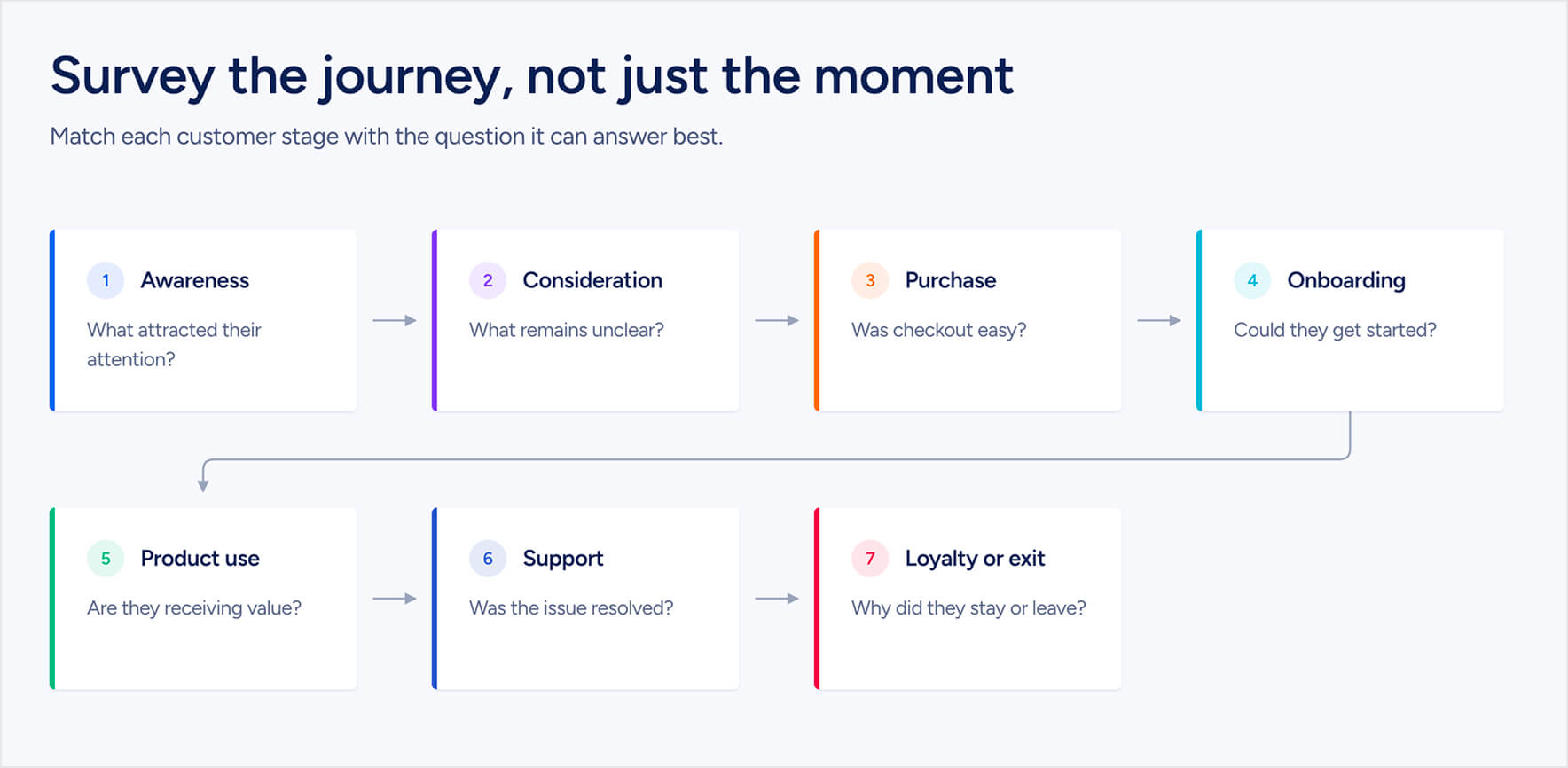
Start by focusing on the journey the customer is attempting to complete. Typical stages involve awareness, consideration, purchase, onboarding, product use, support, loyalty, and exit.
Within each stage, identify the customer journey touchpoints such as a search result, a demo, the checkout process, a delivery message, a help article, a support ticket, a renewal email, or a cancellation form. It should be noted that not all consumer touchpoints are under the control of your company since reviews and word of mouth can also affect people's decisions.
For each case, do the following:
- State the customer's objective
- Describe the action that was carried out or left undone
- Name the team responsible
- List the information that is already available
- Specify the decision that the response should support
The results of a survey which segments customers can indicate what a customer did, while the survey itself can show why. In the case where your data shows that a shopper got to the payment stage and then left, you should ask what prevented them from completing the purchase rather than asking whether they had completed it.
Before carrying out any action, it is necessary to establish a baseline for each significant journey. This should cover (together with a survey score) instances such as:
- Conversion
- Completion
- Repeat contact
- Renewal
- Cancellation
The baseline provides a business context for feedback and enables teams to determine whether an improvement has been effective. It also ensures that a high score does not become the only criterion for success.
For instance, it is possible for a customer to give a positive rating for a support conversation and still get in touch with the company once more regarding the same issue which has not been resolved. So, when examining the survey results and the operational measures, use identical core wording when monitoring changes. Also, only alter the questions when the decision that underlies them changes.
How to design surveys for key customer experience touchpoints
Each stage should have its own timing, metric, and questions. Here, let us look at how to design a survey for key customer touchpoints.
Awareness and consideration
Early-stage surveys should be designed to identify the user's intentions rather than prompting a sales discussion. Once a person has read a comparison or taken part in a webinar, you should ask them what they hope to achieve or what points are still unclear to them. Allow visitors the time needed to form their own views. In addition, limit the customer experience questionnaire to one or two questions.
Purchase and onboarding
Once somebody has made the purchase, check if the process was easy. You can use a Customer Effort Score (CES) question for this. A single open-ended follow-up question can reveal any problems relating to payment, delivery, or the account. It is better to trigger onboarding surveys after a milestone such as setup or first use, rather than on an arbitrary date. The skip logic feature of Zoho Survey can be used to display follow-ups according to what each respondent has completed.
Product use and important moments
Start a customer experience survey following a significant event or apply a regular survey schedule for long-term customers. Ask them what they had tried to achieve, whether they had been successful, and what hindered them. A feature might be used infrequently because customers do not need it, cannot locate it, or do not understand it. The survey provides the necessary context, while the behavioral data shows how common the pattern is.
Customer support
As soon as a ticket has been closed, send out a short survey. The Customer Satisfaction Score (CSAT) metric can be used to evaluate the service, while CES indicates how difficult the resolution seemed. It is important to ask separately whether the issue was actually resolved, since a customer might appreciate the agent and still have the same problem.
The integration between Zoho Survey and Zoho Desk enables feedback to be submitted after a request has been resolved and associates the response with the relevant service context.
Loyalty, renewal, and exit
Transactional surveys look at a single event, while relationship surveys assess the overall brand relationship at predetermined intervals or before the agreement is renewed. The Net Promoter Score (NPS) finds out how likely a customer is to recommend the company. According to Bain's method, the percentage of detractors is deducted from that of promoters to find NPS.
NPS doesn't constitute a full diagnosis. To find out why the score was obtained, check the data on customer retention, purchases, and support. When someone cancels, find out their main reason and then apply some logic to obtain one useful piece of information.
Choose a metric that fits the question
CSAT, CES, and NPS cannot be used interchangeably since customer experience has various dimensions. Here is what each metric measures:
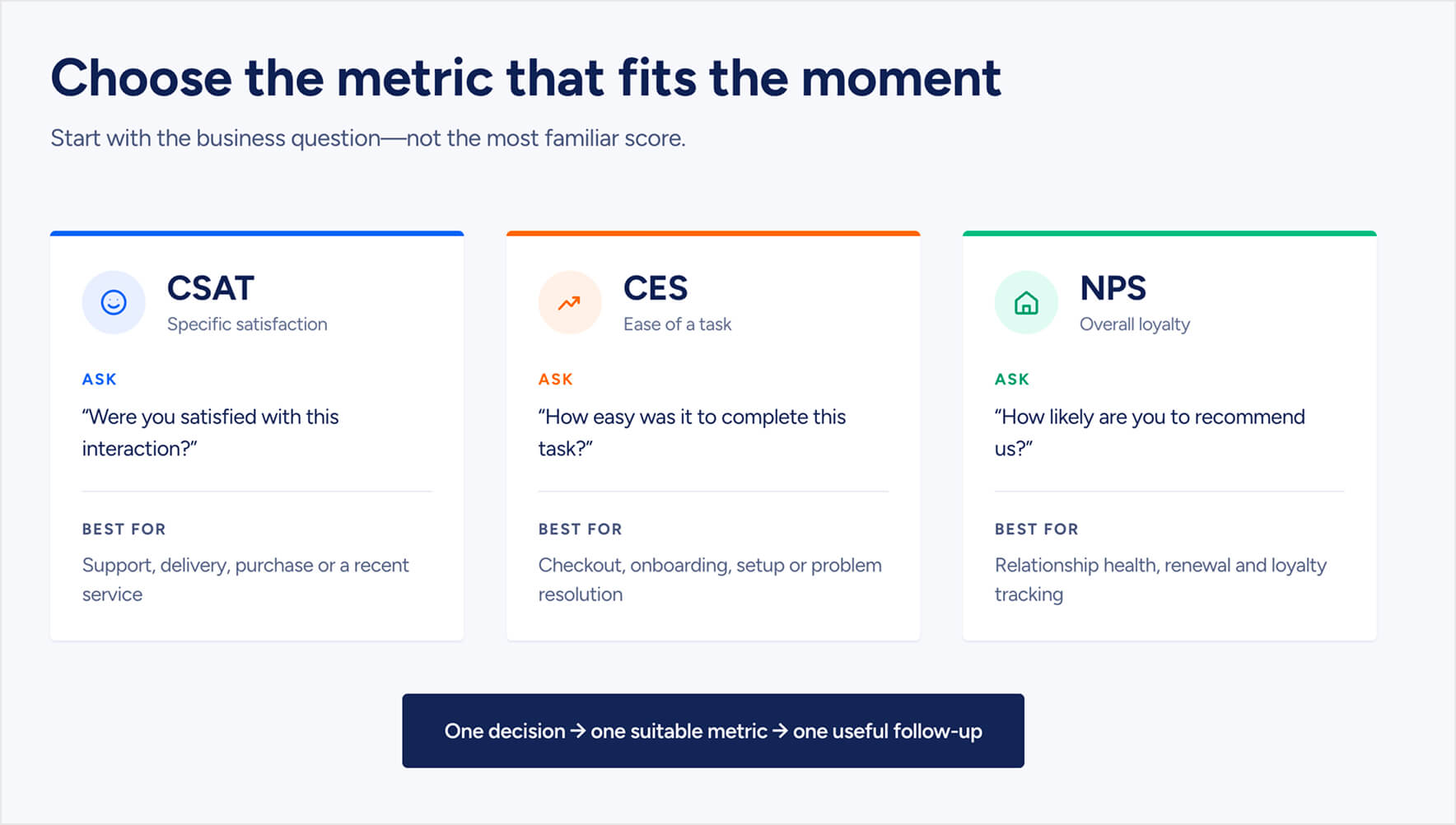
- CSAT measures satisfaction with a product, service, or recent interaction.
- CES measures how easy or difficult it was to complete a task.
- NPS measures the broader relationship through willingness to recommend.
Customer experience survey best practices
When you survey customer experience across several stages, consistency matters but copying one survey everywhere does not. Use these practices to keep feedback reliable and useful.
Keep every survey focused
Ask only what a team can act on. Start with the main outcome, add one diagnostic follow-up, and request open feedback only when someone reviews it.
Use neutral, specific wording
The question "How helpful was our excellent support?" tells the respondent how to feel before they've even answered. A more neutral alternative would be "How satisfied were you with the support you received?" Beyond wording, survey results can also be distorted by the range of answer options offered, the order in which they're presented, and the method used to sample respondents. The Pew Research Center also emphasizes the need for careful testing of the question's wording and order.
Match the channel to the moment
Assign the channel to the event. Here are a few examples of using the right channel for different events:
- Email after an online delivery
- An in-product survey
- Using a QR code in a retail store
- Offline collection at an event
Zoho Survey offers all these options including email, embedded surveys, QR codes, social sharing, and offline surveys.
Protect customers from survey fatigue
Set rules for contact so that sales, product, and support do not send requests at the same time. Focus on the times that matter most for key decisions.
Compare segments and journeys
You can compare the results according to customer type, product, channel, journey stage, and outcome. On average, a problem affecting a smaller group may be hidden, and non-response and sampling bias might cause some voices to be left out.
Close the feedback loop
Designate an owner, establish thresholds for follow-up, and inform customers of any changes. By linking survey fields to records in Zoho CRM, and using email triggers to enable team responses, Zoho Survey helps with this. However, human review should still be carried out in the case of complaints and sensitive answers.
Turn a collection of surveys into a CX management system
An effective customer experience management program does not attempt to measure every interaction. Instead, it focuses on the instances that affect trust, effort, value, and loyalty, asks the right questions when listening, and passes the answers to a team that can respond.
You should regularly review the program, remove any questions that aren't being used, look for gaps between touchpoint scores and journey outcomes, and link responses to support, sales, product, and retention data.
Zoho Survey helps build, distribute, personalize, and analyze surveys across various customer experience touchpoints. With a clear journey map and action plan, separate responses become a more complete view of the customer. Check out the features page to learn more about what Zoho Survey brings to the table.