
Walk into a McDonald's in India and the menu looks almost nothing like the one back home. There is no Big Mac made with beef, and no pork product anywhere on the board. In a country where a large share of the population avoids beef for religious reasons tied to Hinduism, and a significant Muslim population avoids pork, McDonald's didn't attempt to adapt its core American menu around the edges; it removed beef entirely and built out an extensive vegetarian lineup. It was anchored by the McAloo Tikki, a spiced potato patty burger designed specifically for the Indian palate and its dietary norms.
This wasn't a cosmetic localization exercise but a business decision built on cultural research. It was about understanding, in granular detail, what a market's belief systems, food practices, and social norms would and would not accept. Brands that skip this step don't just underperform; they frequently fail outright, in ways that were entirely foreseeable to anyone who had asked the right questions of the right people beforehand.
What cultural market research actually involves
Cultural market research is the systematic study of how a specific culture's values, beliefs, social norms, symbols, and practices shape consumer attitudes and behavior—and it's done with the goal of informing product design, marketing, positioning, and business strategy within that cultural context.
It differs from general market research in a critical way: General market research typically assumes a relatively stable set of behavioral drivers and measures how consumers respond to product and pricing variables within them. Cultural market research questions those assumptions themselves, recognizing that the underlying drivers of preference, trust, and purchase behavior aren't universal. Instead, they're shaped by the specific cultural context within which a consumer operates.
Cultural insights in market research matter because so much of what shapes a purchase decision operates below conscious articulation. A consumer in one market may associate a bold, direct advertising tone with confidence and trustworthiness. In another market, that same tone may read as aggressive or disrespectful. Neither reaction is "wrong."
They're both entirely rational responses shaped by different cultural frameworks for what constitutes appropriate communication. A brand that doesn't understand which framework it's operating within will misjudge its own messaging in ways that are invisible from the inside.
How does culture influence consumer decisions?
How does culture influence consumer decisions, specifically? The influence operates across several distinct dimensions that cultural research is designed to surface.
Values and belief systems
Religious practices, moral frameworks, and deeply held beliefs directly shape what products and messaging are acceptable, aspirational, or offensive within a given culture, as the McDonald's India example demonstrates directly. This extends beyond food to nearly every category. Examples include financial products (interest-based lending is prohibited under Islamic finance principles, shaping an entire category of Sharia-compliant banking products), health and wellness (attitudes toward specific treatments vary significantly by cultural context), and even color symbolism in branding and packaging.
Social structures and family dynamics
Who makes purchasing decisions (and how) varies significantly across cultures. In cultures with strong collectivist family structures, a purchase decision may involve extended family consultation in ways that individualist cultures rarely require. Marketing and product research that assumes an individual, isolated decision-maker will systematically misjudge the actual purchase journey in these contexts.
Communication norms and trust signals
What builds trust and credibility differs by culture. In some markets, extensive third-party endorsement and celebrity association drive purchase confidence. In others, peer recommendation from trusted community networks carries far more weight than any advertising claim.
Symbolic meaning and representation
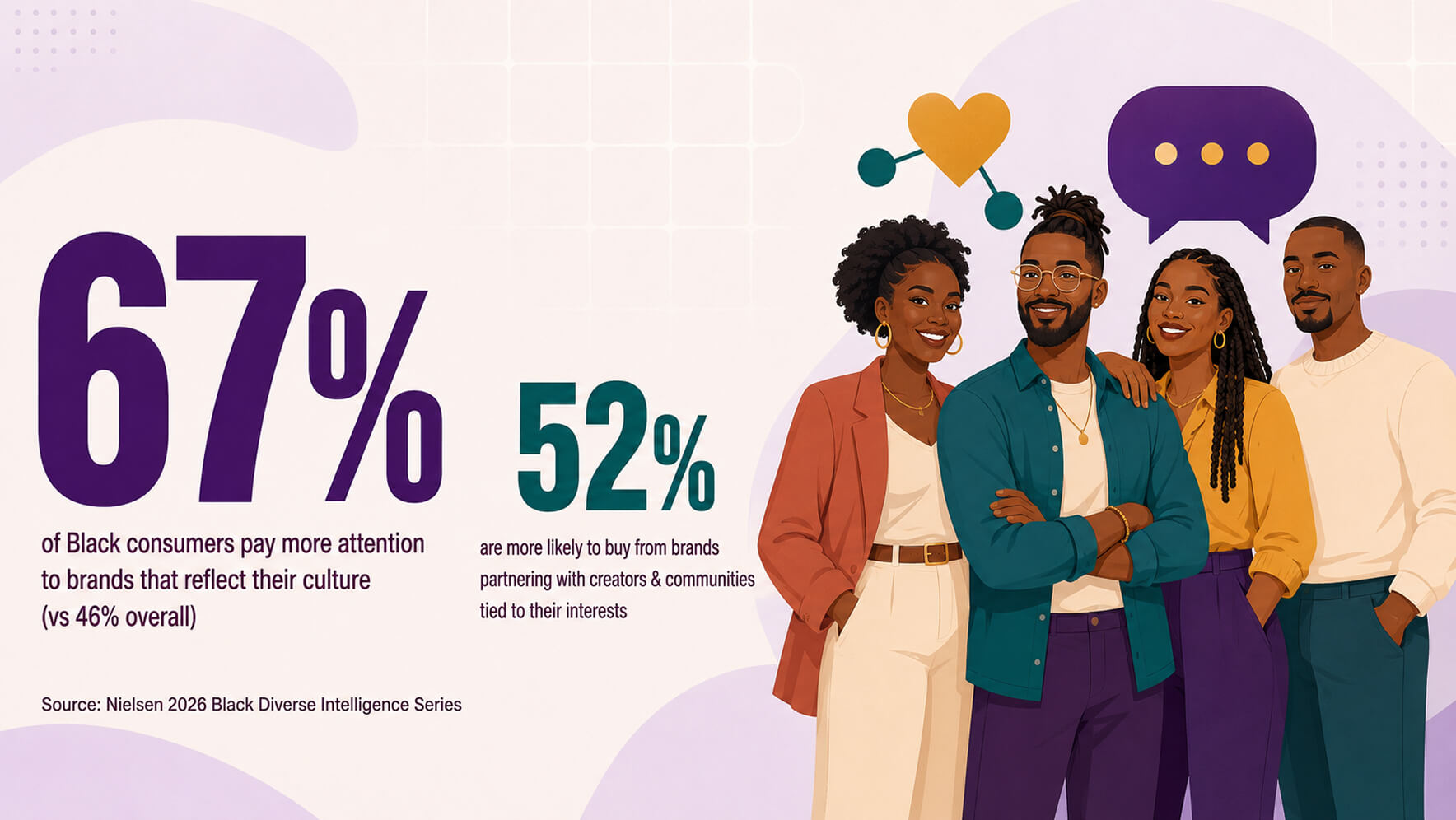
Nielsen's research found that 67% of Black consumers pay more attention to brands that reflect their culture, with 50% of consumers more likely to purchase from brands collaborating with creators, personalities, or organizations associated with their fandoms or interests. This research rightfully identifies the direct implications for how brands approach imagery, casting, and cultural specificity in their marketing rather than defaulting to generic, culturally neutral representations.
Cultural research methods and techniques for market research
Several established cultural research techniques are used, individually or in combination, to build a rigorous understanding of a target market's cultural context.
Ethnographic research and surveys
These involve deep, contextual observation of consumers within their natural environments, like homes, workplaces, or retail settings, combined with structured survey instruments that capture behavioral and attitudinal data at scale. Ethnography reveals what people actually do; surveys quantify how widespread specific behaviors and attitudes are across the broader population.
Cross-cultural comparative surveys
Cross-cultural comparative surveys involve running an identical or carefully adapted survey instrument across multiple cultural markets simultaneously, allowing direct statistical comparisons of attitudes, values, and behaviors between markets. This method is particularly valuable for identifying which aspects of a brand's positioning translate universally and which require market-specific adaptation.
Values and attitudes mapping
Structured surveys designed around established cross-cultural frameworks—such as Hofstede's cultural dimensions theory, which measures cultures across dimensions including individualism versus collectivism, power distance, and uncertainty avoidance—provide a validated, comparable structure for understanding how a target market's cultural orientation differs from markets the brand already understands well.
In-depth interviews and focus groups
Qualitative research conducted with cultural insiders or community representatives surfaces the nuance, symbolism, and contextual meaning that structured survey questions alone may miss. It proves particularly valuable in the early, exploratory stages of entering a new cultural market.
Social listening and community research
Monitoring how a target cultural community discusses relevant products, categories, and brands in their own digital spaces provides an unfiltered view of cultural attitudes that survey research can supplement but not fully replace.
For most commercial applications, a combination of structured cross-cultural surveys and qualitative depth research produces the most complete and actionable picture.
Designing a cultural market research survey
A cultural market research survey requires design considerations that go beyond standard market research practices.
Translate for meaning, not literal accuracy
A survey question translated word-for-word often fails to capture the same connotation or cultural weight in the target language. Professional back-translation (i.e., translating the survey into the target language, then having a separate translator translate it back to the original language to check for meaning drift) is standard practice for rigorous cross-cultural research.
Adapt response scales to cultural response tendencies
Research has consistently documented that response styles to rating scales vary by culture. Some cultural contexts show a stronger tendency toward extreme responses (using the highest and lowest points of a scale), while others show a stronger tendency toward moderate, middle-of-scale responses. Comparing raw scores across cultures without accounting for this tendency can produce misleading conclusions about actual attitude differences.
Involve local researchers in question design
The most reliable cultural research involves local market experts or cultural consultants in the design phase itself. This helps identify which questions are relevant, which topics may be sensitive or require careful framing, and which response options need to be added or removed to reflect locally meaningful categories.
Ask about values and context
A cultural research survey should include questions that go beyond direct product evaluation to understand the broader values and social context shaping the purchase decision. These include questions about family decision-making roles, trust sources, and cultural or religious considerations relevant to the category.
Questions to ask in a cultural market research survey
Representative cultural research techniques translated into survey questions include:
- How much influence do family members have on your purchase decisions in this category?
- Which sources do you trust most when evaluating a new brand? (Community recommendation / Expert or professional endorsement / Advertising / Online reviews / Other)
- Are there any cultural, religious, or traditional considerations that influence your choices in this category?
- How important is it that a brand reflects your cultural identity or values?
- What would make a brand from outside your community feel genuinely relevant to you, rather than an outsider?
- Who else (if anyone) is typically involved in decisions like this in your household?
- Are there specific occasions, traditions, or celebrations that shape when or how you purchase products in this category?
- Does the language used in advertising and packaging affect your trust in a brand?
- Have you ever chosen not to purchase a product because it felt culturally inappropriate or disconnected from your community?
- How do you feel about brands that use imagery, language, or traditions from your culture in their marketing?
- Would you prefer to interact with a brand that has a local presence or reputation in your community over one that doesn't, even if the product is similar?
- What symbols, colors, or visual elements feel most familiar or trustworthy to you in this category?
- Are there any words, images, or gestures that would make you uncomfortable or distrustful of a brand?
- How does your cultural background shape what you consider "good value" for a product like this?
Using Zoho Survey for cultural market research
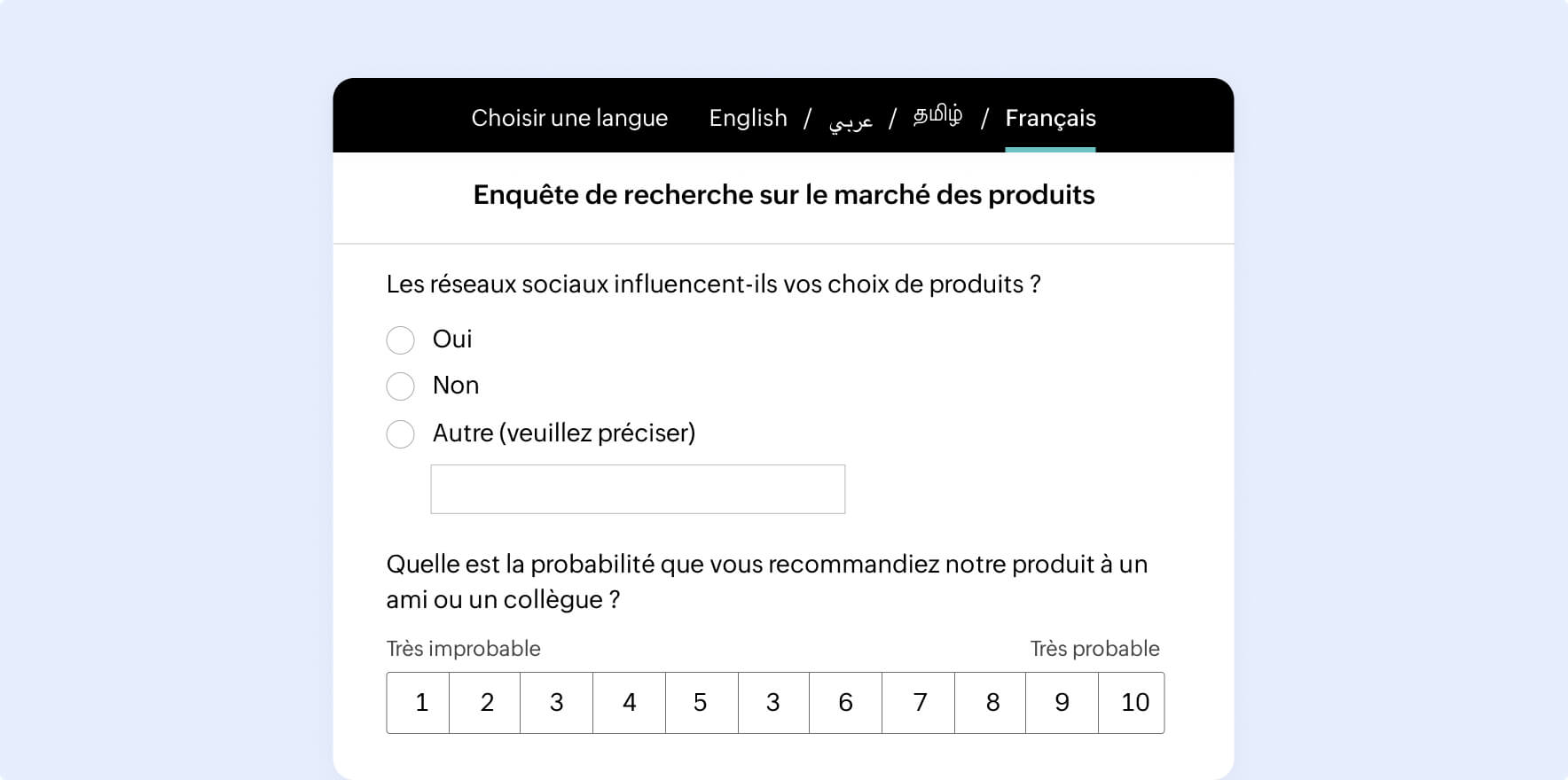
Zoho Survey's multi-language support enables a single research project to be deployed across multiple linguistic and cultural markets simultaneously, with each version customized to reflect local phrasing rather than a single generic translation applied uniformly. This is essential infrastructure for any cross-cultural research initiative, where meaning and not just vocabulary needs to be preserved across markets.
For research teams working without an existing contact base in a target market, Zoho Survey's Buy Responses feature connects researchers with verified panels segmented by geography, demographic, and cultural attributes, making it possible to reach a genuinely representative sample in an unfamiliar market.
Skip logic and branching enable surveys to adapt based on cultural context indicators collected early in the instrument, routing respondents to locally relevant question sets rather than forcing a single rigid path across every market.
Zoho Survey is now available with a seven-day, credit card-free Enterprise trial! Get access to the multi-language and segmentation features needed to run a genuine cultural market research strategy from day one. Get started now!
The bottom line
Cultural market research isn't simply a compliance exercise reserved for brands entering entirely unfamiliar markets; rather, it's the discipline that prevents brands from assuming their own cultural framework is the default. This assumption has produced some of the most well-documented failures in global business history, and continues to produce quieter, less publicized ones in markets and categories brands assumed they already understood.
McDonald's has built one of the most successful international menus in the world not by exporting its American formula, but by researching, respecting, and building around the specific cultural realities of every market it entered. That's the standard which cultural market research is designed to help every brand meet.