Social media competitive analysis: A guide + free template
- Last Updated : August 17, 2026
- 36 Views
- 6 Min Read

Your potential customers are on social media right now, scrolling past a sponsored ad, watching a TikTok from their favorite creator, or seeing a friend post about a new purchase. More often than not, that's where they first hear about a product. A 2026 Kantar study commissioned by Meta found that 92% of consumers use social platforms for product information, compared to 79% who use traditional search engines.
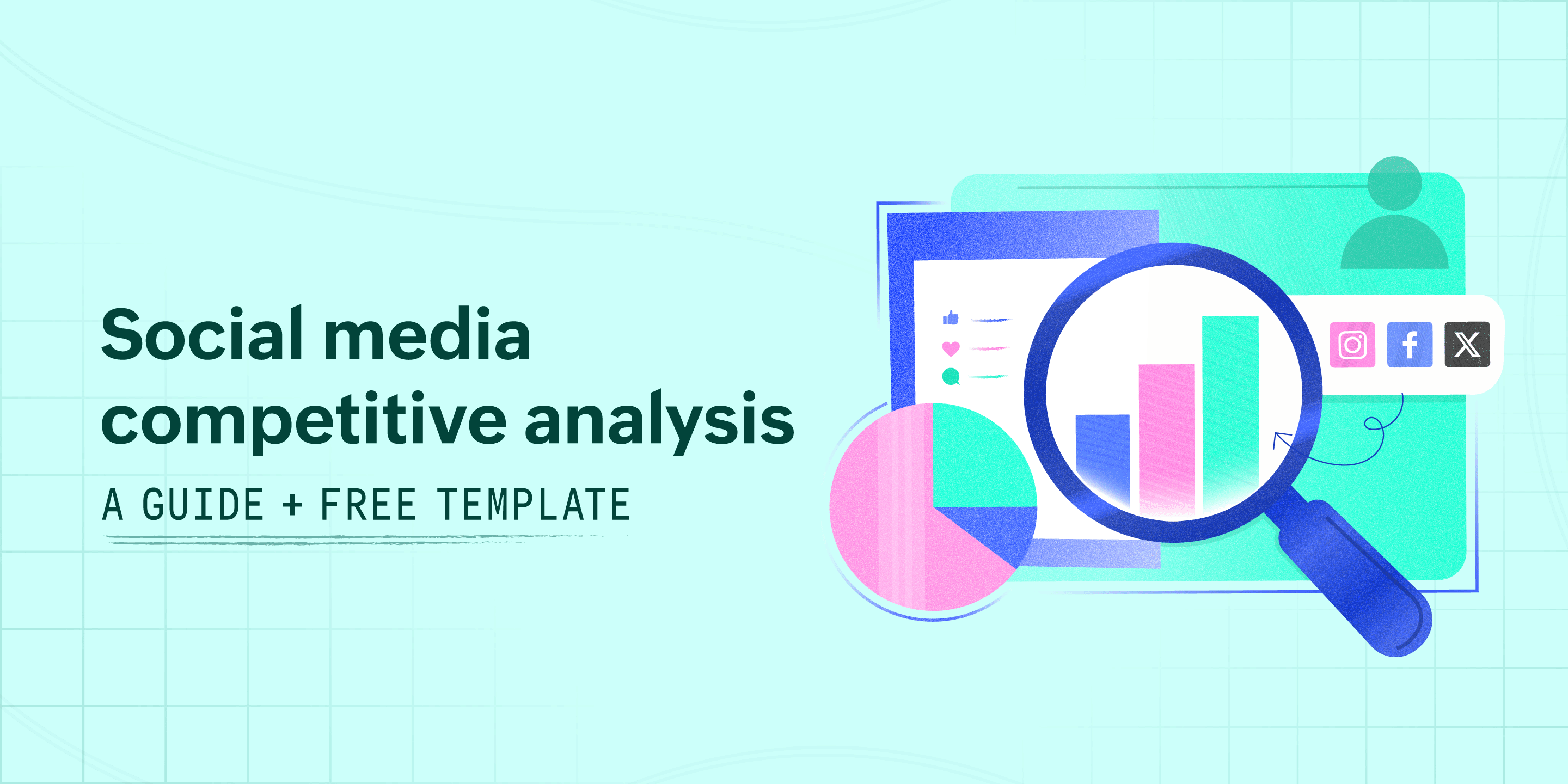
Your competitors are in those same feeds, shaping what your audience expects from brands like yours before they ever find you. A social media competitive analysis helps you understand what your audience is already seeing and responding to, so your strategy is built on signals, not guesswork.
What a social media competitive analysis can actually tell you
A social media competitive analysis isn't just about keeping tabs on competitors to see how they're doing. Done well, it tells you something far more useful.
It shows you where competitors fall short and where your brand can step in. If customers are frustrated by slow responses or generic content, that's an opening. You can use those gaps to differentiate your own approach. This helps you benchmark your own performance honestly, so you know where you're ahead and where you're behind. By staying close to what's happening in your space, you're more likely to spot trends before they pass. On social media, a trend can boom and vanish within days.
What you post matters more than ever. That same 2026 Kantar study shows that 63% of consumers say purchases happen faster when social plays a role. A 2026 McKinsey survey found that 34% of Gen Z say social media is their most important channel during purchase decisions.
A good competitive analysis comes down to three things: observing what's happening in your space, understanding what it actually means, and acting on what you find. Let's look closer at those three things.
Observe: What should you actually be looking at?
Your competitor list shouldn't stop at brands selling the same thing. Think about who else is showing up in your audience's feed—adjacent categories, aspirational accounts, , and creators speaking to the same people. Keep your final list to five to ten brands and search directly on TikTok, Instagram, LinkedIn and YouTube (not just Google) to find who's actually winning attention in your space.
Once you have your competitor list, it's tempting to track every metric available. Resist the urge. A spreadsheet packed with numbers isn't useful if you don't know what to do with them. Instead organize your research into four dimensions.
Audience: Don't just look at follower count. Look at how quickly that audience is growing and how actively they engage. Follower count tells you where a brand stands today. Growth rate tells you where they're headed.
Content: Look at the formats they use (Reels, carousels, short-form video, LinkedIn documents), the topics they return to, and how often they post. Consistent themes and posting cadence usually reveal a deliberate content strategy rather than reactive posting.
Community: Pay attention to how they interact with their audience. Do they respond to comments? How quickly? Are customers tagging them, re-sharing their content, or starting conversations on their own? These signals reveal whether they're building an engaged community or simply broadcasting content.
Brand: Pay attention to how they present themselves. A formal tone versus a conversational one, a bold visual identity versus a minimal one. These choices signal how a brand wants to be perceived and whom they're trying to attract.
Tracking all of this manually across five to ten competitors is time-consuming. Zoho Social's monitoring dashboard lets you keep tabs on competitor profiles, @mentions, hashtags, and keywords across Instagram, Facebook, X, LinkedIn, YouTube, Threads, Bluesky, and Google Business Profile—all in one place. Less tab-switching and manual checking. More time to actually analyze what you find.
Download the competitor audit template to start tracking these four dimensions across your shortlist.
View Template
Understand: Turn data into insights
Collecting data is the easy part. Understanding it is what makes competitive analysis valuable. The question most people ask is "what is my competitor doing?" The more useful question is "what is the audience responding to?" That shift changes everything about how you interpret what you find.
Data | Insight |
A competitor posts five Reels every week. | Short-form video is clearly their primary acquisition channel. |
An update launch received twice the usual engagement. | Their educational launch content is outperforming their promotional posts. |
A competitor's followers grew by 12% this month. | Their recent creator collaboration may be attracting a new audience segment. |
Ask why, not just what
Once you have the data in front of you, it's tempting to replicate what seems to be working, but pause before you do. Ask why this campaign performed so well. Why did engagement spike this month? Why are they posting more frequently now? Why did customers respond to this format and not another? Why did they collaborate with this particular creator?
These questions don't always have obvious answers. Sometimes it's timing, other times it's format. Sometimes the content simply solved a real problem for the audience. But asking them consistently is what separates a useful competitive analysis from a metrics dump.
Look for patterns, not one-off wins
A single viral post tells you almost nothing. What tells you something is when a brand does the same thing repeatedly and it keeps working. Look for recurring content series, repeated hooks, consistent CTAs, the same formats showing up week after week.
Not everything you spot will be strategic though. A brand jumping on a trending audio or a viral meme might spike engagement once and disappear. A brand publishing a weekly founder story for six months is executing a deliberate strategy. One is worth noting. The other is worth learning from.
The more consistently you see something repeated, the more likely it is to be a strategic decision rather than a lucky moment. Did they do it once, or do they keep doing it? If it's the latter, dig deeper. If it's the former, note it and move on.
Act: Turn competitor insights into better decisions
A competitive analysis only becomes valuable when it changes what you do next. The goal isn't to copy your competitors, it's to use what you've learned to make smarter decisions about your own strategy. Every insight should end with an action, whether that's testing a new content format, refining your messaging, or improving the way you engage with your community. Don't copy. Experiment.
A simple four-step framework keeps this manageable:
Observation: What did you notice about a competitor's content or strategy?
Insight: What do you think it means for your audience?
Experiment: What will you actually test based on that insight?
Measure: How will you know if it worked and over what timeframe?
For example, if a competitor's educational carousel posts consistently outperform their product promotions, don't copy their content. Instead test whether your audience responds better to educational content too. Track engagement rate and saves over four weeks and let the data tell you whether the format is worth committing to.
Use the Insights and Experiments tab in Zoho Social's free social media competitive analysis template to record your observations, the insights behind them and the experiments you plan to run. This turns your competitive analysis into a repeatable process instead of a spreadsheet you open once and never revisit.
Make competitive analysis a monthly habit, not a yearly panic
A competitive analysis isn't something you do once and file away. The brands worth watching are constantly publishing, testing and shifting, so a snapshot from six months ago tells you very little about what's working today.
A simple rhythm keeps this manageable. Every month, update your audit, review new patterns, and choose two or three experiments to run. Every quarter, zoom out. Refresh your competitor list, benchmark your own progress, and adjust your strategy based on what you've found.
According to GWI's 2025 Social Media Report, 30% of consumers researched or purchased a product after seeing content that matched their current needs. Relevance matters, but knowing what resonates with your audience takes observation, analysis, and continuous refinement.
Try Zoho Social free for 15 days and use the monitoring dashboard to keep your competitive analysis running month after month—without the manual effort.