
Who Owns The Plug? #4 - Brad Shimmin, Futurum Group
By Raju Vegesna, Chief Evangelist, Zoho
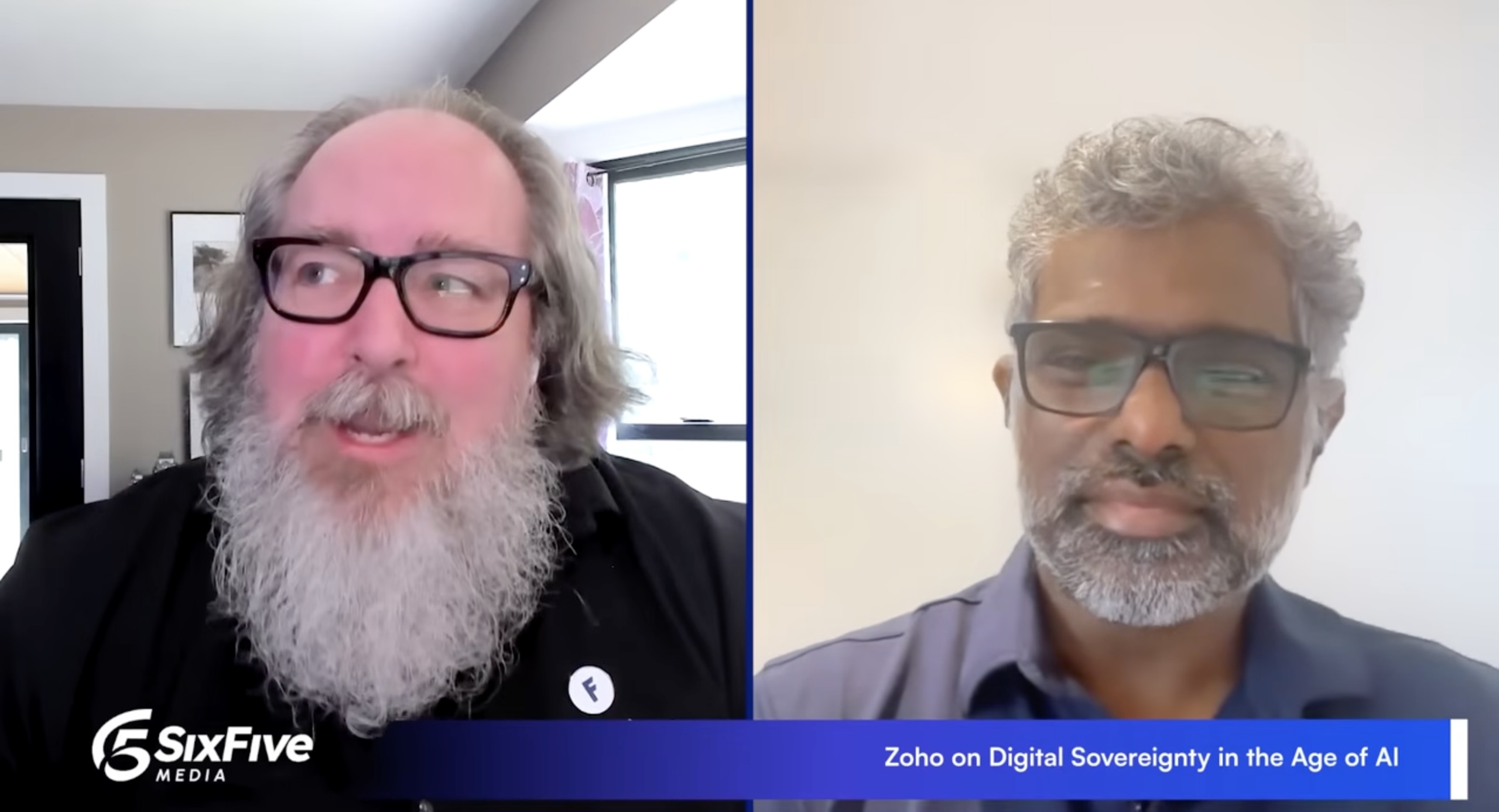
In today's episode of "Who Owns the Plug?", I'm joined by Brad Shimmin, Vice President and Practice Lead for Data Intelligence, Analytics, and Infrastructure at Futurum, to discuss what digital sovereignty requires as AI adoption accelerates.
Whoever owns intelligence owns the value, not whoever owns the tooling around it. Farming and manufacturing show the pattern clearly: workers didn't get richer as those industries automated, the equipment makers did — the "machine that makes the machine" always captures the value. AI is that machine now, so the real question for any business is whether it wants to be a customer of that value capture or its source. Feeding proprietary data into a public model means giving up IP, and that's often by design: model providers commoditize the "pathway" (MCP, the same way Android and Chrome stayed open while Search and the app economy stayed closed) to make surrendering that IP frictionless. The better path is to invert it — take an open model, deploy it, and feed it your own intelligence, so the resulting IP stays owned rather than leaking to a vendor.
Concerning borders, sovereignty is a spectrum rather than a switch, running through energy, trade, satellite navigation, internet backbone ownership (95% privately held), and now the model layer itself. The "book" analogy applies here too: a country can require data to stay within its borders, but if a foreign model reads that data and leaves, the knowledge has left even though the data hasn't. The simplest test is whether you're a customer or a hostage — if you can't walk away from a vendor even if you wanted to, you're already a hostage.
Zoho itself stands as proof of the model: no public cloud, self-built stack top to bottom, its own LLMs, no outside investors. That kind of independence looks unnecessary in good times and only proves its worth during disruptions, which is why the conversation is resonating now.
On open source, the same parallel holds as elsewhere: without Linux, cloud computing and SaaS wouldn't exist, and open models are likely to become the "Linux" the next AI ecosystem gets built on. The dominant closed-model companies are trying to commoditize the app layer, so the app and hardware layers both benefit from pushing back by commoditizing the model layer instead.
The full conversation can be viewed below: