

- HOME
- Supplier management
- Kraljic Matrix: Strategic procurement model for supply chain excellence
Kraljic Matrix: Strategic procurement model for supply chain excellence
Introduction
In today's complex and interconnected global supply chains, procurement managers face unprecedented challenges. Organizations must navigate supplier relationships, manage costs, mitigate risks, and ensure business continuity—all while dealing with geopolitical uncertainties, market volatility, and unprecedented supply chain disruptions.
The answer lies in a proven strategic framework known as the Kraljic Matrix. Developed over four decades ago, this powerful tool has become the gold standard for strategic procurement planning and supplier relationship management. It provides procurement managers with a clear, data-driven methodology to segment suppliers and products based on their strategic importance and supply risk, enabling organizations to develop tailored procurement strategies that align with business objectives.

This comprehensive guide explores the Kraljic Matrix in depth, explaining its components, strategic value, practical applications, and implementation strategies. Whether you're new to procurement or an experienced supply chain professional, this article will equip you with the knowledge and tools needed to leverage the Kraljic Matrix for competitive advantage.
What is the Kraljic Matrix?
The Kraljic Matrix is a strategic procurement framework that segments suppliers and purchased items based on two critical dimensions: supply complexity (supply risk) and strategic importance (profit impact). By plotting suppliers along these axes, procurement managers can visualize their supplier portfolio and develop targeted strategies for each category.
In essence, the Kraljic Matrix transforms procurement from a transactional, cost-focused function into a strategic business capability. Rather than treating all suppliers equally, it enables organizations to allocate resources, develop relationships, and manage risks in proportion to each supplier's importance to the business.
The Four Quadrants
🔴 Bottleneck items (High Impact, Low Supply Risk): Critical to operations but available from suppliers. Requires supply security and pricing stability.
🔴 Strategic items (High Impact, High Supply Risk): Critical and difficult to source. Requires long-term strategic partnerships and active risk management.
🔵 Routine items (Low Impact, Low Supply Risk): Non-critical and easy to source. Ideal for process automation and cost optimization.
🟢 Leverage items (Low Impact, High Supply Risk): Non-critical but difficult to source. Requires competitive bidding and volume consolidation.
Historical background and origins
The Birth of Strategic Procurement
The Kraljic Matrix was developed in 1983 by Peter Kraljic, a pioneering supply chain strategist and senior partner at McKinsey & Company. At a time when most organizations viewed procurement as a purely operational, cost-reduction function, Kraljic's groundbreaking work recognized procurement as a strategic capability essential to competitive advantage.
Kraljic's seminal article, "Purchasing Must Become Supply Management," published in the Harvard Business Review in 1983, fundamentally changed how organizations approach supplier relationships. He argued that not all suppliers and purchases are equal, and that different procurement strategies should be applied to different supplier categories based on risk and importance factors.
Evolution and Global Adoption
Since its introduction over four decades ago, the Kraljic Matrix has become a foundational framework in procurement and supply chain management education and practice. The framework's adoption has evolved across different industries:
- Manufacturing: Used extensively for raw materials, components, and equipment procurement
- Technology: Applied to hardware, software licensing, and cloud services
- Healthcare: Used for medical supplies, pharmaceuticals, and equipment
- Retail: Applied to merchandise sourcing and logistics management
- Energy & Utilities: Used for critical infrastructure and maintenance materials
Components of the Kraljic Matrix
The Kraljic Matrix operates on two primary dimensions that form the foundation of supplier segmentation and strategy development.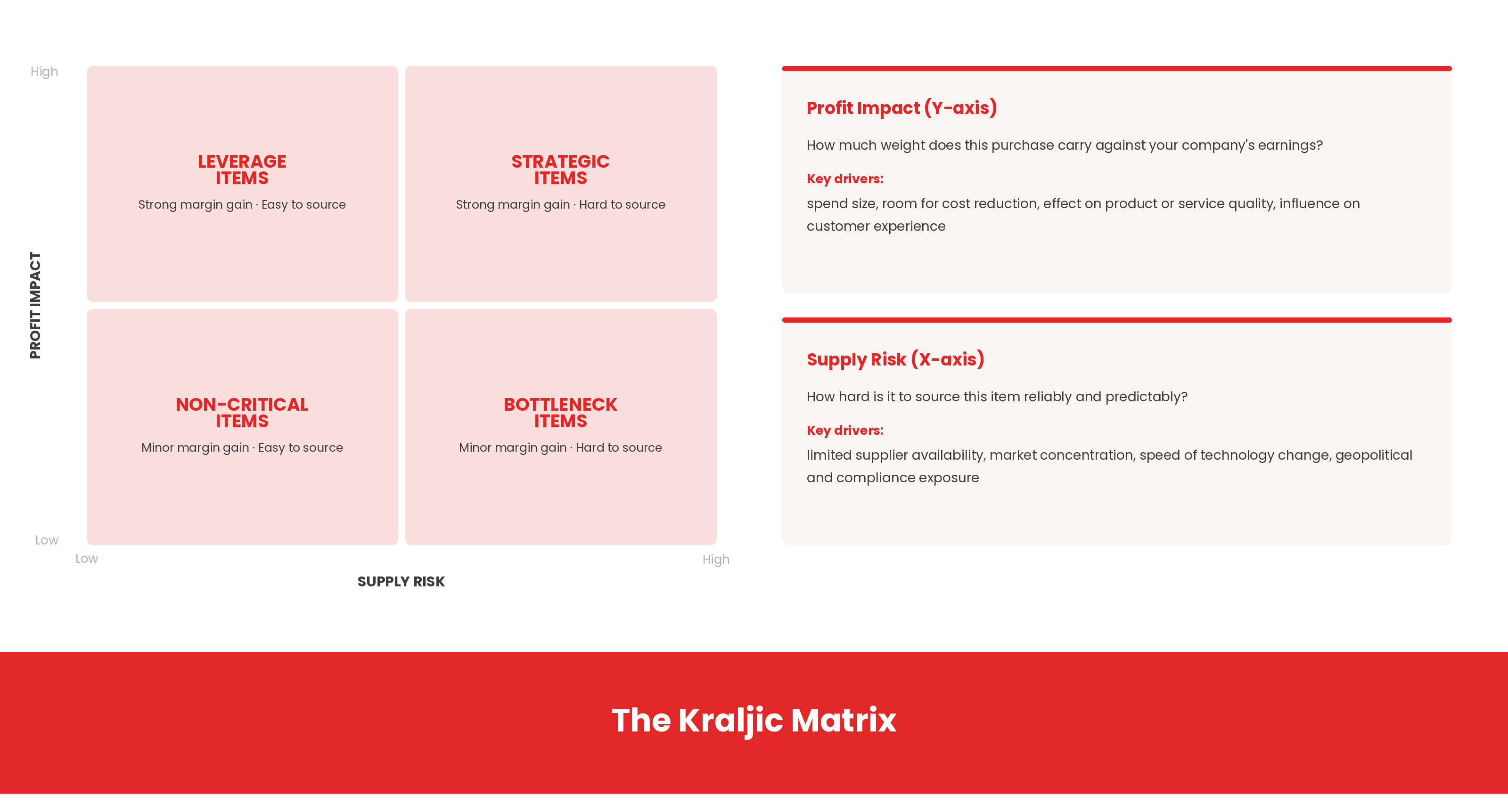
Dimension 1: Supply Risk (X-Axis)
Supply Risk measures how challenging it is to source a particular item or maintain supply from existing suppliers. Key factors include:
- Number of available suppliers: How many vendors can provide the item?
- Lead time: How long before delivery? Extended lead times increase risk.
- Geopolitical factors: Supply sourced from politically unstable regions?
- Technical complexity: How specialized or proprietary is the item?
- Supplier financial health: Risk of supplier bankruptcy or consolidation?
- Switching costs: How expensive is it to switch suppliers?
- Supply volatility: Price fluctuations, availability issues, or quality inconsistencies?
How to score supply risk?
- Score 1-2 (Very Low): Multiple global suppliers, commodity products, no geopolitical concerns
- Score 3-4 (Low): Several suppliers available, standardized products, minimal switching costs
- Score 5-6 (Medium): Limited suppliers (3-5), moderate lead times, some supply variability
- Score 7-8 (High): Few suppliers (2-3), specialized items, long lead times (6+ months)
- Score 9-10 (Critical): Single/near-single supplier, highly specialized, very long lead times (12+ months)
Dimension 2: Profitability Impact (Y-Axis)
Profitability Impact measures how significantly a purchased item affects the organization's profitability, competitiveness, and business success. Key factors include:
- Spend volume: Percentage of total procurement budget spent on this item
- Margin impact: How much does this item's cost directly affect product/service margins?
- Product quality: Does the supplier's quality directly affect customer satisfaction?
- Operational criticality: Is the item essential to core business operations?
- Revenue impact: Does supply availability directly affect revenue generation?
- Competitive differentiation: Does this input provide competitive advantage?
How to score profitability impact?
- Score 1-2 (Very Low): <1% of spend, non-critical to operations (office supplies, standard items)
- Score 3-4 (Low): 1-3% of spend, low operational importance, minimal margin impact
- Score 5-6 (Medium): 3-8% of spend, moderate operational importance, 5-15% margin impact
- Score 7-8 (High): 8-15% of spend, critical to operations, 15-30% margin impact
- Score 9-10 (Critical): >15% of spend, essential to business, >30% margin impact
Why Kraljic Matrix is a strategic model for procurement?
The Kraljic Matrix transforms procurement into a strategic business capability by:
- Aligning supplier strategies with business value: Different suppliers receive different levels of engagement based on their contribution to business success.
- Identifying and mitigating critical risks: By identifying high-risk, high-impact suppliers, organizations can proactively develop contingency plans.
- Optimizing resource allocation: Procurement teams focus their time on relationships that drive business value.
- Driving cost optimization: By tailoring strategies to each quadrant, organizations achieve cost savings while maintaining value.
- Building competitive advantage: Strategic focus on critical suppliers creates market differentiation.
How the Kraljic Matrix is used in procurement?
The Kraljic Matrix is a practical tool that guides tactical and strategic procurement decisions across multiple dimensions:
Supplier segmentation and portfolio analysis
The matrix provides a systematic way to categorize suppliers into four groups, each with unique characteristics and requiring different management approaches. This enables procurement managers to understand their entire supplier portfolio and identify where to focus efforts.
- Relationship management strategy
- Strategic suppliers: Long-term partnerships, executive-level engagement, regular business reviews, supplier development investment
- Bottleneck suppliers: Professional relationships with clear SLAs, long-term contracts, regular performance monitoring
- Leverage suppliers: Transactional relationships, subject to competitive bidding and periodic reviews
- Routine suppliers: Minimal management, automated ordering, periodic vendor maintenance
- Risk mitigation and contingency planning
- Strategic items: Develop multi-supplier strategies, supply agreements, inventory buffers, contingency plans
- Bottleneck items: Secure supply contracts, maintain strategic inventory, develop substitute products
- Leverage items: Use competitive bidding to maintain supplier optionality
- Routine items: Maintain vendor lists with multiple options for flexibility
- Negotiation and contract strategy
- Strategic: Long-term (2-3 years), flexible terms, collaborative goals, continuous improvement
- Bottleneck: Medium-term (1-2 years), price certainty, clear service levels, capacity guarantees
- Leverage: Short-term (6-12 months), competitive pricing, volume-based discounts
- Routine: Minimal, standing orders, e-procurement, automatic reordering
- Resource and effort allocation
- Strategic (30%): Regular business reviews, relationship management, supplier development, contingency planning
- Bottleneck (15%): Contract management, performance monitoring, supply security monitoring
- Leverage (10%): Competitive bidding, cost negotiations, supplier switching
- Routine (5%): Minimal management, automated systems, periodic vendor review
Key benefits of the Kraljic Matrix
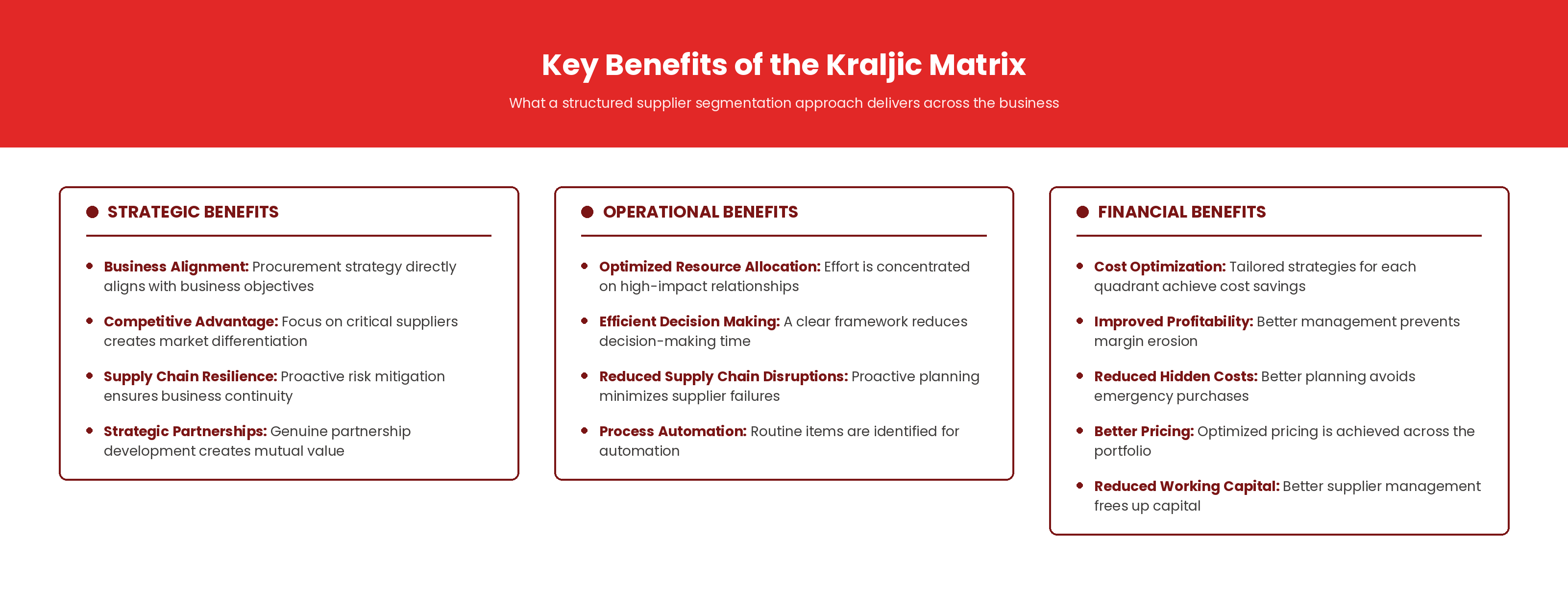
Strategic benefits
- Business alignment: Procurement strategy directly aligns with business objectives
- Competitive advantage: Focus on critical suppliers creates market differentiation
- Supply chain resilience: Proactive risk mitigation ensures business continuity
- Strategic partnerships: Development of genuine partnerships creates mutual value
Operational benefits
- Optimized resource allocation: Effort concentrated on high-impact relationships
- Efficient decision making: Clear framework reduces decision-making time
- Reduced supply chain disruptions: Proactive planning minimizes supplier failures
- Process automation: Routine items identified for automation
Financial benefits
- Cost optimization: Tailored strategies for each quadrant achieve cost savings
- Improved profitability: Better management prevents margin erosion
- Reduced hidden costs: Better planning avoids emergency purchases
- Better pricing: Optimized pricing across portfolio
- Reduced working capital: Better supplier management reduces capital tied up
Implementation guide for procurement managers
Implementing the Kraljic Matrix requires a structured approach. Follow this roadmap: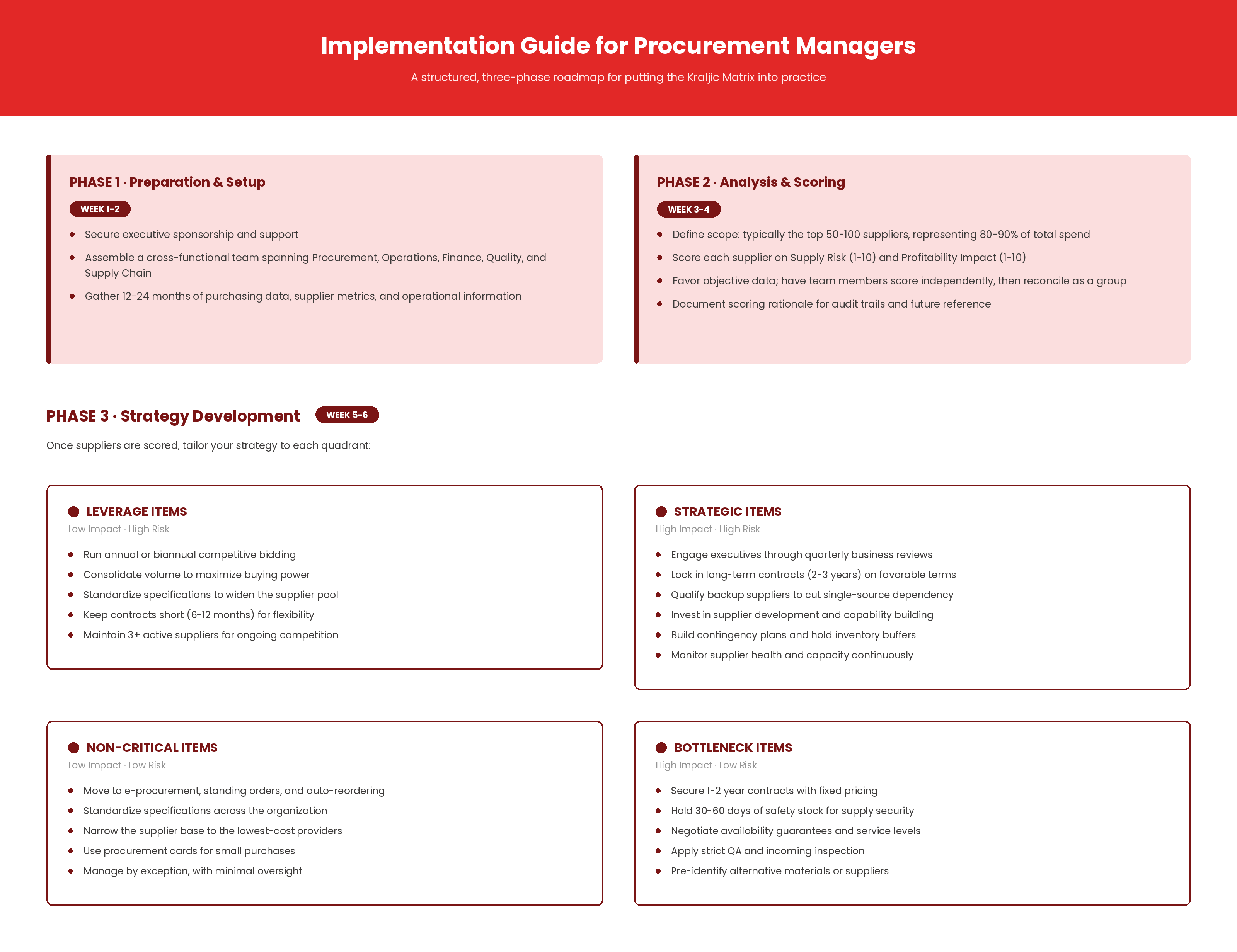
PHASE 1: Preparation and setup (Week 1-2)
- Secure executive sponsorship and support
- Assemble cross-functional team (Procurement, Operations, Finance, Quality, Supply Chain)
- Gather 12-24 months of purchasing data, supplier metrics, and operational information
PHASE 2: Analysis and scoring (Week 3-4)
- Define scope: Typically top 50-100 suppliers representing 80-90% of spend
- Score each supplier on Supply Risk (1-10) and Profitability Impact (1-10)
- Use objective data where possible; have team members independently score then discuss
- Document scoring rationale for audit trails and future reference
PHASE 3: Strategy development (Week 5-6)
🔴 Strategic items (High Impact + High Risk):
- Executive engagement with quarterly business reviews
- Long-term contracts (2-3 years) with favorable terms
- Qualify secondary suppliers to reduce single-source dependency
- Invest in supplier development and capability improvements
- Develop contingency plans and maintain inventory buffers
- Continuous monitoring of supplier health and capacity
Example: Raw Steel Supplier
A manufacturing company with two major steel suppliers (50% each, 20% of total spend, critical to all products). Supply risk: High (7/10), Impact: High (9/10). Strategy:
- Negotiate 3-year supply agreements with annual price escalation clauses
- Commit to minimum quarterly volumes to secure capacity
- Establish joint technology task forces to improve specifications
- Maintain 30-day emergency buffer inventory
- Identify specialty steels that could be substituted if needed
🟠 Bottleneck items (High Impact + Low Risk):
- Secure long-term contracts (1-2 years) with price certainty
- Maintain 30-60 day safety stock for supply security
- Negotiate availability guarantees and service levels
- Implement strict quality assurance and incoming inspection
- Identify alternative materials/suppliers as contingency
Example: Specialty Packaging Material
Custom branded packaging, critical to customer experience, 8% of spend. Risk: Low (3/10), Impact: High (8/10). Strategy:
- Negotiate 18-month contract with stable pricing (±2% variation)
- Maintain 45-day safety stock
- Qualify alternative vendor with different branding approach
- Quarterly business reviews to monitor quality and innovation
🟢 Leverage items (Low Impact + High Risk):
- Conduct annual/biannual competitive bidding
- Consolidate volume to maximize buying power
- Standardize specifications to increase supplier optionality
- Maintain short contracts (6-12 months) for flexibility
- Keep 3+ active suppliers for choice and competition
Example: Maintenance & Repair Services
Maintenance services (janitorial, HVAC, electrical), non-critical but limited local providers. Risk: High (8/10), Impact: Low (3/10). Strategy
- Consolidate 8 different vendors into 3 regional providers
- Negotiate regional contracts at discounted rates (volume leverage)
- Annual competitive rebidding to ensure market pricing
- Keep 3-vendor approach to maintain competition pressure
- Result: 15% cost savings + operational simplification
🔵 Routine items (Low Impact + Low Risk):
- Implement e-procurement, standing orders, automatic reordering
- Standardize specifications across organization
- Reduce supplier base to lowest-cost providers
- Use procurement cards for small purchases
- Minimal management with exception-based monitoring
Example: Office Supplies
Office supplies (paper, pens, etc.), routine, low-impact items with many suppliers. Risk: Very Low (1-2/10), Impact: Very Low (2/10). Strategy:
- Consolidate to single primary supplier (e.g., Amazon Business)
- Set up automatic reordering with pre-defined inventory levels
- Use procurement cards for <$500 purchases
- Standardize office supplies across organization
- Result: 20 hours/month procurement staff freed up + 10-15% cost reduction
Put the Kraljic Matrix into action
Understanding the Kraljic Matrix is only the first step. The real value comes when organisations use it as a practical framework to evaluate suppliers, prioritise procurement efforts, and make better sourcing decisions.
Many procurement teams understand the concept, but struggle to translate it into a structured, repeatable process across categories, suppliers, and business units. Without a consistent approach, supplier segmentation often becomes a one-time exercise rather than an ongoing strategic tool.
To help organisations apply the framework effectively, we have created a ready-to-use Kraljic Matrix Template that enables procurement and finance teams to assess categories and suppliers based on profit impact and supply risk, and define the right sourcing strategy for each segment.
Whether you're managing supplier dependencies, responding to supply-chain volatility, or looking to improve procurement governance, this template provides a practical starting point.
Benefits of using the template:
✅ Improve spend visibility by understanding where money is being committed
✅ Identify supply-chain risks early by mapping supplier dependencies and critical categories
✅ Focus procurement effort where it matters most, rather than applying the same approach to every supplier
✅ Strengthen supplier relationships for strategic and high-risk categories
✅ Reduce procurement risk through better planning, diversification, and contingency strategies
✅ Support CFOs with better decision-making by connecting procurement activities to profitability, resilience, and business continuity
✅ Create a repeatable and standardised framework that can be used across teams, business units, and geographies
In today's environment of geopolitical uncertainty, supply disruptions, price volatility, and increasing pressure on margins, organisations need procurement frameworks that go beyond cost savings.
The Kraljic Matrix helps answer four critical questions:
What do we buy?
How important is it?
What risks are associated with it?
And what should our strategy be?
Download the template and start building a more resilient, strategic, and financially aligned procurement function.
Conclusion
The Kraljic Matrix remains one of the most powerful and practical frameworks for strategic procurement management. Over four decades after its development, it continues to deliver significant value to organizations across industries.
The framework's enduring relevance stems from its elegant simplicity: not all suppliers are equal, and different suppliers require different strategies. By segmenting suppliers based on supply risk and profitability impact, procurement managers can:
- Transform procurement into a strategic business capability
- Identify and mitigate critical supply chain vulnerabilities
- Allocate resources to where they deliver maximum value
- Develop partnerships that create mutual value and innovation
- Achieve significant cost savings through tailored strategies
- Build supply chain resilience and business continuity
For procurement managers facing today's complex supply chain challenges, the Kraljic Matrix provides a proven roadmap for strategic decision-making. The implementation roadmap outlined in this article provides a clear path forward.
The time to implement the Kraljic Matrix is now. Organizations that leverage this framework gain significant competitive advantages. Procurement managers who master this approach become true business partners, driving strategic value that extends far beyond traditional cost reduction.
Take the first step today: review your current supplier portfolio, identify your strategic items, and begin developing tailored procurement strategies for each quadrant. The results will speak for themselves.