

- HOME
- Procurement
- Goods received note (GRN): Meaning, process, and its role in modern procurement
Goods received note (GRN): Meaning, process, and its role in modern procurement
If you’ve ever ordered goods in bulk for a business, you’ve likely faced the uncertainty that follows delivery.
An order is placed. The supplier ships the items. A truck arrives, and boxes are unloaded. But how do you confirm that the shipment matches what was approved? What if quantities differ or some items are damaged? And should an invoice be cleared before these questions are answered?
This is where a goods received note (GRN) becomes essential.
A goods received note is created when goods arrive and are inspected. It records what was actually delivered, including quantities and condition, before the invoice is approved for payment. Although it may seem procedural, the GRN plays a vital role in maintaining accuracy, accountability, and financial control within the procurement process. It serves as a key validation step in the procure-to-pay lifecycle.
What is a goods received note (GRN)?
A goods received note (GRN) is an internal document prepared by the buyer when goods are received from a supplier. It formally captures the outcome of the delivery inspection.
Typically, it includes:
- The items delivered
- The quantities received
- The condition of those goods
The distinction is simple but important. A GRN reflects what physically arrived. A purchase order outlines what was intended. An invoice requests payment. The GRN confirms the delivery itself.
When a shipment reaches a warehouse or delivery location, the receiving team compares it with the purchase order. They verify quantities, assess condition, and note any discrepancies such as shortages, damage, or incorrect items. The GRN is created only after this inspection is completed, ensuring subsequent decisions are based on verified receipt rather than documentation alone.
Why a goods received note is important
At first glance, a GRN may appear to be a routine confirmation document. In practice, it strengthens procurement control at multiple levels.
It ensures that invoices correspond to actual deliveries, preventing overpayment. It supports accurate inventory records by updating stock based on the confirmed receipt. It also creates a documented trail that connects purchasing activity to payment, which is critical for audits and internal governance.
Beyond transaction accuracy, GRNs help procurement teams monitor supplier reliability. Patterns such as recurring shortages or quality issues become visible only when deliveries are consistently recorded.
Ultimately, the goods received note functions as a safeguard. It introduces a moment of verification between delivery and payment, reinforcing both operational discipline and financial integrity.
Where the goods received note fits in the procurement lifecycle
To fully understand the role of a goods received note, it helps to see where it sits in the broader procurement lifecycle. Procurement is not simply about ordering and paying; it is a structured sequence designed to minimize risk and ensure accountability.
A typical procure-to-pay process unfolds in the following sequence:
- A department identifies a need and raises a purchase request.
- After approval, a purchase order is issued to the supplier.
- The supplier ships the goods.
- When the shipment arrives, the receiving team inspects it and creates the goods received note.
- Only after this confirmation does the invoice move forward for payment approval.
The GRN sits precisely between delivery and payment. It acts as the validation point that confirms whether the transaction should move forward. Without this step, invoice approvals become administrative exercises rather than controlled decisions.
The flow from delivery to payment
Seeing the goods received note as part of a structured flow makes its importance more tangible.
Purchase order approved
↓
Supplier delivers goods
↓
Receiving team inspects shipment
↓
Goods received note (GRN) created
↓
Inventory updated
↓
Invoice compared with PO and GRN
↓
Payment approved
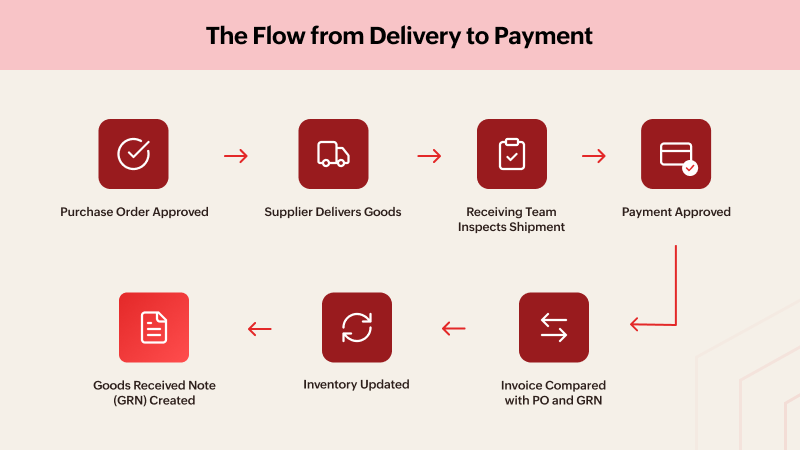
The GRN is the pivot point in this flow. If it is inaccurate, inventory and financial records become misaligned. If it is delayed, payment approvals slow down. If it is skipped, invoice matching loses its foundation.
This is why a GRN is not merely administrative; it is a control mechanism.
Goods received note and three-way matching
In most mature procurement environments, invoice approval depends on three-way matching. This control compares three documents before payment is authorized:
The purchase order (what was approved)
The goods received note (what was delivered)
The invoice (what is being billed)
When all three align, payment can proceed confidently. If there is a mismatch, such as fewer received quantities than invoiced, the issue is flagged before money leaves the organization.
The GRN is what gives three-way matching its credibility. Without a confirmed record of receipt, matching becomes theoretical rather than practical.
Real-world scenarios where GRNs make a difference
The value of a goods received note becomes most apparent when deliveries are not perfect.
For example, suppliers may ship goods in multiple batches due to production schedules or logistical constraints. Each delivery requires its own GRN to ensure inventory and invoice matching remain accurate. Without separate GRNs, stock levels and payment approvals can quickly become confusing.
In another scenario, items may arrive damaged. If the issue is recorded in the GRN during inspection, the discrepancy is clear and actionable. If it is discovered later without documentation, resolving the issue becomes more difficult.
These situations are not rare; they are everyday realities in procurement. The GRN exists to manage them.
Common challenges in GRN management
Although the concept of a goods received note is straightforward, execution can vary widely.
Manual processes often create delays between receipt and documentation. Paper-based records can be misplaced. Spreadsheet-based tracking may introduce errors or inconsistencies. Over time, these small issues accumulate into larger reconciliation problems.
Clear ownership and timely recording are essential for an effective GRN process. When responsibilities are well defined and documentation happens immediately upon receipt, most downstream issues are avoided.
How modern procurement systems improve GRN processes
Digital procurement platforms have significantly improved how goods received notes are managed. Instead of existing as standalone documents, GRNs are integrated into the procurement workflow.
In solutions like Zoho Procurement, GRNs can be created directly from approved purchase orders, eliminating duplicate data entry. Receiving teams log deliveries in real time, partial shipments are tracked accurately, and inventory updates automatically. Finance teams can view receipt status instantly before approving invoices.
In solutions like Zoho Procurement, receiving teams can generate goods received notes directly from approved purchase orders. Partial deliveries can be recorded accurately, discrepancies noted at the time of inspection, and receipt data linked to invoice approval workflows.
This integration improves visibility across procurement, inventory, and finance. Instead of relying on disconnected documents, teams operate from a shared system where receipt status is visible in real time.
The result is faster invoice matching, stronger audit trails, and better alignment between what was ordered, received, and paid for.
Best practices for an effective goods received note process
A strong GRN process does not require complexity, but it does require consistency. Goods should always be physically verified before a GRN is recorded. The GRN should be created immediately upon receipt, not retroactively. Partial deliveries should be documented separately to avoid confusion during invoice matching.
It is also critical that invoice approvals depend on confirmed GRNs. When payment workflows require verified receipt, accountability becomes embedded in the process rather than optional.
Over time, disciplined GRN practices reduce disputes, improve supplier communication, and create cleaner financial reporting.
Why the goods received note remains essential
As procurement becomes increasingly automated, the relevance of the goods received note has not diminished. In fact, automation amplifies its importance.
Digital systems process transactions quickly. If a GRN is inaccurate or missing, the resulting errors propagate through inventory records and financial systems quickly. Conversely, when GRNs are recorded accurately and promptly, they enable reliable reporting and confident decision-making.
The goods received note remains the moment where procurement confirms reality before committing funds. It ensures every payment is backed by verified receipts and every inventory record reflects physical stock.
How Zoho Procurement supports goods received notes (GRNs)
A goods received note is only as strong as the process behind it. In manual environments, GRNs often live in spreadsheets, emails, or paper forms, which makes tracking, matching, and reconciliation harder than it needs to be.
This is where digital procurement platforms make a measurable difference.
Zoho Procurement embeds the goods received note directly into the purchasing workflow instead of treating it as a separate document. When a purchase order is approved and goods arrive, receiving teams can create the GRN from the original purchase order itself. This removes duplicate data entry and reduces errors.
Because the GRN is connected to the purchase order and invoice within the same system, three-way matching becomes seamless. Finance teams can instantly see whether goods have been fully received, partially delivered, or flagged with discrepancies before approving payments.
Zoho Procurement also supports:
- Tracking partial deliveries without confusion.
- Capturing quantity and condition details at the time of receipt.
- Updating inventory automatically when a GRN is recorded.
- Maintaining a complete audit trail of receipt and approval.
Instead of relying on disconnected documents, procurement, operations, and finance teams work from a shared source of truth.

The bigger perspective
A goods received note may appear simple on the surface, but it performs a critical function in procurement governance. It anchors purchasing decisions in verified outcomes and ensures that operational, financial, and supplier data remain aligned.
When organizations treat the GRN as a meaningful checkpoint rather than a routine formality, procurement processes become more resilient. Payments become more accurate. Inventory becomes more reliable. Supplier relationships become more transparent.
Ultimately, procurement is not just about buying efficiently, it is about verifying responsibly. The goods received note is where that verification happens.