

- HOME
- Supplier management
- Supplier risk management: From risk prevention to strategic advantage
Supplier risk management: From risk prevention to strategic advantage
In today's competitive landscape and volatile global economy full of geopolitical tensions, regulatory shifts, climate disruptions, cyber threats, and financial instability that can disrupt supply chains overnight, suppliers and supplier relationships play a greater strategic role. Organizations must move beyond basic vendor assessments and adopt structured, technology-enabled approaches to identify, evaluate, and mitigate supplier risks effectively.
This article explores the fundamentals of supplier risk management, detailing the key risk categories businesses face and outlining practical mitigation strategies tailored for procurement teams. It also provides a step-by-step framework to help organizations assess vulnerabilities within their supplier ecosystem and implement proactive risk governance models.
What is supplier risk management?
Supplier risk management (SRM) is the structured process of identifying, assessing, monitoring, and mitigating risks associated with third-party suppliers and vendors. It ensures business continuity, regulatory compliance, financial stability, and operational resilience across the supply chain.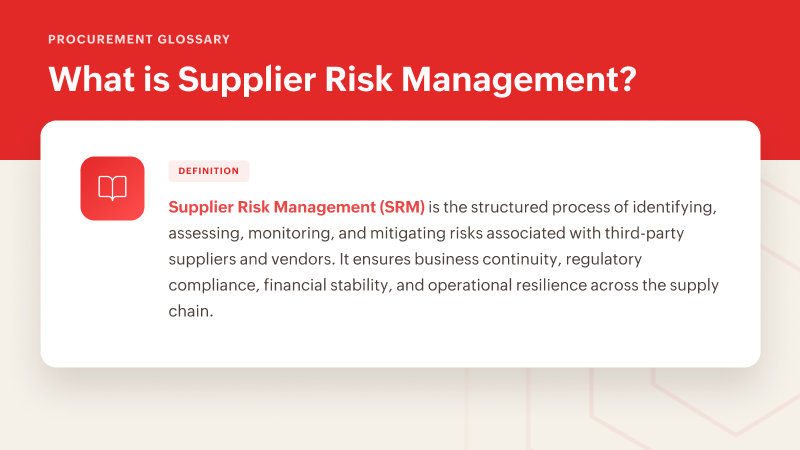
As businesses today go global and become digitally interconnected, their exposure to threats increases. A single supplier failure—whether due to bankruptcy, a cybersecurity breach, labor issues, or regulatory violations—can halt production, damage brand reputation, and impact shareholder value.
Types of supplier risks
Supplier risks can originate from multiple dimensions. Understanding these categories helps organizations design targeted mitigation strategies.
Financial risk
Financial risks arise when a supplier faces financial instability, insolvency, or poor cash flow management. A financially unstable supplier can disrupt operations, increase costs, and put compliance at risk.
A report by the UK National Audit Office highlighted that poor financial oversight and delayed payments across the supply chain amplified systemic risk.
All financial risks come without any warning signs. A supplier's financial state is often not disclosed or known to procurement teams, unless they see invoices go unpaid past the due date. Actively monitoring suppliers and catching early signs of missed payments, contract renegotiations, or sudden leadership changes is crucial.
Operational risk
Operational risk arises due to the supplier's inability to deliver goods or services as agreed to in the contract. Unlike financial risk, here, the risk can be as minimal as a one- or two-day shipment delay to a complete production halt.
Operational risk varies with complexity. If a supplier manages multiple product lines spread across multiple geographies, then it might disrupt the entire supply chain operations of your business. Framing proper SLAs, backup inventory, and supplier distribution—with audit reviews—is crucial.
Geopolitical risk
Global supply chains expose businesses to political instability and regulatory changes. A change in trade policy or sudden civil unrest can disrupt operations. For example, analysis from the World Trade Organization indicated that tariff escalations in 2025 significantly increased costs and disrupted established supplier networks.
Businesses need well-defined supplier policies, audit provisions, and clear compliance clauses embedded in every contract to manage risk effectively. Businesses in today's world need to build supply chains spanning geographies, monitor global developments, and develop regional alternatives where possible.
ESG risk
ESG risks revolve around a supplier’s impact on the environment—carbon emissions, waste management, water usage, and resource sustainability. Environmental risks within supplier and contractor networks can have enterprise-wide consequences.
Suppliers operating globally need to be aware of and comply with local labor laws and environmental regulations, and be aware of data privacy breaches. The "Dieselgate" emissions scandal is one of the most infamous controversies in automotive history that exposed systemic emissions. Governance failures—whether internal or within supplier networks—can destroy credibility and shareholder value.
Supplier-related ESG failures can quickly escalate into full-blown reputational crises, especially in an era of heightened transparency, social media scrutiny, and stakeholder activism. Unlike operational or financial risks, ESG risks often have long-term, compounding consequences, impacting not just supply chains, but customer trust, market valuation, and access to capital.
Cybersecurity risk
With the rise of digital systems, cyberattacks are inevitable. If the supplier's system is compromised and all customer data is breached, your business becomes vulnerable to cybersecurity risks.
Target’s data breach is referred to as one of the biggest security breaches recorded. Weak IT infrastructure, poor access controls, and insufficient security certifications are among the primary reasons for cyber attacks.
Concentration risk
Over-reliance on a single supplier or on multiple vendors from the same geographic region increases vulnerability. A Harvard Business Review analysis highlighted how deeply-tiered supplier dependencies created hidden
concentration risks across the automotive supply chain.
Based on the nature of the goods and the markets you serve, procurement teams should diversify vendor and regional concentrations.
How to mitigate supplier risks effectively
Mitigating supplier risk requires a structured, technology-driven, and cross-functional approach. All departments, from finance to legal, and IT to risk and compliance, are involved in assessing the potential impact of suppliers.
Supplier risk management will be an ongoing and incremental improvement process, which needs to be checked from time to time with necessary changes made to ensure smooth operations and an efficient supply chain process.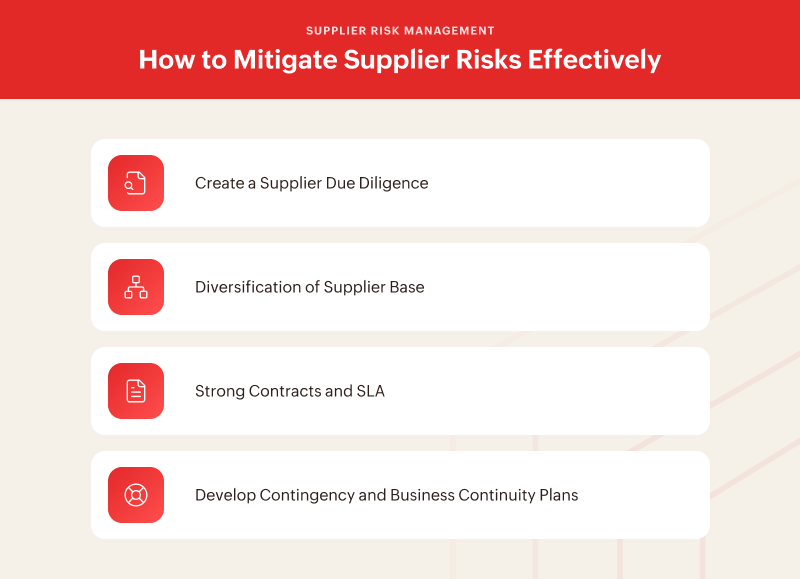
Supplier due diligence
Procurement should collaborate with finance, legal, and IT teams to conduct comprehensive vetting to assess financial statements, review compliance certifications, perform cybersecurity audits, and check ESG credentials.
Creating onboarding documentation with all these metrics and reviewing them on an annual or even quarterly basis, based on the criticality of your business, can help mitigate risk.
Segment suppliers by risk and criticality
Identify each supplier, segment them, and map them into critical suppliers, high-risk suppliers, and transactional suppliers. Allocate monitoring intensity accordingly based on the nature of goods they supply. Strategic suppliers may require quarterly reviews, while low-risk suppliers might just need annual checks.
Diversification of supplier base
Avoid over-dependence on a single vendor; diversification reduces concentration risk and improves negotiation leverage with suppliers. Follow strategies like dual sourcing for critical components or goods, and regional diversification for goods that are coming from a single region.
Companies operating on a high scale can also look into nearshoring strategies to strengthen their supply chain and manufacturing.
Strong contracts and SLA
Well-defined contracts create accountability and legal protection, and reduce damages for both the buyers and sellers.
A contract should follow a five-step framework to mitigate risks:
1. Identify potential risk-causing factors.
2. Assess risk impact and data protection provisions.
3. Implement risk mitigation strategies.
4. Establish clear risk transfer and penalty clauses.
5. Monitor and manage risks and audit rights.
Develop contingency and business continuity plans
Develop action plans based on the priority of each supplier. Hold safety stock in warehouses, create backup supplier lists, and define escalation protocols. Develop action plans tailored to each supplier based on their risk category. Assign ownership across procurement, finance, and operations teams.
Turning supplier risks into a strategic opportunity for your organization
The real value of mitigating risks lies in how you can use information from your procurement and ERP system to unlock growth, resilience, and competitive differentiation.
Building a resilient and adaptive supply chain
Resilience is a strategic asset that enhances customer trust and investor confidence—both key for a business. Building multiple sourcing ecosystems, regional diversification, and nearshoring helps build a flexible supply network. This ensures business continuity, faster recovery from disruptions, and stronger customer trust.
Turn supplier insights into negotiation leverage
The supplier risk assessment profile provides deep visibility into a supplier's financial health, operational dependencies, and market position. This can be used to restructure commercial relationships by renegotiating pricing, optimizing payment terms, and setting performance-based incentives. This helps build cost-efficient cycles, improved margins, and more balanced supplier relationships.

Strengthen strategic supplier partnerships
Risk analysis helps identify high-performing, low-risk suppliers who can evolve into strategic partners. Some suppliers are key to your business; this helps co-invest in process improvements or capacity expansion plans and align demand forecasts. Allocate additional capital, sign exclusive agreements with suppliers that warrant long-term investment, and make them part of your capital allocation and investment decisions.
Accelerate ESG and sustainability leadership
Supplier-related ESG risks, such as environmental violations or unethical labor practices—can damage brand equity. Partner with suppliers to reduce your carbon footprint and implement transparent ESG reporting across the supply chain. Companies that assess their ESG framework improve brand positioning and investor appeal while staying ahead of their competition. This is especially relevant as regulatory bodies and investors demand greater transparency in supply chains.
Elevate procurement to a strategic function
When supplier risk management is embedded into business strategy, procurement evolves from a cost center to a strategic advisor. Procurement systems generate a wealth of data—financial metrics, delivery performance, compliance scores, and risk indicators. When integrated into enterprise systems, this becomes a powerful decision intelligence layer.
With Zoho Procurement, bring supplier management, contract lifecycle management, purchasing workflows, and risk visibility into a single platform. Procurement teams can move beyond operational tasks and actively contribute to risk-informed strategic planning.
Conclusion
Supplier risk management is no longer optional; it is a foundational pillar for resilience, compliance, and sustainable growth. But the true competitive advantage lies in how organizations act on supplier risk intelligence. By identifying risks early, implementing structured mitigation strategies, and continuously monitoring supplier performance, businesses can safeguard operations and protect enterprise value. More importantly, by integrating risk insights into strategic decision-making, organizations can unlock new opportunities—from cost optimization and innovation to stronger supplier partnerships.
Zoho Procurement accelerates this transformation by providing a unified, intelligent procurement ecosystem. With automation, real-time visibility, and built-in risk controls, businesses can shift from reactive risk management to proactive, opportunity-driven procurement. You can also provide vendor portal access to all suppliers to ensure all data is safe in a single place. The system is SOC 2 certified, ensuring the highest level of data protection.