

- HOME
- Business spend management
- Maverick spend in procurement: A guide to identifying and preventing it
Maverick spend in procurement: A guide to identifying and preventing it
Maverick spending is a significant challenge in procurement, leading to financial losses that impact profitability. This guide defines maverick spend, examines its causes, outlines identification methods and types, distinguishes it from related concepts, and provides prevention strategies for finance leaders and procurement teams.
Profitability impact
Spend leakage in procurement reduces profitability by bypassing negotiated discounts and increasing costs beyond budgeted amounts. Organizations lose up to 20% of potential savings annually due to maverick spending. Additional administrative overhead, such as manual invoice reconciliation and dispute resolution, further increases costs. This strains cash flow, reduces margins, and diverts resources from strategic initiatives like supplier diversification.
What is maverick spend?
Maverick spend, also known as rogue spend, is any procurement activity that violates organizational policies, such as purchasing from unapproved vendors or bypassing approval workflows. It includes both intentional and unintentional actions and can account for up to 80% of invoices in organizations lacking proper controls. Unlike routine purchases, maverick spend lacks strategic oversight, increasing risks such as supply chain disruptions, inconsistent quality, and regulatory non-compliance. Finance teams often see this in indirect categories like software licenses or office supplies.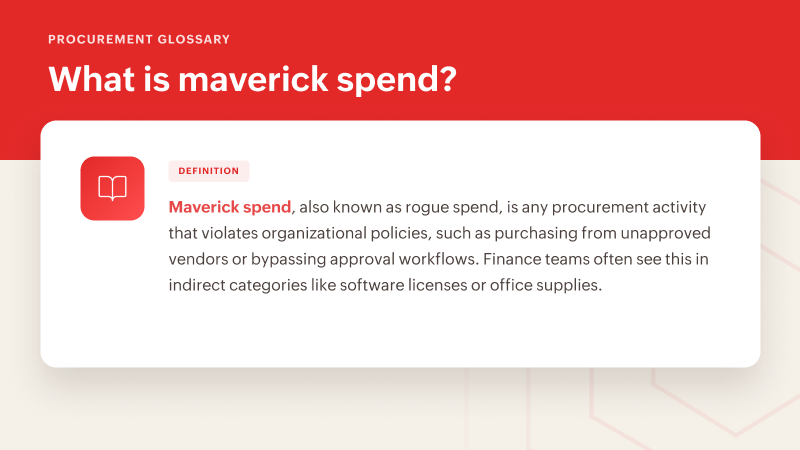
What are the causes for maverick spend?
Maverick spend is not always intentional. It often results from inadequate procurement controls, especially in decentralized organizations. Here are some key causes of it.
Vague policy guidelines
Vague or incomplete procurement policies create confusion, leading employees to interpret rules differently and bypass standard channels. This inconsistency across departments encourages maverick spend as individuals choose convenient alternatives over unclear directives.
Cumbersome approval processes
Lengthy, multi-step approval workflows can frustrate users with urgent needs, prompting them to source directly from preferred vendors. Delays in routine purchases erode trust in the system and drive off-policy transactions to maintain operations.
Decentralized procurement
Distributed buying authority across departments fragments spend and weakens supplier negotiation leverage. Independent units often prioritize speed over compliance, leading to redundant vendors and missed volume discounts. Shortcuts override policy adherence, especially under time pressure. Risk-averse or convenience-driven habits lead to spot buys, perpetuating cycles of non-strategic spending without malice.
Inadequate training and policy compliance
Without regular, role-specific training, employees may be unaware of policies or the consequences of non-compliance. These knowledge gaps enable unintentional violations that can result in significant leakage.
How to identify maverick spends
Before prevention, it is critical to identify the extent of maverick spend within the organization. Its always good to analyze spend data via BI tools or procurement software with built-in spend analytics to spot anomalies like non-PO invoices or transactions from unknown vendors exceeding 5% of category totals.
Tail-spend audits
Tail spend often contributes to maverick spending because it consists of small, scattered purchases made outside official channels with little oversight. Dashboards highlighting tail spend, typically 20% of total spend across 80% of suppliers, can quickly uncover these hidden hotspots.
Vendor audits
Conduct vendor consolidation audits and review AP reports for duplicates or off-contract volumes.
Employee surveys
Employee feedback surveys on purchasing behavior and exception logs from ERP systems provide qualitative insights. AI analytics can also flag patterns in real time.
Types of maverick spend
Maverick spend manifests in distinct forms, each with unique risks.
Spot buying: Urgent, one-off purchases made without negotiation, often resulting in higher costs and lack of compliance.
Non-PO spend: Transactions without purchase orders, evading approval and matching processes, are common in expense reports.
Off-contract buying: Purchases from approved vendors but outside negotiated terms, diluting volume discounts.
Tail spend: High-volume, low-value buys scattered across numerous suppliers; hard to track but cumulatively expensive.
Shadow spend: Unofficial or unrecorded purchases via personal cards later reimbursed, fully invisible to procurement.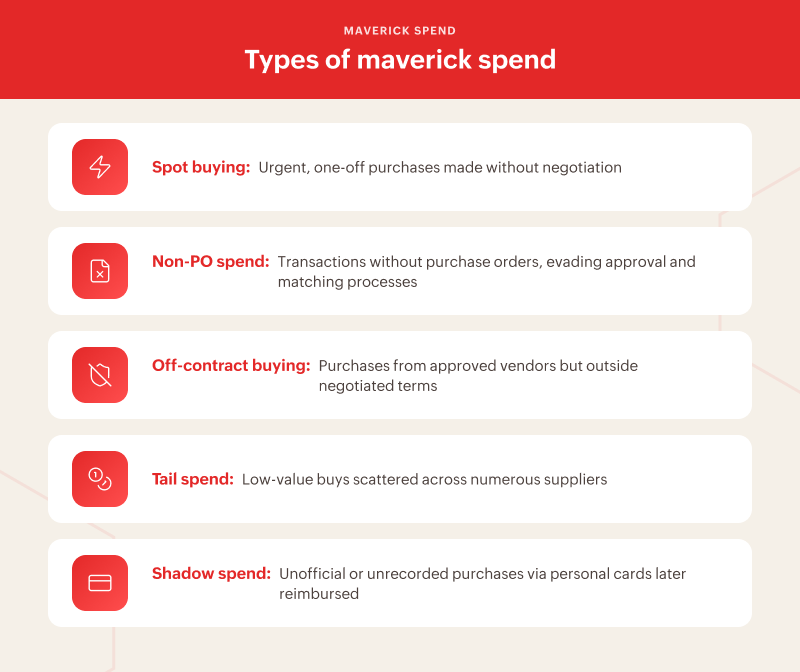
Maverick vs Uncontracted spend
Maverick spend is often confused with off-contract spending. Maverick spend includes all policy-violating purchases, even from approved vendors, if workflows or limits are not followed. Uncontracted spend is a narrower category, referring to purchases from suppliers without a formal agreement, regardless of policy compliance.
For example, off-contract purchases from a preferred supplier are considered maverick but not uncontracted, while buying from a new vendor without terms qualifies as both. Addressing maverick spend targets systemic issues, while managing uncontracted spend focuses on supplier onboarding gaps.
Tips to control maverick spending
Implement these targeted strategies to effectively reduce maverick spend.
Mandate POs for all purchases
Enforce purchase orders through system controls that automatically block payments without proper three-way matching of invoices, receipts, and POs. This eliminates non-PO spend, which often accounts for majority of maverick activity, ensuring every transaction is linked to an approved requisition. Procurement teams gain full visibility, and finance avoids unexpected liabilities. By enforcing pre-approved vendor lists, dynamic pricing, and guided buying to steer users toward compliant options, employees face fewer choices, reducing the temptation to source elsewhere. This approach also consolidates spend and strengthens supplier relationships.
Automate approvals
Implement AI-driven workflows to instantly approve low-value items under $5,000, reducing delays from days to less than 24 hours and preventing urgent workarounds. Rules-based escalation manages exceptions efficiently, maintaining speed and oversight. Finance leaders report faster processing and higher compliance rates with this approach.
Enhance visibility
Integrate spend analytics tools to provide real-time dashboards that track compliance, flag anomalies, and benchmark performance across categories. Proactive alerts on tail spend or vendor proliferation enable quick interventions before leakage increases. This data-driven approach transitions procurement from reactive to predictive.
Employee training
Quarterly training sessions tailored to specific roles, using real-world scenarios such as urgent office supply needs, illustrate policy impacts and the costs of shortcuts. Interactive workshops reinforce compliant purchasing behaviors, with certification tracking to ensure accountability. Teams typically achieve a significant reduction in maverick spend following these training cycles.
Leverage P-Cards
Issue controlled corporate cards with programmable spend limits, vendor whitelists, and real-time transaction controls to manage small purchases securely. Virtual cards for one-time use help prevent fraud and integrate directly with accounts payable for seamless reconciliation. This approach reduces personal card reimbursements which are a common source of maverick spending.
Incentivize compliance
Reward departments achieving over 90% policy adherence with budget flexibility, recognition, or shared savings pools to encourage compliance. Gamification, such as leaderboards, fosters healthy competition and supports a culture of compliance.
Audit routinely
Schedule monthly tail spend reviews using automated reports to identify outliers, reclaiming an average increase in savings through vendor consolidation and contract enforcement. Cross-functional teams address root causes, closing gaps before they escalate. Consistent audits build long-term discipline across the organization.
Metrics for success
Monitor key indicators such as maverick spend percentage (targeting less than 10%), PO compliance rate (over 95%), and savings leakage recovered. Quarterly bench-marking against industry peers ensures sustained progress and helps transform procurement into a value center. Proactive control safeguards margins and strengthens supplier partnerships and operational agility.
Technology solutions to prevent maverick spending
Source-to-pay suites like Zoho Procurement include built-in controls that automatically flag deviations and suggest compliant alternatives. AI predicts maverick patterns using historical data, while mobile apps enable on-the-go approvals without email chains. Organizations using these solutions report greater savings and improved alignment between procurement and profitability goals.
Struggling with uncontrolled maverick spend? Learn how Zoho Procurement can help you stop leakage, enforce compliance, and recover lost profits.