

- HOME
- Procurement
- Guided buying in procurement: A strategic framework for smarter, compliant purchasing
Guided buying in procurement: A strategic framework for smarter, compliant purchasing
Procurement is a complex process for any organization regardless of the size and the industry they operate in. Employees need to adhere to multiple policy documents, email approvals, and perform manual validations. As organizations scale, procurement complexity multiplies. Department-led purchases increase, supplier lists expand, and budget complexity starts to kick in. Guided buying changes this dynamic. Instead of expecting employees to remember procurement rules, the system enforces them intelligently and automatically.
What is guided buying?
Guided buying is a policy-driven, user-friendly purchasing framework embedded within procurement software. It provides employees with a simplified buying experience that automatically routes them to approved vendors, preferred catalogs, and compliant workflows. Unique budget thresholds and approval workflows can be set for each policy and then assigned to departments or even to individual employees to curb maverick spending.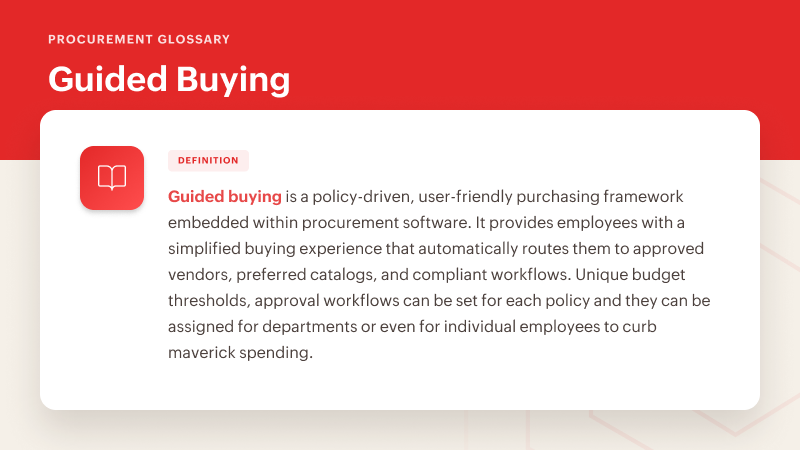
How can guided buying help in the procurement process?
Guided buying aims to reduce rogue spending, accelerate approvals, and strengthen procurement across multiple stages.
Standardizing purchase requests
Employees are directed to structured dynamic catalogs and pre-approved vendors. All purchases are made from preconfigured catalogs and standardized product descriptions. This improves accuracy, speeds up processing, reduces ambiguity, and improves the quality of requisitions.
Improving policy compliance
Adhering to policies is crucial for a successful procurement process in an organization. Guided buying ensures policies are enforced and that all employees adhere to their assigned policy. The system automatically flags violations and ensures all purchases are compliant.
Reducing maverick spending
With a guided buying process in place, the system embeds spend policies directly into the purchasing experience. When users initiate a purchase request, they are automatically directed to preconfigured catalogs with relevant buying categories from approved suppliers ensuring spends are curbed at the source.
Accelerating approval cycles without sacrificing control
Email chains, missed notifications, unclear approval structures, and unavailable approvers slow down purchasing. Guided buying addresses this by automating approval logic upfront by configuring approvers based on departments, projects, and budget availability. So when a purchase request is submitted, it is instantly routed to the appropriate stakeholder.
Enhancing spend visibility
By centralizing the purchasing process, every transaction from requisition to purchase order flows through a structured process. This enables the procurement team to:
-->Identify overspend trends early.
-->Track spend across different categories.
-->Renegotiate supplier contracts.
Guided buying transforms procurement from a transactional function into a data-driven strategic partner.
Broader organizational benefits of guided buying
Procurement teams benefit with immediate operational improvements, but the broader impact of guided buying extends across the organization.
Financial discipline
By directing purchases towards a policy driven approach, organizations capture spend leakage, and increase accuracy, driving to more cost-savings.
Operational efficiency
Automation reduces manual intervention, and helps procurement teams shift their focus on strategic sourcing and supplier performance management.
Governance and audit readiness
Every purchase goes through a digital audit trail, approval history, timestamps, and policy checks; everything is recorded automatically.
For growing enterprises expanding across geographies, granular control becomes critical—and when paired with a user-friendly interface, clear status tracking, and faster processing times, it drives stronger adoption and sustained operational efficiency.
Broader organizational benefits of guided buying
Procurement teams benefit with immediate operational improvements, but the broader impact of guided buying extends across the organization.
Financial discipline
By directing purchases towards a policy driven approach, organizations capture spend leakage, and increase accuracy, driving to more cost-savings.
Operational efficiency
Automation reduces manual intervention, and helps procurement teams shift their focus on strategic sourcing and supplier performance management.
Governance and audit readiness
Every purchase goes through a digital audit trail, approval history, timestamps, and policy checks; everything is recorded automatically.
For growing enterprises expanding across geographies, granular control becomes critical—and when paired with a user-friendly interface, clear status tracking, and faster processing times, it drives stronger adoption and sustained operational efficiency.
Step-by-step process to implement guided buying
Implementing guided buying is not merely a software deployment; it requires more of a structured rollout. It is a process transformation which requires a structured approach and framework to ensure long-term success.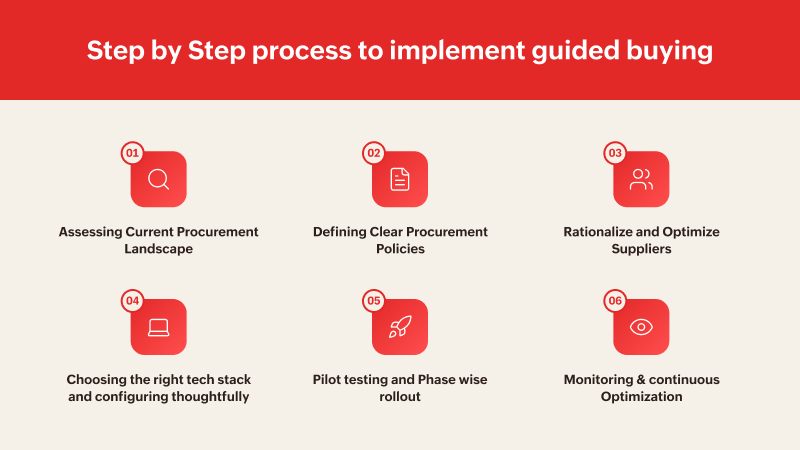
Assess your current procurement landscape
Often, organizations assume their procurement process is working fine until they look at the data. Start by evaluating your current process: measure the current maverick spend percentage, approval cycle duration, budget variance patterns, and time taken on manual processing.
Understanding your baseline helps you build a strong internal case for change and helps you measure improvement after implementing new systems.
Define clear procurement policies
Setting clear policies and guidelines compliant with the law of the land is crucial for a growing organization. Policies built on a simple and practical framework, aligned with business risk appetite, lead to faster adoption and less friction.
The main segments that a guided buying policy needs to cover are:
-->Spending thresholds by role
-->Approval hierarchies and workflows
-->Preferred suppliers by category
-->Compliance & policy guardrails
-->Budget ownership rules
-->Exception handling processes
Rationalize and optimize suppliers
Supplier consolidation strengthens overall procurement and also helps guided buying with precise structured vendor catalogs and approved supplier directories. If your supplier database is cluttered with duplicates, inactive suppliers, or inconsistent pricing, guided buying will struggle to deliver value.
Choosing the right tech stack and configuring thoughtfully
Identifying the right tech stack is crucial for the success of implementing a process for an organization. Start by defining what your organization needs most, be it spend visibility, stronger compliance, or a simpler user experience. Choose a solution that aligns with these priorities and integrates smoothly with your existing systems to ensure easy adoption and long-term impact.
Enabling punchouts with vendors
By enabling punchouts with vendors, it eliminates the need for procurement teams overlooking the buying process, lowering overall operational expenses. It brings in an enhanced user experience for employees, improves overall procurement efficiency, and reduces maverick spend.
With Zoho Procurement, you can now automate your entire source-to-pay lifecycle, and empower employees with guided buying to streamline purchases.
Pilot testing and phase-wise rollout
Rolling out the system for the entire organization on a single go, might go catastrophic. Instead, choose a pilot group, maybe a department with high purchase volume or a team with frequent policy deviations. Encourage honest feedback from users. Run feedback campaigns. Often, the smallest feedback and simple workflow tweaks dramatically improves user adoption.
Monitor metrics and continuously optimize
Guided buying is an evolving framework, not a one-time policy you implement. As your organization grows and expands across multiple geographies, or increases vendor relationships, your guided buying structure evolves accordingly.
Work along side your finance teams and analyze spending patterns, reduce financial leakage, and support strategic cost optimization. When procurement and finance teams operate with shared visibility, the organization gains structural resilience.
Challenges that organizations face with adopting a new system
Resistance to change
Staff and employees may initially perceive new workflows as restrictive. Conduct user training programs, emphasize the platform's ease of use, and demonstrate the faster approval work cycles and time savings in real time.
Supplier relationships
Inconsistent supplier data can be a challenge. Some vendors may even be reluctant to transition to new portals or share catalog data in the specified formats. Providing hands-on assistance and sharing clear, structured templates can help partners align with your system.
Performance tracking
Define key performance indicators (KPIs) such as processing time, contract compliance rates, cost savings, and user satisfaction.
Integration with existing tech stacks
Most challenges arise from communication gaps, technical limitations, or unclear policy issues that can be addressed through continuous improvement and consistent user feedback.
Guided buying as the foundation of smarter procurement
Guided buying is becoming the operational backbone of structured, scalable purchasing features in modern procurement.
As organizations grow, procurement complexity increases. More departments. More vendors. More approvals. More compliance requirements. Without a structured framework, this complexity leads to fragmented spend, approval delays, and reduced financial visibility.
For organizations looking to move beyond fragmented purchasing tools, Zoho Procurement provides a comprehensive source-to-pay platform that unifies the entire procurement lifecycle. From supplier onboarding and sourcing to purchase requisitions, combining guided buying, workflow automation, supplier management, and vendor payments, Zoho Procurement supports a structured, policy-driven process at every stage.
When guided buying is implemented thoughtfully with clarity, simplicity, and strong communication it becomes less about enforcement and more about empowerment.