

What is RFQ? RFQ vs. RFP vs. RFI explained with key differences and use cases
In many procurement discussions, the terms RFQ, RFP, and RFI are often used interchangeably. That creates confusion.
Each document serves a distinct purpose within the procurement process. While they may appear similar, they are designed for different stages of sourcing and different types of decisions.
Using the wrong document does more than delay progress. It leads to misaligned supplier responses, unclear pricing comparisons, and inefficient evaluation cycles.
Understanding the difference between RFQ, RFP, and RFI directly impacts sourcing efficiency, supplier selection, and overall procurement outcomes.
RFQ vs. RFP vs. RFI: A quick summary
RFQ (request for quotation) is used when specifications are fully defined and price is the primary comparison factor.
RFP (request for proposal) is used when the problem is defined by suppliers who must propose how they would solve it.
RFI (request for information) is used to gather market intelligence before formal sourcing begins.
If you remember one line, remember this: RFI explores. RFP evaluates. RFQ prices.
What is an RFQ in procurement?
An RFQ is a formal sourcing document issued when requirements are clearly defined and standardized.
The specifications are clear. The scope is defined. The only major variable is price.
You're asking one direct question:
"Here are the requirements. What will it cost?"
The organization specifies detailed technical, commercial, and delivery requirements. Suppliers respond with pricing and confirmation of their ability to meet those specifications.
When to use an RFQ
Use an RFQ when:
- The product or service is standardized
- Technical details are fixed
- You want a fast supplier comparison
- Cost is the dominant decision factor
Example:
You need 1,000 branded laptops with fixed configurations and warranty terms. No customization. No strategic redesign. You issue an RFQ to compare pricing across qualified vendors.
This is tactical sourcing. Clean and efficient.
But here’s the mistake teams make: They issue an RFQ before defining requirements. That leads to vague supplier responses and pricing built on assumptions. Then you’re comparing apples, oranges, and whatever fruit someone guessed you wanted.
What is an RFP?
An RFP is used when the organization understands the business need but requires suppliers to propose how they would address it.
Unlike an RFQ, an RFP evaluates both qualitative and quantitative factors.
Suppliers typically respond with:
- Proposed solution design
- Implementation methodology
- Project timelines
- Risk mitigation strategies
- Commercial structure
When to use an RFP
Use an RFP when:
- The purchase is complex.
- Multiple solution approaches exist.
- Strategic impact is high.
- An evaluation extends beyond price.
Example:
You’re selecting a spend management platform. Integration, reporting, supplier onboarding, scalability, and user adoption all matter. The cheapest option may not be the smartest one.
An RFP helps you compare thinking, not just numbers.
What is an RFI?
An RFI is typically used in the early stages of the procurement process.
It's purpose is to gather information about supplier capabilities, market options, and emerging solutions before formal evaluation begins.
You’re not buying yet. You’re learning.
An RFI does not represent a commitment to purchase. It supports internal research and planning.
When to use an RFI
Use an RFI when:
- Entering a new category
- Assessing supplier landscape maturity
- Defining internal requirements
- Shortlisting potential vendors for future evaluation
Example:
Your company wants to outsource fleet management for the first time. You don’t understand pricing structures or service models yet. An RFI helps you map the terrain before issuing an RFP.
Think of an RFI as reconnaissance. You gather intelligence before making commitments.
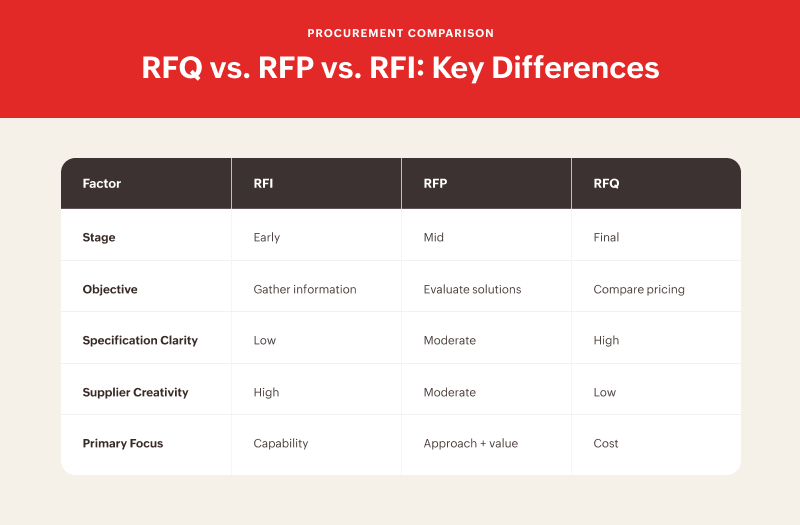
RFQ vs. RFP vs. RFI: Key differences
Procurement typically progresses as follows:
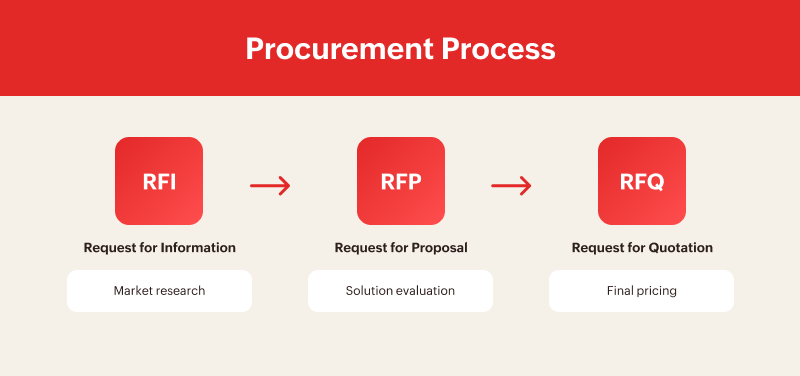
How RFQ vs. RFP vs. RFI work together
In real-world sourcing, these documents often work in sequence. Imagine your organization wants to implement a new procurement system.
Step 1: RFI
You gather information about available platforms, pricing models, and integrations.
Step 2: RFP
You shortlist vendors and evaluate the solution design, implementation approach, security, and long-term roadmap.
Step 3: RFQ
You finalize requirements and request commercial quotations for final comparison.
This structured approach reduces risk. It also improves negotiation leverage because suppliers know you've done your homework.
Skipping stages might feel faster, but it usually isn’t.
Common mistakes in RFQ vs. RFP vs. RFI processes
Several recurring issues undermine sourcing effectiveness:
- Issuing an RFQ before finalizing requirements
- Overemphasizing pricing in high-impact categories
- Launching an RFP without internal stakeholder alignment
- Skipping market research in unfamiliar categories
- Applying full RFP processes to low-value purchases unnecessarily
Procurement maturity lies in selecting the appropriate process, not in increasing procedural complexity.
Ensuring effective RFQ, RFP, and RFI processes
Understanding the difference between RFQ, RFP, and RFI is foundational. How these processes are executed determines their effectiveness.
In fragmented environments, sourcing activities often rely on spreadsheets, email threads, and manual tracking. That approach reduces visibility, weakens evaluation consistency, and increases compliance risk.
High-performing procurement teams structure RFQs, RFPs, and RFIs within controlled workflows that:
- Standardize documentation and approval paths
- Apply consistent, weighted evaluation criteria
- Centralize supplier communication
- Maintain complete audit trails
- Compare total cost of ownership alongside unit pricing
When sourcing processes are structured and traceable, decisions become transparent and defensible. The document initiates the process. Governance, data integrity, and evaluation rigor determine the outcome.

How to decide which document to use
These three questions provide clarity:
- Do we fully understand the supplier market? If not, begin with an RFI.
- Is the business problem defined but solution options unclear? If yes, issue an RFP.
- Are specifications finalized and standardized? If yes, proceed with an RFQ.
The appropriate document aligns with the maturity of requirements.
Frequently asked questions
Is an RFQ legally binding?
An RFQ itself is not typically a binding contract. However, supplier quotations may become binding once formally accepted, depending on terms and jurisdiction.
Can organizations skip the RFI stage?
Yes, if the supplier landscape and category dynamics are well understood. No, if the organization lacks market clarity.
Is an RFQ process faster than an RFP?
Generally, yes. However, using an RFQ prematurely can result in inaccurate comparisons and rework.
Can RFQ and RFP elements be combined?
In some mid-sized procurements, hybrid approaches are used. Careful structuring is required to maintain clear evaluation criteria.
Final takeaway
RFQ, RFP, and RFI are not interchangeable procurement documents. Each serves a defined role within the sourcing lifecycle.
- RFI builds understanding.
- RFP evaluates solutions.
- RFQ compares pricing.
Selecting the appropriate document improves supplier alignment, pricing accuracy, evaluation rigor, and risk control.
Clarity at the beginning of the process determines efficiency at the end.