- HOME
- The 2-hour drive for a 20-minute fix: The real cost of blind dispatch
The 2-hour drive for a 20-minute fix: The real cost of blind dispatch
- Last Updated : July 20, 2026
- 43 Views
- 3 Min Read
The van left at 8:00 AM.
The job? A malfunctioning control panel at a manufacturing facility thirty miles away. The technician had the work order, the tools, and two hours of drive time ahead of him—for a job that took exactly 20 minutes to fix.
That’s not a scheduling issue or a staffing shortage. That’s a visibility problem.
The hidden cost of “just send someone out”
In field service, dispatching a technician feels like the safe call. Something is broken, so you send a person. However, “just sending someone” is one of the most expensive habits in the industry.
Because when the job turns out to be a quick 20-minute fix, the real damage is already done. The fuel is spent, the schedule is disrupted, and the next work order is pushed back. The asset isn’t the problem; the workflow is.
The root cause is almost always the same: Nobody could see what the customer was looking at before the truck rolled.
The two-hour verbal guessing game
Now picture a different, equally frustrating scenario: It’s mid-morning, and your technician has been stuck on-site for two hours. The initial diagnosis failed. They’re now on a voice call with a senior engineer back at headquarters, trying to translate a complex physical layout into words.
“Is the indicator light on the left or the right panel?”
“Which connector are you looking at? The top one or the lower housing?”
Every question takes time. Every vague answer leads to three more questions. Meanwhile, the customer is watching, the clock is ticking, and the day’s schedule is collapsing.
This isn’t a knowledge deficit; your senior engineer knows exactly how to fix the asset. It’s a visual communication barrier. Words are being forced to do a job that a single shared glance would solve in seconds.
What changes when you add a shared view
Visual remote assistance completely rewrites both of these scenarios.
In the first case, a support agent can ask the on-site worker to open a live video stream via Zoho Lens before a technician is ever dispatched. If it’s a simple 20-minute fix, the agent guides them through it on the spot. If a site visit is required, the technician arrives with the exact parts and context needed to get to work immediately.
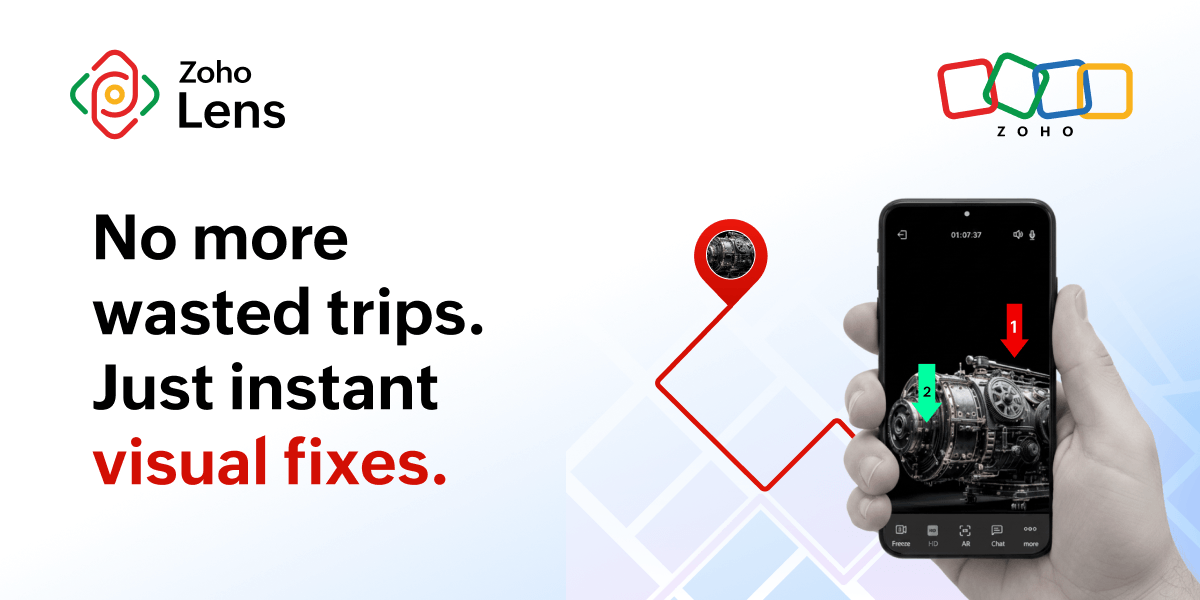
In the second case, the senior engineer stops guessing. They see exactly what the technician sees in real time, placing precise AR annotations directly onto the live screen. “The connector near the top housing” is hard to miss with the permanent digital arrow. The back-and-forth chatter transforms into instant clarity.
Here’s what that looks like in practice with Zoho Lens:
Instant access: Experts or agents join a live session instantly from any browser without any heavy software installations.
Live AR annotations: Draw arrows, highlights, and attach text notes to them while they stay anchored to real-world objects, even if the camera moves.
Freeze frame: Pause live video to let experts detail a complex step without forcing the technician to hold the camera perfectly still.
Session recording: Document interactions automatically for compliance, training, and knowledge base creation.
The dispatch you didn’t have to make
The most profitable dispatch is the one you never had to make.
When your operations team can see a problem before committing to a site visit, the entire decision tree changes. Triage becomes accurate, simple fixes happen remotely, and complex jobs get scoped properly on the first try. For field operations, this isn’t a marginal improvement—it’s a structural shift that eliminates unnecessary mileage, slashes repeat visits, and clears the Monday-morning backlog.
Your team doesn’t lack skill or effort; they’ve just been working in the dark. Zoho Lens flips the switch.
The van can still leave at 8:00 AM. It will just arrive already knowing exactly how to finish the job.
Sign up for a free trial of Zoho Lens and run your first remote session today.
 Martina Joan
B2B content specialist covering augmented reality, remote assistance, and the future of field operations. Perpetually mid-chapter — let's talk cats, chess, or crochet anytime.