- HOME
- Smart building
- Understanding BMS: The Role of IoT, components, data and control.
Understanding BMS: The Role of IoT, components, data and control.
- Last Updated : March 5, 2026
- 582 Views
- 5 Min Read

Change is the only constant, and every technological advancement reinforces this more than ever. Building Management Systems (BMS) have long supported facility managers by helping automate building operations and keep critical systems in check.
Over the years, BMS has helped building managers strike a balance between operational efficiency and cost control. However, traditional systems also came with certain limitations such as compatibility issues with specific hardware, reliance on predefined schedules, and limited integration with other platforms.
With IoT comes liberation. By integrating IoT with BMS, many of these challenges can be addressed, enabling greater flexibility, real-time insights, and new opportunities to optimize building operations without significantly increasing costs.
So what exactly forms the foundation of a BMS, and how does IoT enhance it, let’s explore.
What is a Building management system?
A Building Management System (BMS), also known as a Building Automation System (BAS), is a solution installed in buildings to monitor and control HVAC, lighting, energy usage, fire systems, and security systems.
In a traditional setup, sensors placed across the building collect data such as temperature, humidity, occupancy, and energy consumption. This data is sent to a central computer or control unit, which then commands equipment like chillers, air handling units, or lighting systems to operate in a predefined manner.
Traditional BMS typically works based on fixed schedules and preset conditions. If there is an unexpected change in the schedule the system may still operate according to its preset schedule unless manually adjusted.
What is an IoT-enabled Building Management System?
An IoT-based BMS builds on the traditional model by connecting sensors, controllers, and equipment but to the internet. Instead of being limited to fixed schedules, the system operates using real-time data and cloud connectivity.
The key differentiator is flexibility and real-time intelligence. As devices are internet-connected facility managers can monitor and control systems remotely through a cloud dashboard, settings can be adjusted based on changing conditions and the system can respond dynamically to occupancy, weather changes, or special schedules.
A traditional BMS follows preset rules, while an IoT-enabled BMS adapts to real-time conditions and dynamic environments.
How does an IoT enabled BMS work?
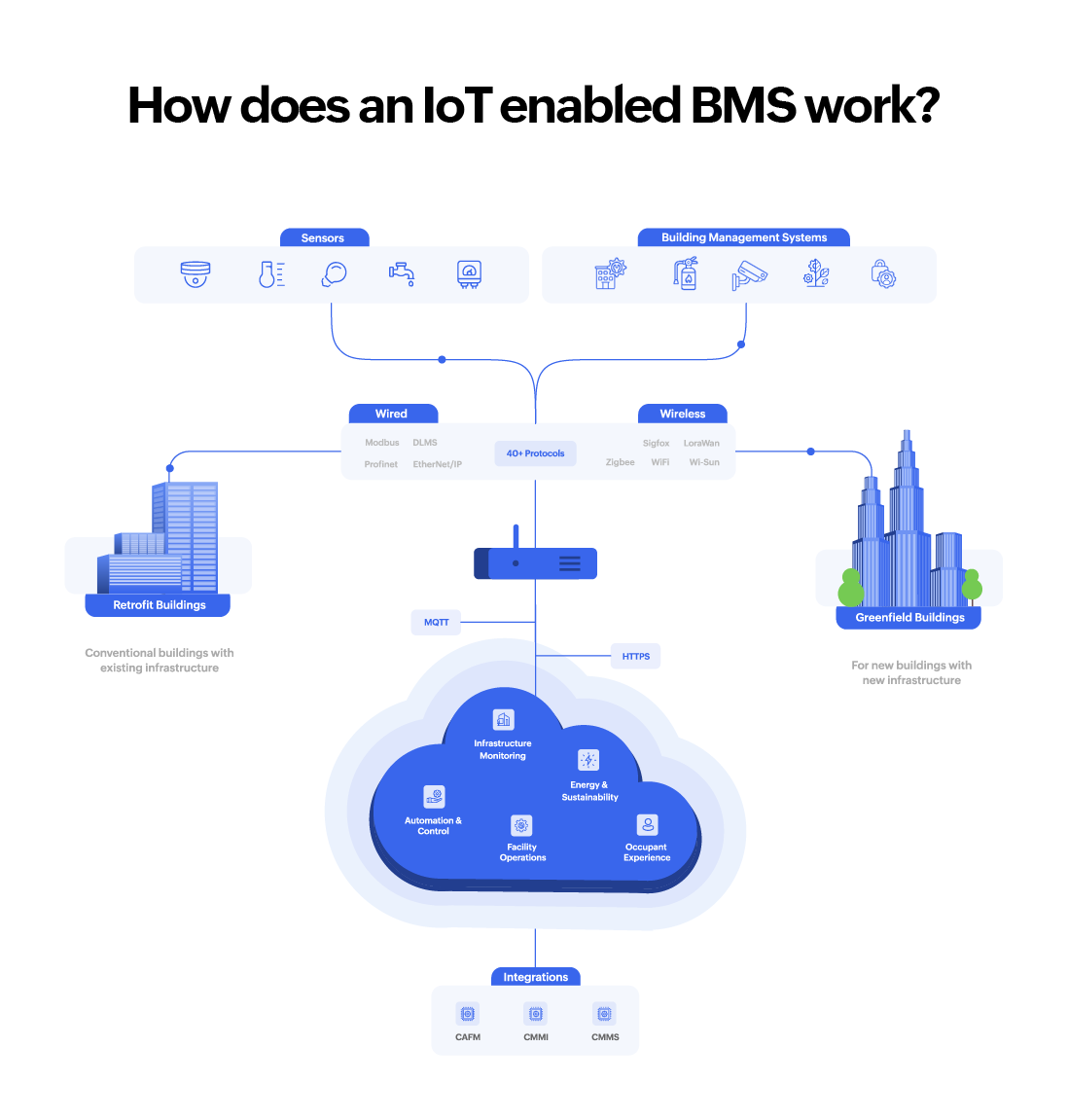
Having a BMS in place gives you centralized control, but it can sometimes be inflexible, as conditions are often preset and may not adapt well to dynamic environments.
This is where IoT comes in. With real-time data and intelligent adjustments, an IoT-enabled BMS enhances operational efficiency and optimizes resource usage through:
Real-time data collection
Sensors are deployed throughout the building gathering real-time data on temperature, humidity, light usage, water usage and energy usage. Based on the information provided by the sensors the control units and actuators modifies the building's operations ensuring a healthy and comfortable ambiance to the occupants.
Controllers
The controller acts as a central hub where a facility manager can monitor the entire building operations in real-time, for example you can manually control the AHU fan to low to high if the occupants in the room increases. Controllers allows for a seamless communication with the buildings HVAC, chillers, lighting offering real-time control over ongoing building operations.
To get started, take a look at how Zoho IoT lets you command and control your devices by predefining what and when they should perform.
Communication protocols
Communication protocols enable the seamless transmission of information between sensors, actuators, and controllers, allowing building systems to act and respond in real time.
BACnet, LonWorks, and KNX are some of the commonly used communication protocols in IoT building automation system.
By enabling smooth data exchange and coordinated control, these protocols help buildings achieve and maintain desired environmental conditions efficiently.
Software
The software layer in a Building maintenance management system provides a real-time view by gathering data from sensors, actuators, and controllers. Data sourced from various building systems is presented in a structured and meaningful way through dashboards.
These dashboards enable real-time monitoring, support data-driven decision-making, and help automate building systems to maintain optimal environmental conditions.
To get a clearer understanding of how data from different building systems can be visualized, take a look here.
Benefits of an IoT-based building management system
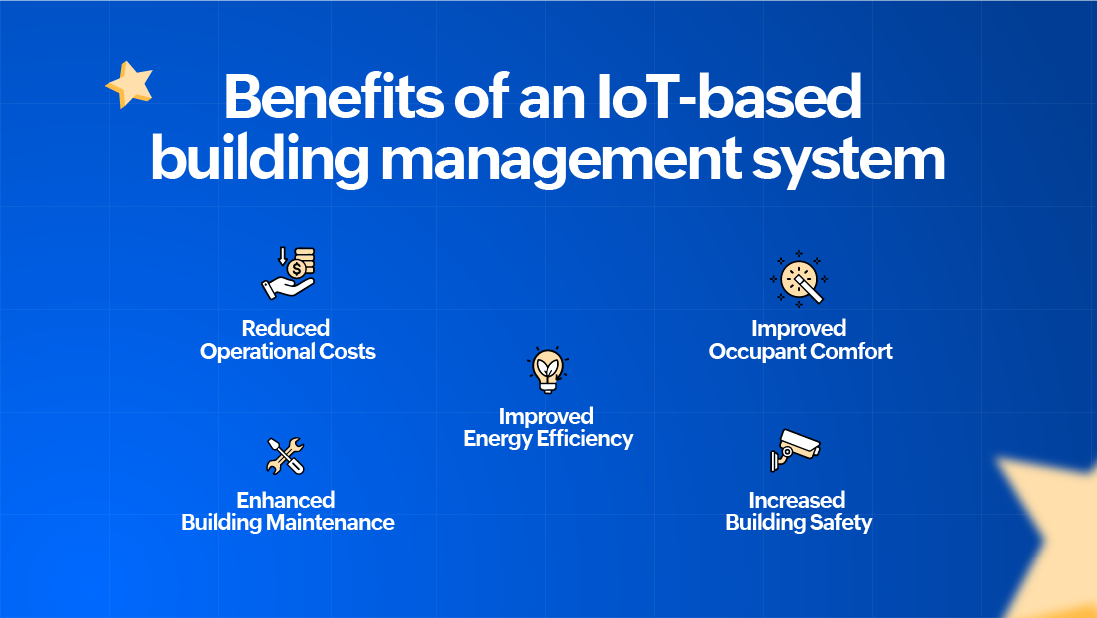
Although an IoT-based BMS allows you to modify and adjust ambient conditions in real time, we often overlook the additional value IoT brings when integrated with a BMS enhancing both sustainability and occupant comfort.
Reduced Operational Costs
Reduce maintenance costs by receiving alerts before major equipment failures occur, enabling preventive maintenance and extending asset lifespan.
Improved Occupant Comfort
Deploying a building facility management system enables automatic regulation of heating, ventilation, lighting, and air quality, keeping the indoor environment healthy and comfortable for occupants.
Improved Energy Efficiency
A building facility management system ensures that building systems such as lighting, heating, and cooling operate only based on occupancy needs, reducing energy consumption and costs. It also allows you to analyze energy usage over time, leading to optimized operations and lower energy bills.
Increased Building Safety
By maintaining appropriate environmental conditions and alerting maintenance teams about potential failures, a building facility management system helps ensure building safety and enhances occupant satisfaction.
Enhanced Building Maintenance
Real-time monitoring of building assets allows maintenance teams to address issues before occupants file complaints, ensuring building systems are well maintained and improving asset longevity.
Is BMS and BAS the same?
Building Automation System | Building Management System |
A Building Automation System (BAS) focuses on controlling specific building functions and is more hardware-centric. It can read conditions within a space and automatically perform actions without manual intervention, such as controlling HVAC, security, and lighting systems. | A Building Management System (BMS) provides facility operators with a centralized view of overall building operations. It delivers real-time data on energy and water usage, equipment faults, assigned work orders, and visual dashboards that support analysis and long-term optimization of building operations. |
Building automation system directs sensors, actuators, and controllers to enable optimized resource usage at the system level. | Building management system guides property and facility managers by offering centralized visibility across multiple building operations. |
Building automation system is typically preferred for small-scale or single-building setups. | Building management system is ideal for commercial buildings spread across multiple locations, enabling seamless remote monitoring and management. |
Zoho IoT for Smarter Buildings
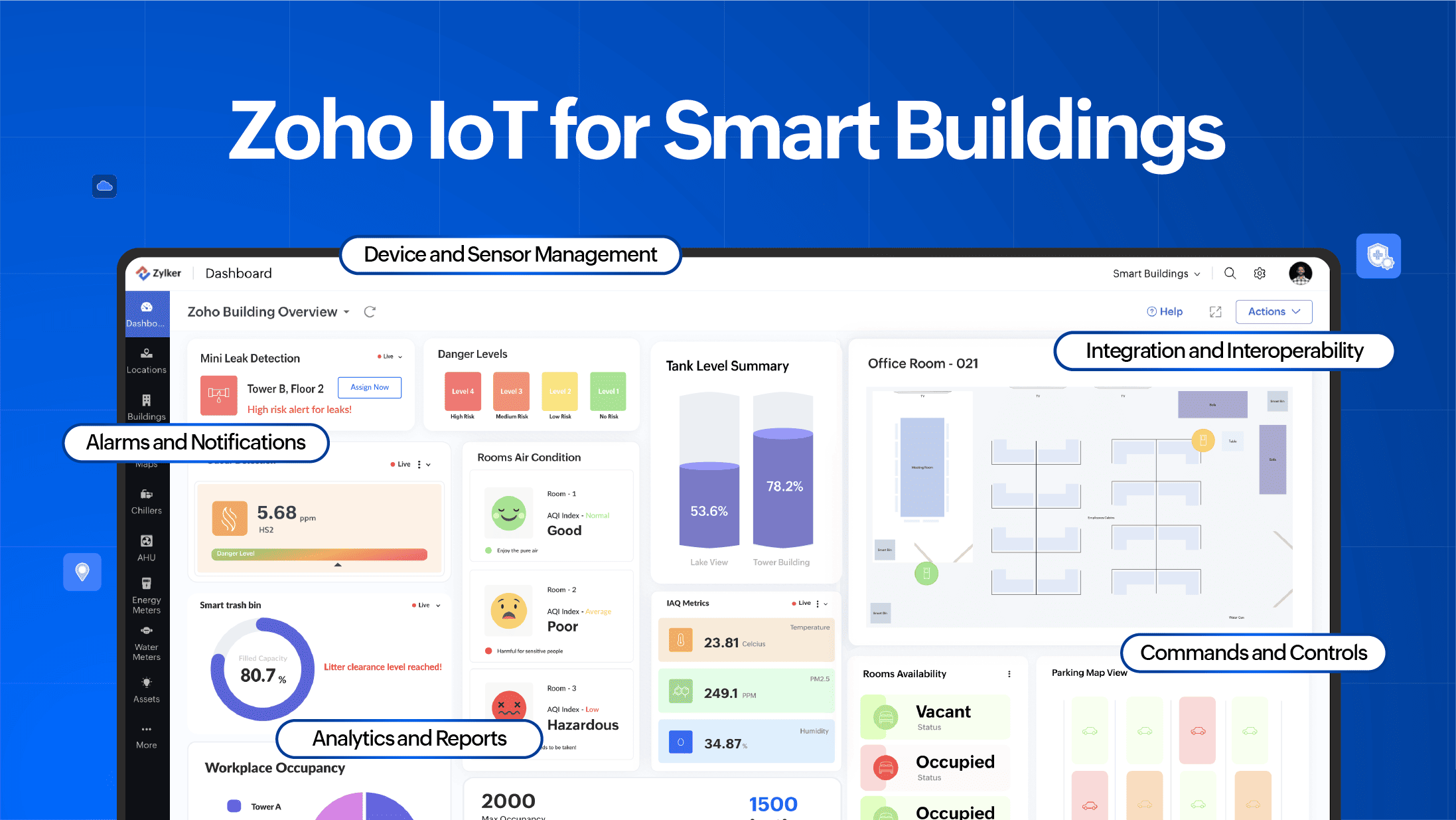
To make managing commercial, residential, or industrial buildings easier, Zoho IoT seamlessly integrates with existing building systems, offering multi-device, protocol, and network compatibility. Even if you’re starting from scratch, we’ve got you covered.
Zoho IoT provides a low-code IoT platform that lets you build solutions based on your buildings requirements, such as:
- Device and Sensor Management - Onboard and monitor sensors, controllers, and meters from a single platform.
- Integration and Interoperability - Integrate with third-party applications, Zoho’s suite of apps like CRM, and protocols such as BACnet, Modbus, and MQTT.
- Commands and Controls - Remotely send commands to building assets to perform specific actions.
- Alarms and Notifications - Configure alerts based on defined conditions and get notified when thresholds are crossed.
- Analytics and Reports - Customize reports and metrics based on building needs to enable data-driven decisions.
Zoho IoT also offers Smart Buildings solutions that enable:
- Energy Management - Monitor energy usage across buildings, track consumption, and reduce energy bills.
- Water Management - Monitor water quality, leaks, and usage per building or unit in real time to reduce wastage.
- Smart HVAC Management - Control humidity, ventilation, and temperature based on occupancy and weather conditions.
- Predictive Maintenance - Detect equipment faults early to prevent breakdowns and extend asset lifespan.
- Asset and Equipment Tracking - Monitor critical assets such as chillers, pumps, generators, and HVAC units in real time.
Before you exit
If you’re still exploring how to get started with iot-based building management systems or would like a quick demo of how this could work for your buildings, schedule a demo or reach out to us at evaluation@zohoiot.com