- HOME
- Digital Health
- The top 7 health tech trends redefining healthcare in 2026
The top 7 health tech trends redefining healthcare in 2026
- Last Updated : December 29, 2025
- 1.9K Views
- 5 Min Read

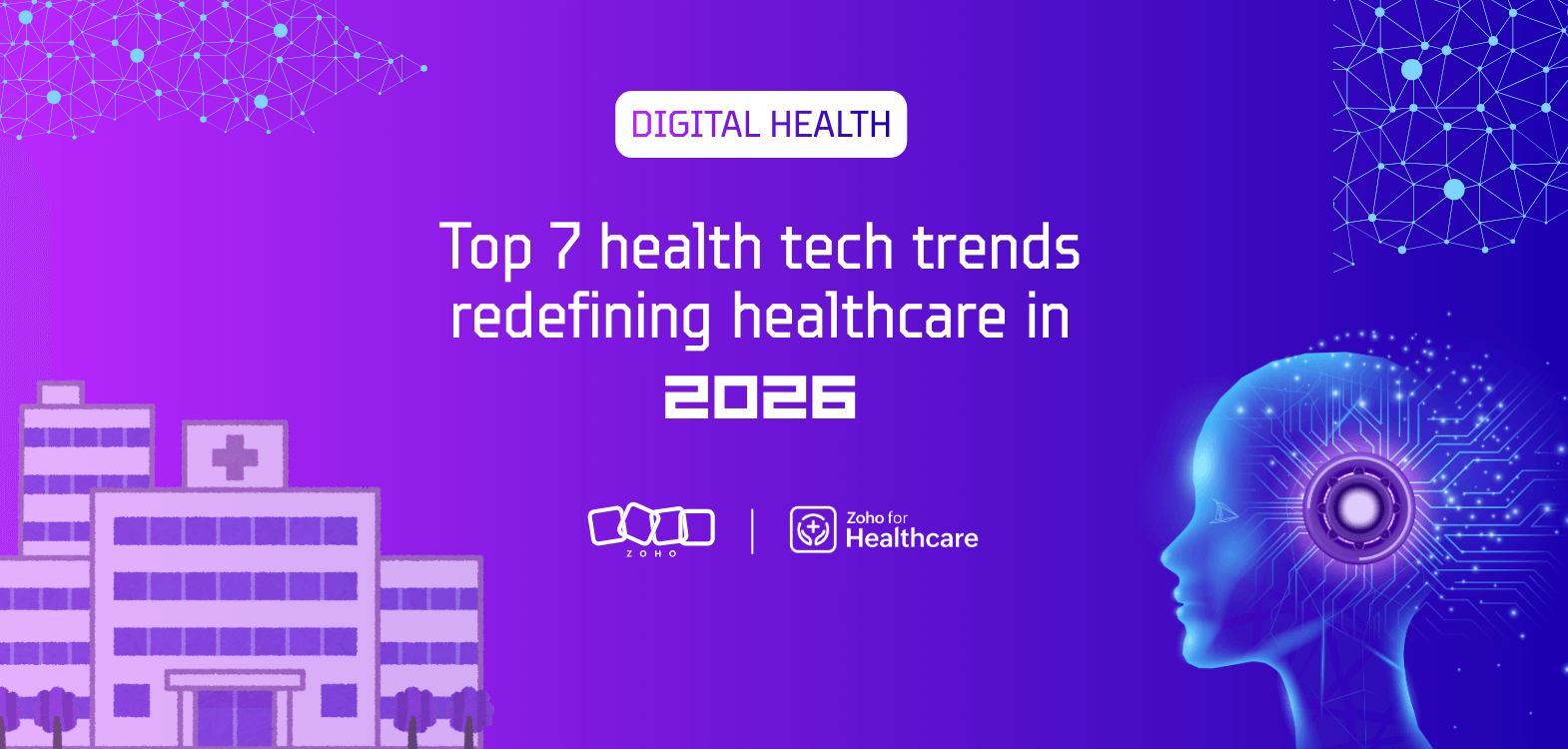
The year 2025 marked a significant turning point for healthcare. Artificial intelligence moved from experimentation to real-world use, virtual care became a necessity, connected devices reshaped remote monitoring, and automation eased the workload of already stretched clinical teams. Technologies that once felt futuristic quickly became part of everyday healthcare operations.
As we move into 2026, this momentum continues, with digital health shifting from innovation to infrastructure. The focus is now on improving operational efficiency, enabling personalized care, and delivering better patient outcomes. Here are some of the key health tech trends for 2026 that are shaping the future of healthcare.
1. The rise of AI—from clinics to laboratories
If there’s one trend that will define healthcare in 2026, it’s the widespread use of artificial intelligence. AI is no longer just a supporting tool; it’s becoming pivotal to how healthcare organizations operate, diagnose, and deliver care.
Medical scribe and clinical documentation automation
AI-powered medical scribe tools help doctors document patient visits more efficiently. These tools listen to doctor–patient conversations and automatically create structured clinical notes in electronic health records. By reducing time spent on paperwork, they help reduce clinician burnout and allow providers to spend more time with patients.
AI for medical diagnosis: Improved accuracy and speed
AI-driven diagnostic models analyze medical images, pathology slides, ECGs, and bio markers to support faster and more accurate diagnoses. By identifying patterns that may be hard to spot manually, these tools help clinicians detect diseases early and make more informed decisions.
AI agents for enhanced care delivery and workflow automation
AI agents automate routine administrative and clinical tasks such as appointment scheduling, patient follow-ups, insurance processing, and initial triage. This reduces manual effort and improves efficiency across healthcare operations.
Beyond administration, AI agents also support the end-to-end patient journey, from symptom assessment to follow-up and ongoing care. They’re also used in laboratories to assist with research and enable patients to monitor and manage their health more effectively.
Generative AI accelerates drug discovery and research
By 2026, generative AI will be driving a major shift in pharmaceutical innovation, significantly accelerating drug discovery and research. Pharma companies are using it to simulate drug effects, generate candidate molecules, and run virtual experiments.
These models also support virtual clinical trials, as well as identify drug repurposing, dosage optimization, and toxicity predictions, reducing discovery timelines and costs. As a result, generative AI is now enabling faster development of therapies, particularly for rare and complex diseases.
Machine learning strengthens prediction models
Machine learning continues to enable predictive analytics across healthcare organizations. These models forecast readmission risks, disease progression, bed occupancy, staffing requirements, and operational trends. By embedding these insights into workflows, healthcare shifts from reactive treatment to proactive and preventive care.
Multi-modal AI for predictive diagnostics
One of the most impactful advancements in healthcare AI is the rise of multimodal AI. It combines multiple data sources, such as medical images, clinical notes, EHR data, and sensor readings to create a complete view of the patient. This holistic approach enables earlier disease detection, better risk assessment, and more personalized treatment decisions.
2. Immersive technologies (AR and VR) transform training and treatment
By 2026, augmented and virtual reality will move beyond experimentation and become practical tools in healthcare. These technologies support clinical training, surgical planning, therapy, and patient education.
Key applications:
- Surgical simulations and pre-operative planning.
- AR-assisted procedures and navigation during surgery.
- VR-based medical education and skill training.
- Pain management and physical rehabilitation.
- Mental health therapies for PTSD, anxiety, and phobias.
- Patient education and consent visualization.
For hospitals dealing with workforce shortages, immersive technology is a scalable way to train staff safely and efficiently, reduce training costs, and improve clinical precision .
3. IoMT and connected health ecosystems expand rapidly
The Internet of Medical Things (IoMT) refers to connected medical devices that collect and share health data in real time. By 2026, IoMT will become a foundation for modern healthcare operations, enabling better coordination and faster decision-making. This shift supports data-driven decision-making and more coordinated care delivery.
Key applications:
- Connected diagnostic and monitoring devices.
- Smart hospital equipment and asset tracking.
- Wearables and implantable medical devices.
- Smart medication dispensers.
- Real-time clinical alerts and analytics.
- Integration with EHRs and care platforms.
IoMT improves visibility across clinical and operational workflows, helping providers deliver coordinated care while giving leaders real-time insights into efficiency and outcomes.
4. Home care and remote patient monitoring (RPM) becomes core to chronic care
With chronic diseases on the rise, healthcare is shifting from hospital-centered care to continuous, home-based care. Remote patient monitoring (RPM) is becoming essential for managing chronic conditions, post-surgical recovery, and elderly care.
Key applications:
- Monitoring vitals such as blood pressure, glucose, and oxygen levels.
- Chronic disease management for diabetes and heart conditions.
- Post-discharge and post-surgical monitoring.
- Elderly and home-based care programs.
These applications reduce hospital readmission, lower patient inflows, improve long-term outcomes, while also expanding access to care in rural regions.
5. Robotics redefine surgical and operational efficiency
Robotics is reshaping healthcare by enhancing precision in physical care delivery. By 2026, robotic systems will be widely used across surgical, clinical, and support settings to improve safety and consistency.
Key applications:
- Robot-assisted and minimally invasive surgeries.
- Surgical navigation and precision support.
- Hospital logistics and supply movement.
- Sterilization and infection control.
- Rehabilitation and elderly assistance robots.
Robotics improves surgical outcomes, shortens recovery times, and supports workforce efficiency, especially in high-demand hospital environments. For healthcare leaders, investments in robotics deliver long-term value by improving clinical outcomes, optimizing physical workflows, and addressing workforce shortages.
6. Digital Therapeutics (DTx) and mHealth for chronic treatments
Digital Therapeutics are clinically validated software-based treatments. Combined with mobile health apps, they support continuous, personalized care outside clinical settings. Doctors often use these treatments together with traditional ones, particularly for chronic and lifestyle-related conditions.
Key applications:
- Diabetes, hypertension, and cardiac care.
- Mental health and behavioral therapy.
- Musculoskeletal and rehabilitation support.
- Medication adherence and lifestyle coaching.
- AI-driven personalized care plans.
DTx and mHealth improve patient engagement, adherence, and long-term outcomes while reducing the need for frequent in-person visits. 2026 will see a shift toward continuous, behavior-based, real-time interventions, empowering patients to manage their health using these solutions.
7. 3D printing and bioprinting unlock new possibilities
3D printing creates medical objects layer by layer using digital designs, while bioprinting uses biological materials such as cells. Together, these technologies enable personalized and regenerative healthcare solutions.
Key applications:
- Patient-specific implants and prosthetics.
- Custom surgical tools and guides.
- Anatomical models for surgical planning.
- Dental and orthopedic applications.
- Bioprinted tissues and regenerative research.
These technologies reduce production time, lower costs, and improve clinical precision, while opening innovation and revenue opportunities for healthcare organizations.
Final thoughts
Healthcare in 2026 will be defined by AI embedded across workflows, connected and intelligent care systems, and patient care that extends beyond hospital walls. These trends signal a clear shift from reactive, episodic care to predictive, continuous, and personalized healthcare delivery.
Additionally, as healthcare becomes more digital and interconnected, cybersecurity will gain even greater importance in 2026, playing a critical role in protecting patient trust, ensuring care continuity, and supporting long-term digital maturity.
For healthcare providers and decision-makers, adopting these technologies is no longer optional. Organizations that adopt early will be better positioned to deliver safer, faster, more affordable, and more patient-centric care, while building a system that’s ready for the future.