- HOME
- Expense Management
- What is corporate expense management? Process, policy, and controls explained
What is corporate expense management? Process, policy, and controls explained
Corporate expense management is the process a company uses to control how employee-initiated business expenses are incurred, reported, approved, audited, and reimbursed. It rests on three elements: an expense policy that defines what employees can spend, a workflow that verifies every claim, and financial controls that keep spending compliant and within budget.
For most companies, employee travel and entertainment (T&E) is the second-largest controllable cost after payroll—and it is growing. The Global Business Travel Association (GBTA) projected global business travel spending to surpass $2 trillion by 2029. At that scale, how a corporation manages expenses is no longer an administrative detail; it is a core finance function.
What does corporate expense management cover?
Corporate expense management covers every expense an employee incurs on the company's behalf: travel bookings, meals and client entertainment, mileage and per diems, corporate card transactions, petty cash across branch offices, and billable expenses passed on to clients.
It also spans more stakeholders than any other finance workflow. Employees capture and submit expenses, managers approve them, the accounts payable team verifies and reimburses them, controllers audit them, and the CFO answers for the total. What makes expense management corporate is this scale: multiple entities, currencies, departments, and policies operating under one governance framework, where informal tracking through spreadsheets and email breaks down.
How does the corporate expense management process work?
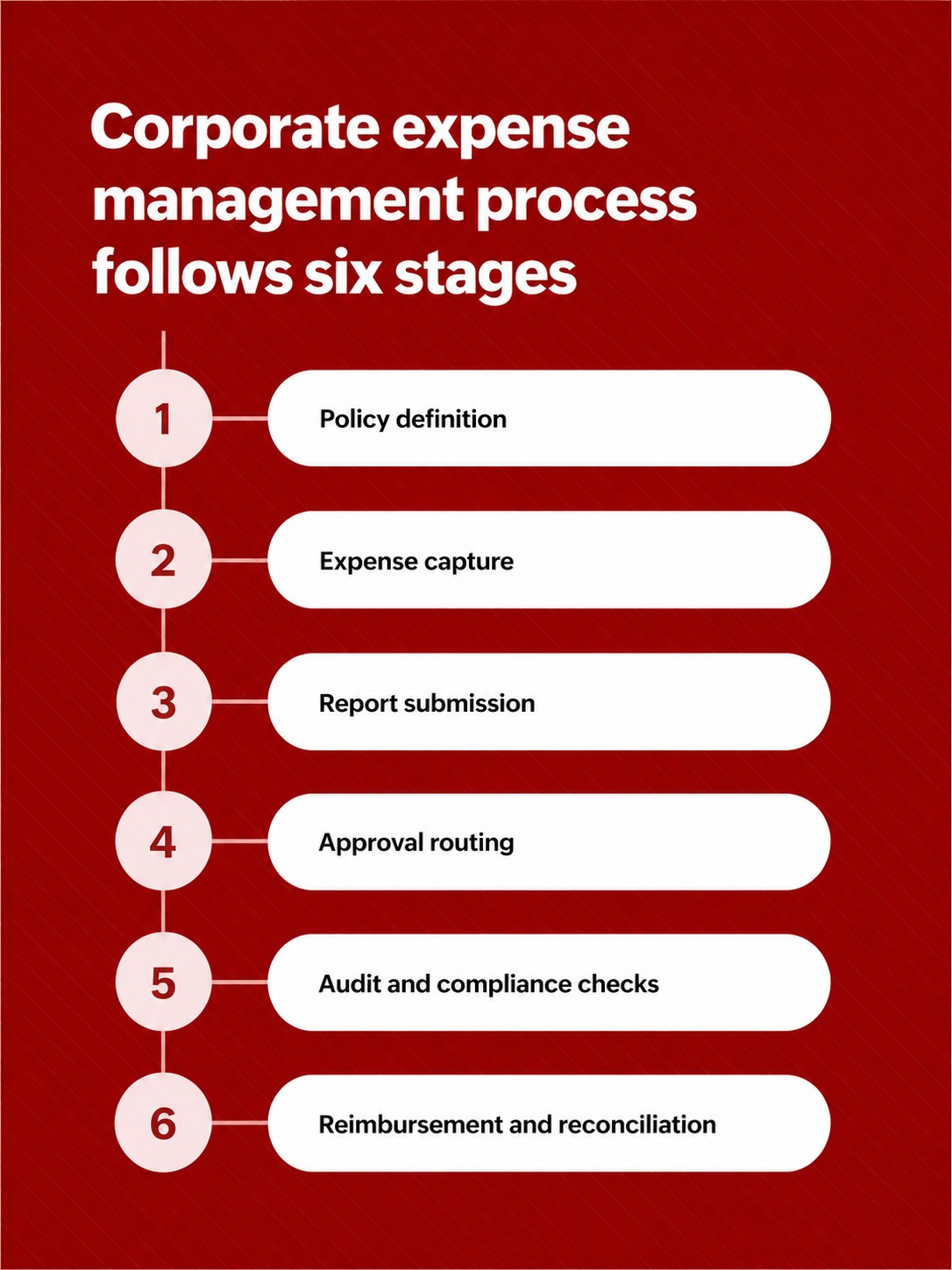
The corporate expense management process follows six stages.
- Policy definition: Finance sets spending limits by category, role, and department, along with per diem rates, documentation requirements, and submission deadlines.
- Expense capture: Employees record spending as it happens—scanning receipts, logging mileage, or letting corporate card feeds create expenses automatically.
- Report submission: Expenses are grouped into expense reports and submitted for review on a schedule or per trip.
- Approval routing: Reports move through an approval hierarchy based on amount, department, project, or location.
- Audit and compliance checks: Claims are checked against policy for violations like duplicate receipts, over-limit spending, blocked merchants, or missing documentation.
- Reimbursement and reconciliation: Approved expenses are reimbursed through payroll or direct deposit, then synced with the accounting or ERP system so books close on accurate numbers.
In most corporations, these six stages run on dedicated expense management software that automates capture, approval, and audit rather than relying on manual review.
Corporate expense management vs. T&E vs. Spend management
These three terms overlap but are not interchangeable.
Term | Scope | Typical owner |
Corporate expense management | All employee-initiated expenses like travel, cards, petty cash, and reimbursements | Controller/AP team |
T&E management | The travel and entertainment subset that includes flights, hotels, meals, and mileage | Travel manager/Finance |
Spend management | All company spending, including procurement, vendor payments, and subscriptions | CFO/Procurement |
Corporate expense management sits between the two: broader than T&E, narrower than spend management. A company can run excellent T&E management and still leak money through unmanaged petty cash or card spending.
Why does corporate expense management matter?
It matters because manual expense processing is expensive, error-prone, and a proven fraud channel.
GBTA research puts the average cost of processing a single expense report at $58 and 20 minutes of labor. Nearly one in five (19%) contains errors, and correcting each one costs another $52 and 18 minutes. For a corporation processing thousands of reports a month, errors alone would consume a full-time team.
The fraud exposure is larger. The Association of Certified Fraud Examiner's (ACFE) Occupational Fraud 2026: A Report to the Nations found asset misappropriation—the category that includes falsified expense reports and fictitious expense claims—in 90% of occupational fraud cases, with occupational fraud overall causing a median loss of $104,000 per case. Detection speed determines the damage:
Fraud caught within 6 months had a median loss of $40,000, while schemes that ran undetected for more than 5 years cost a median of over $1.1 million.
Beyond cost and fraud, expense data feeds budgeting, forecasting, tax deductions, and regulatory compliance. A corporation that cannot see its expenses in real time is planning with stale numbers.
What should a corporate expense policy include?
A corporate expense policy is the rule book the entire process enforces. An effective one defines eligible expense categories and their limits, per diem rates by location, receipt and documentation requirements, submission deadlines, the approval hierarchy, corporate card usage rules, and a clear list of non-reimbursable expenses.
The test of a policy is not how thorough the document is, but whether it is enforced at the moment of spending. A policy that is only checked during quarterly audits catches violations months after the money is gone; a policy configured into the expense workflow blocks them upfront.
How do corporations modernize expense management?
Companies that move off manual processing typically make five changes:
- They automate receipt capture and expense creation with optical character recognition (OCR) and AI.
- They connect corporate card feeds so transactions reconcile themselves.
- They configure policy rules that flag or block out-of-policy claims in real time.
- They integrate expenses with their ERP and accounting systems.
- They track performance through metrics such as cost per report, reimbursement cycle time, and out-of-policy spend rate.
The GBTA and ACFE numbers above explain why: Automation attacks the three biggest costs—processing labor, error correction, and undetected fraud—simultaneously. For a detailed breakdown of what this software does and how to evaluate it, see our guide to expense management software features and benefits.

Frequently asked questions
What is the difference between expense management and expense reporting?
Expense reporting is one stage of expense management: the documentation and submission of expenses. Expense management is the full cycle including policy, capture, reporting, approval, audit, reimbursement, and reconciliation.
Who owns expense management in a corporation?
The controller or accounts payable team typically runs the process day to day, department managers approve claims, and the CFO owns the policy and total spend. In larger enterprises, travel managers own the T&E subset.
What is corporate expense management software?
This is an application that automates the expense cycle including receipt scanning, card reconciliation, approval routing, policy enforcement, and accounting sync. See our full guide to expense management software.
Ready to bring your corporate expenses under control? Try Zoho Expense free for 14 days.