From missed calls to booked jobs: A smarter way to run a trade business
- Last Updated : March 31, 2026
- 243 Views
- 3 Min Read
It’s 10:17 a.m. You’re halfway through a job and already running behind—not because the work is hard, but because the day keeps interrupting itself. Your phone buzzes again. And again. You can’t answer. You’re on the tools. The customer on-site needs you. The next job is waiting. The supplier is chasing a decision. And somewhere in the middle of all that, three missed calls just turned into three lost opportunities—because, in trades, people don’t usually wait. They keep ringing until someone picks up.
This is the reality for many trade and field service businesses. The work is there. The demand is there. But the admin, the follow-ups, the scheduling changes, the quoting, the timesheets, and the invoicing can feel like a second job, often done late at night when you should be switching off.
That’s where Zoho CRM makes a difference. Not because it’s “software,” but because it helps your business run like a workflow instead of a scramble. When you choose to add it, practical AI can take a few pressure points off your plate, too, especially when you’re on the tools and can’t answer the phone.
What changes when enquiries are captured properly
Let’s go back to those missed calls at 10:17 a.m.
In a disconnected setup, they become:
“I’ll call them back later.”
Later becomes 4:45 p.m.
The customer has already booked someone else.
With the right workflow, the missed call doesn’t disappear into the void. It becomes a captured enquiry with a clear next step—even if you personally can’t handle it right then.
This is also where people ask about AI.
So what does “AI” actually mean here?
For a long time, AI in small business mainly meant a chatbot on a website.
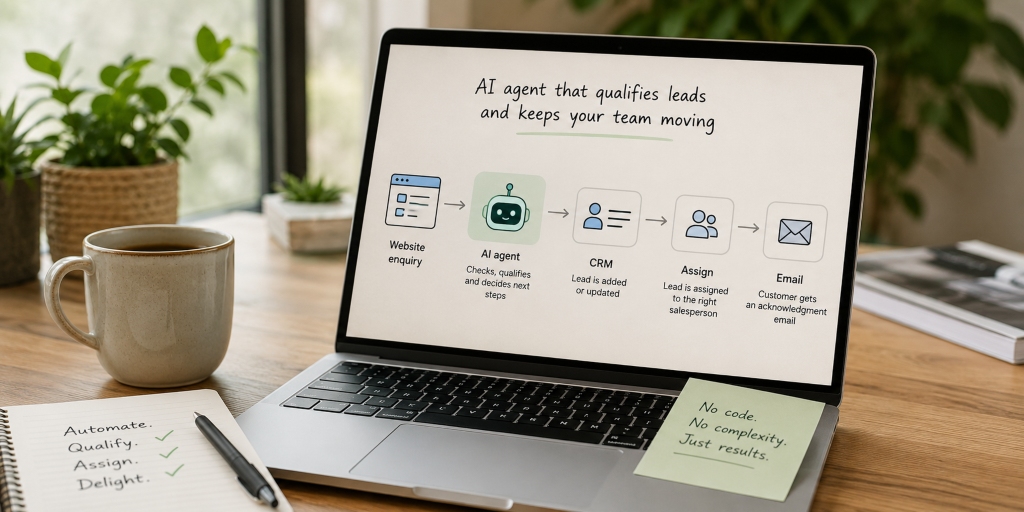
Now we’re seeing more practical use cases: AI agents that take on small roles inside the team. This can include:
An inbound voice agent that answers when you’re busy and captures job details.
An outbound voice agent that follows up on missed calls or confirms bookings.
A sales assistant that reads and drafts replies to common email enquiries.
For trades (especially plumbers and urgent services), this matters because customers often keep calling until they find someone who answers. The win isn’t “AI answered the phone.” The win is: the job doesn’t get lost, and the customer gets a fast response without you stopping the work.
Quoting becomes easier when it’s not rebuilt from scratch every time
Quoting is another place where trade businesses lose time quietly. Not because quoting is hard, but because it’s often inconsistent:
Different templates
Different wording
Scope details missing
Follow-up handled differently depending on who sent it
That inconsistency leads to slow approvals and awkward disputes later.
When quoting is connected to the CRM and job workflow:
Customer and site details are already there.
The quote follows a consistent structure.
Once approved, it turns into a job without retyping everything.
Follow-up becomes part of the process, not a “hope I remember” task.
If you choose to use AI support here, it’s usually simple and helpful:
Drafting a friendly follow-up email.
Prompting you when a quote has gone cold.
Preparing a quick summary so you can respond faster.
Scheduling stops being a daily reshuffle
In trades, scheduling is never “set it and forget it.” Jobs run over. Emergencies appear. Weather changes plans. Staff availability shifts. The chaos happens when your schedule and your job details aren’t connected. That’s when you get:
Double handling
Confusion about what’s been confirmed
Customers calling to ask “are you still coming?”
Teams turning up without context
With a connected workflow, scheduling becomes easier because:
Job details, notes, site address, and history sit together.
Job stages make it clear what’s booked, confirmed, in progress, or complete.
Changes can trigger consistent customer updates (and reduce inbound “checking in” calls).
Conclusion
Trade businesses don’t lose time because they’re disorganised. They lose time because the day is relentless, and disconnected systems make it harder than it needs to be.
That’s why it’s necessary to have good software that brings your key workflows into one connected place, from enquiry to invoice, so you can stay responsive, keep jobs moving, and stop rebuilding the story of each job at the end of the day.
If you want a more personalised approach, implementation partners with experience in your industry can help tailor the system to your workflows and walk you through how it works day to day. From there, you can decide which setup or approach works best for your business.
This is a guest post by Kim Mclachlan, the Founder and Director of Dynamic Digital Solutions, a Zoho Partner based on the Sunshine Coast, Australia. The team helps SMEs streamline operations by implementing connected Zoho systems and ready-to-go vertical solutions including CrewDone (trades & field services), Serv-U (professional services), and Talent Onboard (recruitment & HR)—reducing admin, improving visibility, and supporting sustainable growth.
 Kim Mclachlan
Director, Dynamic Digital Solutions