

- HOME
- Ecommerce insights
- MCP is the next phase of AI in ecommerce
MCP is the next phase of AI in ecommerce
The next step for AI in ecommerce
For a while now, AI has been doing the obvious things in ecommerce. It recommends products. It answers customer questions. It helps write descriptions. It predicts what might sell better.
These are useful, but they still leave the store owner with most of the work.
Because knowing what is wrong is only half the job. If a product is not selling, someone still has to check the inventory, look at the product page, update the description, adjust the price, create a coupon, run a campaign, and then come back later to see if any of it worked.
That is where the conversation around AI is beginning to change.
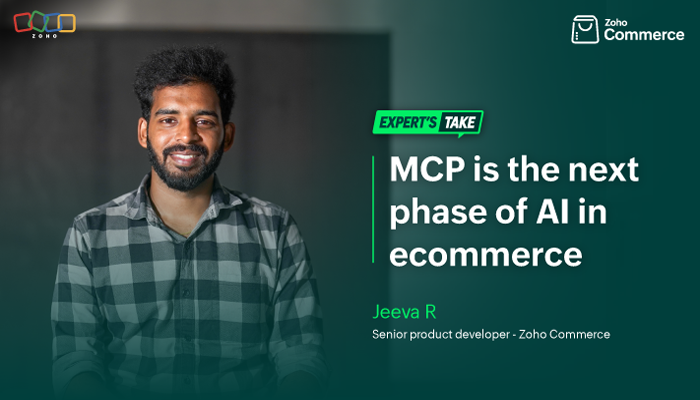
In this edition of Expert’s Take, we spoke with Jeeva R., Senior Product Developer, about how AI is moving beyond suggestions and conversations. As Jeeva explains, modern AI systems are now expected to understand requests, reason through what needs to be done, plan the steps, and execute workflows.
For ecommerce businesses, that could make a real difference, because most of the work inside an online store is connected.
Why ecommerce needs more than answers
On the surface, ecommerce looks simple. You list a product, the customer places an order, and the item gets delivered.
But store owners know how much sits behind that. Inventory affects promotions. Promotions affect pricing. Pricing affects sales. Product content affects discovery. Sales data affects future decisions.
So when something goes wrong, the answer is rarely sitting in one place.
Take a product that has been sitting in inventory for too long. The store owner may notice it in a report, but the report does not solve the problem. The product title may need work. The SEO details may be missing. The price may not be right. The product may need to be part of a weekend offer. After that, the store owner still has to track whether the change helped.
This is the tiring part of ecommerce. The data is there, but the action is scattered.
This is where MCP, or Model Context Protocol, becomes important.
How MCP empowers ecommerce
MCP gives intelligent systems a standard way to work with ecommerce softwares like Zoho Commerce and their capabilities across areas like inventory, catalogs, pricing, promotions, orders, and analytics.
Put simply, it helps AI understand what it can do inside the commerce system, and how to do it securely. So instead of AI only telling a store owner what could be improved, it can help carry out the steps across the right places.
Jeeva points out that MCP enables intelligent agents to coordinate across commerce capabilities without users manually switching between different modules and dashboards.
That may sound like a technical change, but the impact is very practical.
A store owner should not have to jump between five screens to solve one business problem. If the goal is to move excess inventory, the system should be able to connect the related tasks: find the products, improve the listing, create the offer, update the catalog, and track the result.
What this could look like for a store owner
Imagine a store owner asking, “Which products need attention this week?”
An AI agent using MCP could look at inventory, sales movement, product performance, and campaign history. It could identify slow-moving products, improve SEO metadata for those listings, suggest promotional pricing, create discount coupons, and schedule a campaign.
The store owner is not asking for SEO, coupons, and reports as separate tasks. They are trying to solve a business problem.
That is the important difference.
The same applies when new products are added. Instead of manually writing titles, descriptions, meta tags, and keywords for every item, the store owner could ask AI to optimize SEO metadata for newly added products. The system can use the product information already available and create a stronger starting point.
Or take reporting. A request like, “Show me revenue trends, low-performing categories, and products that need attention,” should not leave the user with only a chart. It should help them understand where to look next and what action may be needed.
This is where AI starts becoming more useful in day-to-day commerce work.
Less time moving between screens
The bigger point here is not that AI can create a coupon faster or write better metadata. Those are helpful, but they are small parts of the larger change.
The real value is in reducing the distance between a business question and the action that follows.
Store owners do not think, “I need to open the catalog module, then the promotions module, then the analytics dashboard.” They think, “How do I sell this stock faster?” or “Which products need work before the weekend campaign?”
MCP helps AI respond to those goals with context. It gives the agent a way to work across the commerce setup instead of treating each task like a separate request.
That makes the experience feel less like using a tool and more like working with someone who understands the store.
AI is becoming part of the workflow
So, what does this mean for ecommerce businesses?
It means AI can do more than just answer questions. It can understand your business situation and help move your work forward.
For store owners, this could change how they manage catalogs, inventory, promotions, pricing, campaigns, and reports. The goal is not to remove human decision-making, but to reduce the repetitive effort that sits between decision and execution.
That is why MCP matters.
It gives AI the context and structure needed to work inside ecommerce operations, not just around them.
Because the next phase of AI in ecommerce will be about giving it a business goal and getting real work done.
