

- HOME
- Taxes & compliance
- Year-end accounting checklist for Kenya
Year-end accounting checklist for Kenya
Significance of financial reporting
Whether in Kenya or any other country, year-end accounting procedures require significant effort from businesses. This is due to the nature of the process; there are a lot of things to sort out in a short time. The accuracy of financial statements cannot be compromised, as they reflect the actual financial health of the business to the stakeholders. Shareholders and the government use these statements to make investment decisions and collect taxes, respectively. In simple terms, these statements determine the capital flow, which is the fuel for economic growth.
In order to maintain the integrity of the financial reporting, there are several compliance requirements businesses in Kenya need to adhere to on a daily basis. Year-end accounting is a set of procedures carried out to ensure business accounts are balanced, reflecting their commitment to regulations throughout the year. This results in enhanced reliability and stakeholder confidence.
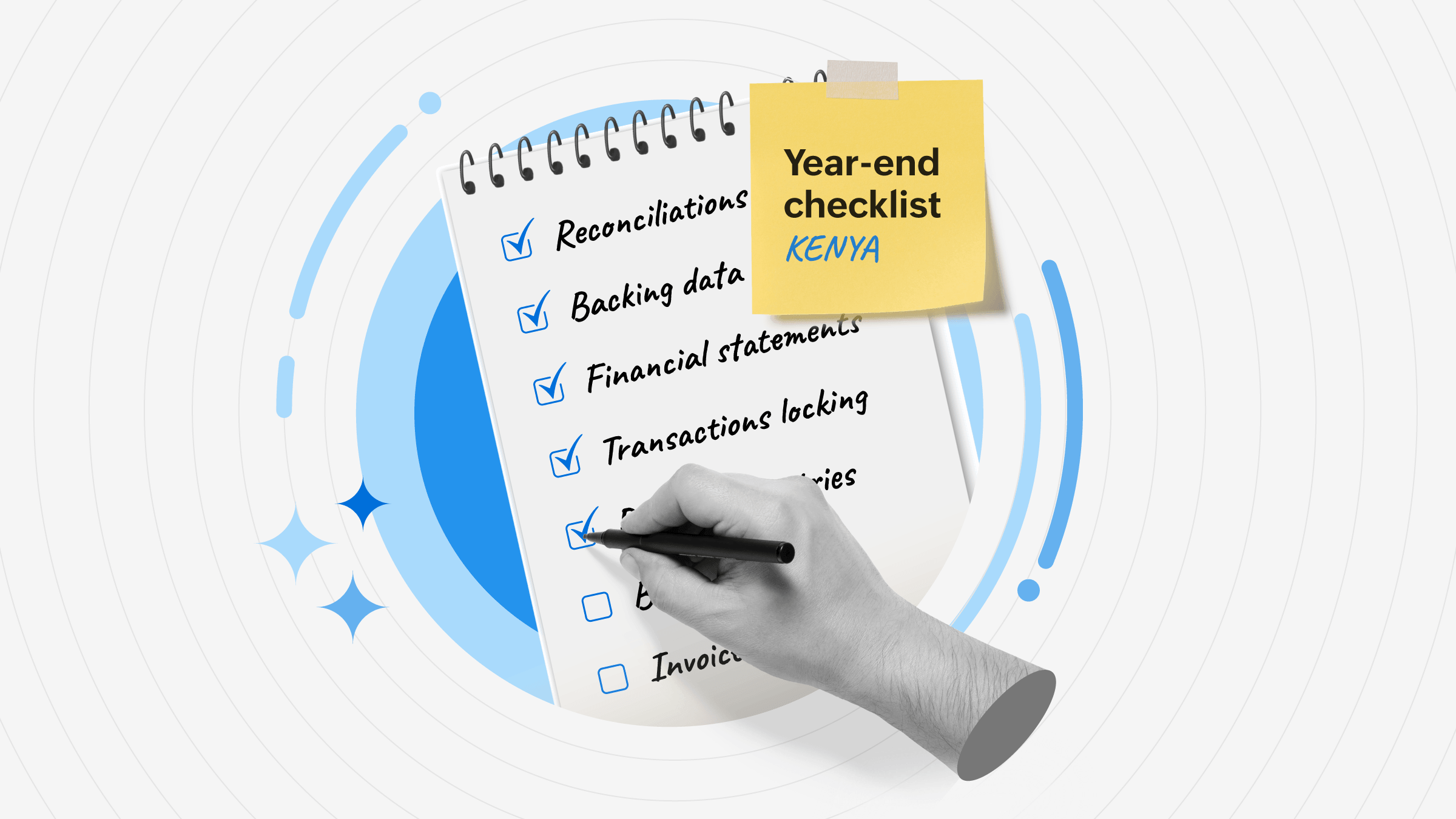
To put it simply, year-end accounting tasks will ensure everything aligns with what your business worked for all year. So, it is recommended to have a checklist of all your tasks before performing the year-end accounting so you can approach the process with clarity and ensure no steps are missed.
The checklist
◻ Checking transactions
As you carry out numerous business transactions all year long, there is a high chance that you'll fail to record some of the completed transactions in your accounting books. You might have either saved them as draft transactions or failed to create them. So, it is vital to check all draft transactions, bills, invoices, and other documents to ensure all transactions relevant to a particular financial year are recorded correctly in the journal.
◻ Handling overdue receivables and payables
It is vital to follow up on customers who have pending payments against invoices issued by your business. Reaching out to those customers and sorting out overdue payments will help your business close the books and avoid confusion while balancing accounts. It is also better to ensure that all overdue payments pending to vendors are settled while approaching the year-end, as it will help you close the books more easily.
◻ Writing off bad debts
One of the crucial steps in year-end accounting is identifying receivables that cannot be recovered from your customer. After classifying such debts as unrecoverable, appropriate adjustments have to be made in the relevant accounts. For example, every business has to set aside some money from their profit as a provision to manage bad debts. That money will be placed under a particular account. During the year-end, all debts acknowledged as "bad debt" will be written off by deducting the calculated amount from that particular account to make up for the loss incurred by the unrecoverable receivables.
◻ Bank reconciliation
Bank reconciliation is performed to ensure that transaction records in your accounting books match the bank statements and M-PESA transactions. This step is performed to identify any errors in the books or fraudulent activity that happened in your bank account. Instead of performing bank reconciliation at the year-end, it is better to carry out the process on a monthly basis to simplify reconciliation at the end of the fiscal year. Businesses can leverage accounting software with a bank reconciliation feature to save time.
◻ Inventory revaluation and adjustments
Every year, it is important to re-evaluate your stock and update it in your accounting books. The value of inventory you hold can change from time to time; this makes inventory revaluation crucial so that books reflect the accurate value of your stocks. Also, any mismatch in the quantity of inventory can be identified by comparing the inventory summary report with physical stock. Any changes in value or quantity should be reported in your books as adjustment entries.
◻ Managing foreign transactions
Businesses operating in Kenya are mandated to report their financial statements in Kenyan shillings. But some businesses in Kenya might be taking part in cross-border transactions dealing with currencies other than the Kenyan shilling. This makes accounting for these transactions difficult, as the exchange rate between a domestic currency and a foreign currency will fluctuate daily.
For example, if your business invoiced a foreign client in the US on Monday and that transaction was recorded in your books in Kenyan shillings based on the exchange rate on Monday, but your client made the actual payment in US dollars on Friday, the exchange rate on the payment date may differ from the exchange rate used when the invoice was recorded. This will result in either a loss or gain for your business. This is known as exchange rate loss or gain, and it has to be recorded appropriately so your accounting books are balanced. It is best to choose an accounting software that applies foreign exchange rates automatically to manage global transactions effectively.
◻ Transaction locking and financial statements
Locking transactions will prevent users from making any changes once the accounts are adjusted and balanced. This will enable your business to prepare financial statements that are consistent with your business records, avoiding unnecessary anomalies.
In Kenya, businesses are required to file several financial statements as per the regulation. Below are the three main financial statements that businesses need to prepare:
Balance sheet
Profit and loss statement
Cash-flow statement
Where applicable, audited financial statements may be required before submission to the relevant authorities. Choose an accounting solution with transaction locking and automated report-generation features, as it can simplify financial reporting.
◻ Tax filing
As per the Kenyan Revenue Authority, businesses are required to file three main tax returns:
Corporate income tax: Filed within six months from the end of the financial year.
VAT return: Filed every month.
Withholding tax return: Filed every month.
Before filing a tax return, performing reconciliation will help identify any errors in the return.
◻ Profit sharing
Once the profit is computed for the financial year, a part of it will be shared among shareholders. This can be done by creating a new account to which funds are transferred and later shared among shareholders. The rest of the profit will be transferred to a retained earnings account for future business use. It is better for a business to use an accounting system with a manual journaling option that can be used to create accounts and transfer funds with flexibility.
◻ Preparing for the new financial year
Below are a few things your business needs to consider before beginning accounting for the new financial year:
Update the transaction series number for the new fiscal year with a different prefix. It will make it easy to trace the transactions relevant to the new year.
Update the prices of the items that your business is dealing with in the new year.
Mark customers and vendors as inactive if you are not doing business with them anymore. Also, add the details of new customers and vendors with whom you plan to work in the new fiscal year.
Review and update the terms and conditions and ensure they are correctly reflected in invoices, quotations, and other business documents for the new financial year.
This checklist can help you perform your year-end tasks with proper insights and confidence. You can further streamline year-end accounting by using accounting software that can help you execute the outlined tasks effortlessly.
Check out the features of Zoho Books, a cloud accounting software that is trusted by businesses not just in Kenya but across the globe. We also offer a free trial for your business so you can experience the benefits of this powerful tool first-hand.
Explore Zoho Books with a click: https://www.zoho.com/ke/books