

- HOME
- CPQ (Configure, Price, Quote)
- CPQ in billing: How enterprises close the gap between quote and invoice
CPQ in billing: How enterprises close the gap between quote and invoice
When the quote and invoice tell different stories
A quote is a preliminary proposal that captures everything agreed upon before billing begins. An invoice is the document that demands final payment for services rendered or products delivered.
The reasons they disagree are usually straightforward.
- Scope creep: Clients introduce changes or additional requests mid-project.
- Cost fluctuations: Raw material or resource costs shift because of market conditions, changing what was originally quoted.
- Hidden fees and additional charges: Labor and logistics costs vary over a project's duration.
For enterprises, managing this gap is one of the most persistent and expensive problems in the revenue cycle. CPQ (Configure, Price, Quote) closes it by ensuring that everything promised by sales is delivered by billing.
The enterprise gap: A common edge-case
Enterprise deals are rarely straightforward. A single contract might include multiple product lines configured differently per business unit, custom discount tiers negotiated during the sales cycle, usage-based components layered on top of a flat subscription fee, and mid-contract amendments, add-ons, or seat expansions.
The gap arises because CRM systems are built for flexibility, while billing systems are designed to operate under rigid rules and fixed structures. When deal complexity isn't formally translated into billing logic through CPQ, it becomes a source of friction. Sales works from one version of the deal; billing works from another. The invoice becomes a point of contention rather than a confirmation.
The real cost of quote-to-invoice misalignment
The consequences aren't confined to the billing department. For enterprises, the gap triggers a domino effect across finance, operations, and strategy.
Financially
- Spiked DSO: Disputed or incorrect invoices stall the collections process. When finance teams spend time clarifying ambiguities in invoices instead of on payments, Days Sales Outstanding (or average collection period) climbs, and cash flow suffers. This is perhaps one of the most critical indicators of financial health.
- Revenue leakage: Customers who receive invoices that don't match agreed terms, short-pay—settling only a portion of what is owed. The gap between what was quoted and what gets collected compounds over time.
- Write-offs: Unresolved disputes eventually become bad debt. When customers refuse payment on invoices they consider inaccurate, the receivable gets written off. This is not delayed payment, but a permanent revenue loss.
Operationally
- Labor drain: Manual reconciliation between quotes and invoices means sales, finance, and ops are all working to resolve the exact problem. This leads to duplicated efforts and drives up operational costs.
- Audit and compliance risk: Frequent mismatches create paper trails. When quotes and invoices don't align, revenue recognition becomes harder to defend under scrutiny.
The strategic consequences compound this further. Businesses running broken Q2C processes can't move fast enough to grow accounts. Billing friction at renewal is often the last experience a customer has before churning.
From quote to cash: Understanding where CPQ fits in the process
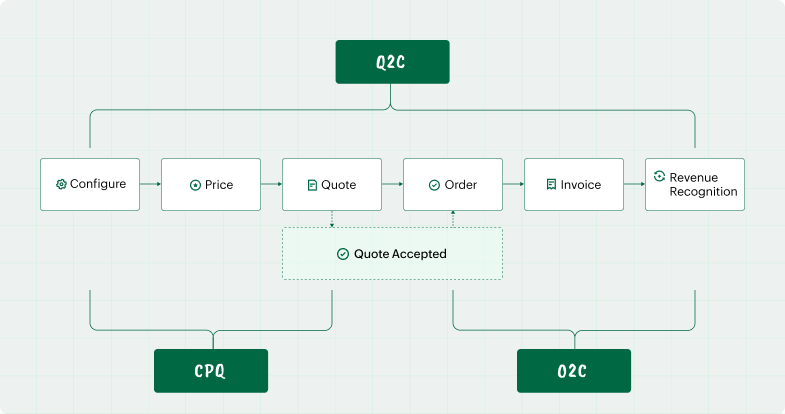
Order-to-Cash (O2C) covers everything from order creation through to invoicing and collections. It begins after a deal is closed. Quote-to-Cash (Q2C) starts earlier—at the moment a sales representative begins configuring a deal. Q2C defines what has to happen for the deal to close in the first place: pricing, approvals, contracting, invoicing, and collections.
Q2C and O2C are frequently used interchangeably, but they are distinct processes. Q2C is the overarching process that leads into O2C.
For enterprises or any business with complex pricing and negotiated contracts, the starting point matters most. Configured prices, discount structures, and custom terms have to travel intact all the way from the first conversation to the final invoice. CPQ sits at the front of the Q2C process; it's the mechanism that makes that possible.
What is CPQ and why does it matter beyond sales?
CPQ is a system that helps sales teams build accurate, rule-governed quotes for complex products or services. covering custom bundles, volume discounts, contractual pricing tiers, and approval workflows.
Each word maps to a distinct function:
Configure handles product and service complexity like bundles, add-ons, and compatibility rules.
Price applies the right commercial logic including volume tiers, negotiated discounts, and contractual uplifts.
Quote assembles everything into a formal, approvable document.
For sales, CPQ ends at a signed quote. For billing teams, that's where the dependency begins. Every pricing rule, custom term, and mid-cycle amendment agreed on during the sales process has to appear in the final invoice accurately, and without manual re-entry.
When properly integrated into billing, CPQ becomes the source of truth that makes this possible.
Why CPQ is really about buyer confidence
Before a buyer signs, the quote is the only evidence they have that your pricing is structured, your terms are clear, and the invoice they'll eventually receive will match what was agreed to. If the quote looks like it was manually built from the ground up or if a rate doesn't match the original decision, the probability of the deal halting is high—and a paused deal seldom converts into a sale.
This is where CPQ changes the equation. It doesn't just make quoting faster; it makes every quote a document the buyer can trust, because every line item in it is governed by pricing logic and not individual judgment.
The shift introduced, transforms quotes from mere sales documents that finance must verify into financial commitments that the billing system can execute directly.
How Zoho Billing's CPQ resolves the problem, end-to-end
Imagine this: You're closing a complex enterprise deal. A quote is built, approved, and automatically converted to a billing-ready subscription with no manual re-entry by finance. An amendment comes in mid-contract dictating changes to add-ons and plans originally configured. It propagates automatically into the next billing cycle, and the revenue is recognized without delay.
CPQ in Zoho Billing enforces pricing rules at the source. This simply means that every quote that leaves your system is accurate before it reaches the buyer. No surprises on their end and no rework on yours.
What sales closes is exactly what finance bills and what the buyer was promised.
If you'd like to know more about how Zoho Billing's CPQ helps enterprises build accurate quotes and land confident buyers, click here.
FAQ
No. The trigger is deal complexity, not company size. CPQ becomes necessary when pricing logic that once lived in spreadsheets becomes inconsistent at scale. It's suitable for any business, be it SMBs or enterprises.
A proposal makes the case for why a vendor fits a prospect's needs. A quote formalizes the transaction—what is being sold, at what price, under what terms. CPQ is concerned specifically with the quote stage.
Look for clarity on every product, bundle, discount, and term, each with no ambiguity about what the final invoice will reflect. A CPQ-generated quote should be self-explanatory: what's on it is what gets billed.
Amendments propagate automatically into the next billing cycle. The change made at the quote level is the same change that appears on the invoice—no manual update required.
Quote-invoice mismatches complicate ASC 606 and IFRS 15 compliance which are the standards that govern when revenue can be formally recorded. CPQ in Zoho Billing maintains a single traceable record from quote to recognized revenue, giving finance teams a cleaner audit trail.