

- HOME
- Accounting trends & insights
- Month-end closing checklist for small businesses in Bahrain
Month-end closing checklist for small businesses in Bahrain
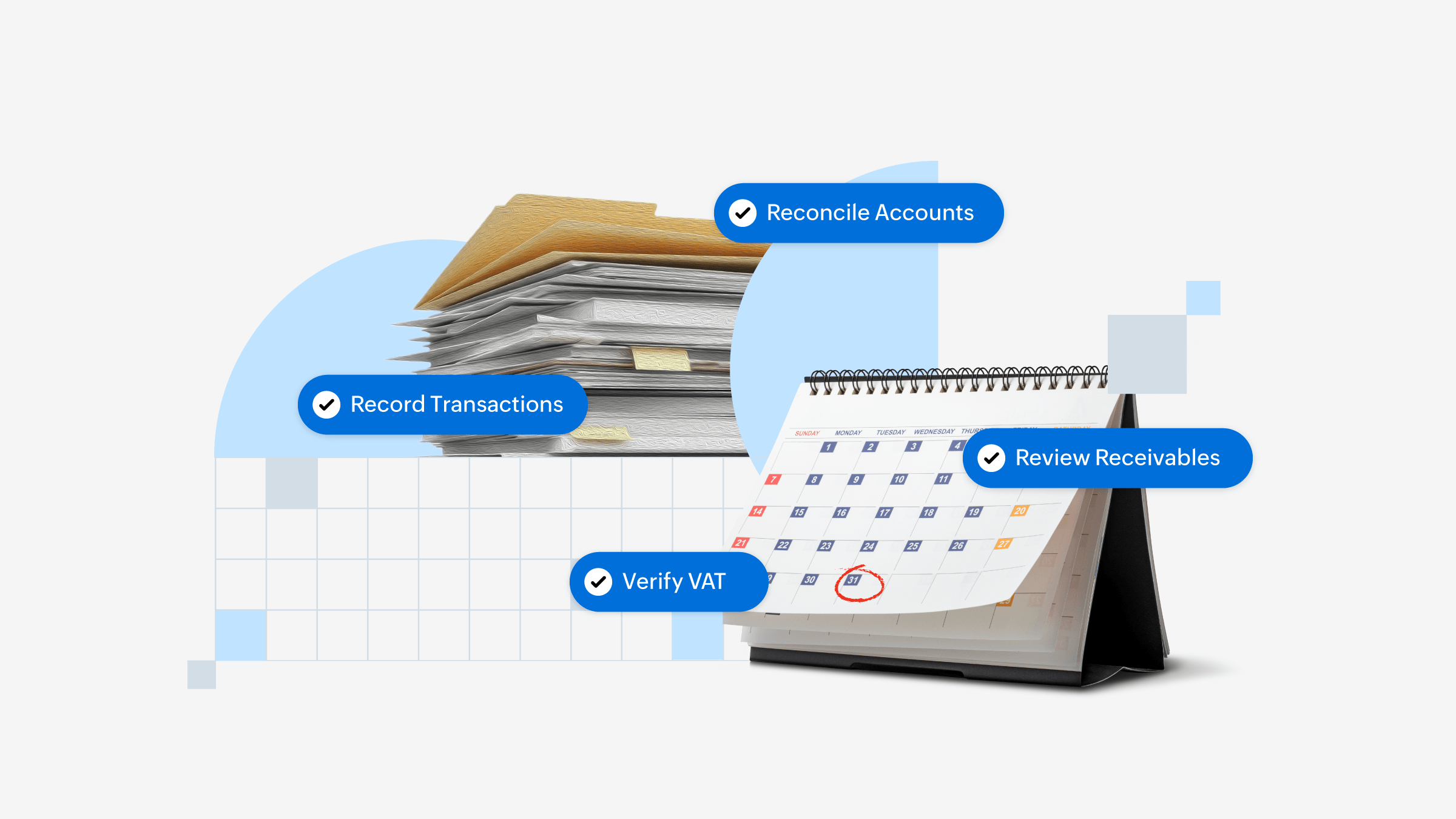
Month-end closing is a critical financial process that helps small businesses maintain accurate records, meet compliance requirements, and make informed decisions. In Bahrain, where VAT compliance, financial reporting accuracy, and audit readiness are essential, a structured and consistent month-end close is indispensable.
This guide provides a clear, step-by-step framework to help businesses in Bahrain close their books efficiently each month while aligning with local VAT regulations and accounting best practices.
Why month-end closing matters for businesses in Bahrain
Since the introduction of Value Added Tax (VAT) in Bahrain in 2019, and the revision of the standard VAT rate to 10%, businesses are required to maintain detailed and accurate financial records. VAT-registered businesses must file returns with the National Bureau for Revenue (NBR) and ensure all reported figures are supported by valid documentation.
Additionally, Bahrain mandates financial records be retained for a minimum of five years. This makes a consistent month-end closing process essential not only for VAT filing in Bahrain, but also for audit readiness and financial transparency.
A well-executed month-end close ensures VAT returns are accurate and submitted on time, financial statements reflect the true performance of the business, and cash flow and profitability are clearly understood.
Step 1: Collect and organize financial documents
The month-end process begins with gathering all financial documents for the period, including sales invoices, supplier bills, expense receipts, bank statements, payroll records, and supporting documents such as credit notes and agreements.
Maintaining well-organized records ensures no transaction is overlooked.
In the context of Bahrain VAT compliance, documentation is especially important because input VAT can only be claimed when supported by valid tax invoices. Proper record-keeping reduces the risk of errors, disallowed claims, and compliance issues.
Step 2: Record all transactions with correct VAT treatment
After collecting the documents, all financial transactions must be accurately recorded in the accounting system. This includes sales, purchases, expenses, and adjustments.
Each transaction should be classified correctly, with the appropriate VAT treatment applied. Transactions in Bahrain may be standard-rated, zero-rated, or exempt, and incorrect classification can lead to errors in VAT reporting. Ensuring accuracy at this stage helps maintain clean books and simplifies VAT return preparation.
Step 3: Perform bank reconciliation
Bank reconciliation involves comparing accounting records with bank statements to ensure consistency between the two. This process helps identify discrepancies such as missing entries, duplicate transactions, or unrecorded bank charges.
Reconciling bank accounts on a monthly basis ensures the reported cash position is accurate and financial statements are reliable. It also enables early detection and resolution of errors.
Step 4: Reconcile accounts receivable
Accounts receivable reconciliation involves reviewing outstanding customer invoices and matching them against payments received during the month. This helps identify unpaid invoices and provides visibility into receivable aging.
Regular monitoring of receivables improves cash flow management and ensures revenue reported in the books is accurate. It also supports timely follow-ups, reducing the likelihood of delayed collections or bad debts.
Step 5: Reconcile accounts payable
Accounts payable reconciliation ensures all supplier invoices are recorded and outstanding liabilities are accurately reflected. This involves matching vendor bills with accounting entries and verifying unpaid balances.
This step helps prevent duplicate payments, ensures accurate liability tracking, and provides clarity on upcoming financial obligations, supporting better cash flow planning.
Step 6: Review and validate VAT records
VAT review is a key step in the month-end closing process for businesses in Bahrain. It involves verifying that output VAT on sales and input VAT on purchases are calculated correctly.
Businesses must ensure all input VAT claims are supported by valid tax invoices and only eligible expenses are included. Any discrepancies should be corrected before preparing the VAT return.
Since VAT returns in Bahrain are generally due by the end of the month following the tax period, timely and accurate month-end closing helps avoid last-minute errors, penalties, and compliance risks.
Step 7: Review inventory and cost of goods sold
For inventory-based businesses, it is important to verify stock levels and ensure inventory records are accurate. This may include conducting physical stock checks, identifying obsolete or damaged items, and updating inventory values.
Accurate inventory management ensures the cost of goods sold (COGS) is correctly calculated, which directly impacts profitability and financial reporting.
Step 8: Record accruals and adjustments
Accruals and adjustments are necessary to ensure financial statements reflect the true financial position of the business. This includes recording expenses that have been incurred but not yet paid, such as rent and utilities, and allocating prepaid expenses appropriately.
Depreciation of fixed assets should also be recorded to account for their usage over time. These adjustments align income and expenses with the correct accounting period, ensuring accurate reporting.
Step 9: Finalize payroll accounting
Payroll accounting involves recording all employee-related expenses, including salaries, bonuses, and reimbursements. It is important to ensure payroll records are accurate and aligned with bank transactions.
Proper payroll accounting ensures employee costs are fully captured in financial statements and helps maintain consistency in expense reporting.
Step 10: Review financial statements
Once all entries and adjustments are completed, businesses should review key financial statements, including the profit and loss statement, balance sheet, and cash flow statement.
This review helps identify unusual trends, inconsistencies, or errors. For instance, unexpected spikes in expenses or fluctuations in revenue should be examined. This step provides valuable insights into business performance and supports better decision-making.
Step 11: Close the books for the month
The final step in the process is to close the accounting period. Closing the books ensures no further changes can be made to the completed period, preserving the integrity of financial data.
This is particularly important for maintaining consistency in records and ensuring readiness for audits and compliance reviews.
Common challenges in month-end closing
Many small businesses delay their month-end closing or attempt to resolve discrepancies only at the year-end. This often leads to increased workload, higher risk of errors, and compliance challenges. Inadequate documentation is another common issue, which can result in disallowed VAT claims.
These challenges can be addressed by maintaining a disciplined monthly process, ensuring proper documentation, and using systems designed to handle VAT accounting in Bahrain effectively.
Best practices for efficient month-end closing in Bahrain
An efficient month-end close requires consistency and the right processes. Recording transactions regularly instead of accumulating them at the end of the month helps reduce errors and improves accuracy.
Establishing a standardized checklist ensures all steps are followed consistently. Businesses can also benefit from using accounting software that supports VAT compliance in Bahrain, automated bank reconciliation, and real-time financial reporting. Assigning clear responsibilities within the team further enhances accountability and efficiency.
How month-end closing supports year-end compliance
A consistent month-end closing process simplifies year-end accounting and reporting. When financial records are accurate throughout the year, preparing annual financial statements and handling audits becomes significantly more efficient.
In Bahrain, where compliance with VAT regulations and recordkeeping requirements is critical, maintaining accurate monthly records reduces complexity during year-end and ensures smoother audits.
Final thoughts
Month-end closing is a foundational financial process that supports accuracy, compliance, and informed decision-making. For small businesses in Bahrain, adopting a structured approach to monthly closing ensures VAT obligations are met, financial records remain reliable, and business performance is clearly understood.
As operations grow, managing this process manually can become increasingly time-intensive. Many businesses in Bahrain gradually adopt cloud-based accounting tools to streamline workflows, improve accuracy, and stay compliant with VAT regulations. Solutions such as Zoho Books are often explored by businesses looking to simplify month-end closing, VAT filing in Bahrain, and overall financial management in a scalable and efficient manner.
By following a consistent and well-defined process each month, businesses can maintain clean books, reduce compliance risks, and build a strong foundation for sustainable growth.