Trade show ROI: Are you measuring the right metrics?

Explore how to measure trade show ROI the right way. Learn how to evaluate trade show performance through pipeline value, engagement quality, retention, and long-term impact.

If you've ever hosted a trade show, then you'll understand how cost and resource-intensive they can be.

First, there are months of event planning, then come issues like booth design, sales team training, managing event logistics across cities, and so much more. And finally, you and your team remain on your feet at the venue for hours, engaging with attendees, scanning badges, and making your sales pitch.

A week later, someone from leadership asks: "So, what was the ROI?" And suddenly the room goes quiet.

If your answer is just, "We collected 600 leads," you already know that's not enough. In today's environment, where event metrics matter more than the venue or the food you serve, trade show ROI must be clear, structured, and measurable for your event to be scalable and repeatable. Otherwise, your exhibition budget will be the first thing questioned next year.

We'll explain why measuring trade show success should go beyond lead counts. We'll look at which exhibition success metrics that exhibitors should track and which make the most sense for the organizers. And we'll show how analytics transforms trade show performance from guesswork into a scalable and repeatable event strategy.

Measure trade show ROI the right way

How to measure trade show performance

What is trade show ROI really?

At its core, trade show ROI measures the value generated compared to the cost invested. The traditional formula to measure ROI is straightforward.

  • ROI = (Revenue – Cost) ÷ Cost

But in the case of events, this calculation needs to be customized.

Unless there are active sales at the event, it is rare to predict or assess the revenue-generation potential at trade shows. Especially in the B2B industry, where interactions influence brand perception more than immediate sales, deals can still take months to close.

The event ROI can not be accurately assessed because the attendees' buying stage and perceptions at the event cannot be easily mapped or quantified. Despite your best effort, deals can take months to close, and event conversations may or may not turn into partnerships. Some leads may convert after years. So if you only measure revenue generated within 30 days of the event, you will not get a clear picture of the ROI.

Ideally, your ROI from the trade show should include:

  • Immediate revenue generated
  • Sales pipeline created
  • Strategic relationships formed
  • Brand visibility in key markets
  • Long-term customer value
  • Data and insights collected

In other words, ROI is not just about what was closed at the event. It is also about what it influenced for future business and growth. That is why measuring trade show ROI requires depth, not surface numbers.

Why the lead count from your trade show is not enough

Most exhibitors return from a trade show and proudly say, "We collected 1,000 leads." But the type of quality of leads hardly gets a mention.

If 70% of those contacts collected are not real decision-makers, the number looks impressive but delivers little business impact. What if most of these numbers were visitors curious about your product/service but weren't aligned with your target market? In this case, your cost per qualified lead will be very high, as what you spent didn't really make it to the right audience with the potential to convert.

Trade show ROI can be improved when your focus shifts from quantity to quality of leads generated. For example, instead of only counting badge scans, you should examine how many of those leads match your ideal customer profile, how many requests you received for a product demo or a follow-up call, how many of your attendees had purchasing authority, and which of the attendees showed buying intent within the next 6-12 months.

When you filter your leads generated in this manner, it gives you a clearer picture of your trade show's performance.

Booth conversations are only the beginning of measuring trade show ROI. This is where structured analytics connects these conversations into actual outcomes. Exhibition management software helps you track this journey and centralize registration data, lead capture, and post-event follow-up, making it easier to measure the success rate of discussions held at the event.

Exhibition success metrics for exhibitors

If you're an exhibitor, your investment is very direct and visible. You pay for booth space, travel, branding, logistics, promotional materials, and staff time. That means your trade show ROI must reflect returns that justify these expenses and show how much real business was generated when assessing your event's impact. It cannot stop at counting how many people scanned their badges at your booth. That's surface-level measurement. Real trade show performance must go deeper.

1. Pipeline value, not just revenue

Many teams look at revenue closed during or immediately after a trade show to judge its success. But that view is often too narrow. Most deals do not close during the event week. Trade shows usually start conversations first, and revenue follows later. A more meaningful way to calculate trade show ROI is by tracking the pipeline value influenced by the exhibition.

You should look at how many qualified leads were added to your CRM from the show, then calculate the total potential deal value associated with those opportunities.

For example, if your booth generated 80 serious conversations and those leads created a combined pipeline worth $500,000, this number becomes a powerful performance indicator, even if revenue has not yet closed.

You should also compare the average deal size of exhibition-sourced leads with that of other marketing channels. Sometimes, trade shows attract more serious buyers with larger budgets. If your exhibition leads close at a higher average value, that improves your trade show performance significantly.

Another important factor is sales velocity. If the leads from your trade show close much quicker than you had expected because you had a face-to-face conversation first, then your sales cycle shortens. That has a direct financial impact. Faster deal cycles improve cash flow and resource efficiency, which strengthens your overall trade show ROI calculation.

2. Lead qualification depth

It might sound exciting when registration leads start streaming in, but event planners and exhibitors should treat them as vanity metrics and focus on the quality of these leads instead. Not all scanned badges represent meaningful opportunities. Exhibition success metrics must also include qualification depth, not just volume.

A good qualification process actually begins before the event, during registration form creation. This is where organizers typically collect foundational information such as a visitor's name, company, and designation. These details help exhibitors quickly identify whether someone is likely to be a decision-maker or simply exploring.

However, deeper qualification often happens during and after the event through conversations and follow-up surveys. Teams should evaluate questions like:

  • Pre-event registration insight: Did the attendee's designation suggest they were a potential decision-maker or influencer?
  • During event conversations: Did the interaction reveal their purchase timeline or project urgency?
  • Post-event feedback or follow-up: Did the attendee indicate a clear level of interest after the discussion?

Capturing insights across these different stages helps build a more complete picture of lead quality. It also allows teams to classify leads more effectively, such as hot, warm, or exploratory, so follow-up teams can prioritize outreach.

This depth of analysis transforms trade show performance from guesswork into measurable impact. It also helps you train booth staff better for the next event.

3. Engagement quality at the booth

Booth traffic is visible and easy to count, but the quality of engagement tells the real story. Two booths may have similar visitor numbers, yet one may generate serious opportunities while the other only casual interest.

You should evaluate the average length of conversations held at your booth. The longer people stay and converse at your booth, the more interested they are. If your team conducted product demonstrations, you should measure how many demos were started and how many were completed. For deeper intent tracking, you can add downloadable product-related resources that require attendees to provide their contact details or scan the badge, whether at your booth or directly through the event mobile app, thereby broadening your engagement and offerings.

You should also track meeting bookings scheduled during the exhibition itself. If attendees commit to follow-up calls before leaving the venue, that indicates strong intent. In fact, if people visit your booth repeatedly during multi-day events, then they are genuinely curious and interested. These leads have a much higher and quicker conversion potential.

In hybrid or digital trade shows, engagement can be tracked more efficiently by using a Virtual Expo Management software. Virtual booth visits, resource downloads, chat interactions, and meeting requests provide clear behavioral signals. If you can track these metrics effectively, you will achieve a much more accurate trade show ROI.

4. Cost efficiency metrics

Cost efficiency is the practice of maximizing value, attendee experience, and ROI while minimizing expenditures and resource waste. Trade show ROI must always be connected to cost efficiency.

Looking at total revenue alone rarely tells the full story of trade show ROI. A more useful approach is to examine the trade show's cost efficiency. Start with the cost per qualified lead by dividing your total exhibition spend by the number of leads that met your qualification criteria.

From there, you can go deeper by calculating cost per opportunity and cost per customer acquisition. These metrics add important context to the numbers.

When you compare trade show performance with other channels such as digital ads, webinars, or outbound campaigns, the results can be surprising. Trade shows often appear expensive up front. But a closer look at the metrics sometimes reveals that the cost of acquiring an enterprise client is actually lower, thanks to the depth of the relationship and the trust that develops through in-person conversations.

Seen through a cost-efficiency lens, trade show ROI becomes easier to evaluate with evidence rather than instinct.

Exhibition success metrics for organizers

Organizers measure trade show ROI differently as they have a broader responsibility. They must create value for exhibitors, sponsors, and attendees simultaneously. If any one group walks away dissatisfied, the long-term sustainability of the event is at risk.

That is why organizers often assess success using a broader mix of indicators such as revenue stability, engagement levels, and ecosystem health.

1. Exhibitor retention and renewal rate

One of the strongest indicators of trade show performance for organizers is exhibitor renewal. If a high percentage of exhibitors rebook for the next edition, that shows they experienced measurable trade show ROI.

You should track booth renewal rates year over year. If exhibitors upgrade from smaller booths to premium placements, that signals confidence. Early rebooking behavior is also a very strong sign. That's because companies only commit months in advance when they're satisfied with previous outcomes.

Retention data should also be analyzed by industry segment. If certain exhibitor categories renew more frequently than others, that insight can guide future content themes and audience targeting strategies.

Exhibitor retention is not just a number. It reflects the perceived economic value of the entire event by your key stakeholders.

2. Sponsorship revenue growth

Sponsorship revenue is another key metric for organizers. Trade show ROI from the organizer's perspective depends on how effectively sponsorship packages deliver visibility, engagement, and measurable outcomes for participating brands.

A good starting point is to track whether sponsorship revenue is increasing year over year. Growth in the average sponsor deal size often signals that brands trust the event's reach, audience quality, and engagement potential. It also suggests that sponsors see clear value in returning or expanding their presence.

However, revenue alone doesn't tell the whole story. Organizers also need to measure how effectively sponsors are activated across different event formats, like physical, virtual, and hybrid.

For in-person exhibitions, engagement indicators may include:

  • Did attendees interact with sponsored sessions or keynote talks?
  • Were sponsor booths well-visited during exhibition hours?
  • Did branded installations, demos, or activations attract consistent footfall?

For virtual or hybrid events, the metrics shift toward digital engagement signals, such as:

  • How many attendees joined or watched sponsored sessions online?
  • Did sponsored digital banners, emails, or platform placements receive clicks?
  • How many attendees visited virtual sponsor booths or downloaded sponsor resources?
  • Did attendees interact with sponsor representatives through chat, polls, or meeting requests?

Tracking these signals helps organizers understand whether sponsors achieved real visibility and meaningful audience interaction, not just logo placement. Over time, this data also helps refine sponsorship packages, allowing organizers to offer formats and placements that consistently deliver measurable value to sponsors.

3. Attendee engagement metrics

Attendance numbers alone do not define trade show performance. Engagement depth tells a more accurate story.

You should measure session attendance rates, workshop participation levels, and networking activity. If attendees are actively moving between sessions and booths, it shows strong programming alignment.

Dwell time in exhibition zones is particularly important. Longer dwell times indicate stronger interest and better layout planning. Movement data can reveal which areas of the expo floor attracted more traffic and which sections were underutilized.

4. Attendee satisfaction and retention

Attendee satisfaction plays a major role in long-term trade show ROI. When participants feel the event delivered real value, they are far more likely to return. One of the simplest indicators to track is repeat attendance year over year, which shows whether the event consistently meets audience expectations.

To understand attendee sentiment more clearly, organizers should also use in-event polls and post-event surveys. Typical questions may include:

  • How satisfied were you with the overall event experience?
  • Did the event meet your objectives for attending?
  • How likely are you to attend again next year?
  • How likely are you to recommend this event to a colleague?

Event apps and event management platforms make this process easier by allowing organizers to create, distribute, and collect poll responses in one place. Attendees can respond directly from their devices during or after the event, improving participation rates.

These platforms also help analyze feedback through built-in dashboards, making it easier to track satisfaction scores and Net Promoter Score (NPS). High satisfaction and retention ultimately strengthen exhibitors' confidence, as brands prefer events with stable, engaged audiences.

Why event analytics changes everything

Without event analytics, trade shows may become high-energy experiences with unclear outcomes rather than strategic investments in business growth.

Analytics allows you to track attendee movement across event zones and identify peak hours of booth engagement. This will help you understand the metrics much better. On top of that, you can even measure how popular a session was and compare different editions year over year.

This kind of structured reporting transforms how trade show ROI is presented to leadership. Instead of saying, "The event felt successful," you can say, "This exhibition generated 35% more qualified pipeline than last year and improved lead conversion by 12%."

Analytics also supports budget planning. If one trade show consistently delivers higher conversion rates than others, you can reallocate resources accordingly.

A simple framework to calculate trade show ROI

  • Calculate the total investment. Include booth rental, staffing, travel, accommodation, marketing materials, software tools, and promotional costs. Also, don't forget to include hidden operational expenses, such as printing and design charges.
  • Identify qualified leads. That does not mean you have to account for every scan. Filter leads based on relevance and intent established during the registration stage. Ensure that your registration form includes designations and details, and that your team collects visiting cards or reconfirms them with attendees during check-ins and badge printing.
  • Track conversion over time. Monitor how many leads move through your sales pipeline over 6–12 months after the event.
  • Measure influenced revenue. This refers to deals in which the trade show played a role in advancing the prospect, even if the final conversion occurred later through another channel. You can measure this by tracking the event as a touchpoint in your CRM and attributing revenue to opportunities where the trade show interaction influenced the buyer journey.
  • Include strategic value. Trade shows often generate benefits that are not immediately tied to sales, such as industry partnerships, media visibility, or product feedback from potential customers. These outcomes can be measured using metrics such as partnership discussions initiated, media mentions, product demo feedback, and analyst and press interactions during the event. When you follow this structure consistently, trade show performance tracking becomes standardized. You can compare different events objectively.

Consistently following this structure can help you track trade show performance much more effectively and compare different events objectively.

Make trade show ROI measurable with Zoho Backstage

Trade shows are exciting. They are energetic. They create real human connections. But investment decisions in events can not be based on energy or buzz. They are based on numbers.

If you want continued support from leadership for your exhibition strategy, you must measure trade show ROI by looking beyond raw lead counts and tracking engagement quality, measuring conversion rates, including long-term customer value, and using analytics tools to centralize reporting.

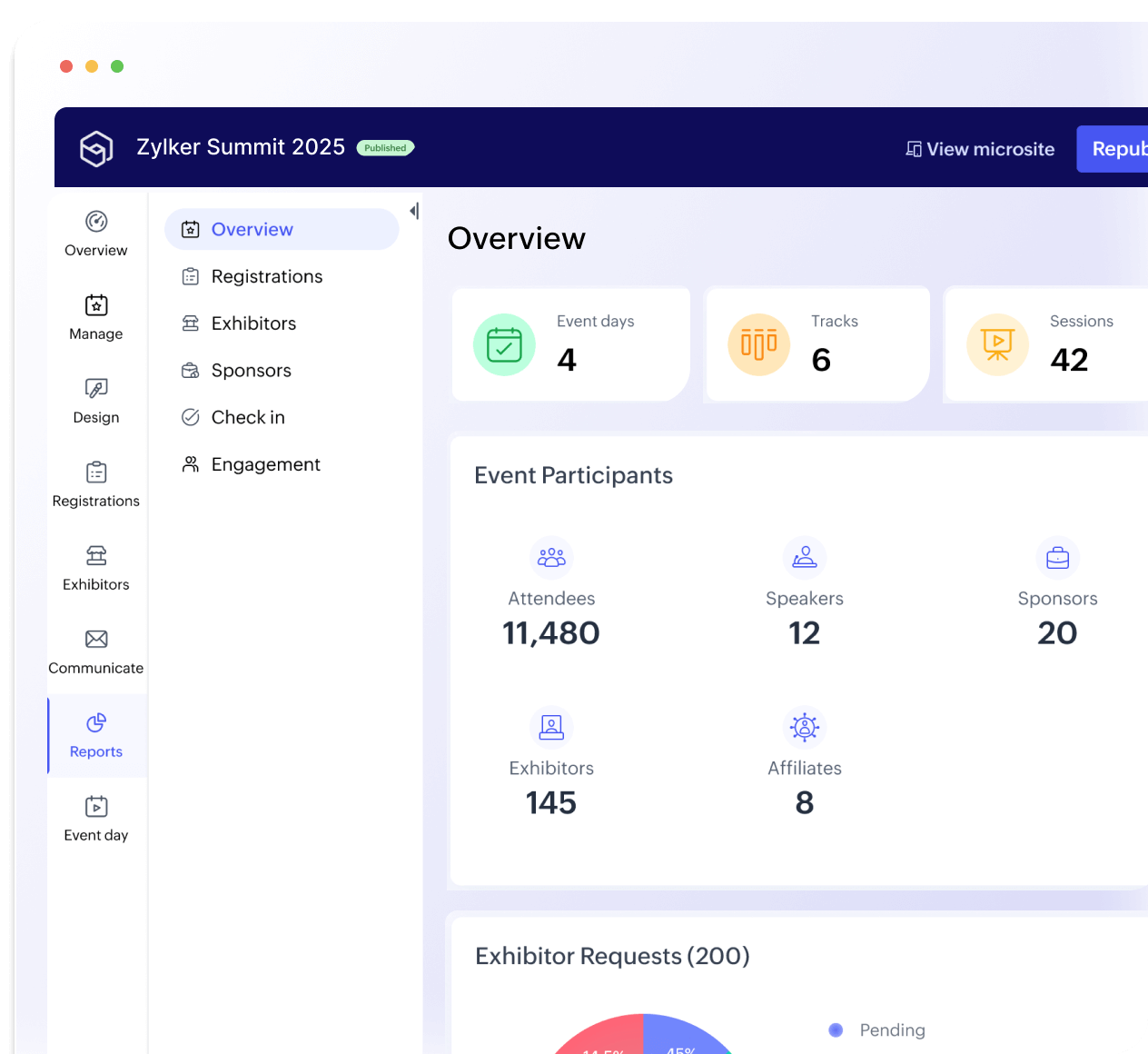
Zoho Backstage helps exhibitors and organizers manage exhibitions through integrated planning, check-in, expo management, and analytics dashboards. When registration data, engagement tracking, and performance reporting live in one system, calculating trade show ROI becomes easier and more accurate.

If you want your next exhibition to be backed by data instead of assumptions, it might be time to explore a more connected way to manage and measure trade shows.

FAQ

Trade show deals rarely close within a week of the event. Most B2B sales cycles take anywhere between 30 and 180 days, depending on deal size and complexity. It's best to evaluate trade show ROI over a few months so you capture actual conversions and pipeline movement.

Yes, but only if they approach the event strategically. Small businesses should focus on targeting highly relevant prospects instead of trying to attract everyone. Measuring qualified pipeline value rather than total scans will give a clearer picture of trade show performance.

Trade shows are often part of a broader marketing journey. A prospect might attend your booth after seeing an ad or reading your content earlier. Using a multi-touch attribution model helps you understand how much influence the exhibition had in closing the deal.

There is no universal benchmark because industries vary widely. However, trade show leads often convert at higher rates than cold outreach because face-to-face interaction builds trust. The key is to compare conversion rates with your other channels, not industry averages alone.

Yes, international exhibitions often deliver long-term strategic value beyond immediate sales. They may open doors to partnerships, distributors, or new market entry opportunities. In such cases, trade show ROI should include brand positioning and expansion impact, not just direct revenue.