The 2026 integrated event promotion playbook to boost registrations

Discover how to boost registrations, coordinate marketing channels, and simplify event promotion with an integrated event management platform.

SoLoMo—Social, Local, Mobile—is changing how companies promote events by connecting with audiences across every touchpoint. Take Pilot.com's "Entrepreneur Exclusive" series. They featured local speakers in targeted social campaigns, mailed QR invites to Nashville business owners, and built mobile-first landing pages.

The result? Packed rooms and engaged attendees who actually wanted to be there.

The strategy works because it meets people where they already are: scrolling social feeds, living in specific cities, and glued to their phones. But when every channel runs independently, the cracks show—outdated posts, delayed emails, broken links, confused attendees.

That's why more teams are turning to integrated event management platforms—tools that keep every post, email, and page in sync, so your campaigns actually work together.

Stop juggling 5 tools: Streamline your event promotion with an integrated platform

The real cost of disconnected event promotion strategies

Disconnected promotion tools don't just create extra work—they drain budgets, kill conversions, and leave your team assessing and speculating what went wrong.

Manual data juggling eats your time

Every week, someone on your team exports the registrant list, reformats it for your email tool, uploads a CSV to LinkedIn for custom audiences, and updates the master tracking spreadsheet. Then they do it again next week because 50 more people registered. That's 3-4 hours weekly per event.

If your event marketing specialist earns the U.S. average of $71,018 annually (per Glassdoor's 2025 data), that's roughly $34/hour. Over an 8-week campaign, you've burned $1,088 in labor costs just moving data between tools.

Run five events a year? That's $5,440 spent on copy-paste work.

Messaging conflicts kill registration rates

Your email team sends "Only 50 spots left" on Tuesday. Your social manager, working from last week's content calendar, posts "Register now" with zero urgency on Thursday. Meanwhile, your sales team doesn't have access to the live registration list, so they're cold-emailing people who signed up three days ago.

The result isn't just awkward—it's expensive. Inconsistent messaging confuses prospects about urgency, value, and availability. When your channels contradict each other, prospects hesitate or abandon the decision entirely.

If your target is 500 registrants at $300 per ticket, even a modest drop in conversion—say 20 fewer registrations—costs you $6,000 in lost revenue.

Timing failures and reporting blindness compound the problem

Your registration form goes live on Monday, but the announcement email isn't sent until Thursday. Social posts start the following week. By then, the initial momentum's gone. Worse, your paid ads are still pointing to last month's landing page URL. When you finally check the results, the numbers don't add up.

Your email tool shows 200 clicks. Google Analytics shows 150 landing page visitors. You have 40 registrations. Where did 110 people disappear? Without unified tracking, you're guessing.

And when the speaker cancels at the last minute? Cue the DMs: "Why didn't anyone tell me?" "The landing page still has the old agenda." Another hour-long meeting to get everyone aligned again.

What does integrated actually mean for event promotion?

Integrated event promotion isn't about complex API connections—though that's helpful. The first step is to keep your campaign assets, messaging, and data in one place, so your team stops working against each other.

One source for assets and messaging

The typical workflow: Your designer creates a new speaker banner and saves it in a folder. Your social team can't find it, so they use last month's version. Your email team finds it, but doesn't know the early bird deadline has been extended from Friday to Sunday. By Saturday, prospects are seeing three different deadlines across your platforms.

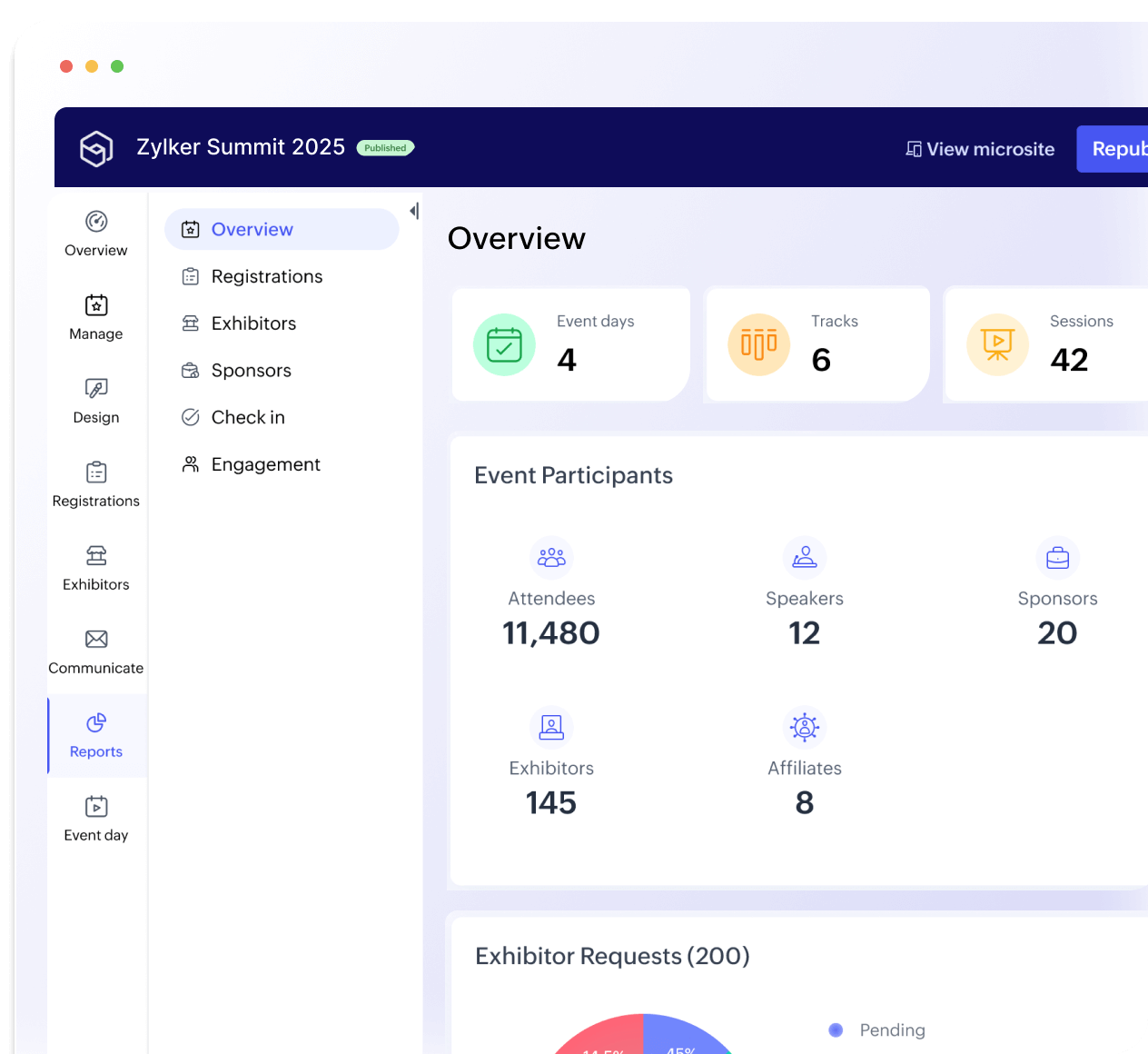
Event management platforms solve this by centralizing campaign assets and messaging variables. For example, in Zoho Backstage, you upload logos, speaker photos, and banners into a common media library. When you update the early bird deadline in your campaign settings, it automatically updates across email templates and landing pages—no manual find-and-replace across five tools.

Unified audience segmentation

You know Sarah attended last year's event and downloaded three whitepapers. Your email tool doesn't know that. Your LinkedIn ads treat her like a cold prospect. She gets the same generic "Learn what our event offers" message as someone who's never heard of you.

Integrated event management platforms let you build segments once and apply them everywhere. Create a "Past Attendees" segment in Backstage, and they automatically receive "Welcome back—here's what's new" emails, while first-timers get "What to expect" messaging. No exporting lists or rebuilding audiences in each tool.

Bidirectional data sync between your event tech stack

The problem shows up in two places: someone registers at 10 AM, but your email tool doesn't know until you export the list that evening—so the welcome sequence fires eight hours late. Or your sales team updates a lead's title in the CRM, but your event platform still shows old data, throwing off segmentation.

Event platforms with bidirectional sync fix this. Registration data updates your email, CRM, and analytics tools instantly—and when your CRM changes a contact's details, those updates sync back automatically.

How event tech platforms handle integrations

  • Native integrations: Pre-built connections between platforms (like Backstage with Zoho CRM or Zoho Campaigns) that sync data automatically with minimal setup
  • Third-party connectors: Tools like Zapier and Zoho Flow that bridge platforms without native integrations, though they add latency and cost per automation

Some platforms—like Zoho Backstage—also offer a third: low-code/no-code automations. Here, you can connect with any tool—even your internal lead scoring system or custom CRM. Your event tech or IT team can build these connections, or Backstage's Jumpstart team can implement them for you in days.

4 integrations your event management platform should support

These four integrations eliminate the busywork that bogs down campaigns and unlock capabilities that disconnected tools can't deliver.

1. CRM integration

Event platforms and CRMs need real-time communication. Registrations automatically update contact records with event details, attendance history, and engagement scores. When sales teams update account information, those changes are reflected in event segmentation instantly.

Without CRM sync, sales teams work blind. They can't see who registered until someone emails them a spreadsheet, so they waste time calling people who have already signed up. Marketing can't segment by deal stage or account value because that data is locked in a separate system.

What to look for:

  • Real-time bidirectional sync (not daily batch updates)
  • Custom field mapping for event-specific data
  • Automated alerts when high-value accounts register

Zoho Backstage, for example, integrates natively with CRMs like Zoho CRM to sync contact data and trigger sales notifications automatically.

Once CRM sync is solid, the next step is making sure email tools react to that data in real time.

2. Email marketing integration

This connection auto-enrolls registrants in nurture sequences and keeps email content synchronized with the latest event details. Template variables pull information dynamically—change the early-bird deadline once, and every scheduled email updates automatically without manual edits.

When email tools aren't connected, delays kill momentum. Unsubscribe lists also don't sync, so people who opted out keep receiving event emails. This risks your emails being directed to spam folders and, worst, blocked by mail servers due to spamming recipients.

What to look for:

  • Automatic syncing of registrant lists
  • Ensure unsubscribes are respected across all tools
  • Templates that automatically update dates, speakers, and venue info

With email and CRM working together, personalized sequences trigger based on both registration behavior and account data—enterprise customers receive different nurture tracks than SMB prospects. Next, amplify those messages through integrated communications.

3. Communications platforms (WhatsApp, SMS, Chat)

Messaging app integration extends event communication beyond email through channels that attendees check constantly. Confirmations, reminders, and last-minute updates via WhatsApp or SMS achieve 90%+ open rates. Email open rates, by comparison, are 20-30%.

For international events, attendees prefer regional messaging platforms. Last-minute updates about speaker delays or room changes need instant delivery that email can't guarantee.

What to look for:

  • Integrations with WhatsApp, SMS, and other conversation and work management apps like Zoho Cliq
  • Automated triggers for time-sensitive communications
  • Opt-in management by channel preference
  • Two-way messaging for attendee questions

You can use email for detailed content and messaging apps for urgent, time-sensitive updates. But to understand what's actually working across all these channels, analytics integration becomes essential.

4. Analytics and reporting integration

Analytics integration consolidates performance data from all promotional channels into unified dashboards. Complete attendee journeys become visible—from first touchpoint through attendance—with results attributed to specific campaigns and channels.

Manual metric compilation from five platforms leaves critical questions unanswered: Which channel drove high-value registrations? What's the cost per attendee by source? Which email subject lines predicted higher attendance rates?

What to look for:

  • Cross-platform attribution connecting emails to ads to registrations
  • Customizable dashboards surfacing stakeholder-relevant metrics
  • Exportable reports showing ROI by channel and segment

At Zoho Backstage, you get registration source analytics via integrations with Google Analytics and Zoho PageSense. The Zoho Analytics integration also lets you create custom dashboards combining event, CRM, and marketing data.

This final integration layer ties everything together—CRM data, email engagement, social performance, and messaging metrics flow into one view that shows what's actually working.

Other integrations that can help

  • Social walls: Showcase event-related posts in real time to boost engagement
  • Chatbots: Answer registration and logistics questions 24/7
  • Embeddable widget: Let partners or sponsors promote your event directly from their sites
  • Ad retargeting: Re-engage visitors who started but didn't complete registration

Common mistakes to avoid when running integrated event promotion programs

Even with the right tools, event promotion can go off track fast. Most teams don't fail from lack of effort—they fail from misalignment, over-automation, or neglecting what the data is actually saying.

Here are the most common mistakes to watch for (and how to fix them):

  • Ignoring your audience: Treating every contact the same way wastes effort and dilutes impact. Look at past behavior, interests, and engagement—then tailor your messaging so it actually resonates.
  • Mismatched timing: Emails, ads, and social posts all running on their own timelines confuse prospects. Coordinate launches and deadlines to create momentum and urgency.
  • Failing to update content: Last-minute changes—speaker swaps, agenda edits, venue updates—often slip through the cracks. Keep every channel in sync so attendees always see accurate info.
  • Skipping the review: Sending a campaign and moving on is a missed opportunity. Dive into attendance, engagement, and conversion data to sharpen the next promotion.

More tools don't mean more results. Start by balancing integrations with the features your event management software already provides. Sometimes you need a dedicated email campaign platform for advanced sequences; other times, the built-in email functionality is enough.

Instead of connecting every possible tool, integrate only what's essential. And wherever possible, enable bidirectional sync so you can manage workflows directly from your event platform. This keeps processes centralized, reduces errors, and saves your team hours.

Run integrated event marketing campaigns with Zoho Backstage

Running events successfully isn't about stacking tools—it's about keeping everything connected, sending the right messages at the right time, and using your data to make smart decisions.

Zoho Backstage handles all of that in one platform. From registration and ticketing to landing pages, emails, and attendee engagement, it's built to run your events smoothly.

Its built-in marketing tools are powerful on their own—but when you need more, the integration stack lets you connect with any external tool, so everything stays in sync and your team works from a single source of truth.

FAQs

It's a system that keeps your emails, social posts, landing pages, and analytics all in one place. Instead of juggling spreadsheets and multiple apps, an integrated platform automates workflows, syncs data across channels, and helps your team stay coordinated.

Integrated systems let you personalize messaging based on audience segments and trigger communications automatically. Attendees get relevant updates, reminders, and content at the right time, which drives higher registration and attendance rates.

Not always. Many platforms—like Zoho Backstage—have built-in email, landing page, and social promotion tools. Use external tools only when necessary, and integrate them selectively. Focus on syncing data so your workflows stay centralized.

Focus on CRM, email marketing, social media, messaging apps, and analytics. Start with the tools you use most, and only add more if they solve a specific problem—less is often more.