How to plan an event for your business in 2026: A 10-step guide

Planning an event in 2026? Learn how to streamline everything—from registrations to analytics—with the help of smart event management software built for modern businesses.

If you’ve found yourself sketching plans to host more corporate events this year, you’re in good company—the events management space has been at its busiest lately. Calendars are flooding with invites for multi-day AI conferences, every SaaS product you’ve signed up for is hosting a user-group summit, and city-level corporate meetups have you trying a new sport every week as you network with peers.

As per a Forbes study, nearly 66% of B2B marketers are planning to spend more money and effort in event marketing this year. This trend is set to grow further, as more businesses turn to event marketing as a means of escaping noisy digital channels and connecting with customers and prospects directly.

So, as the events space gets busier, well-crafted events are slowly becoming a competitive moat. Seasoned event planners will tell you that every single aspect of the event experience leaves its mark on attendees—starting from your event format (in-person, hybrid, online) to guest list, venue, speaker lineup and more.

That’s where great event planning comes into picture. A structured event plan gives hosts a rounded approach to event management, by covering every detail of your event from conceptualization to completion.

Combining the right mix among event formats, agenda playbooks and detailed event management software like Zoho Backstage can help you curate an impactful event plan for your business.

This detailed guide tells you how to plan and scale your events step-by-step with real and actionable examples.

A practical 10-step guide to planning business events

What is an event plan and what does it look like?

An event plan is an organized blueprint of the entire event’s proceedings in a structured and action-oriented format. It outlines the core components and goals of the event, incorporates the key tasks assigned to your events management team, and helps you systematically execute the event from start to finish.

Combining a well-built event plan with an efficient event planning software can make events simplified and highly efficient for organizers.For instance, Fluitec International, a global leader in fluid monitoring and maintenance, streamlined the planning of their multi-city Lubrication Academy events by using Zoho Backstage to build a fully featured two-day Las Vegas event in under 90 minutes, saving 5–6 hours per setup.

Compared to self-made spreadsheets and checklists, agile event planning offers a sophisticated mechanism to handle events, and understand the actual expense vs ROI post event.

What are the key features of a corporate event plan?

From hybrid company events that bring in-person and remote teams together, to a large-scale conference booth, every event plan across scale and format have a few fundamental concepts in common. When event planners nail the initial structure of an event, the fine details are better fleshed out.

Here’s what a good planning blueprint will address:

The purpose of the event

This is where you understand and define the core objective of the event. Businesses and organizations hold events for various purposes with various outcome expectations. Some of the most common objectives that help determine the “why” of the event include:

  • Lead generation: You’d like to find more prospective customers for your business
  • Prospect warm-up: You’re looking to bring all your warm leads into a single forum to educate and persuade them to convert into customers
  • Customer engagement: You want to foster deeper relationships with your customers, address concerns and identify new engagement opportunities
  • Brand growth: You’d like to help more people in your target market discover and engage with your brand and offerings
  • Partnerships: You are trying to identify future partnerships and pitch yourself as a potential partner to peers

Your event can have a combination of many objectives in general—but you’ll definitely be able to identify a primary goal which becomes your north star metric.

The target audience

Once you have defined the objective of your corporate event, you are already halfway through to identifying your target audience. When you create a prospective attendee list, the organizing team (sales, marketing, HR) can evaluate if this audience cohort aligns with the outcomes you want to achieve.

Your choice of audience directly influences the channels you’ll use to reach them, the way you invite them, and even what kind of information you collect from them. For example, if the expected outcome from an in-person corporate conference is an increase in partnership opportunities, your audience will comprise more senior leadership stakeholders— which means personalized invites via emails, phone calls and other one-on-one channels.

Some examples of audience cohorts you can form:

  • C-suite and executives for partnership opportunities, strategic alliances, and high-value networking.
  • Middle management for knowledge-sharing, process adoption, and organizational alignment.
  • Partners and vendors for ecosystem growth and operational collaboration.
  • Direct customers and users for retention, upselling, and brand awareness.

Remember, the closer your offering is tied to the audience, the closer you are to achieving your event objectives.

The value proposition

Your value proposition is the unique benefit that you can offer to your audience; it is directly tied to the purpose of your event. Your value proposition ties back to your outcome once again—depending on objectives like lead generation, engagement or partnerships, your value could be educational, experiential or networking-focussed.

Ex: A B2B SaaS platform whose objective is to find more cold leads will take part in SaaS conferences, whereas the same platform will conduct a user group community meet-up to re-engage existing users.

Some of the most common offerings include:

  • Thought leadership discussions with experts
  • Networking opportunities
  • Workshops and hands-on experience
  • Product demos

Your 10-step guide on how to plan an event

If you have the fundamental aspects of your event in place like the purpose, the audience, and the key value proposition, you are ready to plan out your event step-by step.

However, if the corporate event planning process happens over disjointed e-emails, spreadsheets, and async notes at your organisation, then an event management software like Zoho Backstage makes it simplified, streamlined and leak-proof.

Event managers, freelance event planners and marketing folks who are planning to manage events can follow this checklist.

Simplify event planning with Zoho Backstage

Planning a great event takes time and collective effort across teams—but the pay-off is significant in terms of ROI, customer relationships and brand growth. With a sturdy event plan made with the help of an event planning software such as Zoho Backstage, event planners and marketing teams can build events with simplified and scalable planning.

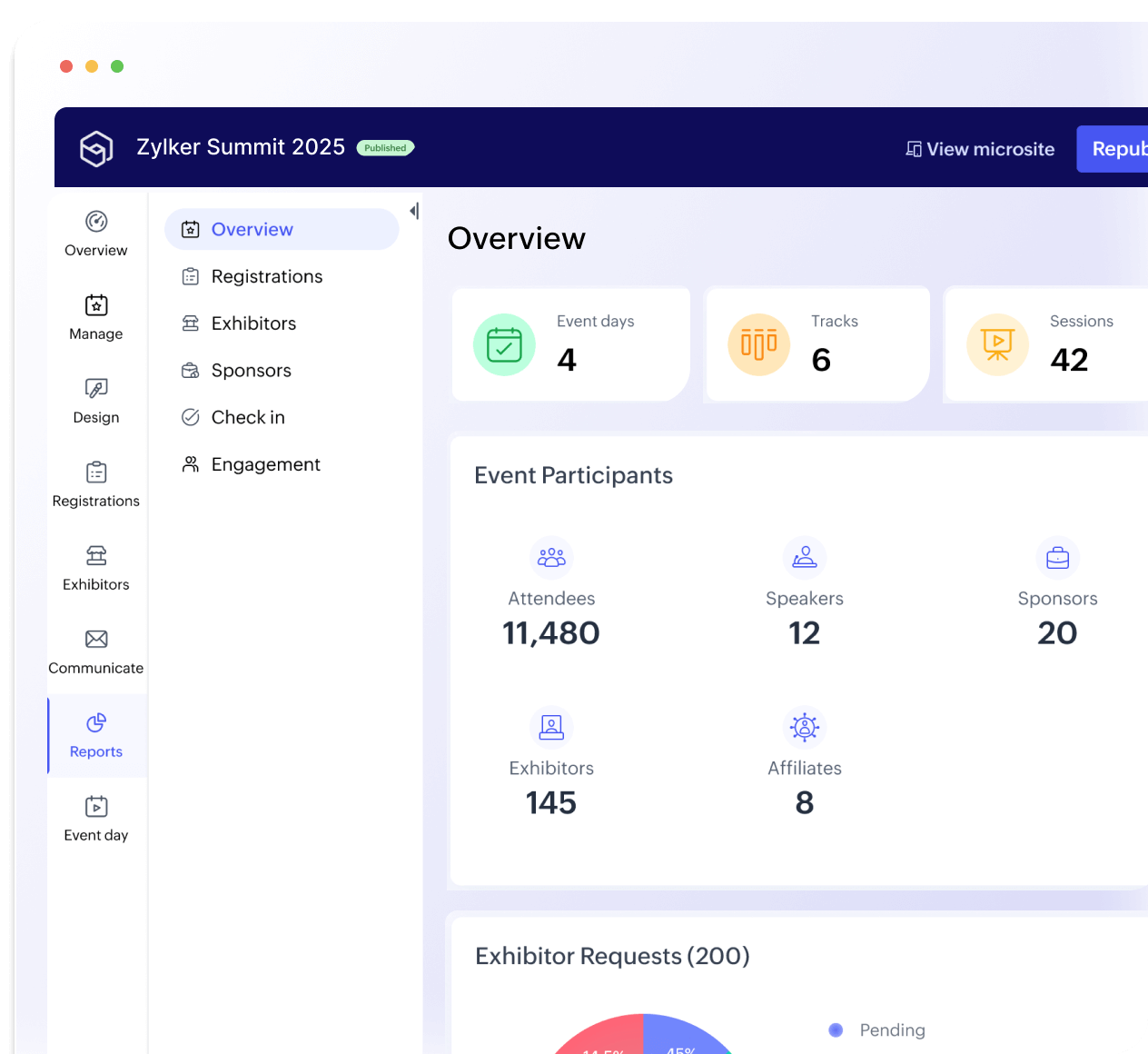
event management software dashboard

FAQ

You can plan a B2B corporate event by first defining your objectives and identifying the audience. You can then choose the right format and execute a step-by-step plan from invitation to post-even success.

There are various components of event planning. It broadly includes the purpose or objective of the event, target audience, budgeting, venue selections, collaterals, promotions, logistics, and post-event follow-up.

An event plan is important for B2B teams to ensure all event tasks, stakeholders and materials are streamlined to ensure maximum outcome. Whether your event is in-person, hybrid, or virtual, an event plan can help you make the most of your event.

There are 3 main types of events: in-person events, virtual events, and hybrid events. You can decide the best event format for you depending on your goals and audience.

An event planning software, like Zoho Backstage, is a platform that simplifies event management by helping you manage all event activities (from planning to execution), stakeholders and tasks in a streamlined interface.

An event planning software like Zoho Backstage helps manage events by automating tasks, reducing errors, improving attendee experience, providing analytics to measure ROI.