Event content strategy: What the best events do differently

Events generate more content potential than almost any other marketing activity. Most of it never gets used. Here's how you can change that.

An event is one of the few marketing activities where you have your entire audience in one place, fully present, for hours. What you do with that attention is an event content strategy question. Get it right, and a two-day event fuels three months of content, deepens customer relationships, and gives your brand a point of view worth paying attention to.

But that only happens when your content strategy is built around why people actually show up. According to Freeman's Attendee Intent and Behaviour Report:

  • 87% show up to discover new products, solutions, and partners
  • 70% prefer in-person events for training and professional development, specifically
  • 81% value access to industry experts through sessions like round tables

All of these insights direct you to the specific content your event needs to deliver. The sections below guide you through building a strategy around them, along with three real-world events to show what it looks like in practice.

Event content strategy

From podium to pipeline: The event content strategy guide

Define your event goals before touching the agenda

Every agenda decision you make flows from one thing: what you need the event to accomplish. Get that wrong, or leave it vague, and you end up with a schedule full of sessions that don't add up to anything after the event is over. The mistake most event planners make is starting with the agenda before the goal is clear.

So before you confirm a single speaker or session format, answer this: what does success look like after this event?

  • If it's a pipeline, you need content that captures and qualifies leads: gated sessions, sales-assisted invites, and touchpoints that move someone from attendee to active user.
  • If it's brand authority, you need content that demonstrates expertise without selling: keynotes and thought leadership panels that position you as the place where the industry thinks out loud.
  • If it's advocacy, you're building rituals around returning attendees: peer learning formats, networking, and post-event support structures that give existing customers a reason to stay connected.

At Zoho, we run over 750 events a year across 150 countries with a 25-person team. And we split our goals into two clear categories:

  • Brand objectives like building trust, community, and thought leadership
  • Revenue objectives like driving product adoption, pipeline growth, and exploring new markets.

Those aren't interchangeable. For example, we recently ran two events in Uganda. The Zoho Women in Business Summit in Kampala was built around empowerment, peer connections, and the celebration of women leaders.

A few days later, we ran Discover Zoho in the same city. This was a focused event built entirely around Zoho CRM and CRM Plus—our two products. Same country, same company, two completely different content strategies — because the goals were different from the start.
Research your audience using data you already have

The data you need already exists. It's sitting in your CRM, in your registration forms, in the session engagement reports from your last event, and in every conversation your sales team has had with prospects this quarter.

Start with your sales team. They know which questions prospects ask in demos, objections that come up repeatedly, and problems your audience is actually trying to solve right now.

Then look at your registration data. Not just who signed up, but what they told you when they did. Past session engagement shows you what content landed and what didn't. If a workshop had a 40% drop-off rate last year, that's a signal. If a panel generates twice as much Q&A activity as any other session, that's a signal too.

Finally, drill down on the nuances. The deeper the audience's understanding, the more specific the content decisions become. We learned this by running events across the Middle East and Africa:

  • In KSA and UAE, use-case-based content resonated
  • In Oman and Qatar, the audience preferred feature breakdowns
  • In Egypt, the events were hosted in Arabic instead of English

Quantitative data is a good starting point and tells you which sessions landed and where people dropped off. But the qualitative intelligence is what will set you apart. Your local marketers and sales teams are usually what make the difference between content that feels relevant and content that merely covers the topic.

Pick formats based on what you need them to do

Format is one of the most consequential decisions in event content planning, and it's usually made on instinct. A keynote is added to the agenda because it's expected. A panel gets added because you have three speakers and no clear structure. That is not a well-defined event content strategy, but knee-jerk reactions to changing circumstances.

Every format has a specific role to play in an event:

  • A keynote builds authority and sets a narrative. It's your best tool for thought leadership, but it's a one-way street. It doesn't capture leads, surface objections, or tell you anything useful about your audience.
  • An open Q&A is great for building trust. People ask what they actually want to know, and the answers (or the inability to answer) tell the room more about you than any prepared presentation would.
  • Workshops move behavior. If your goal is product adoption or skill building, a workshop gives attendees something they can apply immediately, which is what makes it stick.

The format you choose also shapes the content you can repurpose afterwards. A keynote, for example, gives you a clean recording and quotable moments. A panel, on the other hand, gives you multiple perspectives on a single topic. This is perfect for a recap blog, not so much for video clips.

Format decisions have consequences, and that extends to details most planners treat as fixed: some of our events start at 2 pm, some build in prayer breaks, some drop parallel tracks entirely. Small calls that make a bigger difference than any keynote slot.

Plan content capture before the event, not after

Most post-event content problems are actually pre-event planning failures. The session that would have made a great LinkedIn clip wasn't recorded cleanly. The attendee reaction that captured the energy of the room wasn't photographed because nobody briefed the photographer on what to look for.

By the time the event ends, your future event marketing opportunities are gone.

Irrespective of the scale of the event, content capture has to be planned before the agenda is finalized, not assigned to someone the week before the event. That means deciding in advance:

  • Which sessions are worth recording and at what quality
  • What speaker soundbites are you trying to capture, and briefing speakers accordingly
  • Who owns social capture and what they're looking for—candid moments, audience reactions, behind-the-scenes footage,
  • Which slide decks and transcripts you need, and collecting them beforehand rather than chasing speakers for them later

💡Pro tip: Create a capture brief

A capture brief is a document that tells every person involved in content production exactly what they're capturing, why, and how. It can make repurposing systematic rather than reactive.

Repurpose with a system, not a scramble

Repurposing works when it's planned in advance. Start with your highest-value sessions—the ones most likely to resonate with your audience based on registration data and past engagement—and map what each one yields before you've even run it.

For example, a keynote becomes a long-form video, three to five clips for social media marketing, and a thought leadership blog. A customer story becomes a sales enablement asset and a case study pull quote.

The content doesn't change. The format does, and each format reaches a different audience at a different stage.

Then build a publishing window. We plan a 60-90-day post-event content calendar before the event. That means by the time the event ends, we know when it gets published, who owns it, and what channel it's going to. So that when your event ends, it kicks off a publishing sequence that keeps the brand visible long after the room has emptied.

Measure against the goal you set at the start

Attendance numbers are the easiest thing to measure after an event, which is probably why they're the most reported. But attendance doesn't tell you whether the event did what it was supposed to do. The metric has to match the goal you set at the start:

  • If the event was built around a pipeline, you're tracking MQLs sourced, session-to-meeting conversion rates, and how many attendees moved to the next stage of the buying process within 30 days.
  • If it were built around advocacy, you'd look at return attendee rates, post-event community activity, and whether existing customers are going deeper into the product.
  • If it were brand authority, reach and on-demand views over time matter more than day-of attendance.

For Zoholics, we track products per bundle per user as one of our post-event metrics. That's a direct measure of whether the event moved customers to adopt more of the platform — the revenue objective the event was built around.

If that number doesn't move after a user conference, the content strategy failed regardless of how many people were in the room.

Three events, three content strategies

Content strategy looks different at a 200-person peer conference, a three-day supply chain gathering, and a 10,000-person enterprise event. Here's why — and what you can take from each.

Spryng 2026

Spryng is a 200-person gathering for senior B2B SaaS marketers with one goal: get the right people in the same room and give them something worth discussing. So they built the event around peer connection.

The content strategy follows directly from that. The keynotes give the table discussions that follow a shared reference point. Every attendee is matched by company size, role, and interests before they arrive. The table discussions are grouped the same way.

Even the venue, a backyard with picnic tables rather than a hotel ballroom, is a format decision — one that removes the formality that tends to keep conversations surface-level.

GS1 Connect 2026

GS1 Connect is a three-day supply chain conference that aims to help professionals across food, retail, and healthcare understand and implement GS1 Standards. The audience spans every knowledge level and every part of the supply chain—from first-timers who need a Standards 101 introduction to senior leaders mapping out a multi-year traceability roadmap. That breadth is the defining challenge of the content strategy.

The response to that challenge is visible in the agenda structure:

  • Pre-conference workshops run the day before the main program, so attendees can arrive with foundational knowledge already in place.
  • A multi-track main program, so a hospital supply chain manager and a CPG brand director leave with content relevant to their specific context.
  • Trading Partner Roundtables, consistently ranked the top reason to attend, put retailers and suppliers in the same room to work through shared challenges directly.
  • On-site certification exams are built into the program at no additional cost, giving attendees a tangible outcome to take back to their organization.

Every one of those decisions serves the same goal: to meet the audience where they are, regardless of where that is.

Adobe Summit 2026

Adobe Summit runs on two goals: drive product adoption among existing customers and cement Adobe's position as the platform for digital experience. The content strategy serves both, but through two deliberately different experiences (in-person and virtual).

In-person attendees in Las Vegas get the full program. 200+ sessions, hands-on labs, free certification exams, preconference training, and direct access to Adobe product teams. It's a multi-day adoption play designed to send customers home with new skills and a deeper relationship with the platform.

Summit Online is a different calculation entirely. It is free to attend and includes keynotes, strategy sessions, and on-demand content. It reaches prospects, international attendees, and customers earlier in their journey without diluting the value of the in-person ticket.

Why your event platform is part of the content strategy

A content strategy is only as good as your ability to execute it. And execution gets messy fast when your registration data, speaker materials, and post-event analytics all live in different places.

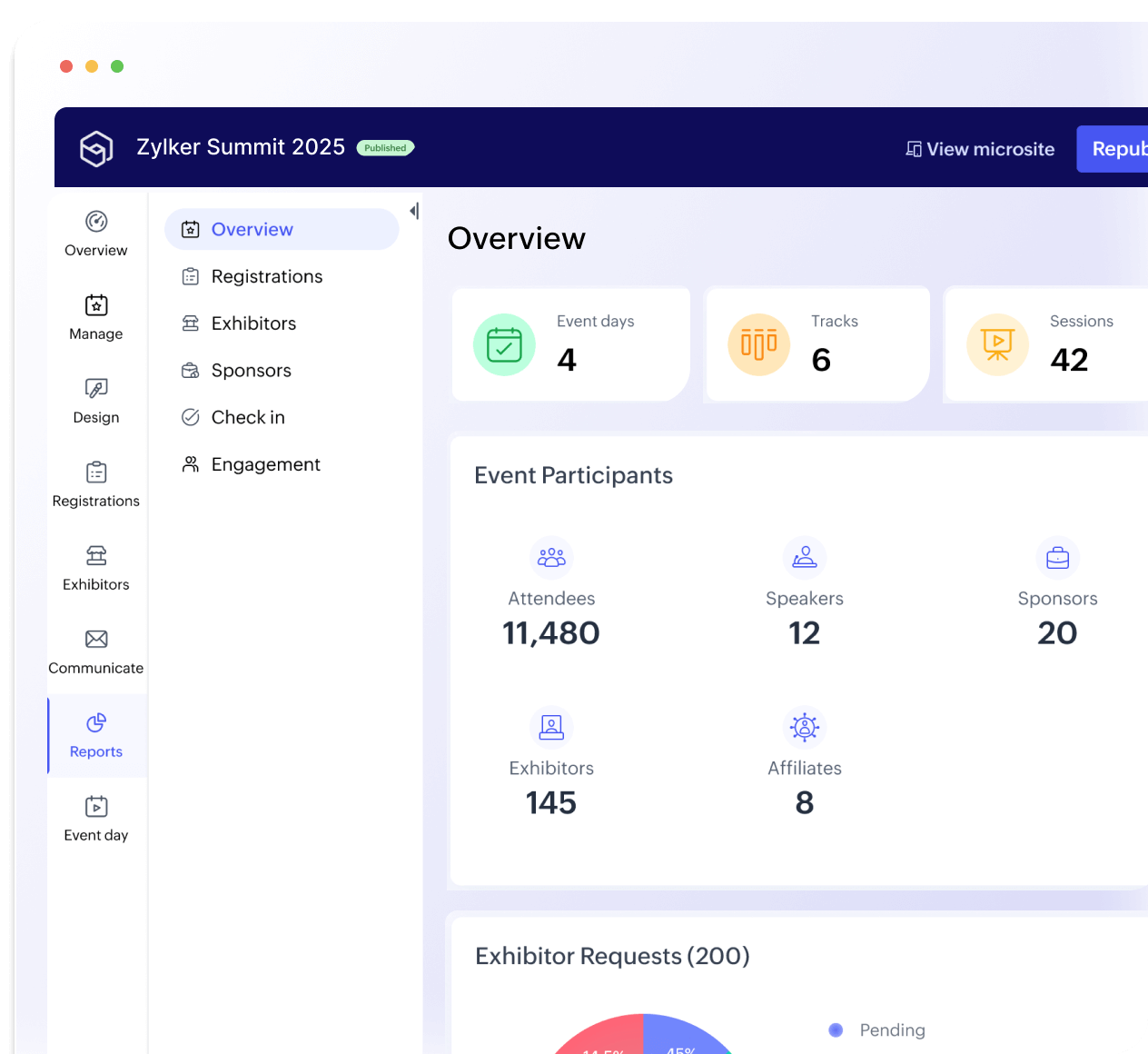
Zoho Backstage keeps everything connected. The data you collect at registration shapes your content decisions before the agenda is set. During the event, real-time engagement tells you what's landing. After it, you know exactly what to repurpose, because the data already told you what people cared about.

Your next event deserves a content strategy that actually executes. See how Zoho Backstage makes that possible.

FAQ

The fastest way to keep it fresh is to let your audience data lead. What questions came up last year that went unanswered? What sessions drove the most engagement? Build this year's content around what last year revealed or missed, rather than what you covered.

Map your highest-engagement sessions to content formats before the event ends. A 30-minute session becomes a blog post, three LinkedIn clips, and a sales enablement asset. Schedule distribution over 60-90 days and tie follow-up emails to the specific sessions each attendee engaged with.

Use registration data to build parallel tracks and segment your follow-up sequences by role, company size, or interest. If a CMO and a marketing manager attended the same event, their post-event content, session recommendations, and follow-up emails should reflect that.

Prioritize registration capture, real-time engagement tracking, speaker management, and CRM integration. Registration data tells you what content to build before the event. Engagement tracking tells you what to repurpose after it. Finally, CRM integration ensures your follow-up is automated and personalized.