How event analytics can help you build smarter, impactful events

Great events aren't just planned, they are a treasure trove of data—to be carefully evaluated, meticulously tracked, and deeply studied to ensure future event success. Learn how event analytics helps organizers understand what works, fixes what doesn't, and builds events that keep evolving.

You know that moment after your event wraps up, the lights go off, the crowd thins out, and you finally take that deep breath of relief? But right before you sink into your chair and call it a win, there's one thing you can't skip: dipping into your data and mapping your event analytics.

Why? Because events don't end when the last guest leaves. The real magic happens later, when you dig into what worked, what didn't, and what could've made the whole thing even better. These are the lessons that help you plan your next event with well-informed, data-backed reasoning.

This guide will discuss how event data analytics can transform your planning, improve attendee experience, and help you craft data-driven event strategies that actually move the needle.

How to use event analytics to improve event experiences

Using event analytics to improve event experiences for attendees

What is event analytics (and why you should care)?

Event analytics is like your event's heartbeat monitor. It tracks the pulse of everything that happens before, during, and after your event. It helps you see not just what worked or didn't, but why, so you can make every event stronger than the last.

From attendee registrations and check-ins to engagement levels, feedback, and sponsor ROI, event analytics takes your gut feelings and turns them into hard data.

And here's the truth: data-backed events perform better. Data is critical for improving future events, yet only the smartest event marketers know how to use it effectively. By using event data analytics, you can move from guessing what your attendees want to knowing it.

Event analytics goes a step beyond simple metrics. Metrics tell you what happened: how many attended, how long they stayed, how many clicked, or how many responded. Analytics, on the other hand, uncovers the why behind it all. Why did certain sessions attract higher engagement? Why did one marketing channel perform better than others?

Think of metrics as the raw ingredients, numbers and figures you collect, while analytics is the recipe that helps you turn those ingredients into insights. Metrics measure performance; analytics interpret it. Together, they give you a complete picture of your event's health and direction.
Decoding your event data: What's worth tracking

Event planners collect mountains of data, like registration numbers, poll responses, feedback forms, and click rates—but somewhere in that flood of numbers, the real story gets lost. The secret to stress-free, successful events isn't tracking everything; it's tracking the things that truly move the needle.

1. Quality over quantity

There's a difference between data that fills dashboards and data that drives decisions. Hundreds of data points mean little if they don't connect to your event's purpose, whether that's engagement, lead quality, or brand recall. The real magic lies in identifying the few key signals that define success.

2. Turning numbers into narratives

Attendance figures, poll results, and session duration. They're all just numbers until you interpret them. A packed hall doesn't automatically mean a great session, just like a smaller audience doesn't mean failure.

When you add context to your data, the narrative changes. Why did people leave early? What made one speaker trend on social media while another didn't?

Visual dashboards and comparative insights help you tell that story and transform data into meaning, and meaning into momentum for your next event.

3. The evolution of event intelligence

Every successful planner eventually learns that analytics evolve just like events do. You begin with basic tracking (what happened), progress to diagnostic understanding (why it happened), and eventually arrive at predictive foresight (what's next).

That's when you stop reacting and start anticipating. And when that happens, you can build events that feel effortless because you already know what your audience wants.

4. Insights that empower every team

Event data doesn't live in a silo. When shared across teams, it becomes a common language for growth.

  • Marketing teams learn which campaigns sparked genuine excitement — and which ones missed the mark.
  • Operations gain visibility into pain points like check-in delays or crowd bottlenecks.
  • Sponsorship teams discover which brand activations truly resonated with attendees, shaping more meaningful collaborations next time.
  • Leadership finally sees the bigger picture — how events align with business goals and create measurable impact.

5. The bridge between knowledge and action

Understanding your data is one thing; knowing what to do with it is another. Once you've separated noise from insight, the next step is to translate analytics into real-world strategies.

And that's where the next stage of your event journey begins: applying what you've learned to plan experiences that feel more personal, more seamless, and more unforgettable.

How to apply event data analytics to your planning process?

Now that you know how to read your event data, here's how to apply it to your planning. Event analytics shouldn't just sit in reports; they should shape every decision, from your session formats to your sponsorship strategy.

1. Predict what your audience wants

With event analytics, you can identify trends in attendee behavior over a series of events. Maybe your audience likes morning sessions more than evening sessions. Maybe they like panel discussions in groups more than single keynotes. Once you know that, planning is no longer luck-based; it's a strategy.

2. Design more tailored attendee experiences

Personalization is one of the most important elements of building a genuine connection with your attendees. Event data analytics allows you to segment audiences based on interest, activity, or ticket type and then provide experiences that are tailored to their specific needs.

With the Zoho Backstage event app, you can send personalized agenda suggestions or networking invitations based on data that you've already gathered.

3. Increase operational efficiency

Analytics can help you find out inefficiencies you may have otherwise completely overlooked. Maybe your registration process is too slow, or participants fall off mid-way through online sessions. Event data enables you to repair these operational loopholes so that events can flow more smoothly next time.

With Backstage, you can see real-time check-in figures, session numbers, and traffic patterns to gain real-time visibility into event performance.

4. Build stronger sponsor relationships

Event sponsors don't mind the number of attendees you get for your event or how good the feedback was. Their only goal is ROI. Event analytics provide exactly that: evidence of value.

Rather than false "lots of foot traffic," you can prove them with data-based facts such as "Booth 5A experienced 35% greater activity during Day 2's keynote breaks." That level of transparency in reporting wins trust and brings sponsors back again.

Post-event analytics: The key to long-term event success

This is where most planners go wrong: they stop collecting event metrics once the event is over, as they must move on to planning the next event. However, what sets great event planners apart from good event planners is what they do 'after' the event has ended. Post-event analytics tells you about what worked and what to do differently, so you can continue to improve. Here's how you can turn it to your advantage:

1. Attendee feedback and sentiment

Survey results, NPS (Net Promoter Scores), and qualitative comments can be organized to reveal sentiment patterns. With Zoho Backstage, feedback analytics help visualize what attendees loved, and what didn't quite hit the mark.

For example, if your keynote session scored a 4/5 but networking got a 3/5, you know exactly what to tweak.

2. Engagement recap reports

How many people downloaded the session materials? Watched recordings? Shared posts from your event hashtag? Tracking such event analytics tells you how long your event's impact lasted and how strong your content was.

3. Revenue and ROI tracking

This is the big one. With built-in event analytics, you can measure ROI across ticket sales, sponsorships, and engagement metrics. Instead of just knowing "we sold out," you can see why you did, and replicate that success again and again.

How to build a data-driven event strategy?

Now that you've got all this data, the next step is learning how to use it right.

Step 1: Gather

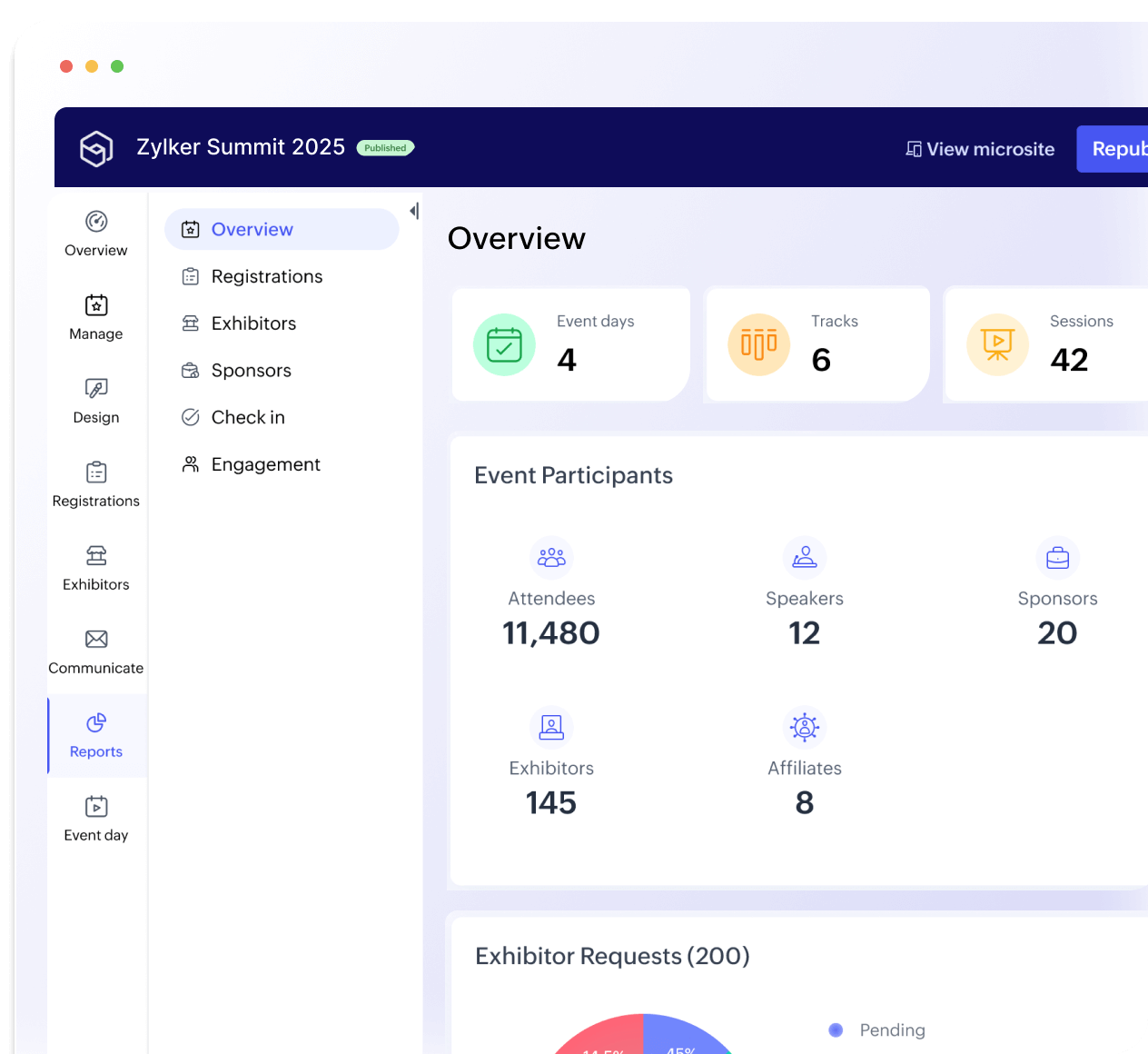
Collect all your event data, like attendance, engagement, marketing performance, and feedback. Keep the data organized in one place like Zoho Backstage's centralized dashboard so that you don't end up juggling spreadsheets.

Step 2: Analyze

Don't just glance at numbers. Look for patterns and correlations.

  • Did higher engagement correlate with better session ratings?
  • Did certain marketing channels bring in more high-value attendees?

That's where insights hide.

Step 3: Apply

Turn those insights into action:

  • Rework your session topics.
  • Improve event flow based on foot traffic data.
  • Tailor sponsor packages using engagement reports.

Step 4: Refine

Each event gives you new data. Feed that back into your strategy, and you're in a continuous improvement loop.

That's what separates average event planners from data-driven ones: the ability to adapt fast.

Real-world example: How event data changes everything

Let's take a quick scenario.

Say you hosted a hybrid conference with 2,000 attendees. Engagement data shows that your virtual sessions had 60% completion rates, but in-person ones had 85%. That gap? It tells you virtual attendees might need more interactive features, like live polls or breakout sessions.

You roll out those changes next time, track engagement again, and your completion rates may rise to 78%. That's the power of event analytics. It's not just about numbers; it's about learning, adapting, and improving every single time.

Level up your next event with Zoho Backstage

If you've made it this far, you already know the truth: data is your most powerful event planning tool. And the right platform can make all the difference.

Zoho Backstage brings everything you need to analyze, optimize, and improve your events in one platform. From tracking attendance to measuring engagement and post-event feedback, its analytics dashboard gives you insights that help you continuously refine your event strategy.

Ready to see it in action? Discover how event analytics can help you create events that impress and evolve!

FAQs

Ideally, review your event analytics within 48 hours after the event while the data and feedback are still fresh, then again after a week to spot deeper trends.

Yes. By comparing engagement and attendance patterns across past events, analytics tools like Zoho Backstage can forecast preferences and improve planning accuracy.

For virtual formats, focus on session attendance duration, chat and poll participation, and content downloads as these reflect real engagement, not just logins.

Look for a mix of quantitative (attendance, participation) and qualitative (feedback, sentiment) indicators. A healthy balance of both signals genuine success.

Yes, you can use Zoho Backstage. Backstage integrates event and marketing data and lets you track how campaigns convert into registrations and engagement all in one dashboard.