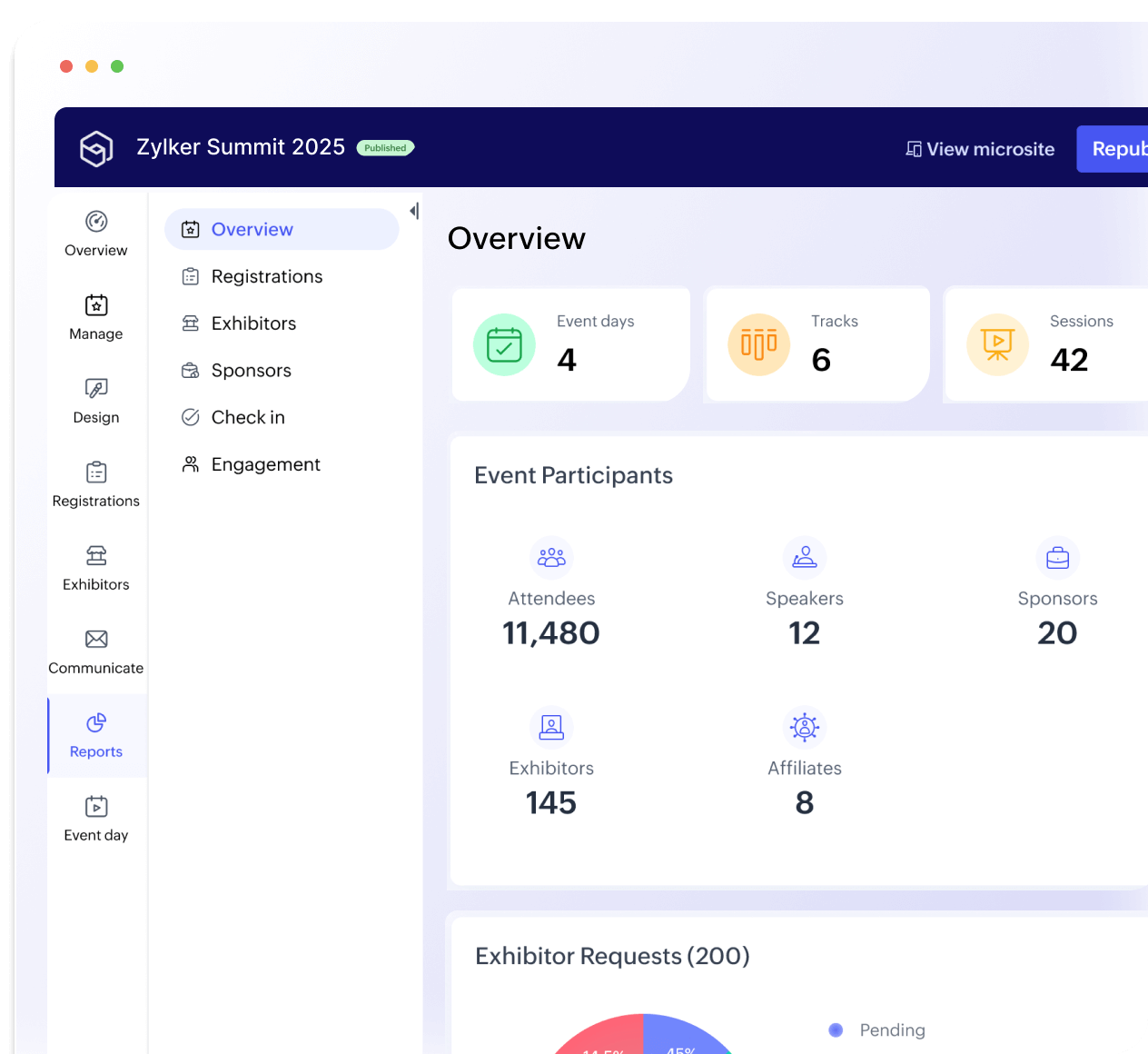
9 common event management challenges (and how to solve them)
Here are some of the most common challenges event planners and managers face, and how you can solve them:
1. Budgeting problems
Budgets are every event organizer's least favorite part.
Event budgeting requires both planning and discipline. You plan to stay within the limit, but somehow, costs creep up. Venue charges change, catering adds "service fees," and sponsors don't pay on time. Before you know it, your neat Excel sheet is out of control.
Why it happens:
- Too many manual updates and spreadsheets.
- Unclear visibility of where the money's actually going.
- No real-time tracking of ticket sales or sponsorship income.
How to fix it:
Start by setting up a centralized system to track every transaction and expense. Event pros using automation tools can reduce budget deviations and unnecessary chaos.
Zoho Backstage helps you connect event revenue with performance by tracking ticket sales, registrations, sponsorship metrics, and session attendance. That's data you can actually use to justify spending or reallocate budgets.
Because let's be honest: the only thing worse than overspending at an event is not knowing why you overspent and what you overspent it on.
2. Communication breakdowns
You send an email to your team. Someone replies in your internal messaging platform. Someone else leaves a note in the shared doc. The result? Pure confusion.
Miscommunication is one of the most common event management challenges. When information is scattered, small updates (like "Session B moved to Hall 3") can spiral into massive mix-ups.
Why it happens:
- Teams using too many disconnected tools.
- Stakeholders not aligned on the same plan.
- Real-time changes not reaching everyone fast enough.
How to fix it:
Centralize. Everything.
Zoho Backstage can give your team a shared workspace through an app, so that speaker updates, schedules, announcements, and attendee messages all live in one place. The built-in agenda manager ensures that if one track changes, it reflects everywhere instantly (web, app, website).
Zoho Backstage's email campaigns help communicate with people who might want to register or have already registered.. No more "I didn't know the session was moved" moments.
You can't control human errors. But you can definitely control the chaos it causes by setting up automated communication that
3. The scheduling puzzle
Ever tried to fit 20 sessions, 5 workshops, and 3 panels into a two-day event? It's like playing Tetris blindfolded.
Creating a schedule that works for everyone, like speakers, attendees, and sponsors, is one of those challenges in implementing event management software that's more complicated than it looks. Especially if you're juggling multiple tracks or hybrid sessions.
Why it happens:
- Schedules built manually = high error rate.
- Speaker conflicts and last-minute edits.
- Different time zones for virtual/hybrid setups.
How to fix it:
A dynamic scheduling tool can save your sanity. Zoho Backstage makes it simple to organize sessions, allocate time slots, and adjust on the go.
You can publish the schedule on your event site and mobile app in one click. Any edits sync instantly, and you don't have to resend PDFs or update a million emails.
Bonus: Attendees can even personalize their schedules through the app. It's smoother for them and less stressful for you.
4. Poor attendee engagement
You spend months planning every detail, and then your attendees look bored halfway through.
The truth? Engagement isn't just about great speakers or fancy venues anymore. People crave connection. They want to be part of the experience, not just watch it. When sessions feel one-sided or monotonous, attention drops fast. Attendees start scrolling on their phones, checking emails, or slipping out early.
The challenge here isn't just short attention spans; it's competing for engagement in a world full of distractions. In hybrid or virtual setups, this becomes even tougher because you're battling screen fatigue, time zone gaps, and limited opportunities for real human interaction.
How to fix it:
Start thinking beyond sessions and presentations. Focus on building moments that spark curiosity and participation. Mix formats, like panels, fireside chats, polls, and interactive Q&A. Encourage networking before, during, and after sessions, whether in-person or online. Add gamification to reward participation and keep the energy alive.
Once your engagement strategy feels strong, Zoho Backstage can help you bring it to life. With Backstage, you can:
- Use live polls and Q&A to make sessions interactive.
- Enable AI-powered networking suggestions so attendees connect with people who share their interests.
- Add gamification elements (like leaderboard challenges) to keep energy high and attendees active throughout.
When attendees participate rather than just listen, your event stops feeling like a lecture and starts feeling like an experience.
5. Managing multiple stakeholders
You've got speakers, sponsors, exhibitors, tech partners, and volunteers. And every one of them has different needs, formats, and deadlines.
Now imagine juggling all of that across a dozen email threads, WhatsApp messages, and spreadsheets; it's a recipe for confusion. Speakers want last-minute slide uploads. Sponsors need visibility updates. Exhibitors keep asking about booth setups. Meanwhile, your volunteers are still waiting for instructions on arrival times.
Managing so many moving parts means even one missed update can snowball into chaos. When there's no unified way to track who's done what, your entire workflow becomes reactive instead of proactive.
Why it happens:
- No single system for tracking deliverables.
- Too many back-and-forth emails.
- Hard to measure who's done what.
How to fix it:
Set clear workflows early. Zoho Backstage's sponsor management modules let you centralize everything, like bios, brand materials, deliverables, booth details, and more.
Each exhibitor gets a brand page and lead capture tools, while sponsors can access engagement reports post-event.
That means fewer update emails and better collaboration all around.
And for hybrid or in-person expos, Backstage's interactive floor plan builder gives both you and attendees a visual layout of booths. Clearer organization = fewer headaches.
6. Technical confusion when implementing software
This is a big one.
For many event planners, switching to new event management software is almost scarier than a no-show keynote speaker. You worry it'll take too long to set up, confuse your team, or break something mid-event.
Why it happens:
- Poor onboarding or unclear documentation.
- Too many tools stitched together instead of one platform.
- Resistance from teams used to "how we've always done it."
How to fix it:
Look for platforms built for humans, not techies.
Zoho Backstage, for example, doesn't need coding knowledge. Its no-code website builder lets you design your event site using pre-built themes. The registration and ticketing tools have zero commission on ticket sales, and setting up custom forms takes minutes, not days.
And if you're worried about training your team, the Backstage interface is unified across web and app. So once you learn it, you can manage everything, from session tracking to announcements, without switching tabs.
When choosing event management software, simplicity matters as much as power.
7. Last-minute registration and check-in chaos
Doors open in 10 minutes. The line outside? A mile long. The check-in desk? Total gridlock. You can almost feel the stress rise as your team flips through printouts, attendees fumble with emails, and the crowd grows impatient. It's not just about time—it's about first impressions. A chaotic entry can set the tone for the entire event.
Why it happens:
- Manual registration lists that take forever to process.
- Walk-ins not synced with online registration data.
- Badge printing delays and printer malfunctions.
- Lack of staff coordination during peak check-in hours.
How to fix it:
Automate your check-in and badging. Start by simplifying and automating your entire check-in process. Offer digital tickets with scannable QR codes, allow pre-registration confirmation, and use self-service kiosks to handle crowds efficiently. Make sure your badge printing system is integrated with your registration data to avoid duplicates or delays.
Zoho Backstage's check-in and badging features let you scan QR codes, register walk-ins, and even print branded badges instantly. You can track attendance in real-time and avoid double entries.
And since it integrates with your ticketing data, you'll know exactly how many attendees actually showed up versus how many signed up.
Smooth entry = happy guests = less stress for your team.
8. Post-event reporting
The event's over. You survived. But now, everyone's asking for:
- "Please give me the report."
- "How many people attended?"
- "What was the session feedback?"
- "What's the ROI?"
Why it happens:
- Data stored in silos (ticketing here, surveys there, leads somewhere else).
- No unified analytics.
- Manual calculations that take weeks.
How to fix it:
Centralized analytics is your best friend. With Zoho Backstage, you can track engagement metrics like session attendance, app activity, and lead scans from exhibitors, all in one dashboard.
Combine that with financial metrics like ticket sales and sponsorship performance, and you've got a clear picture of your ROI.
According to a report, 71.2% of event organizers struggle to prove event ROI due to fragmented data. If you're one of them, this is your way out.
Numbers don't lie, but only if you can find them.
9. Data privacy and compliance
In a world full of GDPR, CCPA,DPDP, and "Can I delete my data?" requests, ensuring data privacy and security of your attendees is no longer optional.
Why it happens:
- Using multiple tools without consistent privacy policies.
- Unclear attendee consent handling.
- Manual processes for data deletion or requests.
How to fix it:
Stick to platforms with built-in privacy features.
Zoho Backstage offers data privacy and consent management options that help you handle attendee data safely. You can collect only what's needed, store it securely, and stay compliant with regional laws.
Transparency builds trust, and trust keeps attendees coming back.