Importing JSON Files
JSON (JavaScript Object Notation) is a structured data format commonly used by APIs, configuration files, and modern data exchange. Zoho Analytics imports JSON files that follow specific structural requirements described below.
This page covers the JSON-specific options and structural requirements. For the general import procedure, plan availability, role permissions, and common settings that apply to all file formats, see Importing Data from Files.
Supported file extensions
| Extension | Description |
| .json | JSON file |
JSON import is available from all three file sources: Local Drive, Pasted Data, and FTP. See Starting an Import on the landing page for source-specific entry steps.
Supported JSON structures
For a JSON file to import successfully, it must meet the following structural requirements:
- The data must be a JSON array containing one or more objects (enclosed in [ ]).
- Each object in the array represents one row. The keys in the first object are used as column headers.
- JSON objects that contain simple values without keys (for example, [1, 2, 3]) are not supported. Each object must use key-value pairs.
- If your file contains multiple JSON objects separated by commas but not enclosed in an outer array, only the first object imports. Wrap the objects in [ ] to import all of them.
- For the full list of JSON structures Zoho Analytics can import, with examples, see Supported Formats for Importing JSON Files.
Importing a JSON file
JSON import follows the standard procedure described in Starting an Import on the landing page. The JSON-specific step is the file-type selection:
- After selecting your source and providing the source details, the import wizard opens.
- From the File Type dropdown, select JSON.
- Complete the general settings: Table Name, First Row Contains Column Names, and Format of Date columns. These are documented in Configuring Import Settings.
- Configure the JSON-specific options in JSON-specific settings below.
- Verify the Preview, configure On Import Error options, then click Create.
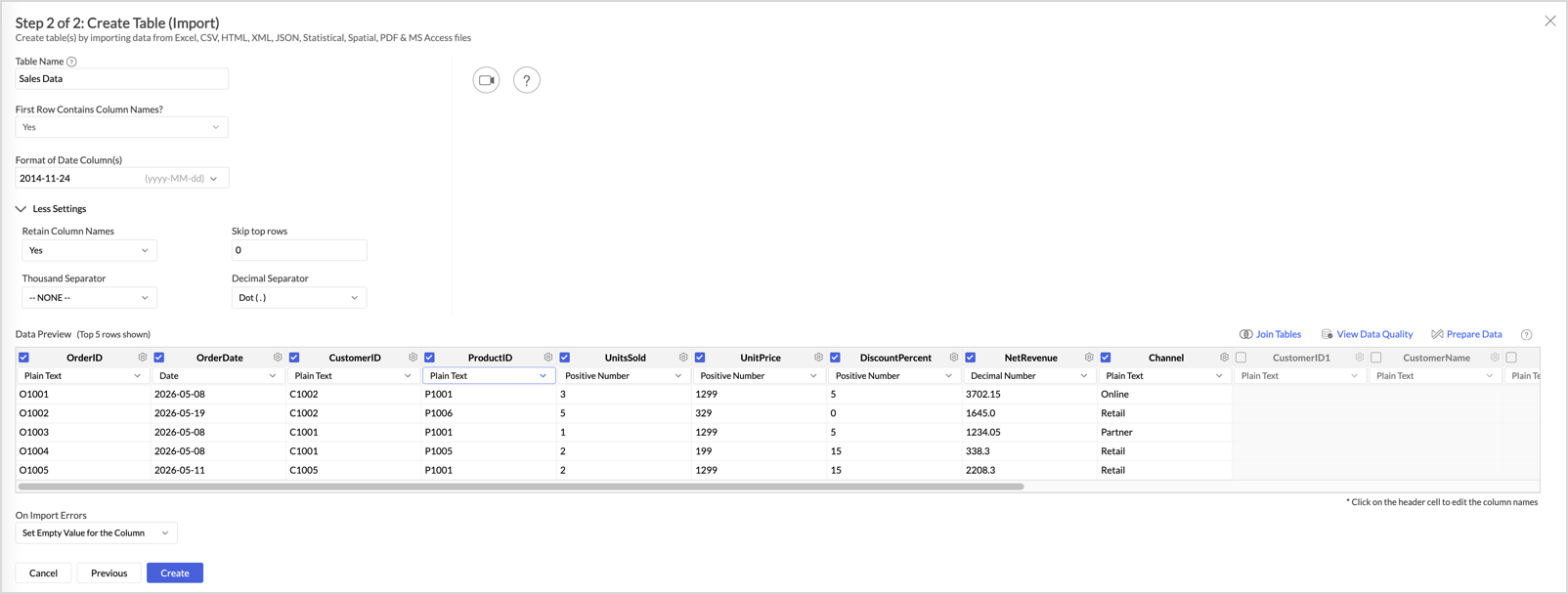
JSON-specific settings
The following option appears in the More Settings section of the wizard when the file type is set to JSON.
Retain Column Name
Controls how Zoho Analytics generates column names from the keys in your JSON file. The default value is No.
When set to No (the default), Zoho Analytics generates column names by concatenating the JSON object path using dots.
For example, if your JSON object contains a result object with date and amount keys, the corresponding columns are named result.date and result.amount. This preserves the full hierarchy in the column name and avoids ambiguity when multiple branches of the JSON have keys with the same name.
When set to Yes, the column uses only the inner key name. Using the same example, the columns would be named date and amount instead of result.date and result.amount.
Notes and limitations
- File size: 100 MB per file and 1 million rows per import. For larger JSON files, see Import Large Data Files using Zoho Databridge.
- First-row header requirement: For JSON imports, the first object in the array effectively defines the columns. This differs from CSV, where the First Row Contains Column Names option is configurable.
- Nested objects: Nested JSON objects are flattened during import. When Retain Column Name is set to No (default), Zoho Analytics generates column names using the full dot-separated JSON path (for example, result.date and result.amount). When set to Yes, only the leaf key name is used (for example, date and amount). See Retain Column Name above.
- Nested arrays: Arrays nested within JSON objects are flattened during import. Each array element is imported into a separate column. The column names are generated using the array name followed by an underscore and the element index. For example, if an object contains an address array with the values ["Home", "Office", "Billing"], Zoho Analytics imports the values into the columns address_0, address_1, and address_2.
- Missing keys: When some objects in a JSON array do not contain keys that are present in other objects, Zoho Analytics creates columns for all discovered keys. If a key is missing in an object, the corresponding column value is imported as empty for that row.
Related
- Importing Data from Files - import home page covering source selection, common settings, and operational tasks
- Importing XML Files - for hierarchical data in XML format
- Importing CSV Files - for flat tabular data
- Import Large Data Files using Zoho Databridge - for JSON files larger than 100 MB