Queue Stats
Zoho Voice's Queue Stats module provides comprehensive analytics to understand and evaluate your call center's queue performance. It offers two views, Dashboard and Table, to help you analyze queue metrics in the format that best suits your needs.
The Dashboard view presents queue performance through visualization and interactive charts. This view provides insights into key metrics such as service level, queue service time index, abandoned calls, busy rate, repeat call rate, average call duration, peak calls, traffic intensity, call heat map, call traffic intensity, handle time and wait time percentiles, call sentiment, customer emotions, customer intent, and more.
The Table view presents the similar metrics in a structured tabular format for detailed analysis. You can also download the data as a CSV file for further analysis.
To support the diverse operational needs, the queue stats supports two configuration modes:
Org-Level config: A standardized dashboard configuration managed by super admins and admins, ensuring a consistent view across the organization.
On-Demand config: A personalized dashboard configuration available to all users (except Technicians), offering them to customize their own view without affecting the organization-wide setup.
With flexible viewing options, customizable filters and performance thresholds, queue stats enables data-driven decision-making, helping teams to optimize queue performance and overall service quality.
View options
Choose how you want to analyze queue performance:
Dashboard View: Displays queue metrics using interactive charts and visualizations.

Table View: Displays similar metrics in a tabular format and the data can be downloaded as a CSV file.
Note
A few metrics displayed as percentages in both the Dashboard and Table views are represented as counts in the downloaded CSV file.
Filter options
Customize your dashboard view by applying filters based on:
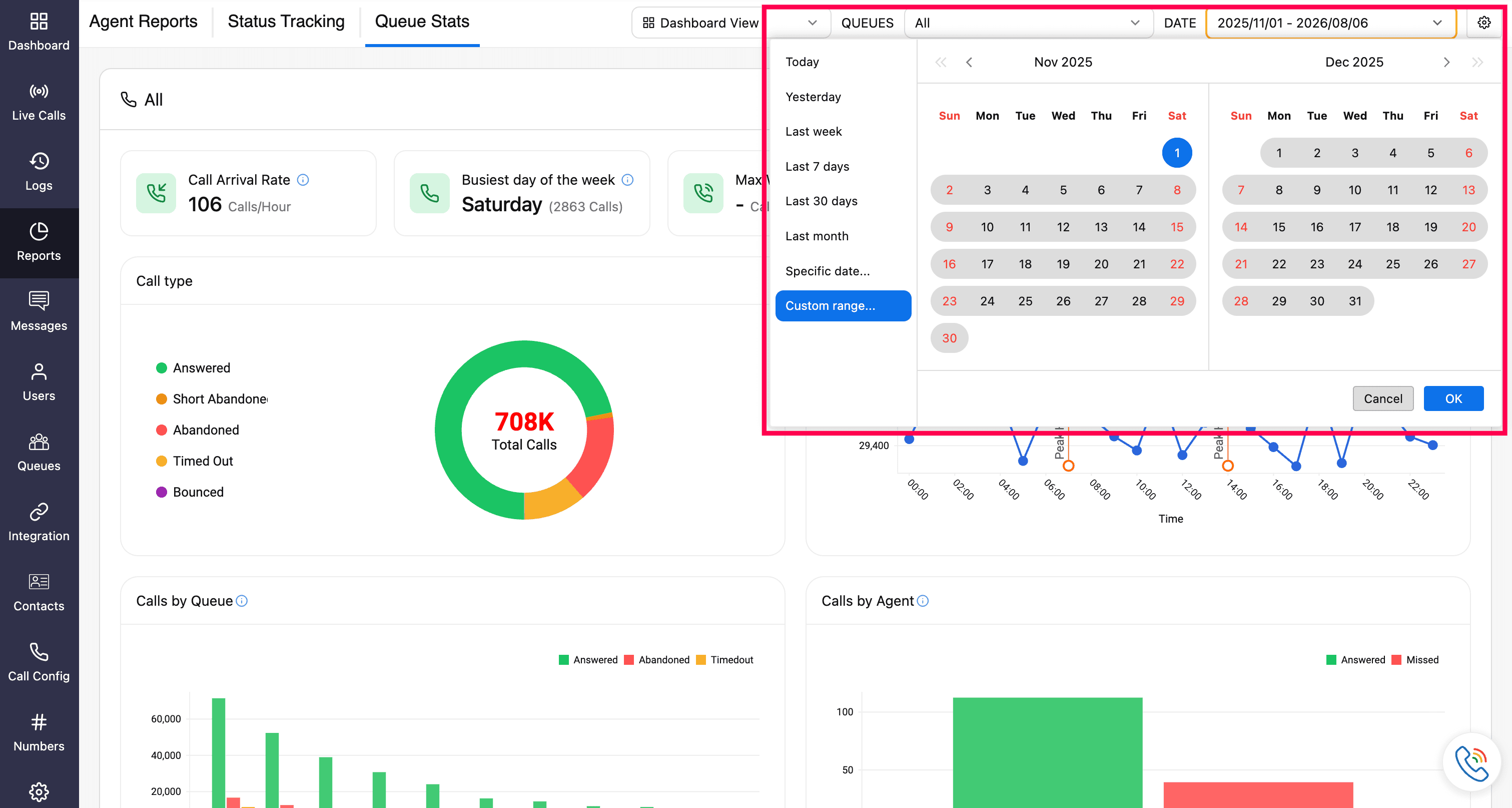
Date: Select the predefined date ranges like today, yesterday, last 7 days, last 30 days, last month, specific date, or select a custom range (up to one year prior from the current date) for a granular analysis.
Queues: Select one, multiple, or all queues from the dropdown to tailor the data view according to your needs.
Who can set the configuration (Threshold Values) for the Dashboard?
The dashboard offers two configuration levels:
Org level configuration
The threshold values can be set only by the super admin and admins.
Applies organization-wide and is the default view for all users (including supervisor and supervisorplus roles).
Useful for setting standard threshold values to ensure consistent performance monitoring across the organization.
On-demand configuration
Available for all users except technicians.
The threshold values can be customized by supervisors and supervisor plus users, if permitted by the super admin or admin.
This is a personal configuration view and does not affect other users or organization-level settings.
Configuration is not saved permanently; a page refresh will reset all metrics to default threshold values.
Visibility is limited to the user who sets it.
Note
For On-Demand configuration to be available, the super admin or admin must enable the Allow On-demand Config Access option in Org-Level Config.
Configure Key Threshold values
Note
Default threshold values are pre-set. You may retain or modify them based on your requirements.
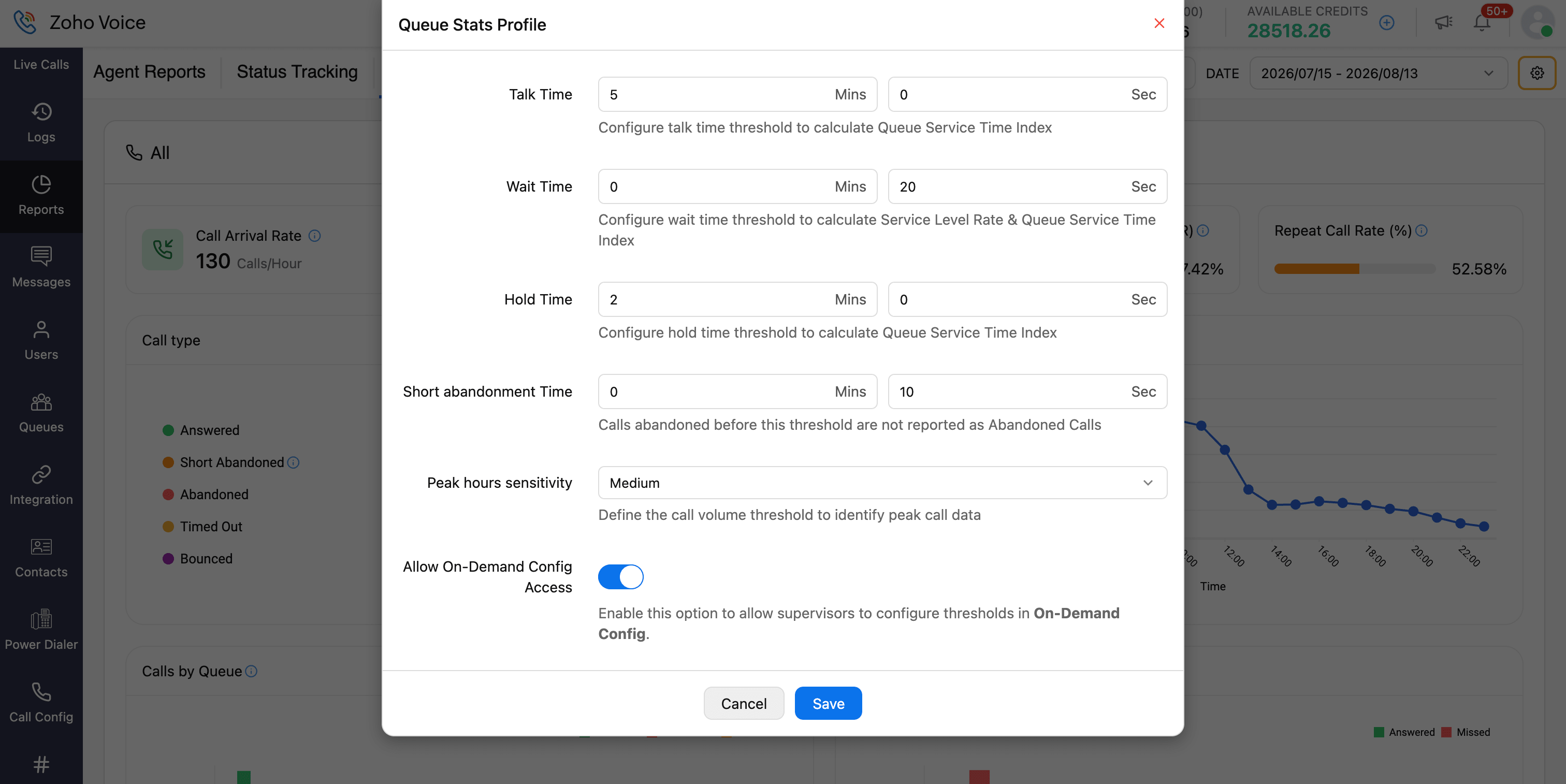
Configure the following key thresholds to tailor your dashboard view:
Key Thresholds | Description |
Talk Time | The duration an agent actively speaks to a caller (excluding hold time). Starts when the call is answered and ends when the call is disconnected. |
Wait Time | The duration a caller spends in the queue before their call is answered by an agent. This metric applies only to answered calls and is used in calculating Service Level Rate and Queue Service Time Index. |
Hold Time | The duration a caller is placed on hold during a live call (after answering, before resuming or ending the call). Used in calculating Queue Service Time Index. |
Short-Abandoned Time | The duration a caller stays in the queue before hanging up the call prematurely. This is usually within a short time (e.g.: under 5 seconds). Calls that end before this defined threshold are categorized as short-abandoned and not counted under standard abandoned calls. |
Peak Hours Sensitivity | Determines how the system detects and highlights high-traffic periods based on incoming call volume. Levels:
|
Steps to configure Key Thresholds values
Go to the Reports module from the left sidebar menu.
Select the Queue Stats tab.
On the dashboard, click the Date filter in the top-right and select a date range.
Click Queues and select one, more or all queues for your analysis.

To configure Org level settings (available only to super admin and admins):
Click the Settings icon in the top-right corner.
Select Org level config.

Enter values for Talk Time, Wait Time, Hold Time, Short Abandoned Time, and choose Peak Hours Sensitivity.
Enable Allow On-Demand Config Access to permit supervisor plus and supervisors to create their own On-Demand configurations.
Click Save to apply the configuration.
Note
For On-Demand settings (available to supervisor plus and supervisor users): If Allow On-Demand Config Access is enabled by the super admin/admin, these users can follow the same steps via On-Demand Config to set personalized configurations for their own view and analysis.
Dashboard overview
Once the relevant Org-Level or On-Demand configuration is applied, the Queue Stats dashboard is displayed with three primary sections for effective performance analysis:
All - Provides insights across all calls, regardless of outcome.
Answered - Focuses on metrics related to calls that are answered.
Unanswered - Highlights statistics for calls that were unanswered due to agent unavailability or calls placed outside the business hours.
All section
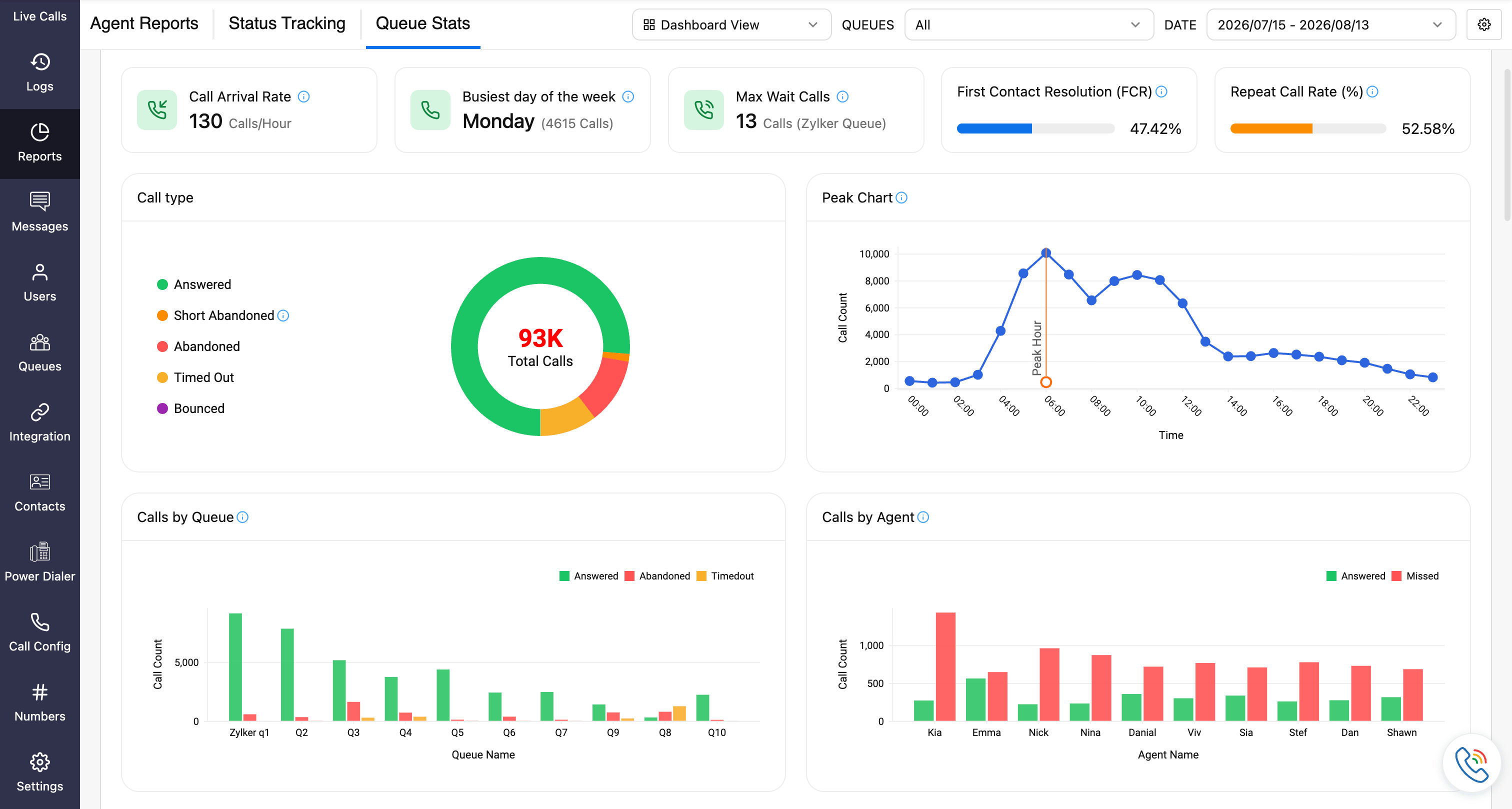
This section includes data for all incoming call types and presents the following key metrics for the selected date range and the queues:
Call Arrival Rate: Displays the total number of incoming calls received per hour.
Busiest Day of the Week: Highlights the day of the week that records the highest cumulative number of calls across all weeks in the selected date range.
Peak Calls: Displays the maximum number of calls waiting in the queues.
First Contact Resolution (FCR): Indicates the percentage of incoming calls that were successfully resolved during the first interaction, without the need for any follow-up calls from the same customer on the same day.
Formula:
FCR(%) = (Number of unique callers who made only one call on the same day / Total incoming calls) × 100Repeat Call Rate: Indicates the percentage of incoming calls made by the same caller more than once on the same day, which may suggest unresolved issues or the need for follow-up.
Formula:
Repeat Call Rate(%) = (Number of repeat calls from the same number on the same day / Total incoming calls) × 100

Call Types
These metrics are visualized using a donut chart for easy interpretation:
Answered: Number of incoming calls successfully answered by agents in the queue.
Short Abandoned: Number of incoming calls where the caller hung up while waiting in the queue, typically within a short, predefined time threshold (e.g., under 5 or 10 seconds).
Abandoned Calls: Number of incoming calls where the caller hangs up before the call is answered by an agent, usually after exceeding the configured short-abandon time threshold.
Timed Out Calls: Number of incoming calls that remained unanswered beyond the configured maximum wait time and were automatically disconnected by the system.
Major visuals
Peak Chart: Line chart showing daily call volume trends for the selected date range.
Calls by Queue: Bar chart ranking the top 10 queues by call volume. Effective when multiple queues are selected in the filter.
Calls by Agent: Bar chart highlighting the top 10 agents based on number of calls handled.
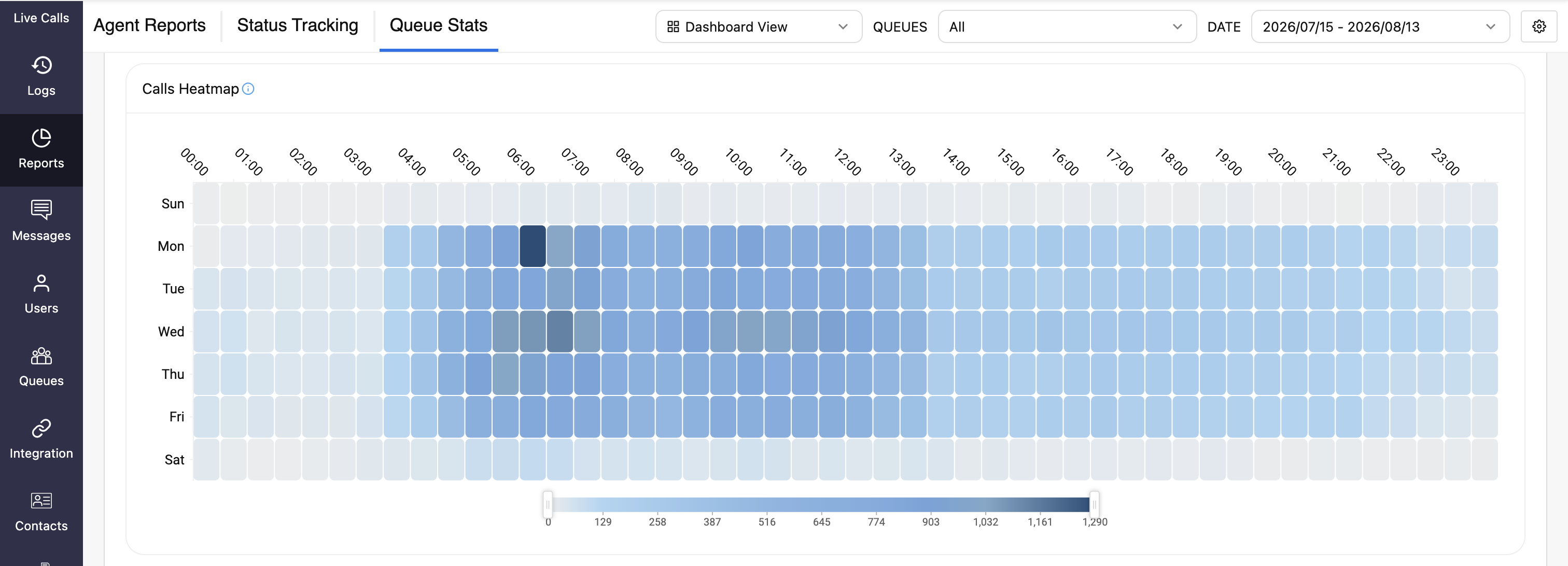
Calls Heatmap: Visual matrix that displays the distribution of incoming calls across selected days at every half an hour intervals. Hover over each cell to see the exact day, hour, and corresponding call count. User can adjust the call count range if needed to refine the heatmap view.
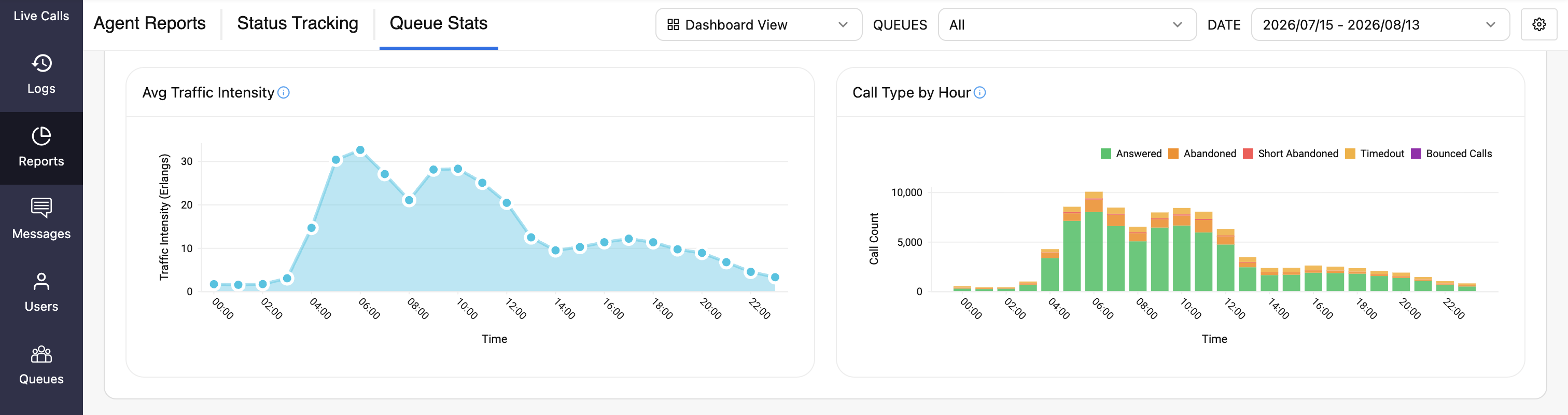
Avg Traffic Intensity: Displays the average traffic intensity for each hour, calculated from the total handle time (talk time + hold time) of answered calls. The values are measured in Erlangs, helping you understand the call load handled during each hour. Hover over a data point to view the traffic intensity for the selected hour.
Call Types by Hour: Displays an hourly breakdown of call types, including Answered, Timed Out, Abandoned, Short Abandoned, and Bounced, in a stacked bar chart. Hover over a segment to view the call count for each type during the selected hour.
Answered section
The Answered section provides detailed analytics for all answered calls. It highlights essential performance metrics to help assess agent responsiveness and queue efficiency for the selected date range and queue(s):
Wait Time: Displays the average and maximum duration callers spent waiting in the queue before being answered by an agent.
Hold Time: Displays the average and maximum duration callers were placed on hold after their call was answered, but before the conversation resumed or ended by the agent.
Talk Time: Displays the total, average, and maximum duration agents spent actively speaking with callers. This excludes both hold and wait times.
Handle Time: Displays the total, average, and maximum duration agents spent handling calls, including both talk time and hold time.
Call Duration (Avg): Displays the average length of a call, measured from the moment it enters the queue until it is disconnected.
Average Speed of Answer (ASA): Displays the average time it takes for agents to answer incoming queued calls, calculated from the moment the call starts ringing for an agent until it is answered.
Calls Missed by First Agent: Displays the number of calls that were not answered by the first agent but were eventually picked up by a subsequent agent. (Note: Not applicable for the Simultaneous Ringing type where the call rings for all agents in a queue at once.)
Call Transfer Rate: Indicates the percentage of answered calls that were transferred to another agent, queue, or other external number during the interaction.
Formula:
Call Transfer Rate(%) = (Number of transferred calls / Total answered calls) x 100

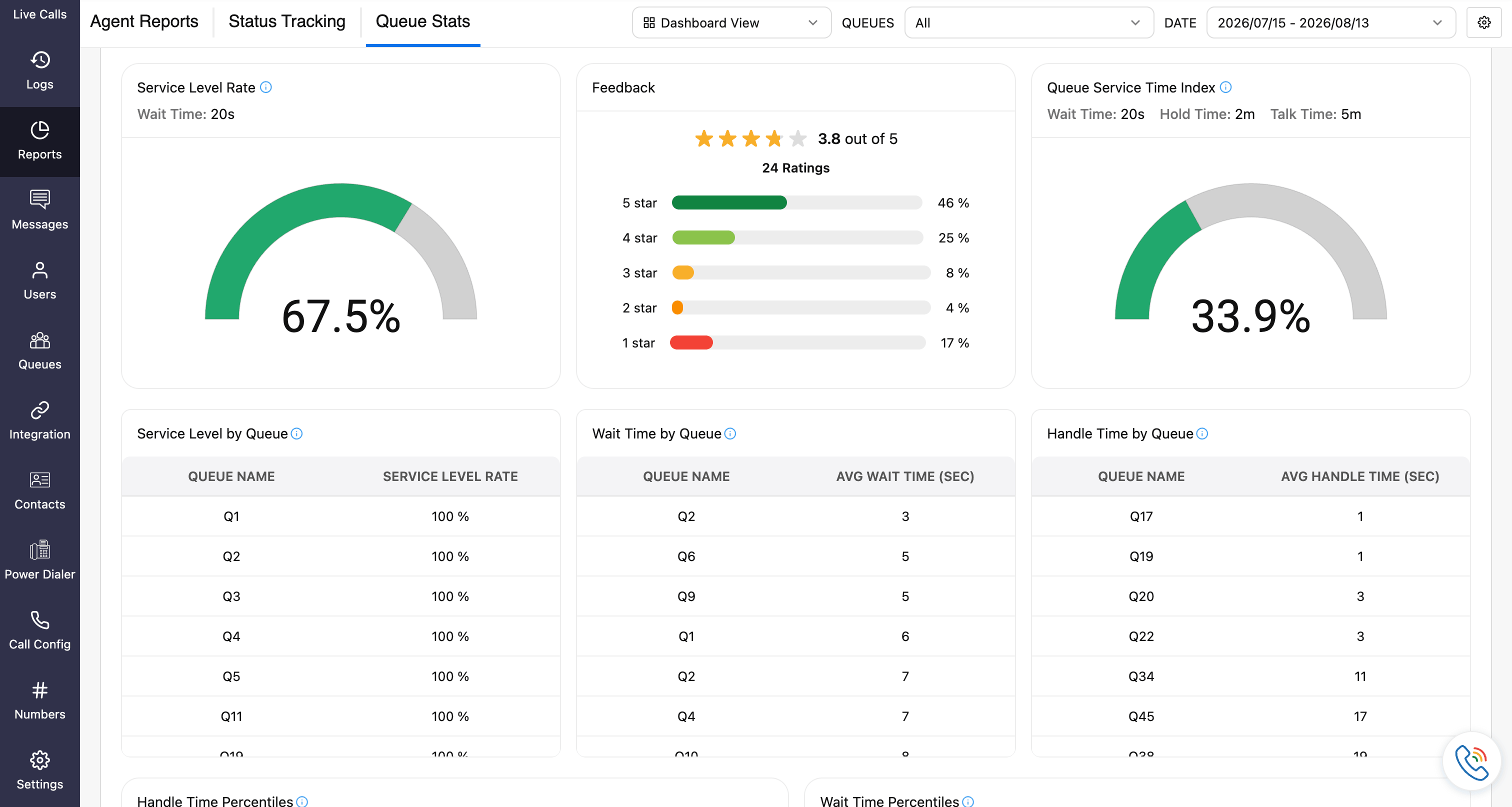
Service Level Rate: Displays the percentage of calls answered within the configured wait time threshold. This metric helps measure responsiveness.
Formula:
Service Level Rate(%) = (Number of calls answered within configured wait time threshold / Total answered calls) × 100
Feedback: Displays the consolidated feedback ratings submitted by callers.
Queue Service Time Index: Represents the percentage of answered calls that were handled within the configured thresholds for talk time, hold time, and wait time. This metric helps assess overall service efficiency and agent responsiveness.
Formula:
Service Time Index(%) = (Number of calls that met all three thresholds / Total answered calls) × 100
Service Level by Queue: Lists the top 10 queues with the highest service level rates.
Wait Time by Queue: Lists the top 10 queues with the lowest average wait time.
Handle Time by Queue: Lists the top 10 queues with the lowest average handle time.
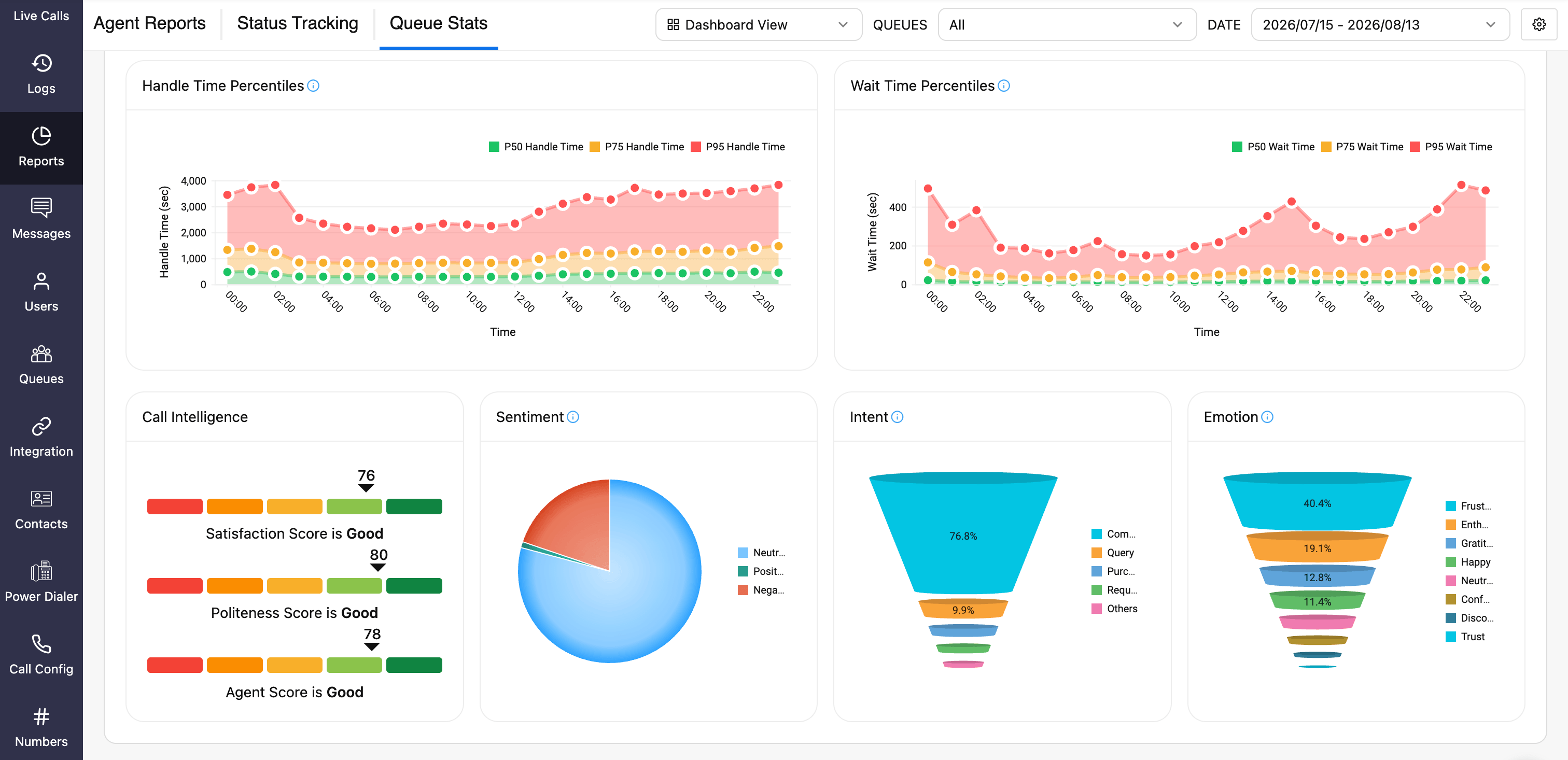
Handle time Percentiles(Hrs): Displays how handle times (talk time + hold time) are distributed each hour. P50 (50th percentile) represents the typical handle time, while P75 (75th percentile) represents the handle time of calls that took longer to handle, and P95 (95th percentile) represents the longest handle times across calls.
Wait Time Percentiles(Hrs): Displays how wait times are distributed each hour for answered calls. P50 (50th percentile) represents the typical wait time, while P75 (75th percentile) represents the longer wait time experienced by callers, and P95 (95th percentile) represents the longest wait times experienced by callers.
Call Intelligence: Displays the average AI-generated scores for queue calls with Call Transcription and Intelligence enabled. The scores include:
Satisfaction Score: Indicates the caller's level of satisfaction during the conversation.
Politeness Score: Indicates the agent's level of politeness while interacting with the caller.
Agent Score: Evaluates how effectively the agent handled the call.
Sentiment: Displayed as a pie chart, this visualization analyzes customer conversations and classifies the overall sentiment as Positive, Neutral, or Negative. Hover over a segment to view the call count for each sentiment.
Intent: Displayed as a funnel chart, this visualization analyzes customer conversations to identify the primary intent of the call, such as Complaint, Inquiry, or other supported intent categories. Hover over a stage to view the number of calls for each intent.
Emotions: Displayed as a funnel chart, this visualization identifies customer emotions expressed during conversations, such as Happiness, Frustration, Confusion, or Neutrality. Hover over a stage to view the number of calls for each emotion.
Unanswered section
This section presents analytics for all unanswered calls, providing insights into call patterns and agent availability for the selected date range and queues:
Off-Duty Calls: Displays the number of calls received outside the configured business hours that went unanswered.
Voicemails Left: Displays the number of voicemails left by callers due to agent unavailability.
Abandoned time (Avg): Shows the average duration callers waited in the queue before disconnecting, excluding calls that ended within the short-abandon time threshold.
Queue Busy Rate-Agents on a Call: Displays the percentage of incoming calls that went unanswered because all agents were occupied with other calls at the time the calls entered the queue.
Formula:
Queue Busy Rate(%) = (Number of unanswered calls due to agents being busy / Total incoming calls) × 100
Call Abandon Rate: Shows the percentage of incoming calls where callers disconnected while waiting in the queue before being answered by an agent, excluding those disconnected within the configured short-abandon time threshold.
Formula:
Call Abandon Rate(%) = [Number of abandoned calls / (Total incoming calls - Short abandoned calls)] × 100

Table Overview
The Table view displays the similar queue performance metrics in a structured tabular format, making it easier to analyze and compare data across queues.
On the Queue Stats page, select Table View from the view dropdown at the top of the page.

To customize the displayed columns, click the Settings icon and select Manage Columns.

Select the required metrics and click Save.
When multiple queues are selected, the table is sorted by Total Calls in descending order by default.
Click the sort icon next to a column header to sort the data in ascending or descending order.
The table view includes metrics available in the Dashboard view, along with additional metrics such as:
Calls put on hold: Number of answered calls that were placed on hold atleast once.
Missed Call Rate: Percentage of calls that went unanswered, including timed-out calls and all abandoned calls.
Call Handling Efficiency: Percentage of call time spent actively talking to callers versus time spent on hold. Higher values indicate more active conversation time and less time on hold.
Formula: Call Handling Efficiency (%) = (Average talk time / (Average talk time + Average hold time)) × 100, where average talk time and average hold time are calculated for answered calls. |
To export the table data, click the Download icon in the top-right corner of the page. Optionally, set a password for the downloaded file and click Download Now.

Note
A few metrics displayed as percentages in both the Dashboard and Table views are represented as counts in the downloaded CSV file.

Note
The applied filters are retained when switching between the Dashboard and Table views.