
Units of Measurement

Note: This feature is available only for certain plans. Visit the pricing page to check if it’s available in your current plan.
Units of Measurement are labels used to measure quantities, like meters stand for length, kilograms stand for weight, liters stand for liquids, or hours stand for services. They make it easy to count, track, and trade items accurately, ensuring everything stays precise and organized within the system. Without standard units, confusions can occur in orders, production, and inventory management.
Scenario: Charles Stone runs a business selling sugar, cooking oil and also offers home cleaning services. To keep track of all the diverse goods and service items offered, he uses units of measurement in Zoho Inventory and ensures every item is recorded using the correct unit.
He stores sugar by grams, oil by liters, and charges cleaning services by hours worked. This clear system improves accuracy, streamlines inventory management, and ensures customers are billed fairly, helping the business run smoothly.
What’s New in Units of Measurement?
Unit Groups are introduced as an enhancement of Unit Conversions. Your existing unit conversions will be combined and mapped together as a unit group named under its respective base unit.
Earlier with unit conversions:
- You will have to create individual conversions for the base unit to be converted to different target units.
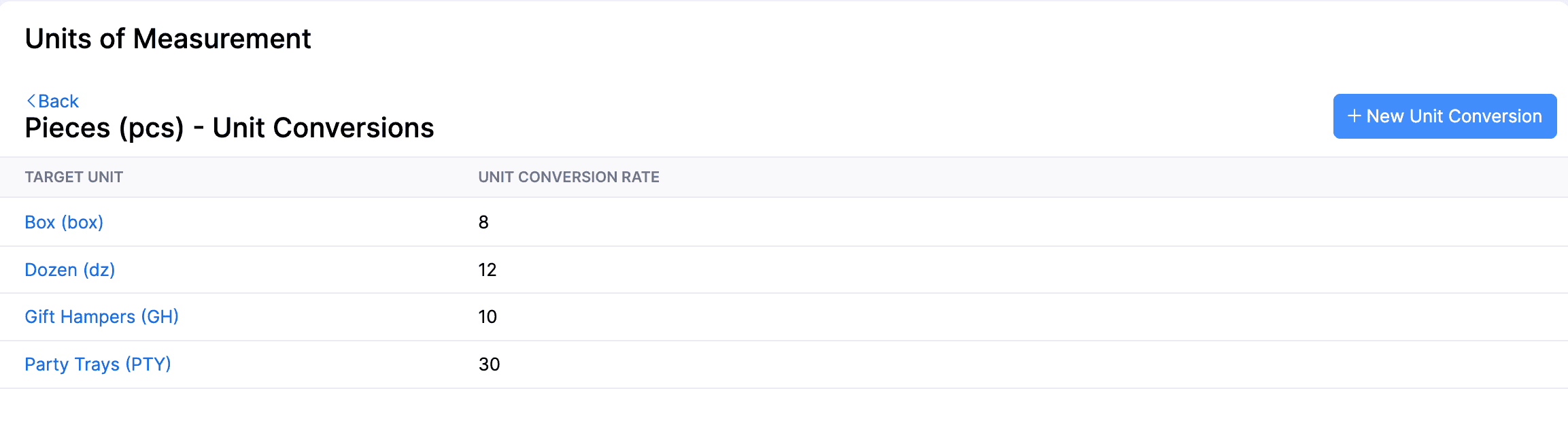
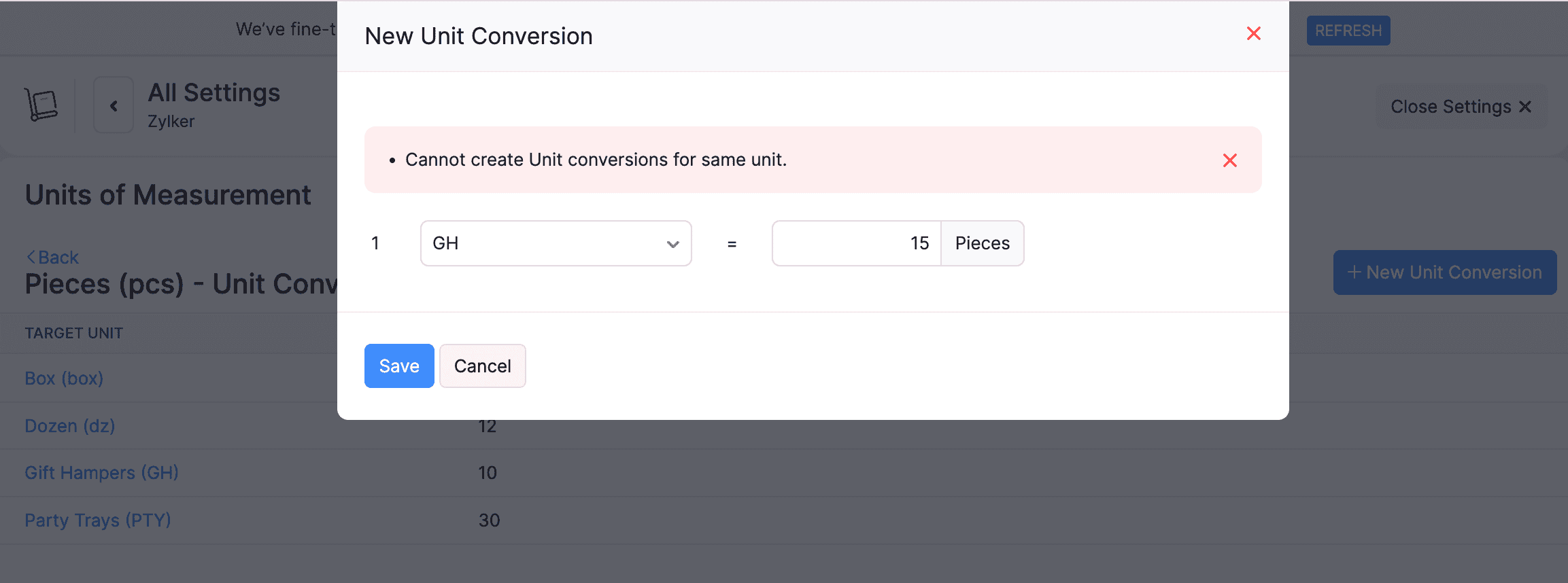
- You cannot create the same conversion with different conversion rates.
Now with unit groups, you can:
- Create two unit groups to facilitate the same conversion for different items.
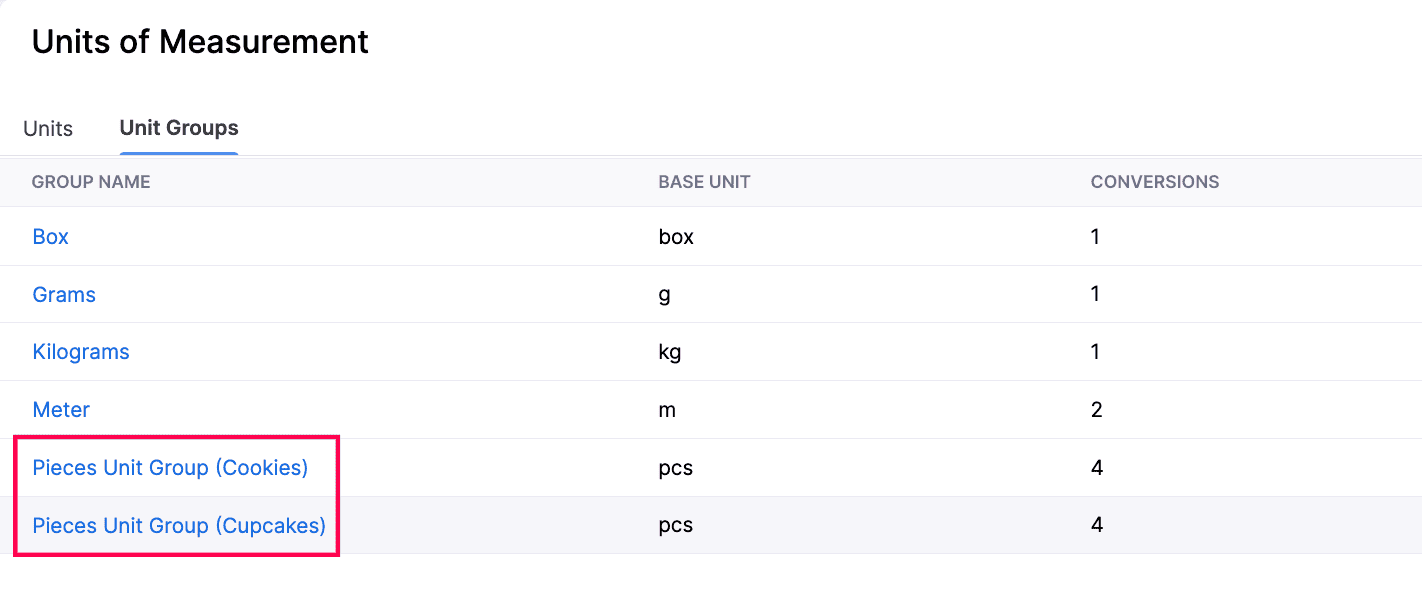
- Create the same conversions with different conversion rates based on your requirements.
Scenario: Patricia sells cookies and cupcakes, which are tracked in pieces as the base unit. Cookies are sold as 1 box of 5 pieces, while cupcakes are sold as 1 box of 8 pieces.
Previously with Unit Conversions, the base unit and target unit could be mapped with only one conversion rate. Which means she could create only 1 box equals 5 pieces or 1 box equals 8 pieces.
With Unit Groups, Patricia can create separate unit groups for both cookies and cupcakes, even though they share base and target units. She can define both conversions where 1 box equals 5 pieces for cookies and 1 box equals 8 pieces for cupcakes.
This allows the same units to have different values for different items, making Unit Groups more flexible and structured than individual unit conversions.
Units
Units are used anytime when the items are purchased, produced, stored, or sold, covering not just physical goods like sugar, oil, or chocolates, but also services measured in hours or logistics tracked by speed and time.
Create New Units
If you need units other than the available existing units, you can create a new unit in Zoho Inventory. Here’s how:
- Click the Gear icon at the top right corner of the page.

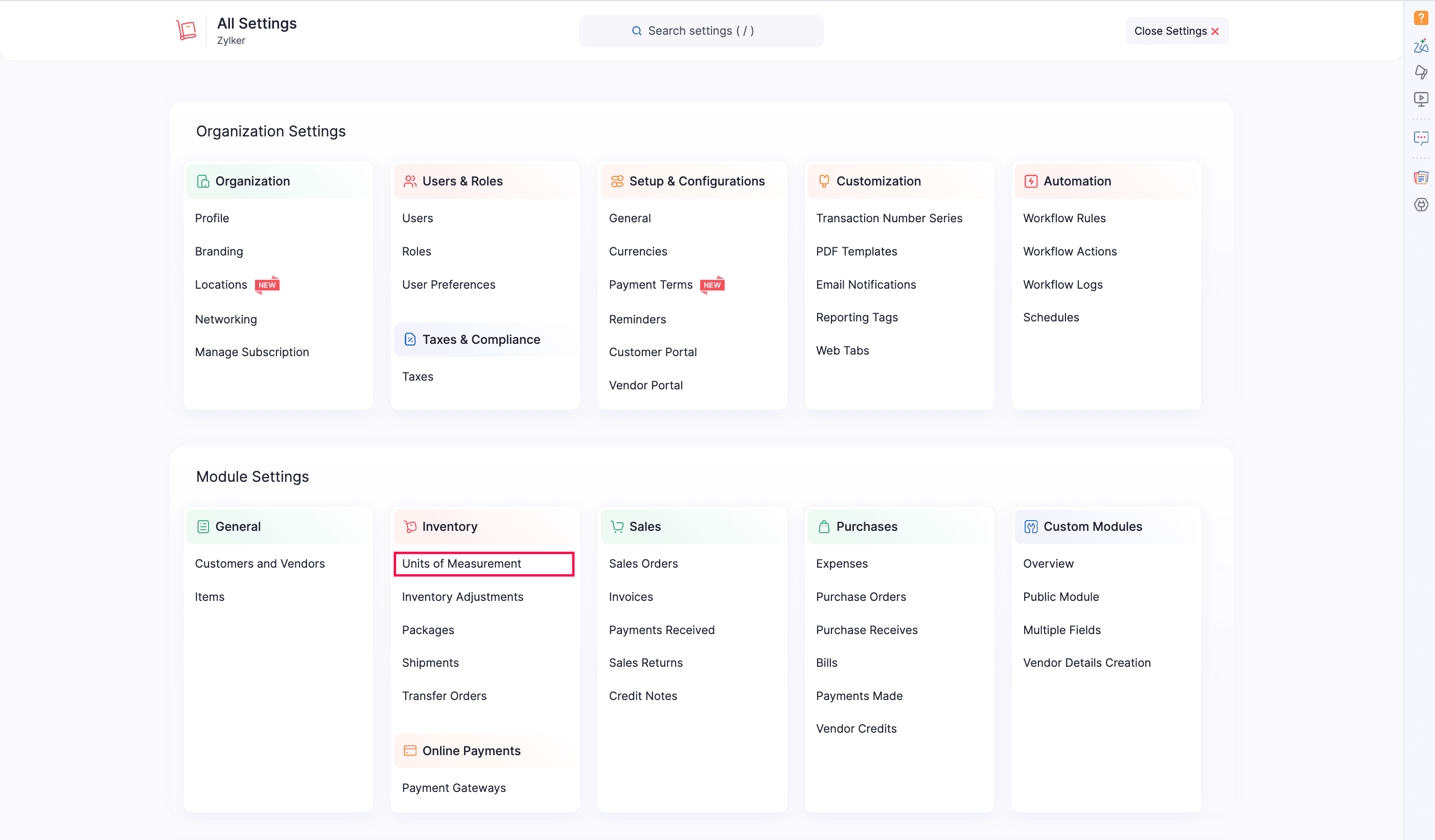
- Scroll down to Module Settings and click Units of Measurement under Inventory. You can also search for Units of Measurement in the search bar.
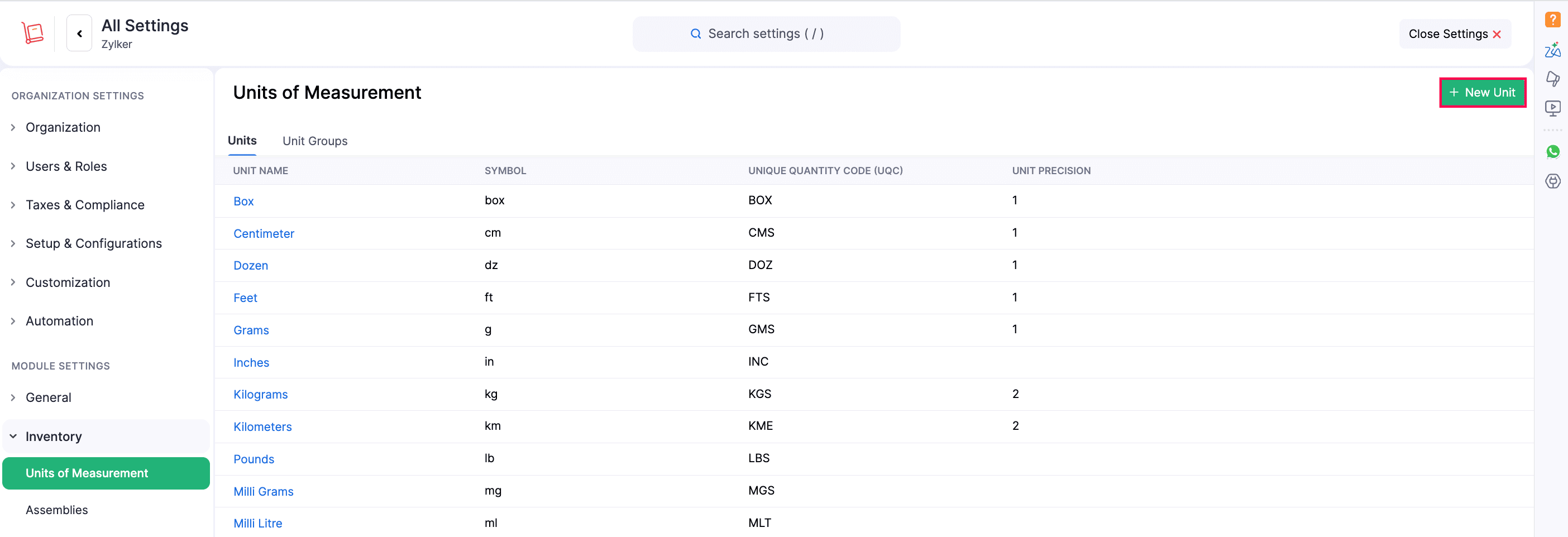
- Click + New Unit at the top of the page.
- Fill in the required details in the Create Unit page.
- Click Save.
| Field | Description |
|---|---|
| Name | Enter a name for the unit. |
| Symbol | Enter a symbol to identify the unit you create. For e.g., m stands for meter, km stands for kilometer and g stands for grams. This symbol will be used in the sales and purchase transactions. |
| Unique Quantity Code (UQC) (Applicable only for India, Kenya, and Singapore editions) | Select a unique quantity code from the dropdown for the unit. For e.g., LTR stands for litres, KMS stands for kilometers and DOZ stands for dozens. |
After creating units, you can associate them with the items if you want to do sales and purchase in the same units.
Unit Groups
Prerequisite: You’ll have to enable unit conversion in order to create unit groups.
Unit Group is a combination of unit conversions that allow an item to be measured in multiple units for sales and purchase of an item. One base unit is defined for the item and it is linked to different target units through unit conversions. This ensures all sales and purchase transactions follow consistent conversion logic, keeping stock levels, quantities, and pricing accurate for the associated item. They are particularly useful when items are purchased, stored, and sold in different units.
Key Component of Unit Groups
Base Unit: The base unit is the main unit you use to measure an item in your inventory. Example: In Patricia’s bakery, each cupcake is measured in pieces as the base unit.
Target Unit: Target unit is the converted units in which you want to sell or purchase your items. Example: Patricia sells cupcakes in dozens or boxes, which become the target units.
Unit Conversion: Unit conversion is used to define how many base units are equivalent to one target unit. This defined conversion rate is used to calculate item quantities during sales and purchase transactions automatically. Example: If 1 dozen is defined as 12 pieces, when Patricia sells 1 dozen cupcakes, the system automatically converts the quantity to 12 pieces and updates the inventory in the base unit.
Scenario: Patricia runs a bakery where cupcakes are tracked in pieces as the base unit. She sells them to customers in boxes of 5 or gift hampers of 10, and sometimes purchases them from suppliers in dozens or party trays.
Instead of individually mapping pieces to different target units, she creates a unit group with pieces as the base unit and maps all target units like boxes, gift hampers, dozens and party trays with their respective conversion rates in just a click. This allows her to manage all sales and purchase conversions within a single structured setup, making the configuration more organized and easier to maintain.
Enable Unit Conversion
Here’s how you can enable unit conversions:
- Click the Gear icon at the top right corner of the page.
- Scroll down to Module Settings and click Units of Measurement under Inventory.
- Click Enable Unit Conversion.

- Click Enable Unit Conversion again in the pop-up that follows to confirm.
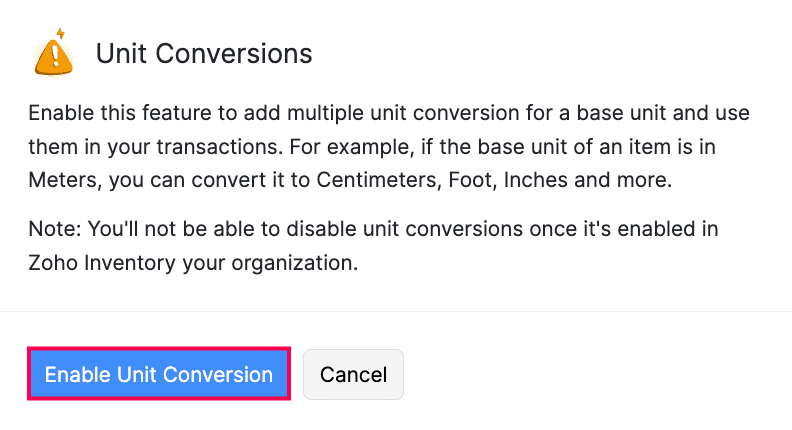
Warning: You cannot disable unit conversion once it is enabled for your organization.
After enabling unit conversion, you can see the Unit Groups tab next to Units tab at top of the Units of Measurement page. To create a unit group you should have defined unit precisions for your target unit and base unit.
Configure Unit Precision
Unit Precision is the number of decimal values you want to add for your units during the unit conversion. Rounding off values depend upon the unit precision configured here. Here’s how you can configure Unit Precision:
- Click the Gear icon at the top right corner of the page.
- Scroll down to Module Settings and click Units of Measurement under Inventory.
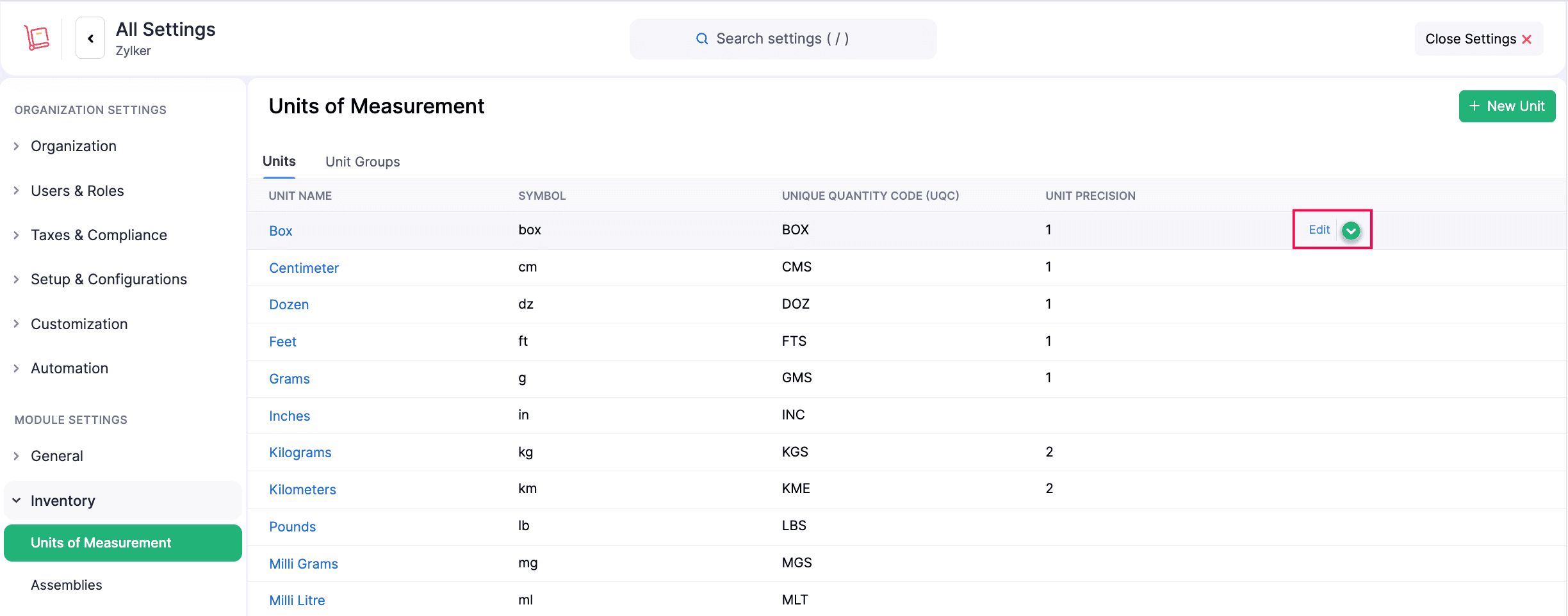
- Hover over the unit you want to edit in the Units tab.
- Click Edit next to the required unit.
- Select or search the preferable value in the Unit Precision field’s dropdown.
- Click Save.
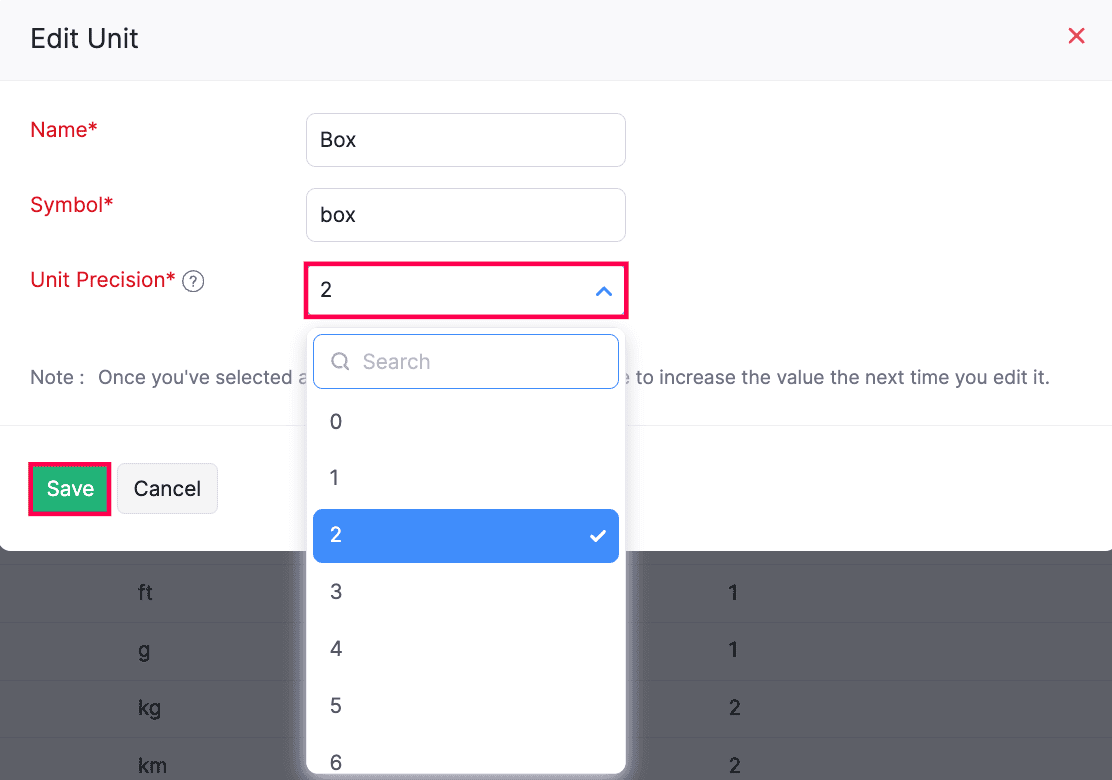
Warning: You cannot reduce the value of unit precision if the unit is associated with a transaction.
Create Unit Groups
Pro Tip: You can also create a new unit group while creating items in the New Item page under the Item Details section.
Here’s how you can create a unit groups in Zoho Inventory after configuring Unit Precisions:
- Click the Gear icon at the top right corner of the page.
- Scroll down to Module Settings and click Units of Measurement under Inventory.
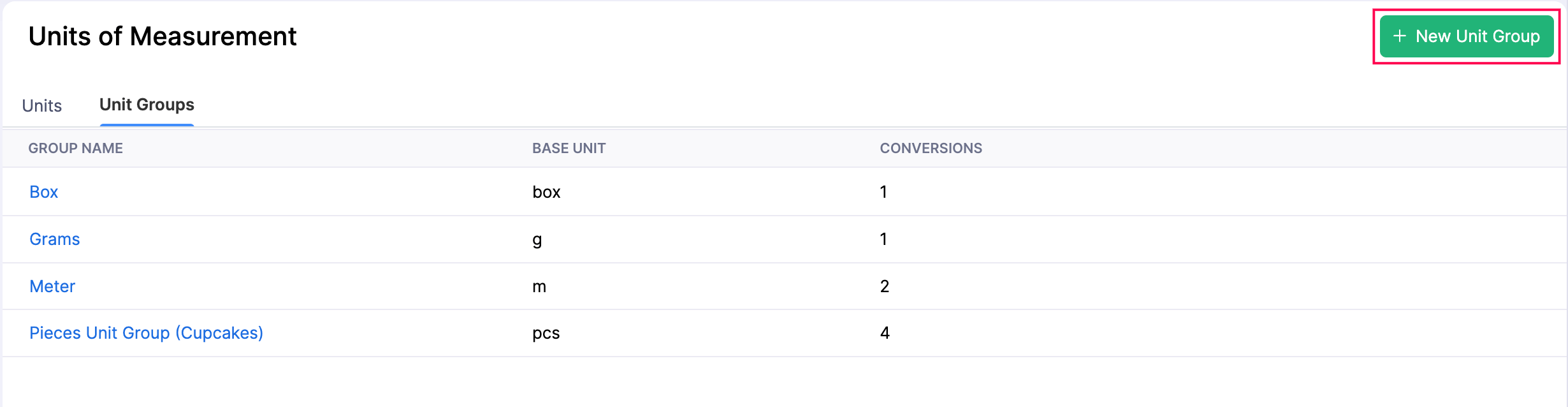
- Click the Unit Groups tab in the Units of Measurement page.
- Click + New Unit Group.
- Enter a name for your unit group.
- Select the required base unit from the dropdown.
- Under Unit Conversions, you can map the required target units and configure conversion rates.
- Select the required target unit from the dropdown.
- Enter the conversion rate value to define how many items in inventory will be affected during a sales or purchase.
- Click + Add Conversion to create a new conversion inside the unit group.
- You can set up multiple unit conversions under one group.
- Click Save.
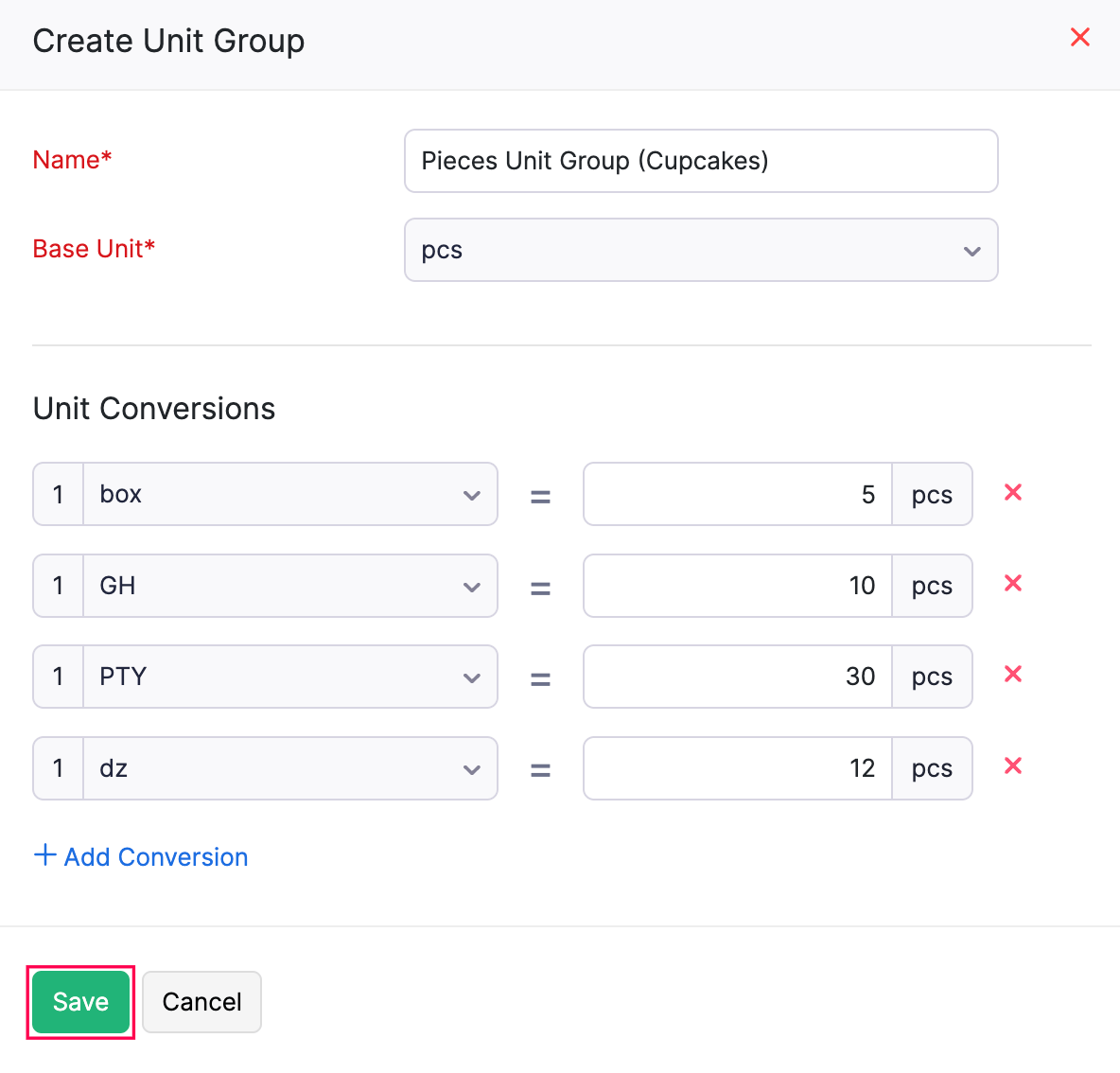
Note: A unit group cannot have two conversions with the same base and target units. If you want to create conversions for the same base and target unit with different rates of conversion, you can create separate unit groups.
Associate Units and Unit Groups to Items
Here’s how you can associate the created units or unit groups with Items:
- Go to Items on the left sidebar and navigate to Items.
- Click the + icon near Items or + New on the top right corner of the Items page.
- Click Edit to associate units or unit groups with existing items.
For Units:
- Select Unit in the Unit field dropdown under Item Details section if you want to sell and purchase items in same units.
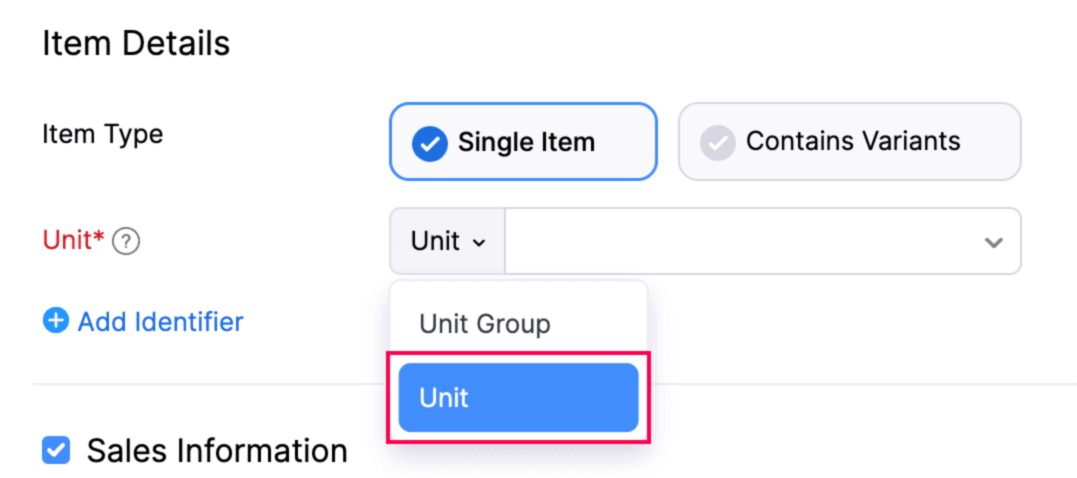
- Search or select the required unit to associate with the item. The selected unit will be the base unit of your item.
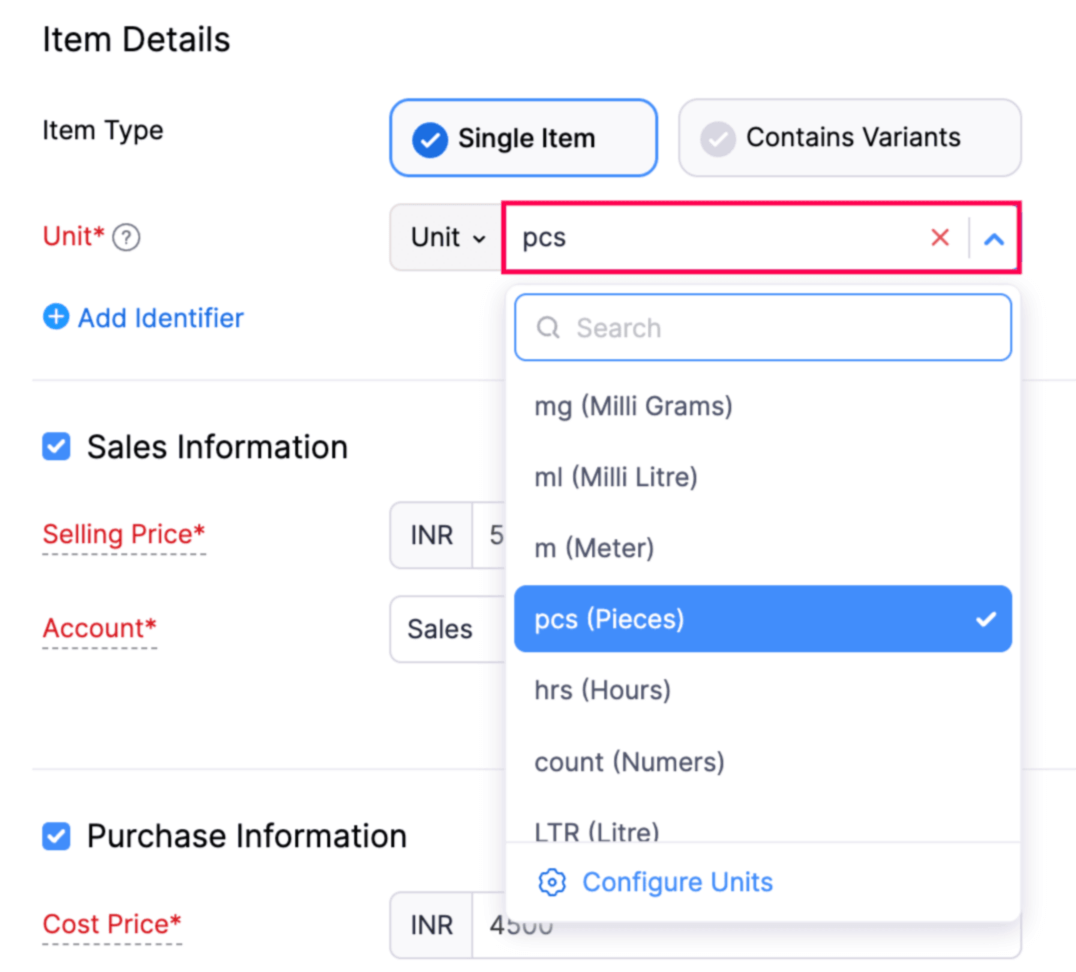
Note: You cannot set default sales and purchase unit if you select unit.
For Unit Groups:
- Select Unit Group in the Unit field dropdown under the Item Details section if you sell and purchase items in different units.
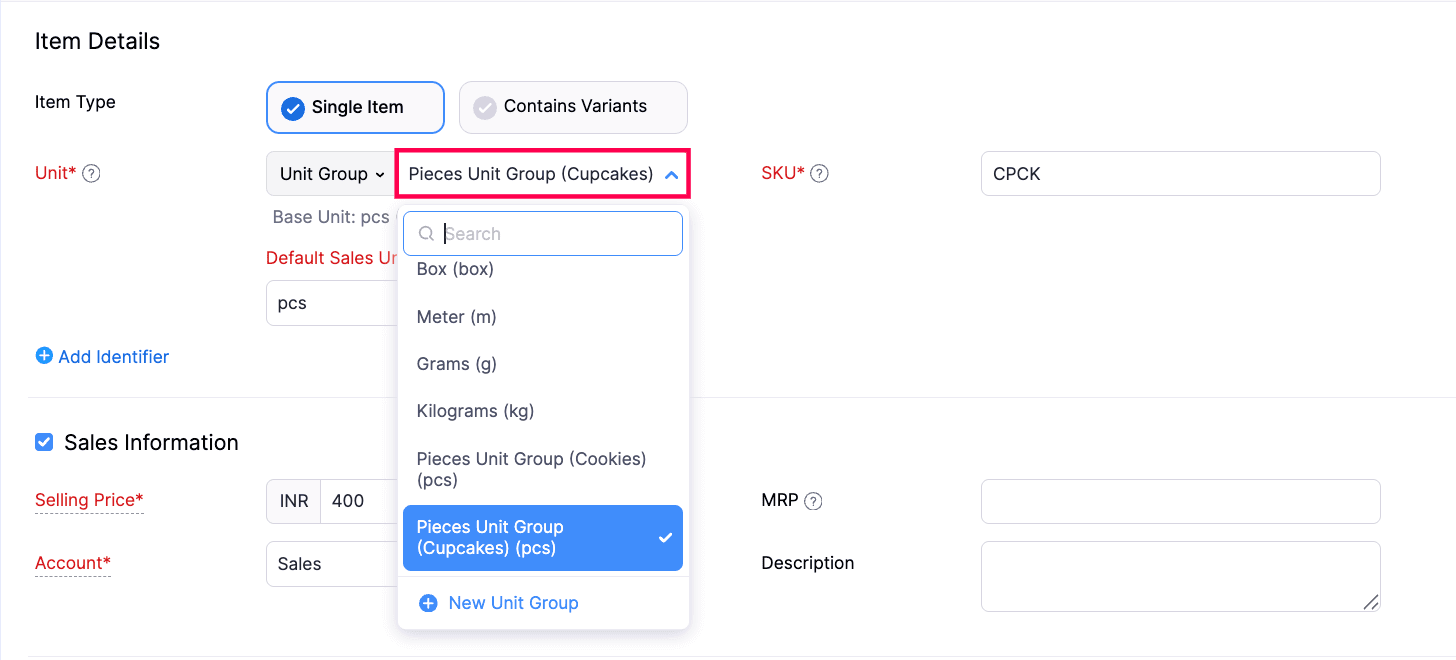
- Search or select the required unit group to associate with the item. The base unit configured for unit group will become the item’s base unit by default.
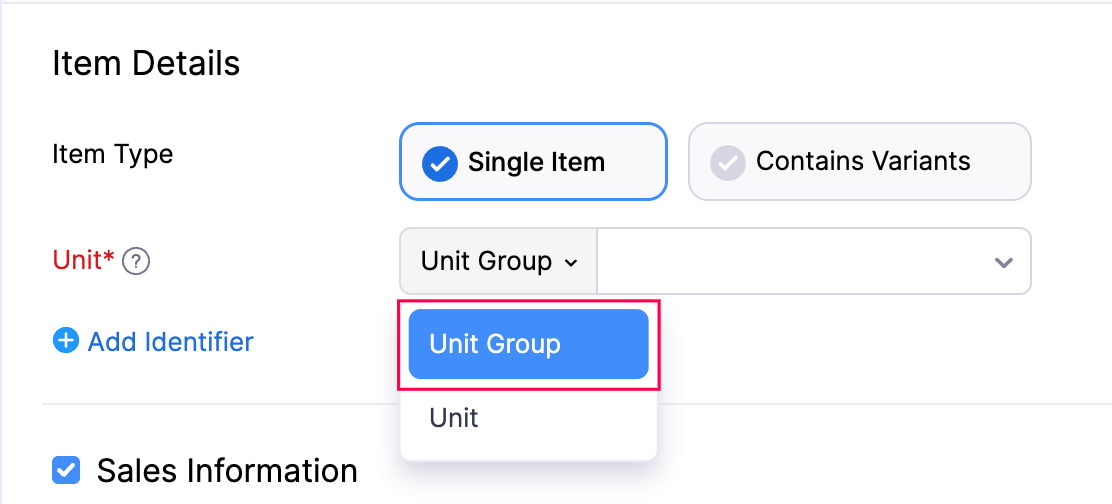
- Once the unit group is selected, you can select default sales unit and purchase unit from the dropdown.
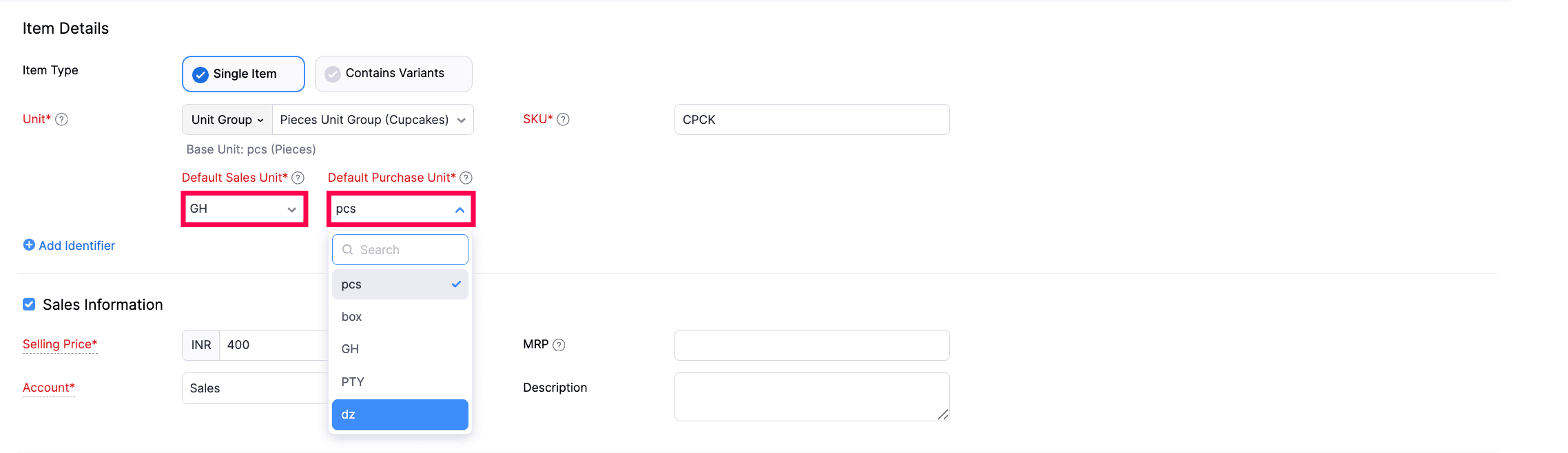
Note: When you create any sales or purchase transaction, the quantity will be measured in the default sales or purchase unit entered here.
- Click Save, once you fill in all your item details.
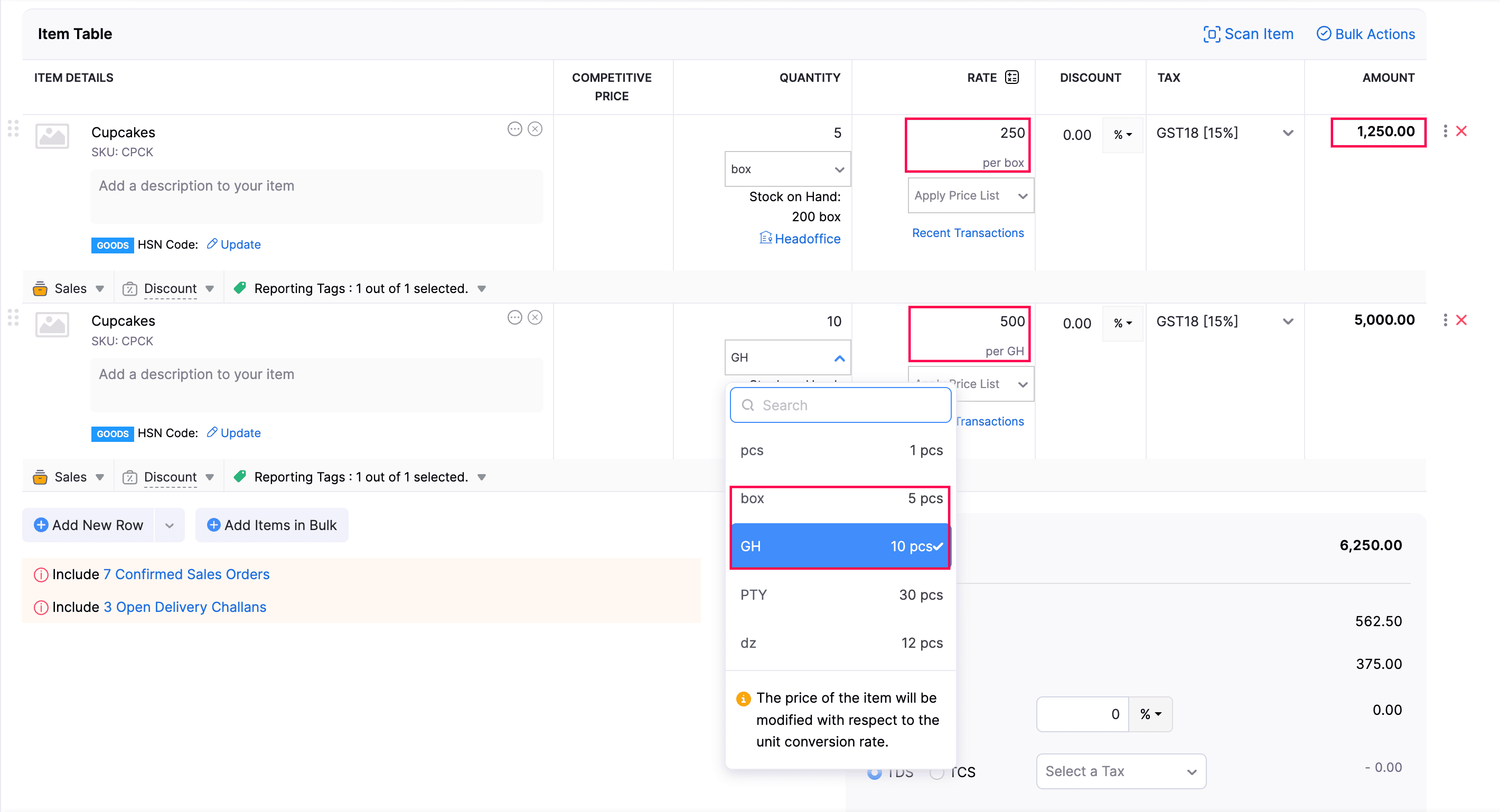
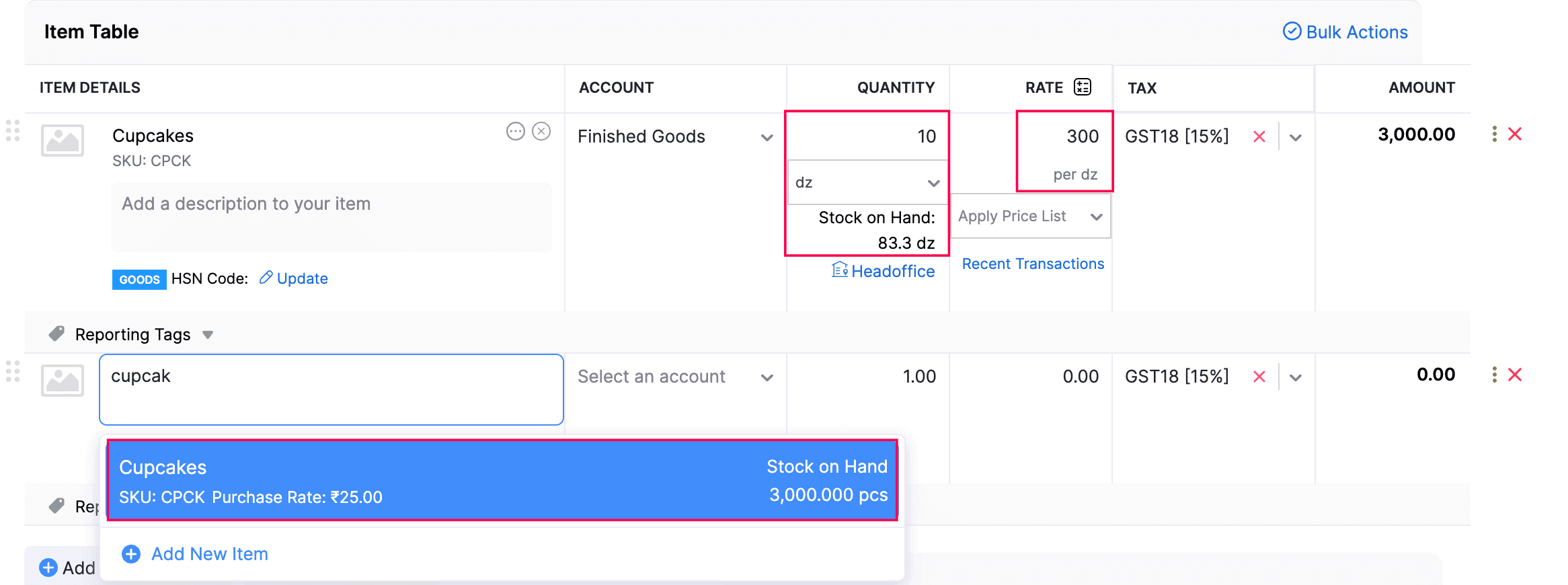
You can also change the default sales and purchase units when you create the respective transactions. The item’s stock on hand, rate, and amount will be calculated based on the conversion rate configured under unit group in the Item Preferences.
For Sales Transactions
For Purchase Transactions
Edit Units and Unit Groups
Note: This action is applicable for both Units and Unit Groups.
You can edit and update changes to the existing or the new units of measurement you create. Here’s how:
- Click the Gear icon at the top right corner of the page.
- Scroll down to Module Settings and click Units of Measurement under Inventory.
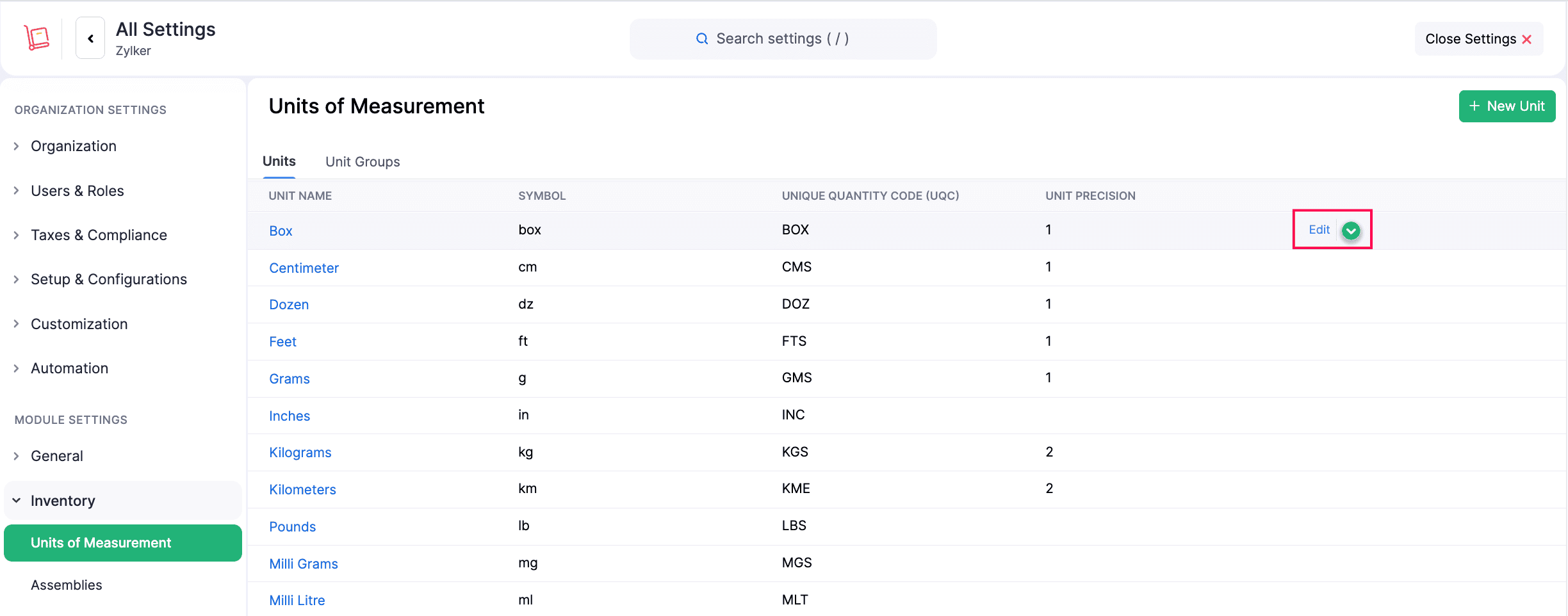
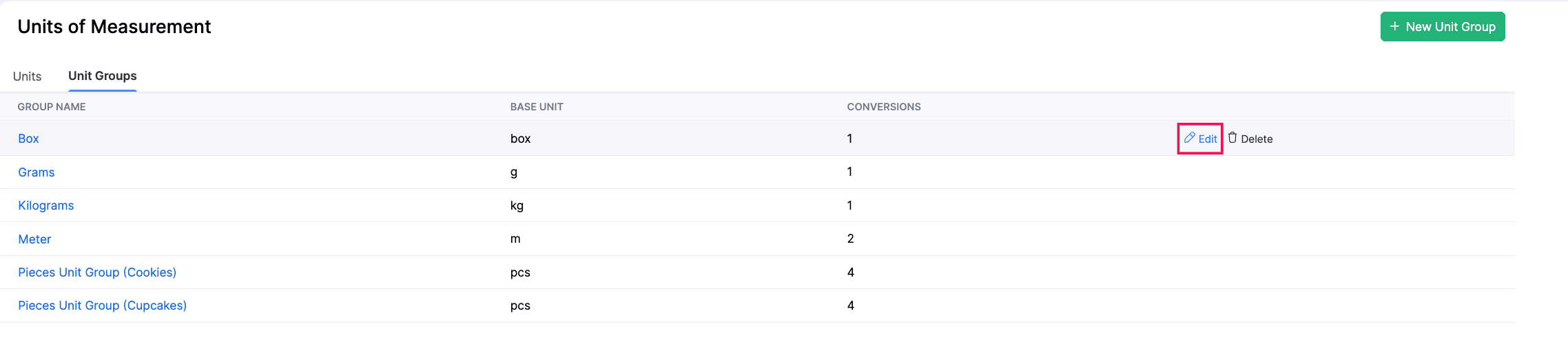
- Hover over the unit of measurement you want to edit.
- Click Edit next to the required unit of measurement.
Units:
Unit Groups:
- Fill in the required details in the Edit page.
- Click Save.
Delete Units and Unit Groups
You can delete units of measurement if you no longer need them. Here’s how:
Note: You cannot delete a unit of measurement that is associated with in a transaction. Disassociate it first and then try deleting it.
- Click the Gear icon at the top right corner of the page.
- Scroll down to Module Settings and click Units of Measurement under Inventory.
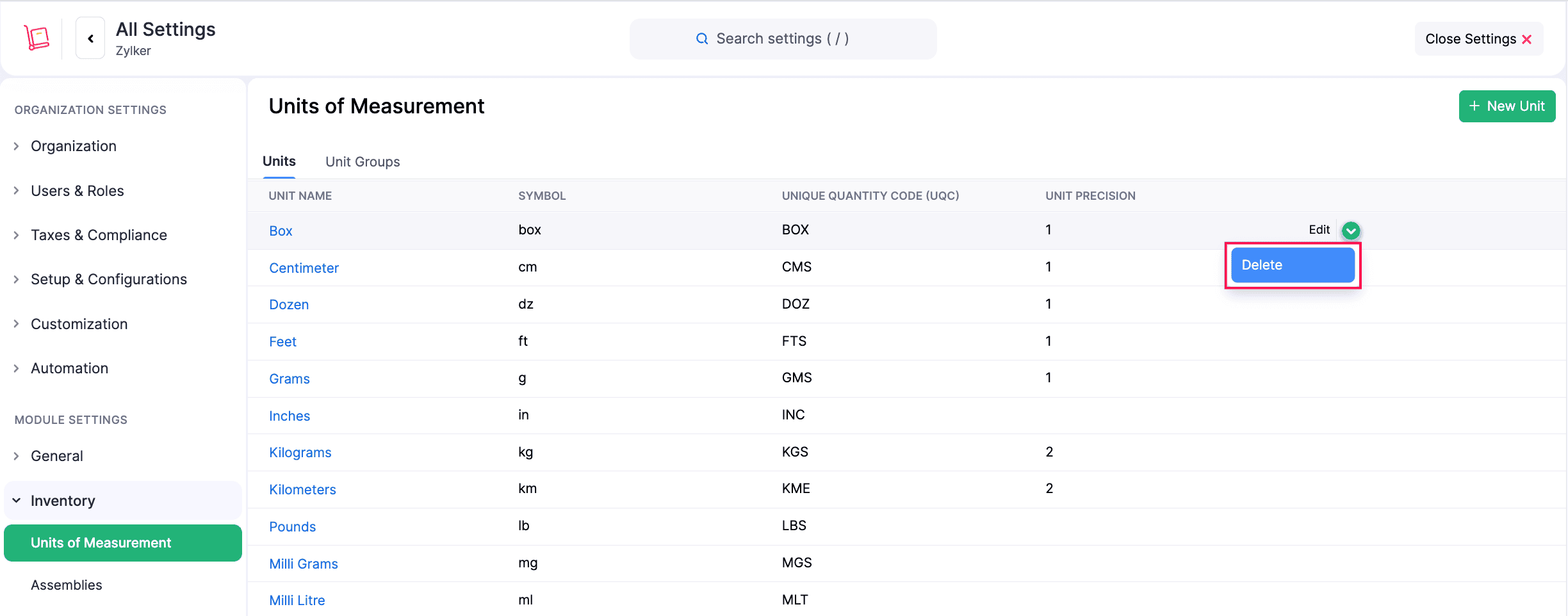
- Hover over the unit of measurement you want to delete.
- Click the dropdown and select Delete for a unit.
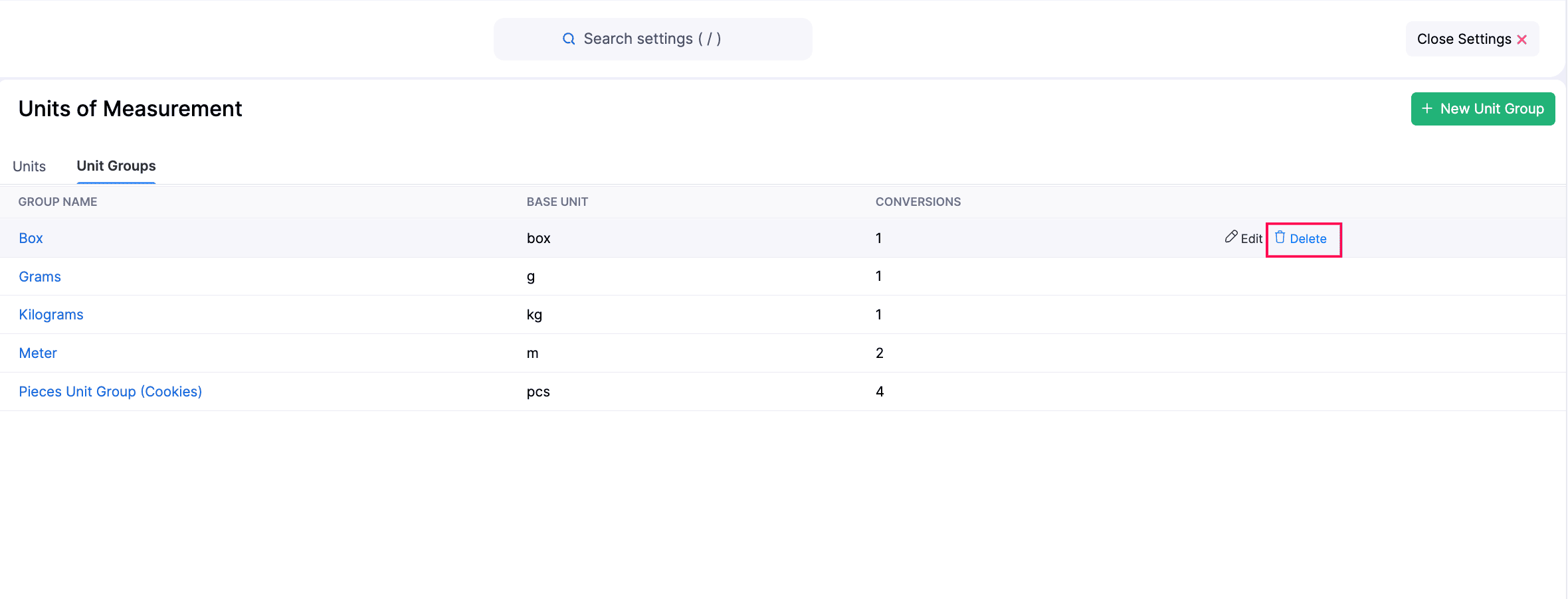
- Click Delete directly if it is a unit group.
- Click Delete in the pop-up to confirm.