

- HOME
- Taxes & compliance
- Sales tax exemptions explained for newbies
Sales tax exemptions explained for newbies
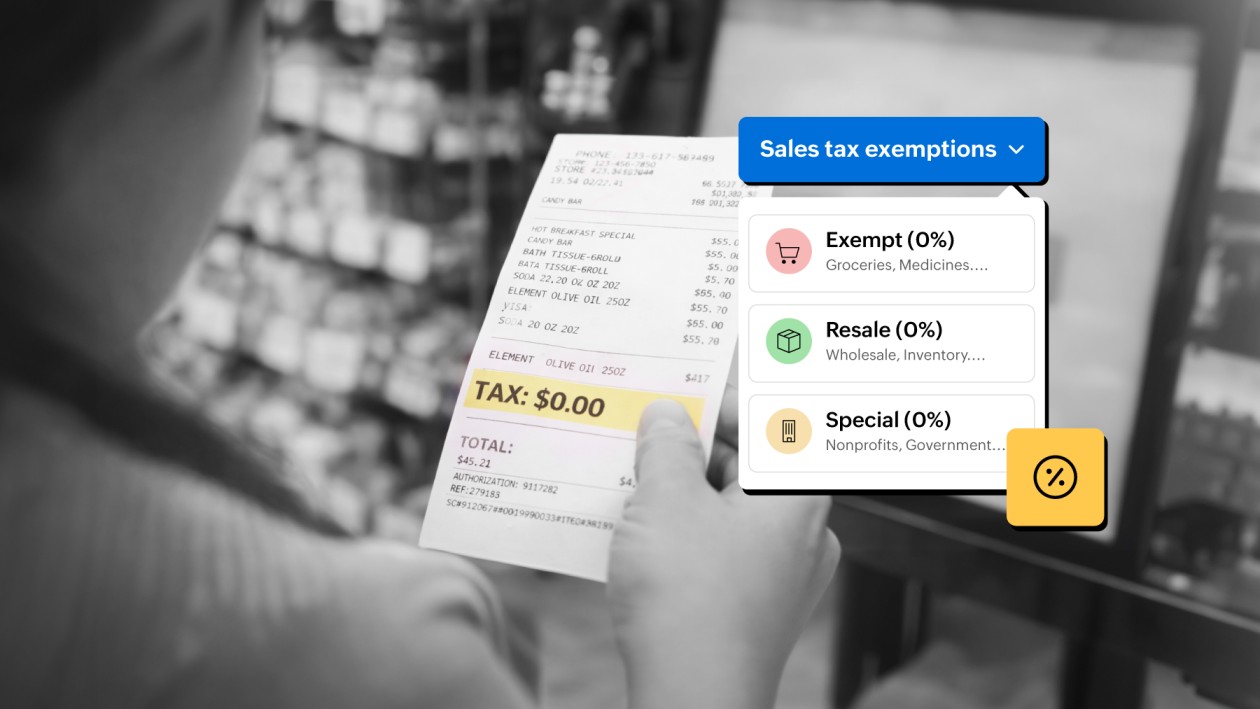
You're at the cash register, the cashier calculates your total, and then adds on a few extra dollars for sales tax. We all know the drill. But did you know that sometimes sales tax doesn't need to be applied? This is a legal policy, not a loophole. It's called a sales tax exemption.
The basics: What is sales tax?
Sales tax is a percentage added to the price of goods and services at the point of purchase. In the US, it's set at the state level (sometimes the county or city level too), which is why you pay 0% in Oregon and a hefty 10.25% in parts of Illinois. There is no single, standard national rate, which makes it slightly complex for business owners.
What is a sales tax exemption?
A sales tax exemption is when certain purchases, or certain buyers, are legally excluded from paying sales tax. These exemptions usually exist to reduce the financial burden on specific groups or to avoid taxing things twice in a supply chain.
Types of sales tax exemptions
Here are a few categories that fall under sales tax exemptions.
Select goods and services: Groceries are the classic example. Many US states don't tax unprepared food/raw ingredients. Prescription medications are similarly exempt in most states. Children's clothing gets an exemption in several states.
Select buyers: Non-profits, churches, and government agencies typically don't pay sales tax on purchases made for their organizations. For example, a hospital buying medical supplies or a school buying textbooks are transactions that can be exempt. In simple words, the government isn't taxed when it is buying from itself, similarly non-profits serving the public good are exempt.
Resale exemptions: If you're a retailer who buys products to resell, you don't pay sales tax when you purchase that inventory because the end consumer will pay it when they buy it from you. Charging it twice would be double taxation. Businesses use a resale certificate to claim this exemption with their suppliers.
Manufacturing exemptions: Many US states exempt raw materials and equipment used directly in manufacturing. For example, if you're making furniture and buying lumber, that lumber usually isn't taxed.
How do you claim a sales tax exemption?
Businesses and organizations can claim exemptions with sales tax exemption certificates. An exemption certificate is a form that identifies who you are, why you qualify, and what you're buying. Vendors are required to keep these on file, and if they can't produce them during an audit, they could be on the hook for the uncollected tax.
For individuals, some exemptions are automatic, the store just doesn't charge tax on exempt items. Others, like a sales tax holiday (like during the back-to-school season), apply during specific windows of time.
When a tax exemption applies to all residents in a given jurisdiction, the buyer wouldn't need to prove the sales tax exemption with a certificate (like for groceries). In cases of conditional or use-based exemptions, an exemption certificate is required to prove that the sales is sales tax exempt.
The catch
Exemptions are not uniform across state lines; what's exempt in Texas might be fully taxable in New York. A non-profit that's exempt in one state may need to register separately in another, and the rules keep changing constantly.
If you're a remote seller or an e-commerce business, it's crucial to note that many states have introduced economic nexus laws requiring remote sellers to collect and remit sales tax once specified thresholds are exceeded. You can learn more about how it applies to your state here.
The existence of Streamlined Sales Tax (SST) helps ease the process for sellers. SST is a state-initiated program, in which sales tax and use tax compliance are both simplified for businesses operating across multiple states. Currently, sales tax exemption certificates under the SST program are accepted by 24 member states, including:
Arkansas
Georgia
Indiana
Iowa
Kansas
Kentucky
Michigan
Minnesota
Nebraska
Nevada
New Jersey
North Carolina
North Dakota
Ohio
Oklahoma
Rhode Island
South Dakota
Tennessee (Only associate member)
Utah
Vermont
Washington
West Virginia
Wisconsin
Wyoming
SST establishes a streamlined way to handle sales tax exemptions. Whether you’re selling to exempt entities or claiming exemptions for your own business, SST helps simplify the process for single purchases or blanket use across states. Nevertheless, sellers must apply state-specific exemption rules carefully, as improper use may result in criminal liability for buyers and compliance gaps for sellers.
The takeaway
Sales tax exemptions exist to protect consumers from double taxation, support non-profits and government functions, and keep supply chains from getting priced out of competitiveness.
If you run a business, exemptions are worth understanding carefully. It helps cut costs when you buy from exempt organizations and applies fair rules when exempt buyers purchase from your business. Although it is a complex concept, it's crucial to understand to ensure you have clean books.
Maintaining clean books becomes much easier when using software with a user-friendly interface, flexible pricing, advanced automation, and customizable features. That's what Zoho Books is built around. You can learn more about our comprehensive accounting platform here.