

- HOME
- Taxes & compliance
- The complete guide on late payment charges in the UK
The complete guide on late payment charges in the UK
Key Takeaways
When can you collect late payment charge? A payment becomes overdue on the agreed due date, or after 30 days from invoice or delivery if no date was agreed.
What can you do: The Late Payment of Commercial Debt Act, 1998 gives you the legal right to charge interest, fixed compensation and recovery costs.
You can charge statutory interest at 8% above the Bank of England base rate automatically, even without a contract clause.
Fixed compensation per overdue invoice ranges from £40 (under £1,000) to £70 (£1,000–£9,999) to £100 (£10,000+).
Additional reasonable recovery costs (e.g. solicitor fees, debt collection charges) can also be claimed with proper evidence.
When a customer refuses to pay the agreed late charge, the Small Business Commissioner offers a free complaints service for disputes and the small claims track is to pursue unpaid invoices independently.
Best practice: Set clear payment terms upfront, invoice immediately on delivery, and send a friendly reminder before the due date.
The Commercial Payments Bill (2026) proposes mandatory automatic interest, a 60-day payment cap for large businesses, fixed invoice dispute windows, and real enforcement powers for the SBC.
- Zoho Books helps you invoice on time, automate payment reminders, and keep a full audit trail ready for any late payment claims.
"11 billion pounds... That's what late payments cost the UK economy every single year," claims the Small Business Commissioner (SBC) site. Zooming into the macro-economics, there are real businesses who couldn't pay for necessities and suppliers who extended credit they couldn't afford.
The legislation is indeed there. The Late Payment of Commercial Debt Act, 1998 governs this space. It comes into play when a payment becomes overdue, what interest you can charge, and what compensation you're entitled to claim. This guide walks you through all of it and helps you create a good collection process coded in your daily activities.
What counts as a late payment in the first place?
The answer depends on whether you agreed to a payment date or not.
If you and your client agreed on one, that date is the deadline. The moment it passes without payment, your rights under the 1998 act kick in. If no payment date was agreed to, then the law fills that gap: The default is 30 days from the date your customer received the invoice, or the date you delivered the goods or completed the service, as stated on the UK government's official website.
Ageing reports in Zoho Books help you stay on top of overdue invoices at all times.
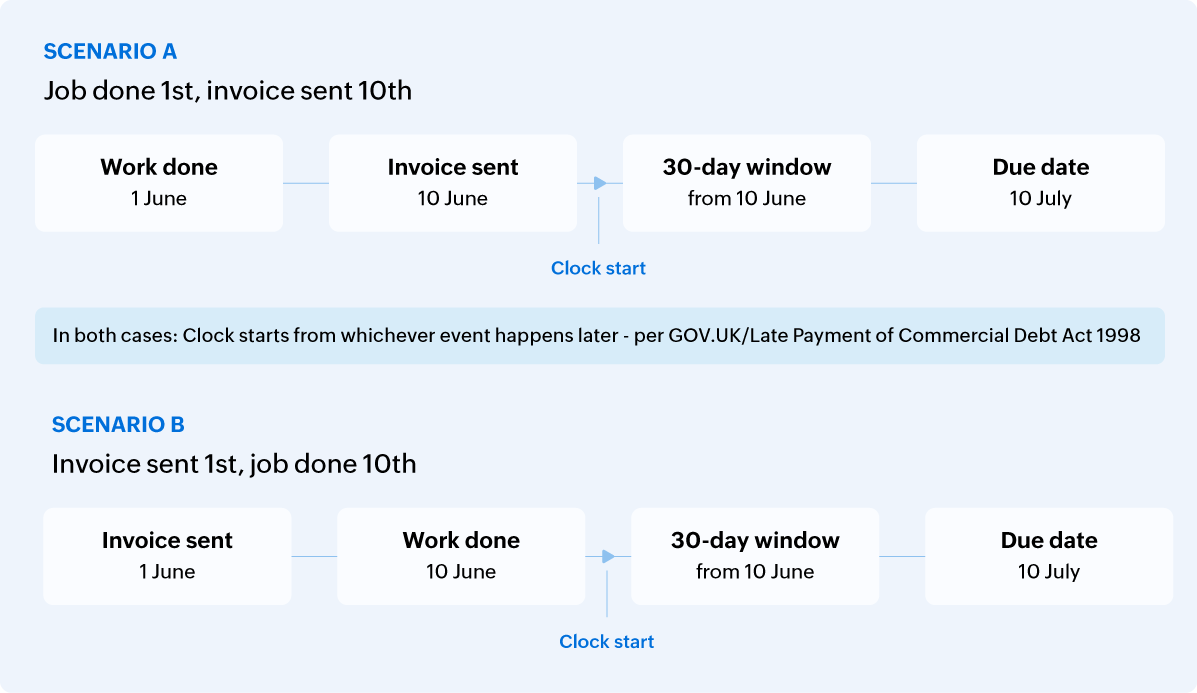
Case 1: If you finish a job on 1 June but send the invoice on 10 June, the 30 days start 10 June, not from when the work was done. So, raise the invoice as soon as your work is done.
Case 2: If you raise the invoice on 1 June and complete the work on 10 June, the trigger starts from 10 June. Delivering the service is crucial to calculate late payment.
Note: The payment terms are flexible as long as both parties are aware of them and agree. This means large enterprises can negotiate longer payment terms. Many SMBs agree to this as they are not willing to sacrifice the relationship with big clients, even when the payment terms cause financial and operational strain. This has given rise to many grievances from small business owners, which is being acknowledged in the new Commercial Payments Bill (being discussed in Parliament as of July 2026). We have addressed the proposed reforms later in the article.
Keep your eyes peeled for updates, too!
Late payment fee when selling to individuals
The Late Payment of Commercial Debt Act of 1998 does not apply to consumer transactions. For B2C, you can still charge late payment interest or fees, but only if your terms and conditions state this upfront before the sale, the rate is fair and reasonable under the Consumer Rights Act, 2015, and it's transparent to the consumer from the start. There's no statutory interest rate and it's entirely contractual.
What and how much can you charge for a late commercial payment?
The Late Payment of Commercial Debt Act, 1998, gives you three rights to charge the late payments legally.
Statutory interest
You're entitled to charge interest at 8% above the Bank of England base rate. This applies automatically, you don't need to have written it into your contract. But if your contract specifies a different rate, that rate applies instead, as long as it represents a substantial remedy for the late payment.
Fixed compensation
On top of the interest, you can charge a fixed sum to cover the cost of recovering the debt. The amount depends on the size of the invoice, which also implies that this is calculated per invoice, not per client. If a client owes you on three separate invoices, you can claim the fixed sum three times.
Reasonable recovery costs
If your actual costs of chasing the debt exceed the fixed compensation amount (think solicitor letters, debt collection fees) you can claim the difference as well. The law allows you to recover reasonable costs, provided you can prove them.
How to calculate late payment interest
The statutory interest calculation
If the Bank of England base rate is 3.75%, the additional statutory interest 8% gets added to it, which is 11.75%.
If you are owed £1,000 pounds, then 11.75% of that (£117.5) is what you call "annual" statutory interest.
Divide it by the number of days in a year to get the per-day value of £32 a day. If your invoice is overdue for 30 days, the interest is (30 x 0.32) or £9.60.
Fixed compensation
This depends on the amount of the invoice in question:
Invoice amount | Fixed compensation |
Up to £999.99 | £40 |
£1,000–9,999.99 | £70 |
£10,000 or more | £100 |
Recovery costs
You can also add the recovery costs, if you have valid proof.
For the new rate combining the invoice value (actual payment for the service you delivered), the interest that was calculated upon the agreed interest rates, the fixed compensation, and the recovery costs if any, you can raise an invoice again with all these as separate line items.
How to exercise your right and enforce late payment charges without killing relationships
More than half (52%) of small businesses in the UK experienced late payments in the first quarter of 2025, according to the Federation of Small Businesses. The tension is widespread and, while the government is bringing a new bill, here's what you can do now.
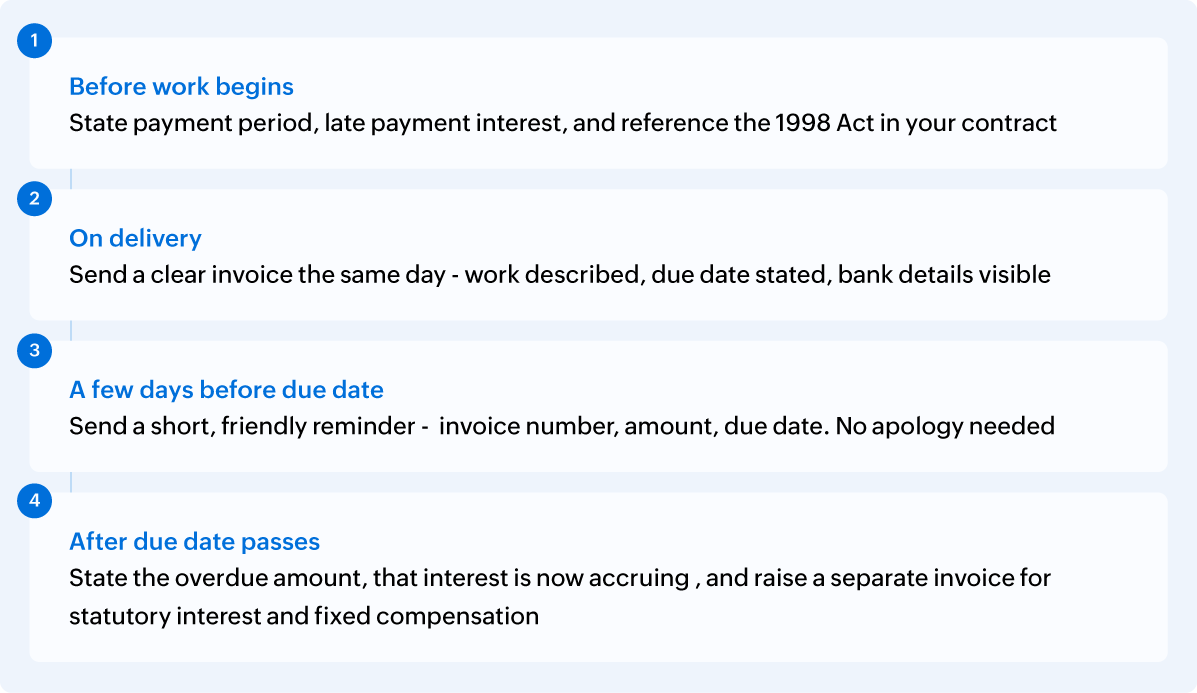
Put all terms in the contract before the job starts
The best time to establish payment terms is when both parties are still keen on each other. State your payment period clearly, referencing the Act, and specify that statutory interest will apply to overdue invoices. When delays arise, this makes it feel like a standard practice rather than a confrontation. You can find more ways to avoid payment delays here.
Invoice clearly and immediately
This is something that is completely in your control. A clear invoice with the work described, the payment due date stated, and your bank details visible leaves no room for disputes or statements like, "we weren't sure what this was for." It is also imperative to send it the day the work is delivered.
Chase early
A friendly reminder a few days before the due date is good practice; sometimes, your client just honestly forgets to pay. A short, professional nudge often resolves it before it becomes overdue and bleeds into the relationship you built.
When it does go overdue
A straightforward message can be sent stating the invoice number, the amount, the due date, and also highlight that the interest is now accruing as per the contract. Most customers pay during this time.
Who can help you if the client becomes non-responsive?
If the invoice remains unpaid after a reasonable period and the silence is starting to affect your business, raise a separate invoice for the statutory interest and fixed compensation one last time. This signals you know your rights and intend to use them. If it still doesn't move the client, the Small Business Commissioner (SBC) offers a free complaints service for disputes with larger businesses. Beyond that, a court claim is an option; for amounts under £10,000, the small claims track is designed to be navigated without a solicitor.
The latest upgrade to the late payment charges in the UK
The Act gave suppliers the rights, but what was seriously missing was the leverage. There could be cases where large businesses could dictate even 120-day payment terms and the SBC could mediate but couldn't enforce anything. So, most small suppliers absorbed the cost rather than pursue charges that felt more trouble than they were worth.
In 2026, the government introduced the Commercial Payments Bill, built directly on top of the 1998 act, but with actual consequences attached.
Here's what it proposes:
Mandatory interest
This is perhaps the most meaningful change in the bill. This entire guide highlighted the rights that exist but most businesses never use them due to consequences. It is still your call to do so; it is not mandated by the law. The new bill removes that choice entirely. If a client pays late, interest is owed automatically. Period.
A hard cap on payment terms
For the first time, there will be a legal ceiling—large businesses will be required to pay smaller suppliers within 60 days. The long-term goal is to bring that down to 45 days (in 5 years' time)—no more open-ended terms that stretch to a quarter-year that benefits only one party in the agreement.
A deadline to dispute invoices
Clients will have a fixed window to raise a dispute on an invoice. Miss that window, and compensation is owed to the supplier. This directly closes off the tactic of last-minute disputes that appear only when payment is due.
Real enforcement powers for the SBC
The SBC moves from mediator to regulator, with the power to investigate poor payment practices, adjudicate disputes, and fine persistent late payers.
Retention payments in construction
For businesses in the construction sector specifically, the bill proposes to ban the withholding of retention payments, a practice that has long tied up cash flow on projects after the work was done.
The bill still needs to pass through Parliament, so exact timelines aren't fixed.
Apply late fees, send payment reminders, and get aging reports with Zoho Books
Late payments are linked to multiple things. It could be your process, your customers, your systems, or customers' habits. The businesses that get paid on time are usually the ones who made the terms easy, clear, and inevitable upfront and also maintain consistency to ensure that the process runs on its own.
Zoho Books helps you manage everything that's within your control. Send invoices as soon as work is completed, schedule retention payment invoices to be raised when they're due, automate payment reminders, apply late fees to overdue invoices, and track outstanding payments from one place. So, if you ever need to escalate, your paper trail would already be built.