
Key takeaways
By the end of this guide, you’ll:
- Understand what customer loyalty is and why it matters for business growth.
- Learn actionable steps on how to build customer loyalty effectively.
- Discover examples, programs, and tools to retain customers long term.
What is customer loyalty and why does it matter for businesses?
Customer loyalty refers to a customer’s long-term preference for a brand, shaped by consistent positive experiences, trust, and the value delivered over time. Businesses that focus on how to build customer loyalty benefit in several measurable ways:
Higher customer retention rates
Stronger brand advocacy and increased referrals
Improved customer lifetime value
In 2026, as markets become more competitive and customer expectations continue to rise, the ability to build customer loyalty is no longer optional; it's a critical driver of sustainable business growth.
How to create customer loyalty in 6 proven steps
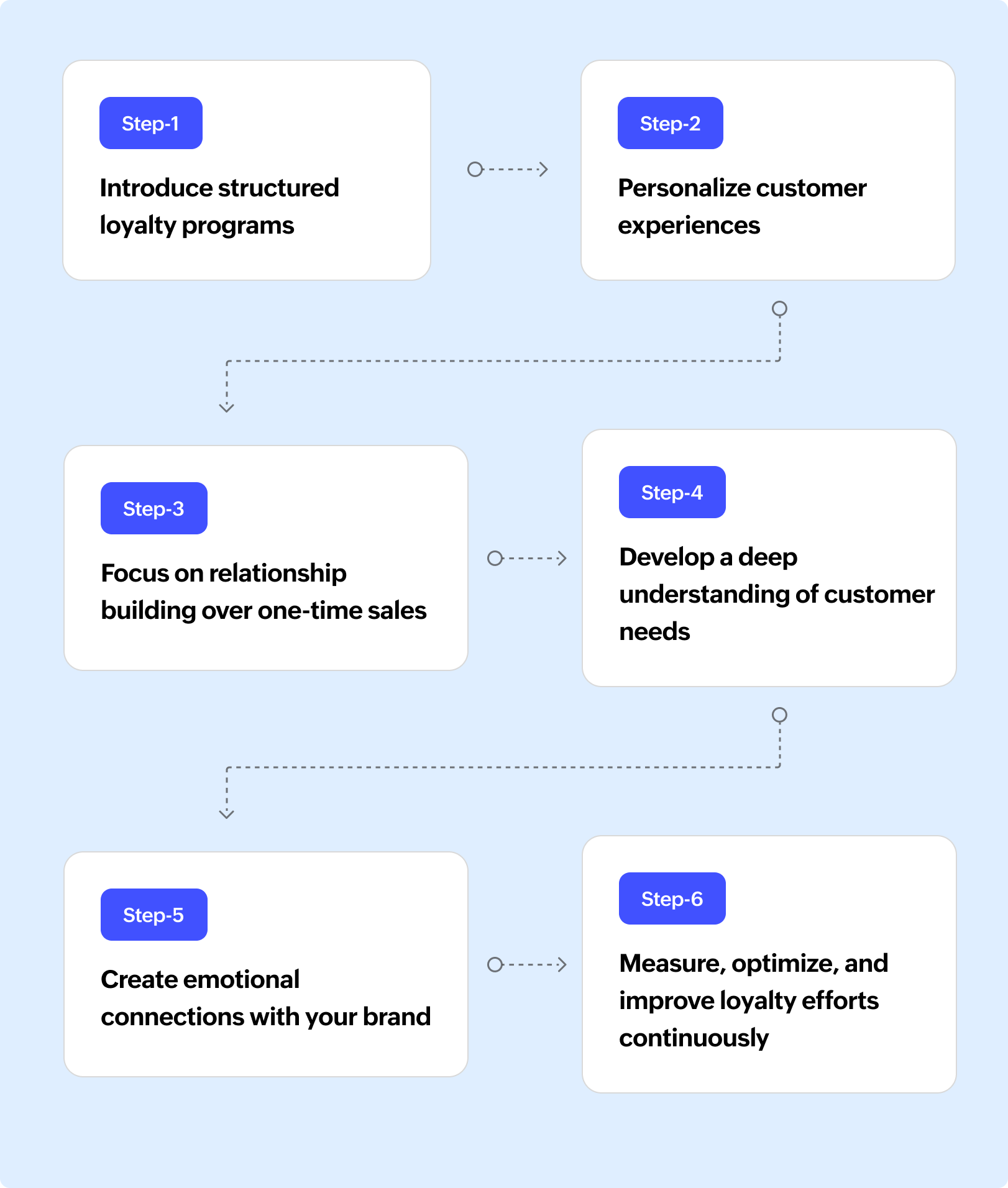
Businesses that focus on how to create customer loyalty invest in consistent experiences, meaningful engagement, and ongoing value. Here are six proven steps to help you build customer loyalty effectively.
Step 1: Introduce structured loyalty programs
Loyalty programs such as points-based rewards, tiered benefits, or exclusive offers encourage customers to return more frequently. When customers know their repeat actions are rewarded, it increases retention and long-term engagement.
Step 2: Personalize customer experiences
Make interactions more relevant by personalizing communication, offers, and rewards. Personalized experiences help customers feel recognized, which directly contributes to higher satisfaction and loyalty.
Step 3: Focus on relationship building over one-time sales
Customer loyalty grows when businesses prioritize long-term relationships instead of transactional interactions. Ongoing communication, post-purchase engagement, and consistent support help strengthen trust over time.
Step 4: Develop a deep understanding of customer needs
Businesses that actively listen to customers through feedback, purchase behavior, and engagement patterns are better equipped to deliver relevant experiences. Understanding customer preferences enables brands to respond proactively rather than reactively.
Step 5: Create emotional connections with your brand
Emotional loyalty is built when customers connect with a brand’s values, mission, or story. Supporting causes, maintaining transparency, and communicating brand purpose can significantly deepen customer attachment.
Step 6: Measure, optimize, and improve loyalty efforts continuously
Customer loyalty is not a one-time initiative. Tracking metrics such as repeat purchase rates, customer retention, and engagement trends helps businesses identify what's working and where improvements are needed. Regular optimization ensures loyalty strategies continue to deliver value over time.
Types of customer loyalty programs to retain customers
Implementing the right customer loyalty program helps businesses build customer loyalty by incentivizing repeat purchases and sustained engagement.
Points-based programs
Reward purchases with points that can be redeemed later. Encourage repeat buying.
Rewards-based programs
Motivate customers to come back by allowing them to redeem earned points for future rewards, ultimately increasing customer lifetime value.
Referral programs
Incentivize customers to bring friends, expanding your customer base.
Tiered programs
Customers unlock exclusive rewards and benefits as they progress through VIP tiers (like silver, gold, and platinum). Increase engagement and long-term retention.
Examples of brands with loyal customers
Here are four well-known brands that demonstrate how strong loyalty strategies drive repeat purchases and long-term customer engagement.
American Airlines’ Advantage program shows strong real-world impact, with members redeeming a record 15 million awards in 2024. The airline reports that nearly 9% of total passenger miles flown were booked using loyalty rewards, underscoring how central the program is to repeat engagement.
Adidas highlights that adiClub members have a significantly higher lifetime value than non-members, showing how loyalty programs strengthen engagement and encourage repeat purchases over time.
Walmart says its Walmart+ loyalty program continues to show strong momentum, with double-digit growth in delivery volumes and consistently rising repeat order rates from members across multiple quarters.
IKEA’s loyalty and engagement initiatives continue to drive strong repeat purchases. With the rollout of its updated Reward Keys program, loyalty members now contribute 58% of total sales, highlighting how well-designed rewards can encourage repeat visits and deeper customer engagement.
How to measure customer loyalty
Below is an overview of the key customer loyalty metrics businesses use to evaluate retention and engagement, along with their respective formulas.
1. Net promoter score (NPS)
NPS assesses how likely customers are to recommend your brand to others, offering insight into advocacy and emotional loyalty. A high NPS typically indicates strong word-of-mouth potential and customer satisfaction.
Formula:NPS = % of Promoters − % of Detractors
2. Customer lifetime value (CLV)
CLV estimates the total value a customer brings to your business over the entire duration of their relationship, linking loyalty to revenue impact.
Formula:CLV = Average purchase value × Purchase frequency × Customer lifespan
3. Repeat purchase rate
This measures how many customers make multiple purchases. A larger repeat purchase rate suggests customers prefer your brand, indicating meaningful loyalty behavior.
Formula:Repeat purchase rate (%) = (Number of repeat customers ÷ Total Customers) × 100
4. Churn rate
Churn rate indicates how many customers stop doing business with you. Lower churn means more customers are staying engaged, a direct sign of loyalty.
Formula:Churn rate (%) = (Customers lost during period ÷ Customers at start of period) × 100
5. Customer retention rate (CRR)
It measures the percentage of customers who continue doing business with you over a specific period. A higher retention rate indicates stronger loyalty and long-term engagement.
Formula:Customer retention rate (%) = [(Customers at end of period – New customers acquired) ÷ Customers at start of period] x 100
Common mistakes to avoid that hurt customer loyalty
- Poor promotion of loyalty programs means customers may not even realize the benefits available to them, limiting the program’s overall impact.
- Overly complex loyalty programs confuse customers and make rewards feel hard to earn or redeem, which reduces participation over time.
- Lack of personalization through generic offers and communication reduces relevance and weakens long-term customer loyalty.
- Ignoring customer feedback prevents businesses from improving experiences that drive loyalty.
- Poor or delayed communication creates frustration and erodes trust in the brand.
Avoiding these common mistakes helps businesses build customer loyalty more effectively and sustain it over time. Businesses that continuously refine their loyalty approach are more likely to build customer loyalty that lasts.
FAQs on how to create customer loyalty
How can small businesses build customer loyalty?
Small businesses can foster lasting customer loyalty by implementing simple loyalty programs, engaging actively on social channels, and offering thoughtful rewards while maintaining transparency and using customer feedback to drive continuous improvement.
Do customer loyalty programs really work?
Yes, loyalty programs increase repeat purchases, engagement, and referrals, especially when paired with excellent customer service.
How long does it take to build customer loyalty?
Building customer loyalty depends on consistent effort and value delivery. It develops over time as customers repeatedly have positive experiences and feel genuinely connected to the brand.
How much does poor customer support actually impact long-term loyalty?
Poor customer support has a significant impact on retention, with nearly 32% of customers likely to stop doing business with a brand after a single negative experience.