
In the late 1960s, a Harvard researcher studying the toothpaste market noticed something the demographic data couldn't explain. Buyers who looked identical on paper (same age, same income, same household size) were choosing completely different brands for completely different reasons.
Digging into what people actually cared about split the market into four groups:
- People buying mainly to prevent cavities
- People buying for whiter teeth and social confidence
- People chasing flavor and a satisfying brushing experience
- People just looking for the cheapest tube on the shelf
That study became one of the founding examples of psychographic segmentation. And toothpaste brands have been built around those same motivational splits ever since.
The approach still works because the underlying problem hasn't gone away.
What is psychographic segmentation?
Psychographic segmentation is the practice of grouping customers by what they think, value, and care about, rather than by who they are on paper. Where demographic segmentation sorts people by age, income, location, or job title, psychographic market segmentation sorts them by lifestyle, personality, attitudes, and the beliefs that actually drive a purchase decision.
Two customers can share the exact same demographic profile. However, they can still buy for entirely different reasons – one motivated by status, the other by practicality. Psychographic segmentation is the tool built to catch that difference.
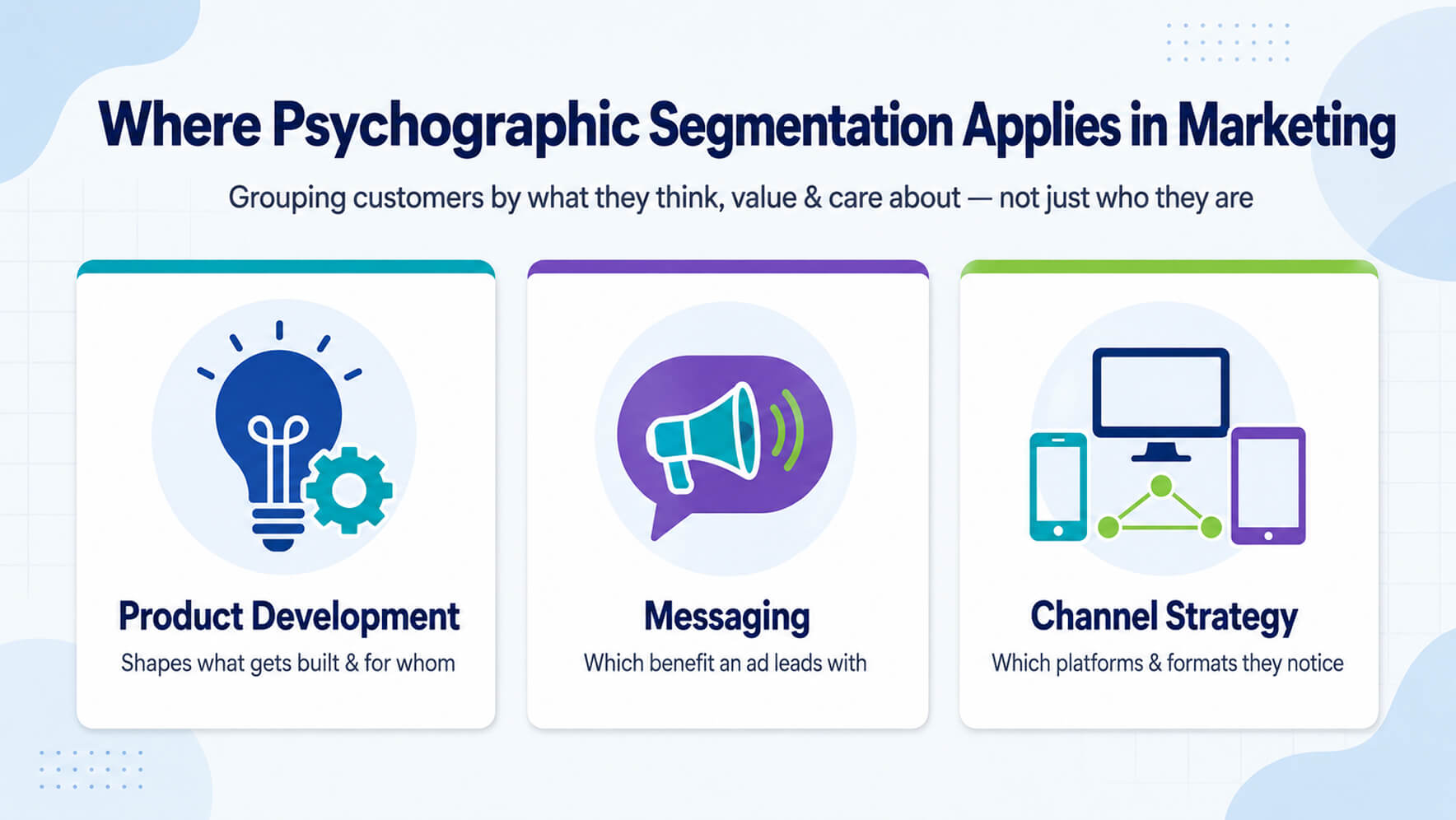
In marketing, psychographic segmentation usually gets applied at three points:
- Product development, where it shapes what gets built and for whom
- Messaging, where it determines which benefit gets led with in an ad or landing page, and
- Channel strategy, where it influences which platforms and formats a segment actually pays attention to.
A segment defined by convenience and time-saving responds to a very different message than a segment defined by craftsmanship and detail (even if both segments buy the exact same product).
Why you need it
Demographic data answers who a customer is. It rarely answers why they buy. That gap matters more now than it used to, because customer expectations around relevance have gone up sharply. A company that only tracks demographic and transactional data has no direct way to measure the factor driving nearly two-thirds of its customer relationships.
There's also a competitive angle. Segmenting only by demographics puts a company on the same map as every other company selling to the same age bracket and income range. Psychographic segments are harder for competitors to copy because they're built from proprietary survey data rather than public census figures. This makes the resulting positioning and messaging genuinely differentiated instead of a slight variation on what everyone else in the category is already saying.
That differentiation compounds over time in a way pure demographic targeting doesn't.
A campaign built around age and income can be reverse-engineered by a competitor within a quarter, since the targeting logic is visible in the ad itself. A campaign built around a psychographic insight such as why a specific group of people actually cares about the category, is much harder to copy without running the same underlying research.
Psychographic vs behavioral segmentation
These two get confused constantly, and the mix-up leads to a lot of wasted survey effort asking the wrong questions. Behavioral segmentation groups people by what they've actually done: purchase history, browsing patterns, app usage, loyalty program activity. It's observed, not stated. This makes it reliable but backward-looking. It tells a company what a customer did, not necessarily what they'll do next or why they did it in the first place.
Psychographic segmentation groups people by attitudes, values, interests, and lifestyle, gathered mainly through stated preference rather than observed action. It's forward-looking in a way behavioral data isn't, because it captures motivation rather than just outcome. A customer's purchase history might show they buy running shoes twice a year. Psychographic data explains whether that's because they're training for competitive races, because running is a stress-relief ritual, or because a doctor told them to get more exercise. Each of those motivations calls for a different product, message, and offer, even though the behavioral data looks identical across all three.
The strongest segmentation models use both together. Behavioral data confirms what psychographic data predicts, and the combination is far more actionable than either type used alone. A product team that only has behavioral data can see a drop-off point in a user journey but can't explain it. Layering a psychographic segment on top (say distinguishing users motivated by efficiency from users motivated by exploration) often reveals that the same drop-off point is a dealbreaker for one group and barely noticed by the other.
Psychographic factors, variables, and categories
Most psychographic segmentation work is organized around the AIO framework (short for activities, interests, and opinions) developed alongside the earliest psychographic research in the 1970s. It remains the backbone of how most surveys are structured today.
Activities cover how people spend their time: hobbies, work habits, social behaviors, media consumption. Interests cover what people pay attention to and care about, from family and career to fitness, travel, or technology. Opinions cover how people see themselves, their community, and the broader world, including political and social attitudes where relevant to the category.
Beyond AIO, a few other psychographic categories show up repeatedly in segmentation work: personality traits, using frameworks like the Big Five:
- Values and beliefs, covering what people consider important in life and in a purchase decision;
- Lifestyle, the observable pattern that activities and interests produce together;
- And social class or aspiration, which shapes buying decisions independent of actual income level.
Together, these psychographic factors give a much richer picture than any single demographic field ever could.
Building psychographic segments with surveys
Psychographic data isn't sitting in a CRM the way purchase history is. It has to be collected directly, and a well-designed survey is still the most reliable way to do that at scale.
- Use Likert-scale attitude statements and not open-ended questions alone Asking someone to rate agreement with statements like "I prefer trying new products over sticking with what I know" produces data that can be scored, clustered, and compared across a large sample. Open-ended questions add color but don't scale into a repeatable segmentation model on their own.
- Cover all three AIO dimensions A survey that only asks about interests misses the activities and opinions that round out a full psychographic profile. Skipping a dimension tends to produce segments that look interesting but don't actually predict behavior well.
- Keep the survey long enough to be statistically useful and short enough to finish Psychographic segmentation typically needs 20 to 30 attitude statements to produce stable clusters through factor analysis. Fewer than that and the resulting segments tend to be unstable; more than that and completion rates start to drop.
- Run cluster analysis on the results rather than eyeballing patterns Once responses are in, statistical clustering, whether k-means or a simpler rules-based grouping, is what actually turns individual answers into defined psychographic segments. Skipping this step and manually sorting responses by hand tends to produce segments shaped more by the analyst's assumptions than by what the data actually shows.
- Validate segments against real outcomes A psychographic segment is only useful if it correlates with something the business cares about (such as conversion rate, retention, or average order value). Cross-referencing survey-based segments against actual purchase or usage data confirms whether the groups the survey produced are meaningfully different in practice.
Running psychographic segmentation surveys with Zoho Survey
Zoho Survey supports the kind of attitude-based questionnaire psychographic segmentation depends on, with Likert-scale question types built specifically for agreement statements across the AIO categories that segmentation models need.
Question banks and templates make it faster to build a 20-to-30-item attitudinal survey without starting from a blank page. Skip logic lets a team branch respondents into different follow-up questions based on earlier answers.
Once data comes in, cross-tabulation and segmentation reporting let a team compare response patterns across demographic fields. Response data exports cleanly into spreadsheet or analytics tools for the cluster analysis itself (which most psychographic projects still handle outside the survey platform) since k-means and factor analysis aren't native survey functions.
Distribution options, including email, embedded links, and social channels, help widen the respondent pool beyond a company's existing customer list.
Teams looking to build out a full segmentation project can start with Zoho Survey's 7-day free trial of the Enterprise plan, which unlocks the advanced logic and reporting features a psychographic analysis project typically requires.
Putting it all together
Demographic data will always be easier to collect than psychographic data, which is exactly why so few companies bother going further. But the customers who look identical in a spreadsheet rarely behave identically in real life. And the gap between those two facts is where psychographic segmentation earns its keep.
A well-built survey, structured around activities, interests, and opinions and validated against real behavior, turns vague assumptions about what customers want into segments a marketing or product team can actually build around. It takes more effort than pulling an age range from a CRM. But it's the difference between messaging that feels generic and one that feels like it was written for the person reading it.