
In the early 2000s, Blockbuster had more than 9,000 stores worldwide, 60,000 employees, and a near-monopoly on home video rentals. Netflix was a mail-order DVD startup with a fraction of the reach. What Netflix had, however, was a relentless focus on understanding exactly why customers found Blockbuster frustrating with late fees, the limited selection, and the inconvenience of having to drive to a physical location.
The company, therefore, built its entire product proposition around eliminating those pain points. It systematically validated that positioning by tracking what customers said about their experience with the incumbent.
Blockbuster, meanwhile, was focused on Blockbuster. By the time the company finally took Netflix seriously, the competitive intelligence had become irrelevant. Customers had already moved.
The lesson isn't about streaming technology or business model innovation. It's about who was paying attention to the customer's relationship with the competition (and who wasn't). A competitive analysis survey is how companies pay that attention at scale.
What competitive analysis actually means and why surveys belong in it
Most competitive analysis frameworks focus on the elements visible from the outside such as pricing pages, product features, press releases, analyst reports, and social media activity. This intelligence is useful but fundamentally limited. It tells you what competitors are offering. It doesn't tell you how customers actually experience it, what they wish were different, or what would make them switch.
Customer surveys fill that gap. A competitive analysis survey goes directly to the source. It asks customers, prospects, and lapsed buyers about their experiences across the competitive landscape, their reasons for choosing or not choosing specific vendors, and the gaps they see in what the market currently provides. This is the intelligence that doesn't appear in a competitor's pricing page or earnings call.
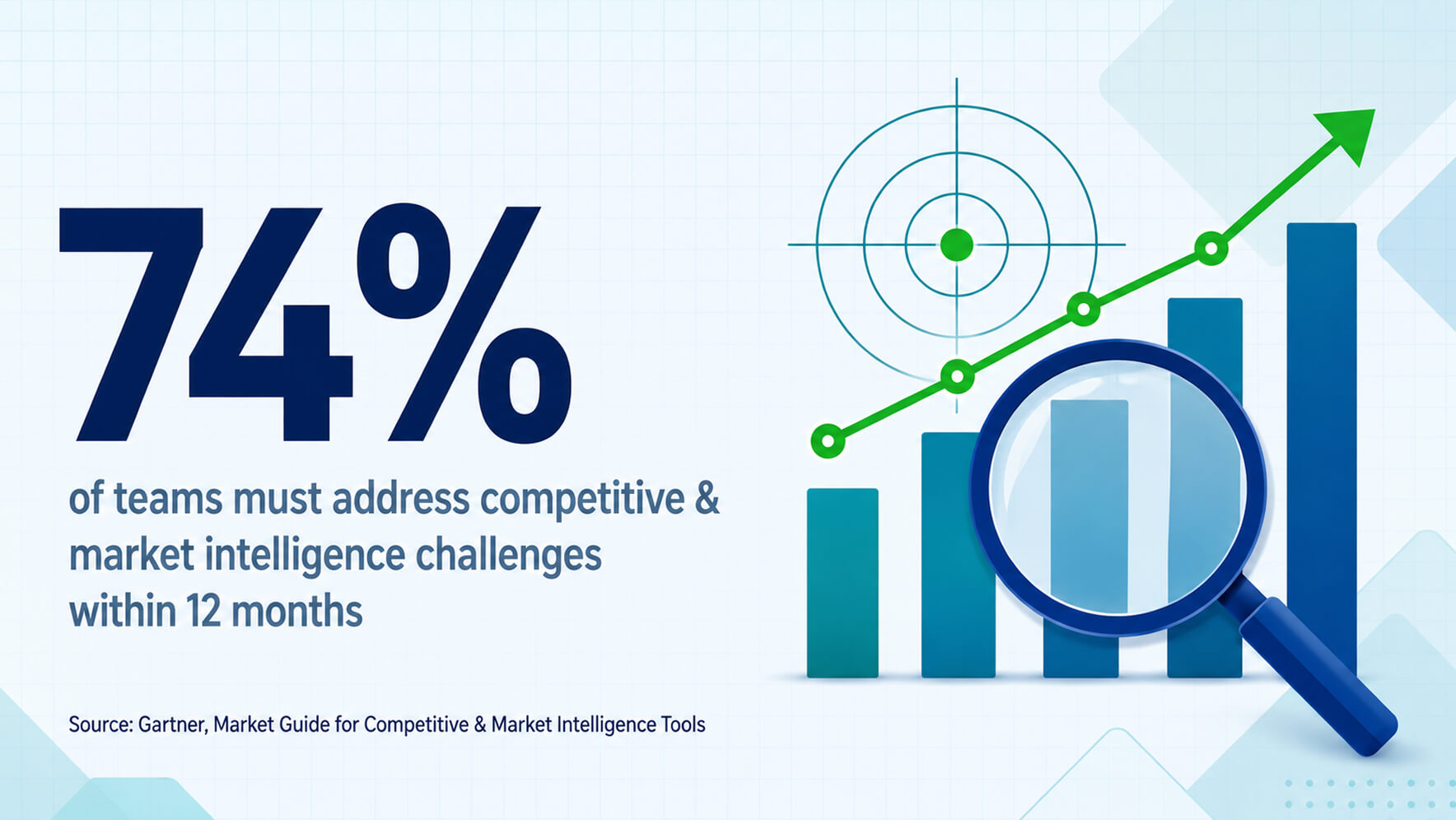
According to Gartner's Tech Marketer Role Survey, 74% of B2B organizations cited competitive and market intelligence as a top near-term priority that must be addressed within 12 months to ensure their teams' success. Yet, despite the near-universal recognition of its importance, most organizations still rely on secondary sources like public data, analyst reports, and sales-team anecdotes rather than structured primary research with customers themselves. Competitive analysis surveys help you close that gap.
What a competitive analysis survey should measure
A competitive market analysis built on customer surveys should cover four distinct dimensions, each of which contributes differently to a complete picture of the competitive landscape.
Awareness and consideration
Which brands do customers think of first in your category? Which ones were on the shortlist before a purchase decision? This is where you discover the actual competitive set which is frequently different from what the internal team assumes. Brands that appear consistently in unaided awareness questions are the ones actively competing for mental real estate in the customer's head, regardless of how they're positioned in analyst reports.
Purchase rationale
Why did the customer choose the brand they chose? What criteria drove the decision? Which competitors were seriously considered and then passed over and why? This dimension reveals the actual decision attributes that matter in your category, rather than the ones your marketing team has decided should matter.
Competitive experience
For customers who have used a competitor's product or service, what was their experience? What did they find better than expected? What disappointed them? Where did they feel underserved? This is the richest vein of competitive intelligence available. It provides a direct account of what it's actually like to be a customer of your competition.
Switch intent and loyalty drivers
What would it take for a current customer to consider switching? What would have to be true about a competitor's offering to make it worth changing? And for customers who already switched what tipped the decision? Understanding the switch drivers on both sides of a competitive boundary is the most commercially direct output of a competitor survey.
How to conduct a competitive analysis survey: A step-by-step approach
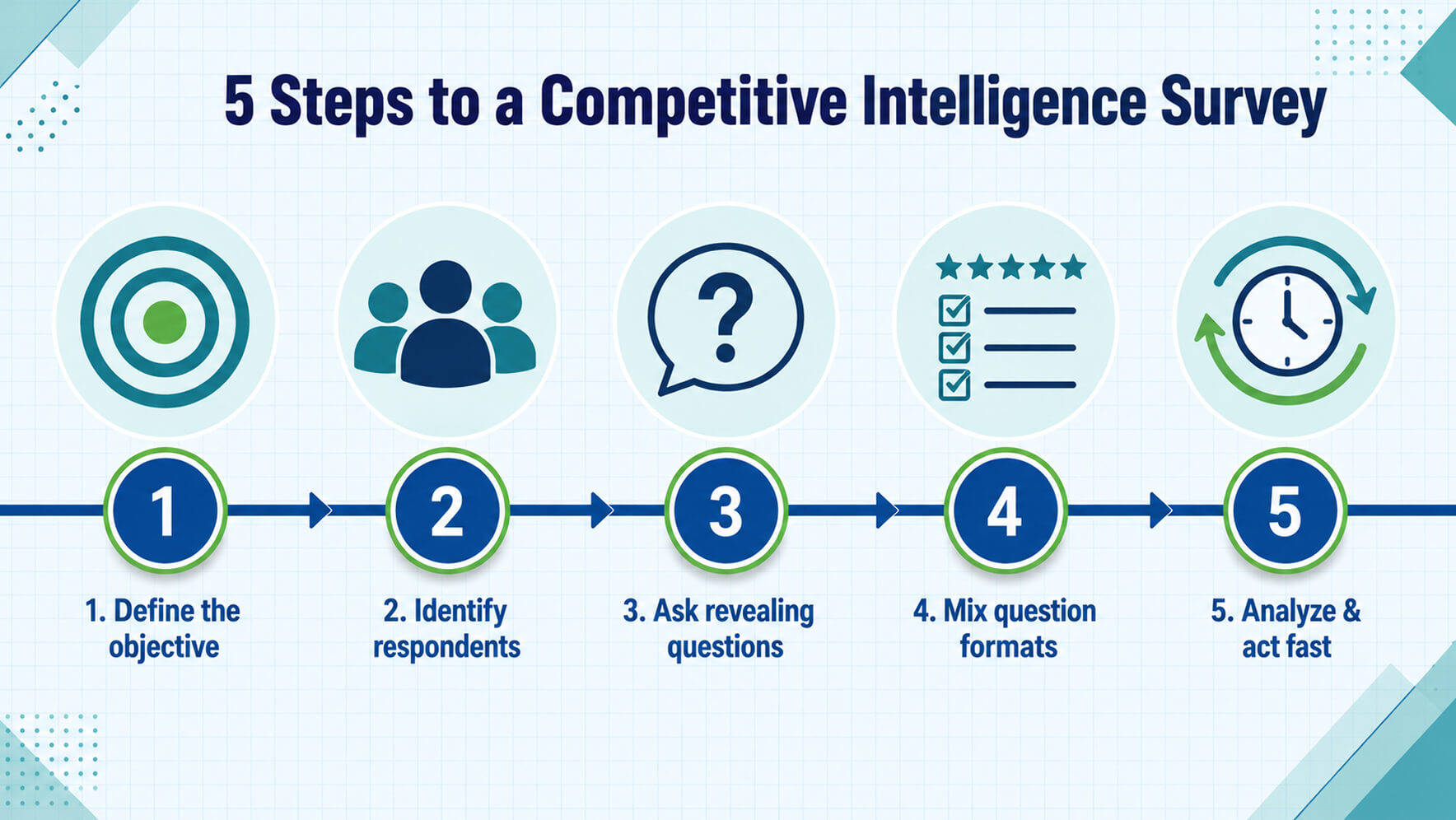
Step 1: Define the intelligence objective
A competitive analysis survey should start with a specific question that the research will answer and not a general desire to "understand the competition." Are you trying to understand why you're losing deals to a specific competitor? Do you want to know how customers perceive your brand relative to the category leader? Are you exploring a new market segment and trying to understand what's currently serving it and how well? The more specific the intelligence objective, the more precisely the questions can be designed around it.
Step 2: Identify the right respondent types
Competitive intelligence surveys should cover at least three distinct respondent groups: current customers (who can speak to why they chose you and what they know of competitors), prospects who chose a competitor (who can explain exactly why you didn't win), and lapsed customers who switched away (who can describe what finally tipped the decision). Each group holds different pieces of the competitive picture, and a survey that covers only one of them (typically existing customers) produces a systematically favorable and incomplete view.
Step 3: Design questions that surface real competitive dynamics
The most common mistake in competitive survey design is asking questions that validate existing assumptions rather than test them. Questions like "How much better than competitors do you feel our product is?" are useless. Questions like "In your own words, what does [Competitor X] do better than we do?" are valuable precisely because they ask for the respondent's genuine assessment rather than calibrating against the researcher's preferred narrative.
Step 4: Use both structured and open-ended formats
Competitive analysis questions in a structured format like rating scales, multi-select, or ranking, allow for quantitative comparison across competitors and over time. Open-ended questions surface the specific language, experiences, and concerns that structured formats cannot anticipate. Both are necessary for a complete competitive picture.
Step 5: Analyze and act within a defined timeframe
Competitive intelligence has a shelf life. Market positions shift, competitors launch new products, and the context in which customers are making decisions evolves. A structured review cycle with findings shared across product, sales, and marketing teams within a defined window after the survey closes ensures the intelligence is current and actionable when decisions are being made.
Competitive analysis questions to include in your survey
The following questions are organized by the dimension they are designed to measure.
Awareness and consideration
- When you think of [product/service category], which brands come to mind first?
- Which brands did you seriously consider before making your most recent purchase in this category?
- How familiar are you with [specific competitor]?
Purchase rationale and competitive choice
- What were the most important factors in your decision to choose [brand]?
- Which competitor did you most seriously consider before choosing [brand] and what made you choose differently?
- What would have had to be true about a competitor's offering to make you choose them instead?
Competitive experience (for customers with competitor experience)
- Have you used [Competitor X]'s product or service in the past two years?
- How would you rate your experience with [Competitor X] compared to your experience with [brand]?
- What does [Competitor X] do better than [brand]?
- What does [Competitor X] do worse?
- Was there something about [Competitor X] that disappointed you or didn't meet your expectations?
Switch intent and loyalty drivers
- How likely are you to switch to a different provider in the next 12 months?
- What would most likely prompt you to switch?
- Has a competitor recently done something that made you reconsider your current choice?
- If you previously used a different provider before switching to [brand], what was the primary reason for switching?
Open-ended competitive intelligence
- In your view, what is the most significant gap in what the current market offers in this category?
- What does no current provider in this space do well enough?
- If you could combine the best features of two different providers in this category, what would that product look like?
Using Zoho Survey for competitive analysis research
Zoho Survey provides the design and distribution flexibility that competitive market analysis research requires. Skip logic and branching route respondents through question paths relevant to their specific competitive experience. A respondent who hasn't used a particular competitor is automatically directed past the competitor-specific experience questions, keeping the survey concise without losing coverage across the full respondent pool.
For teams that need to reach prospects who chose a competitor, or lapsed customers who switched, Zoho Survey's Buy Responses feature connects researchers with verified panels segmented by category, behavior, and demographic attributes.
Real-time reporting allows competitive intelligence teams to monitor response patterns and sentiment distributions as data arrives, with cross-tab reporting enabling segmentation of results by respondent type, competitive history, and customer tenure.
Zoho Survey is now available with a seven-day, credit card-free Enterprise trial. This gives strategy and marketing teams full access to the features needed to build, distribute, and analyze a competitive analysis survey from day one.
Wrapping up
Competitive analysis, built on what your customers actually say about the competitive landscape, is fundamentally different from competitive analysis built on what you can observe from the outside. It's more specific, more actionable, and (because so few organizations do it systematically) more likely to surface the kind of insights that create a genuine strategic advantage.
A competitive analysis survey requires clear objectives, the right respondent mix, and questions designed to surface real intelligence rather than validate existing assumptions. The brands that make it a standard part of their research calendar will know their market better than the brands that don't. And in competitive markets, knowing more as well as knowing it earlier is almost always the deciding factor.