
There are quite a few marketing teams that can tell you what they spent last quarter. But not many can tell you what shifted in how people think about their brand as a result of it. That gap is more common than most organizations want to admit, and it's exactly what brand tracking is designed to close.
A brand tracking survey is not a one-time research project. It's an ongoing measurement program that tells you whether the market sees your brand the way you intend, whether that perception is changing over time, and what's driving the change. Done consistently, it's one of the most useful inputs a marketing team can have. Done poorly or not at all, it leaves a lot of guesswork where there should be data.
This article covers what brand tracking is, which metrics matter most, how to collect them, and what a well-run brand tracking study looks like in practice.
What is brand tracking?
Brand tracking is simply the practice of regularly checking in on how consumers perceive your brand over time. One snapshot tells you very little. What you actually want is a running record, something that shows how awareness, sentiment, and brand associations move as markets shift, competitors make their plays, and your campaigns do their work.
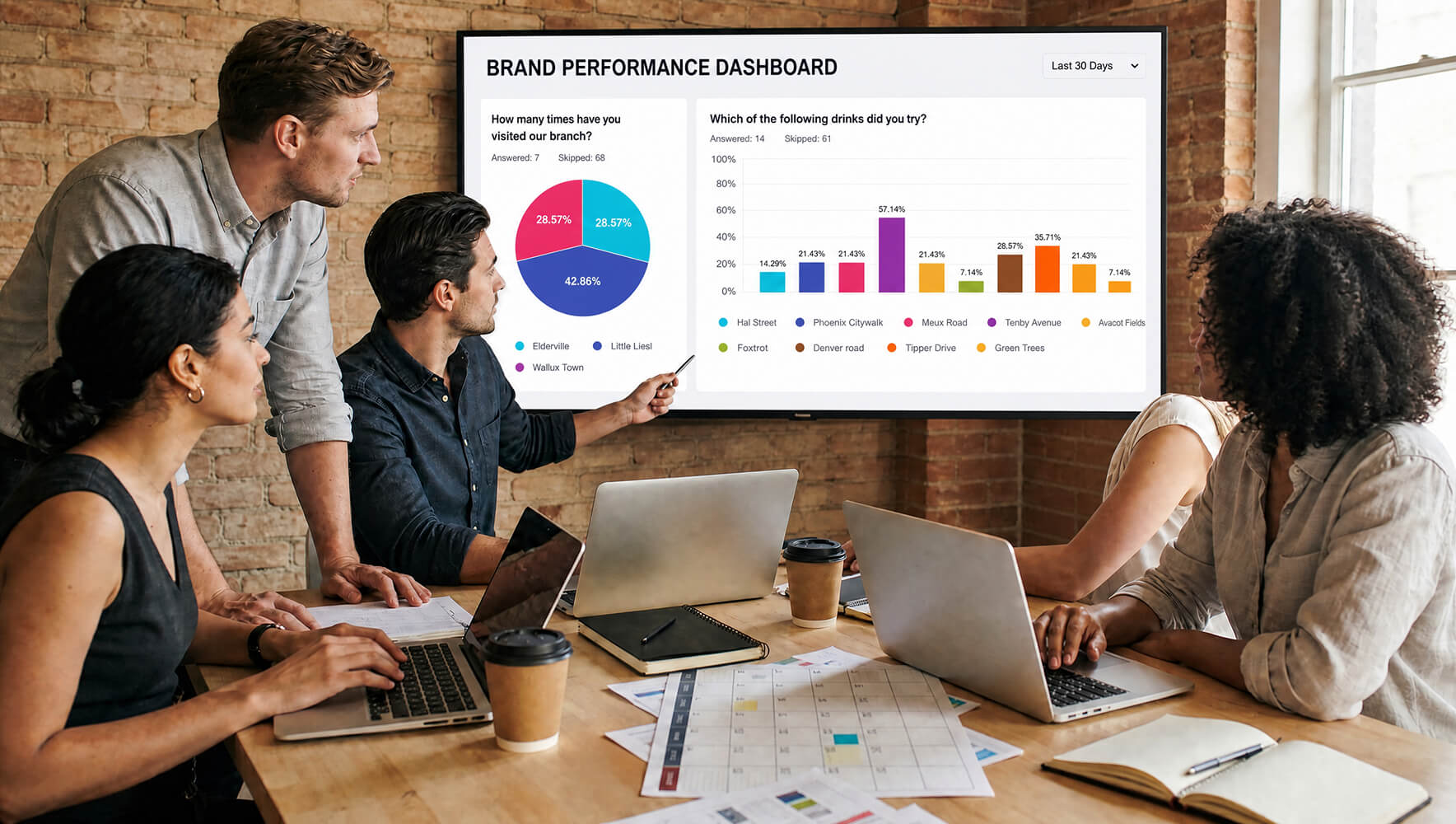
Most brand health surveys run on a set schedule, weekly, monthly, or quarterly, sent out to a representative group of your target audience each time. The questions don't change between waves, and that consistency matters more than most people realise. Without it, you can't compare results, and without comparison the data doesn't really tell you anything useful. The goal isn't to know what people think at a single moment. It's to know whether perceptions are moving in the right direction over time.
In terms of where it sits within market research, brand tracking is its own thing. It's not a product launch survey or a campaign debrief. Those give you a read at a single moment in time. A brand tracker is longitudinal, which means it's built to capture movement, not just take a picture of where things stand today.
Why brand tracking matters
People talk about brands as if they're abstract, but the equity a brand carries is very real. It's what gives you pricing power, keeps customers coming back, and wins you the close calls where someone could just as easily have gone elsewhere. But unlike most things that matter in a business, it doesn't surface automatically. You won't find it in your analytics or your finance reports. It just quietly exists in the background until you go looking for it.
A 1% shift doesn't sound like much until you put a number next to it. Nielsen's experience base shows that, on average, a one-point gain in brand metrics such as awareness and consideration drives a 1% increase in sales. For a brand doing $1 billion in annual revenue, that's $10 million sitting directly behind how well people know and think of you. The business case for measuring it consistently is not hard to make.
Without brand tracking, your marketing team is working with half the picture. Clicks and conversions are visible, sure. But whether the brand underneath all that activity is actually getting stronger or slowly eroding? That part is completely invisible until it isn't, and by then it's usually too late.
Key brand tracking metrics
There will never be a single number that captures brand health. A strong brand tracking program pulls together several metrics, each answering a different question.
Brand awareness
Awareness tracking is about one basic question: how many people in your target market actually know you exist? It sits at the top of the funnel and splits into two types. Unaided awareness is when someone names your brand off the top of their head without any prompting. Aided awareness is when they recognise it from a list. Both matter, but unaided movement is the harder one to shift and honestly the more meaningful of the two.
Read our full guide to measuring brand awareness here
Brand perception
Knowing a brand exists is different from having a view about it. Brand perception measures the associations, feelings, and judgments people attach to your brand. Are you seen as reliable? Premium? Approachable? Two brands with similar awareness scores can have completely different perception profiles, and that gap drives the difference in market share.
Explore how to measure brand perception here.
Purchase intent
Awareness and positive perception don't automatically translate to sales. Purchase intent measures how likely someone is to buy from you in the near term. Tracking it alongside awareness and perception shows you where the funnel is leaking and whether the fix is a messaging or reach problem.
Net Promoter Score (NPS)
NPS comes down to one question: on a scale of zero to ten, how likely are you to recommend this brand to a friend or colleague? People who answer nine or ten are Promoters. Anyone who scores six or below is a Detractor. The NPS score itself is just the percentage of Promoters minus the percentage of Detractors.
What makes it useful in a brand tracker is that it measures advocacy, not just satisfaction. Those two things are not the same. A customer who buys from you regularly but would never recommend you to anyone is a very different signal to one who actively talks you up, and it's worth knowing which one you have more of.
Brand attributes
When people think about your brand, certain qualities come to mind. Maybe it's trustworthiness, maybe it's value for money, maybe it's the quality of your customer service or how innovative you seem. These are your brand attributes, and tracking them over time is one of the more honest tests of whether your marketing is actually doing what you think it is. If the qualities you're trying to own aren't showing up in the data, the messaging or the experience probably needs a look.
Attribute scores are particularly useful when you're running a repositioning effort or launching into a new segment. They tell you whether perception is shifting in the direction you're pushing.
Brand preference and consideration
Even among people who are aware of your brand and think positively about it, preference measures whether they would choose you over a competitor when it comes down to a decision. Consideration measures whether your brand makes it onto the shortlist at all. Both are closer to purchase than awareness or perception, which makes them useful leading indicators for revenue trends.
Brand tracking methods
Which tracking method you use depends on your category, your competitive situation, and how much detail you actually need. There's no one-size-fits-all answer here, and most programs that do this well tend to mix approaches because each one picks up things the others don't.
1. Survey-based tracking
Survey-based tracking is the most straightforward and most commonly used method. A brand health survey goes out to a target audience panel at regular intervals. Always using the same core questions. This consistency will make it easy to compare scores over time and against competitor brands. You get numbers you can trend, segment, and actually act on.
2. Continuous tracking vs. wave tracking
So there are basically two ways to do this. You can run continuous tracking, which means smaller samples sent out throughout the year. The upside is you catch things shifting as they actually happen rather than finding out three months later. Or you go with wave tracking, which is bigger surveys but only at set points, quarterly or twice a year. That one makes more sense if you're in a category where people's opinions don't really move around that much between surveys.
3. Competitive benchmarking
Only tracking yourself tells you very little because you need something to compare it with. Put a couple of competitors in the same survey, and a 60% awareness score actually starts to mean something. If the category leader is on 80%, you've got a problem. If they're on 55% you're doing well. Without that comparison you're basically guessing.
4. Qualitative supplements
A number tells you something shifted, but that's genuinely all it tells you. Score drops and you're left wondering what's actually going on with people. Are they frustrated about something specific? Are they still around but less enthusiastic? Have they already moved to a competitor and you just haven't felt it yet? There's no way to know from the data alone. Getting people into a focus group every so often is what actually answers those questions.
Brand tracking survey questions worth asking
The exact questions in a brand health survey vary depending on your category and what you're trying to measure. That said, a solid tracker tends to cover a few consistent areas:
Awareness
- Which of the following brands have you heard of? (aided awareness)
- When you think of [product category], which brands come to mind? (unaided awareness)
Perception and attributes
- How would you describe [brand] in your own words?
- To what extent do you associate [brand] with the following qualities? (list of attributes)
Consideration and preference
- Which of these brands would you consider purchasing from in the next three months?
- If you were making a purchase in this category today, which brand would be your first choice?
Purchase intent and NPS
- How likely are you to purchase from [brand] in the next 30 days?
- How likely are you to recommend [brand] to a friend or colleague? (0 to 10)
Advertising and campaign recall
- Have you seen or heard any advertising for [brand] recently?
- Where did you see it?
The consistency of these questions across waves is what gives the data its value. Changing the wording between surveys breaks the trend line.
Brand tracking best practices
Knowing what to measure is only part of it. How you actually run the program matters just as much. A survey that goes out at random intervals, changes its questions between waves, or just sits in a report nobody reads will produce data that looks fine on the surface but doesn't really do anything. The difference between a tracking program that keeps getting more valuable over time and one that fizzles out after the first wave usually comes down to a few basic habits.
- Run it regularly: A one-off brand survey is useful context. An ongoing brand tracking study is an early warning system. The value compounds with each wave as the trend data builds up.
- Track competitors in every wave: Your brand doesn't exist in a vacuum. Shifts in your scores only make sense when you can see what's happening across the competitive set at the same time.
- Segment the data: Overall brand health metrics can mask significant differences between audience segments. A brand might have strong awareness among older buyers and near-zero awareness among the demographic it's trying to reach. Segmenting by age, region, or purchase behavior turns an average into something actionable.
- Connect survey data to business outcomes: Surveys are easier to defend internally when they're connected to things the business already cares about. If purchase intent goes up off the back of a campaign and sales follow, note it down and keep noting it down. That kind of documented pattern builds up into something really useful over time and makes the case for brand measurement almost by itself.
- Don't change the questions: It's tempting to refine the survey between waves. Resist it. Comparability is the whole point of a tracking study. If you need to add new questions, add them at the end and treat them as a new baseline.
How Zoho Survey supports brand tracking
Running a brand tracking program manually that includes building surveys, managing panel recruitment, and compiling data across waves is operationally heavy. Zoho Survey's survey templates, branching logic, and built-in reporting make it easier to set up a consistent tracker, distribute it across channels, and read the results in one place.
Cross-tabulation is especially helpful when you're tracking how a brand performs over time. Instead of looking at overall numbers, you can see how different groups respond and whether perceptions are changing within specific audiences. It also makes it much easier to compare results from one survey period to the next without spending hours manually pulling data together. When you're monitoring several brand metrics and competitors at the same time, having everything in one place saves a lot of effort and makes the insights far easier to act on.
Here's a quick look at what Zoho Survey can do:
Wrapping up
You don't need a massive marketing budget to track your brand. If you're making decisions about messaging, positioning, or where to invest your resources, it helps to know how people actually see your brand and whether those perceptions are changing over time.
The key is to start small. Pick the metrics that make sense for where your brand is right now, measure consistently, and the trend data will start showing you things your campaign reports never come close to.