
Trust is the foundation of every banking relationship. Customers hand over their savings, mortgages, investments, and personal financial data with the expectation that their bank will keep them secure and act in their best interests. Yet trust cannot be assumed. It must be measured.
The challenge is becoming increasingly important. The 2025 Edelman Trust Barometer found that trust in financial services stands at 64% globally and ranks in the lower end among all the sectors measured.
Similarly, Forrester's banking research shows that customer experience remains inconsistent across many markets, creating significant opportunities for banks that listen more effectively to their customers.
This is where banking surveys become essential. A well-designed banking survey helps financial institutions understand customer satisfaction, identify trust gaps, improve digital experiences, and uncover the factors that drive long-term loyalty before those issues appear in churn, complaints, or declining account activity.
Why banking surveys matter more than ever
The banking industry has undergone a dramatic transformation over the past decade. Mobile banking, digital onboarding, AI-powered support, and self-service channels have improved convenience, but they have also increased the number of touchpoints where customer expectations can be either met or disappointed.
A customer may interact with a bank through:
- Mobile apps
- Online banking portals
- Branch visits
- Contact centers
- Chatbots
- ATMs
- Email communications
Each interaction contributes to the customer's overall perception of the institution.
The challenge is that operational metrics only tell part of the story. Transaction volumes, app usage rates, and call center resolution times provide valuable data, but they do not explain whether customers trust the institution, feel valued, or believe the bank understands their needs.
Banking surveys fill that gap by providing direct insight into customer attitudes, perceptions, and expectations.
What banking surveys should measure

Effective banking surveys go beyond simple satisfaction scores. They evaluate the factors that influence both short-term experiences and long-term relationships.
Customer satisfaction
Customer satisfaction remains one of the most important indicators of service quality. Banks should regularly measure satisfaction across key interactions, including account opening, loan applications, customer support interactions, branch visits, digital banking experiences, and complaint resolution. Satisfaction data helps identify operational improvements while also highlighting areas where expectations are consistently being met or exceeded.
Trust and confidence
Trust is arguably the most valuable asset any financial institution possesses. Customers trust banks with their personal information, savings, investments, retirement funds, business capital, and other things. Even minor trust concerns can have significant consequences. Banking surveys should therefore assess:
- Confidence in security measures
- Perceptions of transparency
- Trust in financial advice
- Confidence in digital channels
- Belief that the bank acts in customers' best interests
Digital experience
Digital banking has become the primary interaction channel for many customers. For instance, research from Deloitte shows that since COVID, 35% of customers have increased their online banking usage and those customers increasingly expect seamless digital experiences across all financial services channels.
Banking surveys should therefore evaluate a customer's ease of navigation, mobile app usability, transaction speed, digital onboarding experiences, and other factors related to digital banking services. These insights help institutions prioritize digital investments that have the greatest customer impact.
Customer loyalty
What most banks fail to understand is that a satisfied customer is not necessarily a loyal customer. Banks should therefore also pay close attention to factors like the likelihood of a customer to remain with the institution, their purchase of additional products, and even competitive switching intentions. These metrics provide early warning signs of potential churn.
Service quality
Service quality remains a major differentiator even in highly digital banking environments. Areas to evaluate include:
- Staff professionalism
- Product knowledge
- Response times
- Issue resolution
- Communication clarity
- Empathy and support
Understanding service quality perceptions allows banks to improve training and operational processes.
Banking survey questions every institution should consider
The effectiveness of a survey depends heavily on the questions asked. Here are some common questions that every banking and financial institution can ask their customers to measure their experience and gauge loyalty.
Customer satisfaction questions
- Overall, how satisfied are you with our bank?
- How satisfied are you with your most recent interaction with us?
- How easy was it to accomplish your goal today?
- Did our service meet your expectations?
- What could we have done better?
Trust-focused banking survey questions
- How much do you trust our bank to protect your financial information?
- Do you believe we communicate transparently about fees and charges?
- How confident are you in our digital security measures?
- Do you feel our products are designed with customers' interests in mind?
- How trustworthy do you consider our financial advice?
Digital banking questions
- How easy is it to use our mobile banking app?
- Did you encounter any difficulties completing your transaction?
- Which features do you use most frequently?
- Which features would you like to see added?
- How would you rate your overall digital banking experience?
Customer loyalty questions
- How likely are you to recommend our bank to others?
- How likely are you to continue banking with us?
- Have you considered switching banks in the past six months?
- What would most improve your banking experience?
- Which financial services would you like us to offer?
Branch experience questions
- How satisfied were you with your branch visit?
- Were staff members knowledgeable and helpful?
- Was your issue resolved during your visit?
- How long did you wait before receiving assistance?
- How could we improve the branch experience?
Types of banking surveys financial institutions should use
Not every survey serves the same purpose. Different survey types help banks gather different kinds of insights.
Customer satisfaction surveys
Customer satisfaction surveys measure overall satisfaction with the institution or a specific interaction. These are best deployed after support interactions, branch visits, product applications, and account openings.
Net Promoter Score (NPS) surveys
NPS surveys measure customer advocacy using a simple recommendation question. Because recommendation behavior strongly correlates with loyalty, NPS remains one of the most widely used customer experience metrics in banking.
Customer effort surveys
Customer effort surveys measure how easy it is for customers to complete tasks. In banking, reducing effort often has a direct impact on satisfaction and retention.
Transactional surveys
These surveys focus on specific interactions like mortgage applications, credit card approvals, customer support tickets, fraud resolution cases, and branch visits. The closer the survey is deployed to the interaction, the more accurate the feedback.
Relationship surveys
Relationship surveys or feedback surveys evaluate the broader customer relationship rather than a single transaction. These surveys are typically conducted quarterly or annually and help track long-term trends in trust, satisfaction, and loyalty.
How to conduct effective banking surveys
Collecting feedback is only valuable when the survey process is designed properly. Thus, banks need to follow a well-developed framework before carrying out a survey exercise. The steps include:
Define the objective first
Before creating questions, determine exactly what decision the survey will support. For instance, is the survey targeted towards improving mobile banking adoption, reducing customer churn, or testing new product concepts? A clear objective leads to clearer insights.
Keep surveys concise
Length is one of the biggest drivers of survey abandonment. Most banking surveys should take no more than five minutes to complete. Customers are more likely to provide thoughtful responses when surveys respect their time.
Ask neutral questions
Leading questions distort results. So, instead of asking: "How much did you enjoy our excellent mobile banking app?" ask, "How would you rate your experience using our mobile banking app?" Neutral wording produces more reliable data.
Segment responses
Different customer groups often have different experiences. Results should be segmented by age, product type, customer tenure, branch location, and other relevant factors. Segmentation turns broad feedback into actionable insight.
Close the feedback loop
One of the fastest ways to destroy survey credibility is to collect feedback and do nothing with it. Customers should see evidence that their input leads to improvements. Even simple communications explaining how feedback influenced decisions can strengthen trust and future participation.
Using Zoho Survey as financial survey software
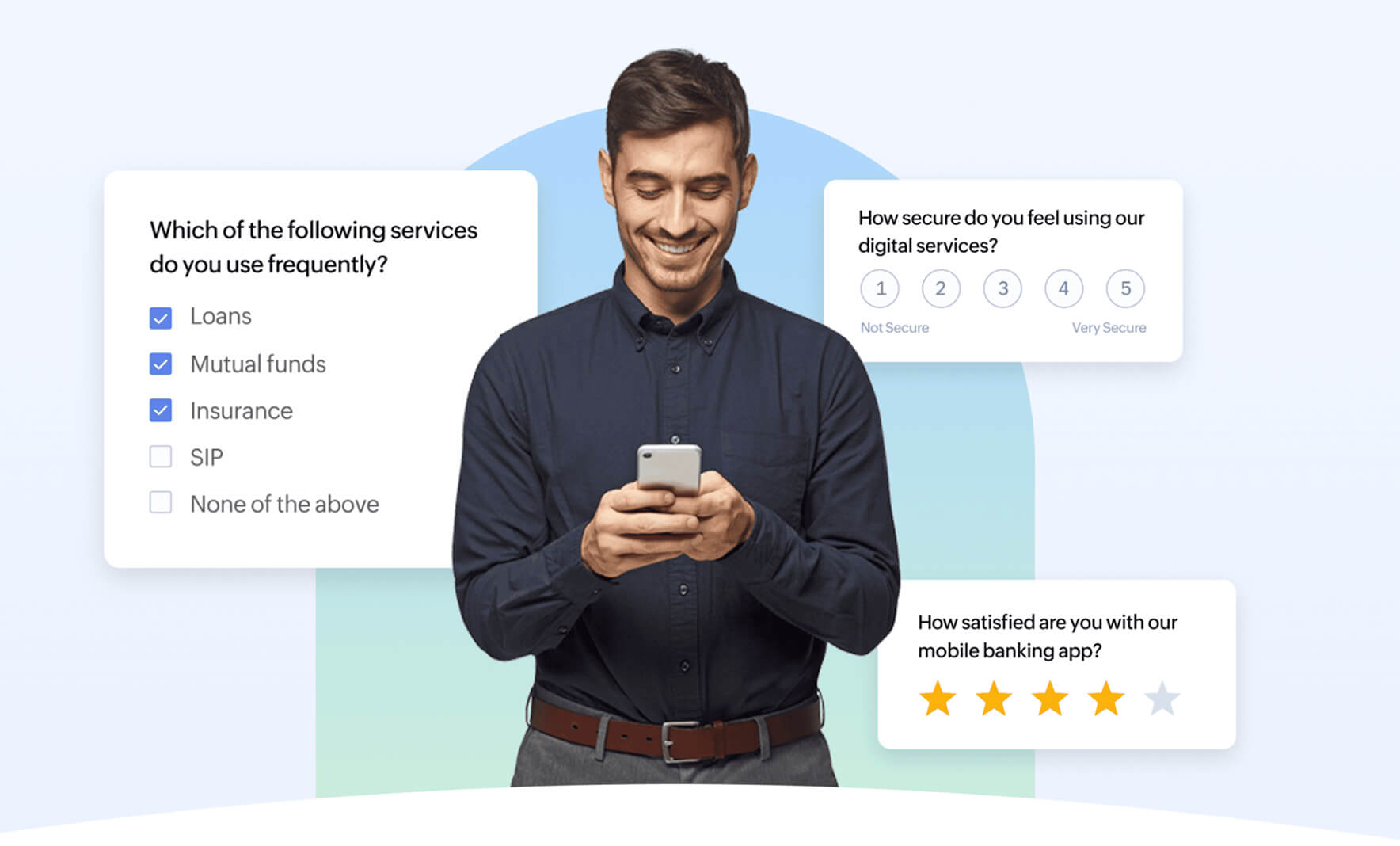
Running effective banking surveys requires more than a simple questionnaire. Financial institutions need survey software that supports secure data collection, advanced reporting, and flexible distribution across multiple customer touchpoints.
Zoho Survey provides the capabilities banks need to design, distribute, and analyze customer feedback programs at scale. Customizable templates help teams quickly create surveys for customer satisfaction, digital banking experiences, branch visits, loan applications, and trust measurement initiatives.
Multiple distribution channels including email, SMS, website embeds, and QR codes allow surveys to reach customers at the most relevant moments in their journey. Advanced logic and branching ensure respondents only see questions relevant to their experiences, improving completion rates and data quality.
Real-time reporting transforms incoming responses into visual dashboards, while cross-tab analysis helps institutions compare results across customer segments, products, regions, and channels. Integration with other business systems further streamlines customer experience management by connecting feedback data directly to operational workflows.
Zoho Survey is available with a 7-day credit card-free Enterprise trial, giving financial institutions full access to the features and capabilities needed to build, distribute, and analyze banking surveys from day one.
Summing it up
In banking, customer trust is earned through thousands of small interactions. Some strengthen relationships while others quietly weaken them. Operational data reveals what customers do. Banking surveys reveal what customers think, feel, and expect. That distinction matters.
Financial institutions that systematically collect, analyze, and act on customer feedback gain a clearer understanding of trust, satisfaction, loyalty, and service quality. Those insights enable smarter decisions, stronger customer relationships, and better long-term business performance. As banking becomes increasingly digital and competition intensifies, the institutions that listen most effectively will be the ones that retain trust the longest.