
A consumer goods brand spent eight months developing a campaign. The brief was sharp, the creative team was talented, and the internal reviews went smoothly. The campaign launched across digital and out-of-home channels with a significant media budget behind it.
Three weeks in, the numbers were flat. Click-through rates underperformed. Social engagement was minimal. The brand tracking data that came back two months later told the real story: The campaign's central message had been interpreted by consumers in a way that was almost the opposite of what the creative team intended. The tone that felt bold and distinctive in the boardroom read as dismissive to the actual audience.
Nobody had asked that audience what they thought before the money was spent.
An ad concept testing survey would have caught this in days. Instead, it took three months and a significant budget to discover the same information. And it came at a point when nothing could be changed.
What is ad concept testing, and why does its timing matter?
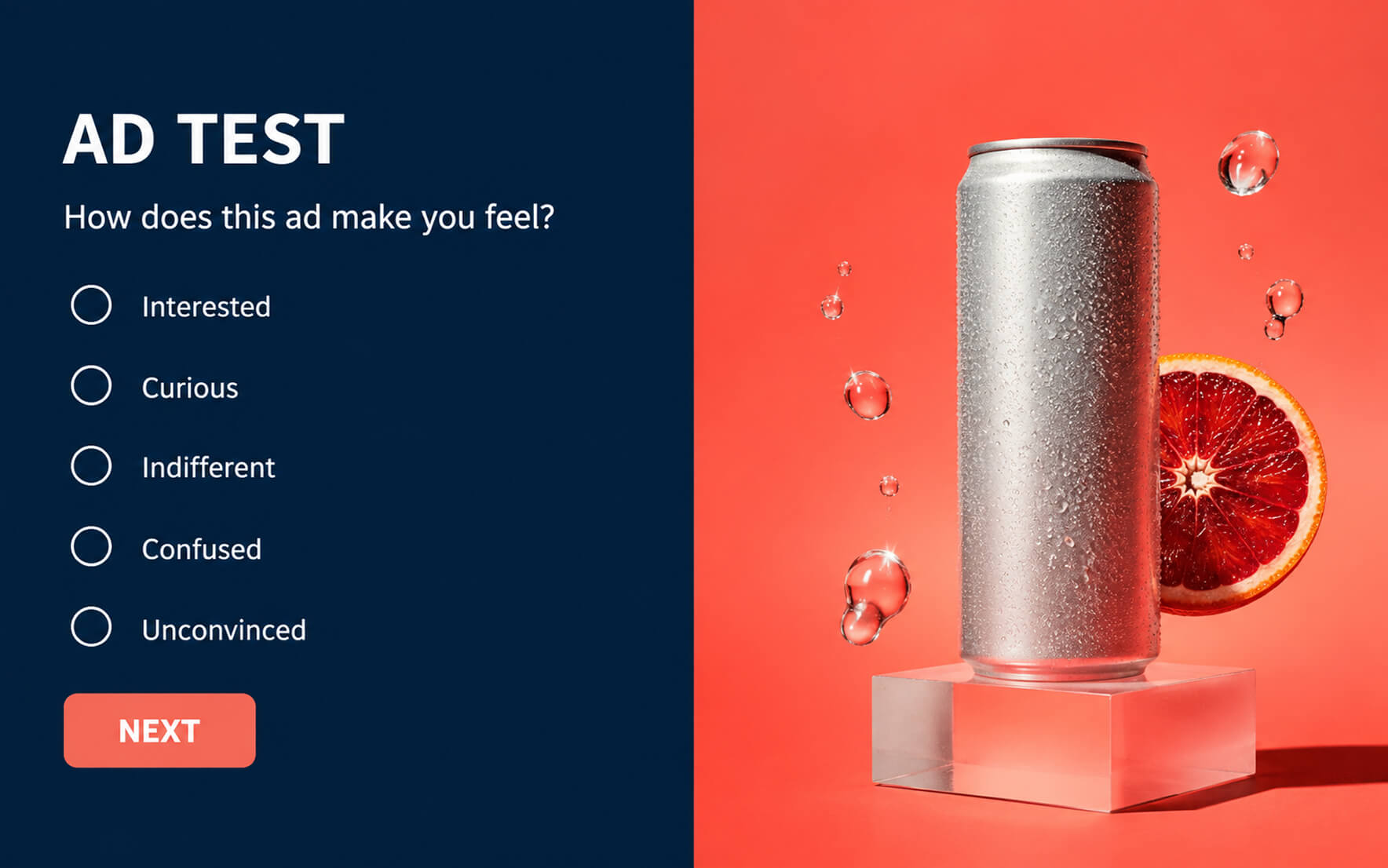
Ad concept testing is the process of presenting advertising ideas at the concept, storyboard, or draft execution stage to a sample of the target audience before launch to measure whether the creative direction is likely to achieve its intended effect. It is a form of ad pre-testing, a validation that happens upstream of production and media spend when changes are still inexpensive to make.
The distinction between concept testing and post-launch measurement is important. Post-launch data tells you what happened after the investment was made. Ad concept testing tells you what is likely to happen before the commitment is made. This is the only point at which that information can actually change a decision.
Kantar's research on early-stage creative validation found that early testing of creative concepts increases the likelihood of short-term sales by as much as 15%. This is not a marginal difference; it represents outcomes that are directly traceable to whether a brand tested and refined its creative before spending on media, or launched on instinct and hoped for the best.
What an ad testing survey measures
A well-designed ad testing survey measures several distinct dimensions, each of which contributes to predicting whether a piece of creative will perform in market.
Comprehension
Does the audience understand what the ad is communicating? Miscomprehension is among the most common and underestimated creative failures. A message that is internally obvious to the team that built it often requires prior context that the target audience simply doesn't have. Testing comprehension early catches this before media spend locks in the confusion at scale.
Brand linkage
Will audiences connect the creative to the right brand? A memorable ad that doesn't generate brand recall is a net negative for the advertiser. In fact, it may even contribute to a competitor's brand equity if the execution feels generic to the category. Brand linkage is especially critical for new product launches and challenger brands entering established categories.
Message resonance
Does the core message of the ad feel relevant, credible, and compelling to the target audience? A message that resonates internally with the creative team may not land the same way with a consumer who has no investment in the brand's narrative.
Emotional response
What does the ad make people feel, and does that feeling align with the intended brand territory? Kantar's Media Reactions 2024 research identified that music and humor continue to be the most impactful creative elements for US consumers. Testing the emotional quality of a creative concept before launch helps ensure the execution matches what the channel and audience actually respond to.
Purchase or action intent
Does exposure to the ad increase the likelihood that the audience will consider, try, or buy? For campaigns with direct response objectives, this is the most commercially critical dimension to test.
Ad recall potential
Is there a distinctive, memorable element to the creative (a character, a visual device, a phrase) that will help the ad break through? The elements that drive those outcomes can be identified and amplified through pre-testing before production is locked.
Ad testing survey questions to include
The following ad testing survey questions are organized by the dimension they are designed to measure. They are applicable to TV, digital, print, and out-of-home concept formats.
Comprehension and message clarity
- In your own words, what is this ad trying to communicate?
- What is the main message you take away from this ad?
- Is there anything about this ad that is unclear or confusing?
- What product, service, or brand does this ad relate to?
Brand linkage
- Which brand or company do you associate with this ad?
- How strongly does this ad feel connected to the [brand name] you know?
- Does this ad feel consistent with what you would expect from this brand?
Message resonance and relevance
- How relevant is the message of this ad to you personally? (1–5 scale)
- Does the message of this ad feel believable and credible?
- How well does this ad communicate something that matters to you?
Emotional response
- How did this ad make you feel? (Select all that apply: Engaged / Inspired / Amused / Indifferent / Annoyed / Confused / Other)
- Which word or phrase best describes your overall reaction to this ad?
- Did any part of this ad feel unexpected or surprising? If yes, in what way?
Ad copy testing and messaging preference
- Which of the following headlines feels most compelling? (Present options A, B, C)
- Which version of this message would make you most likely want to learn more?
- Does the language in this ad feel natural and appropriate for this type of product?
Purchase and action intent
- After seeing this ad, how likely are you to consider purchasing [product/service]? (1–5 scale)
- Does this ad change how you feel about [brand] in any way?
- Would this ad prompt you to seek out more information about the product?
Open-ended diagnostic
- What do you like most about this ad?
- What would you change about this ad to make it more effective?
- Is there anything about this ad that would prevent you from engaging with this brand?
How to design an effective campaign testing survey
Getting the survey questions right makes a difference. But the design decisions that come before the first question are what determine whether the data you collect will actually be worth acting on.
Define what "success" looks like before writing a question
An ad testing survey designed to evaluate a brand-building campaign should weight emotional resonance and brand linkage more heavily. A campaign testing a direct response creative should weight purchase intent and message clarity above other dimensions. In essence, the question mix should reflect the campaign's actual objective.
Show the concept in the closest-to-final format available
A rough storyboard generates different reactions than a polished animatic, which generates different reactions than a finished TV spot. Where possible, test with the format that most closely approximates the final execution. Also, note the production stage clearly when interpreting results, since respondents adjust expectations based on finish quality.
Test multiple concepts, not just one
The most common misuse of campaign testing is treating it as a pass/fail gate rather than a comparative evaluation. Testing two or three creative directions against each other is significantly more informative than assessing a single concept in isolation. It also prevents the false comfort of a concept that scores "above average" relative to nothing.
Include competitive context where relevant
For ad copy testing in categories with established competitors, showing respondents the brand's concept alongside category norms or competitor executions generates comparative data that predicts real-world performance more accurately than isolated concept evaluation.
Recruit the right respondents
An ad concept testing survey directed at a general consumer panel rather than the actual target audience produces data that can actively mislead creative decisions. Recruitment criteria should reflect the demographic, behavioral, and attitudinal profile of the campaign's intended audience as closely as the available panel allows.
Using Zoho Survey for ad concept testing

Zoho Survey offers a ready-built concept testing template that covers logos, messaging, ad copy, and campaign concepts. This gives creative and marketing teams a structured starting point rather than a blank screen. The template is designed to measure customer attitudes toward an idea using both qualitative and quantitative methods, and can be adapted for ad concept testing across any format or channel.
For teams that need to reach beyond their existing contact base, Zoho Survey's Buy Responses feature connects researchers with verified panels segmented by demographic, economic, and geographic attributes. This makes it possible to test an ad concept with the actual target audience profile rather than whoever happens to be on an internal list.
Logic and personalization tools allow surveys to adapt to individual respondents, routing them through relevant question paths based on their answers. Response collection works across multiple channels, and real-time reporting translates incoming results into dashboards as responses arrive.
Zoho Survey is now available with a seven-day, credit card-free Enterprise trial. Give it a try today!
Key takeaways
Ad concept testing is not a guardrail for teams who lack creative confidence. It is standard practice for teams that understand how expensive it is to find out the audience disagreed with you after the campaign has already run. A structured ad testing survey gives creative and marketing teams the information they need to launch with confidence rather than hope.