- Home
- Learning hub
- Customer Experience
Customer experience: Importance, strategies, and how to measure CX
Customer experience refers to how your customers feel when they see, understand, and interact with your product. In a meta sense, CX also includes how your customers feel about your product even when they're not using it.
get started
What is customer experience (CX)?
Customer experience is the overall experience visitors receive from your business and the emotion it creates and registers in their minds, whether positive or negative.
It starts the moment someone lands on your website. It extends to your user interface, how you navigate them through your content, convert them into customers, and treat them when they come to your support for assistance.
Importance of customer experience
In the past, low-cost marketing positioning and placements were attractive enough to bring customers to the store. But today, brands have to more. A lot more.
Brands can no longer be negligent about their designs, language, and UI or be lethargic about how their customer support works. The internet gave power to every customer out there. When a brand fails to offer good support to one customer, the individual can take the issue online and bring it to the notice of thousands of other customers. It affects the brand's value and reputation among its present customers and those who're considering using the brand.
Even an individual customer can cause ripples the brand cannot control. Ultimately it could result in financial as well as reputation loss. So businesses have to tread carefully on how they treat their customers.
How does customer experience impact businesses?
Customer experience shouldn't be viewed from a place of fear. If businesses obsess over how they can make every customer interaction with them a pleasure, customers will, in turn, obsess over the brand.
Providing a committed customer experience will create a domino of benefits for businesses: A satisfied customer will share their positive experience online. It'll grab the attention of current customers and those interested in that brand. It'll increase the brand's reputation and value without them having to spend anything. Also, satisfied customers will turn into loyal spokespersons of your business. Having an army of loyal customers will reduce the cost of marketing, sales, and support operations for a long time.
Know about good and bad customer experience
What differentiates good and bad customer experiences? Without getting into the nitty-gritty of the technicalities, an easy litmus test is to ask customers what they feel when contacting your business.
If they express unhappiness, their experience with your business has been bad. It could be due to multiple factors, such as unavailability, lack of self-service options, inconsistent assistance, disconnected departments, failure to follow up, product issues, and more.
What makes it a bad customer experience?
- No options to instantly contact your business because no one wants to wait.
- Even if you don't have a human available 24/7 to assist, you should have sufficient self-service collaterals or automated assistants, like chatbots, for prospects/customers to find solutions.
- Nowadays, customers expect to reach out to businesses in their preferred mode of communication. When a business forces customers to contact them only via selected mediums instead of providing omnichannel customer service, that will create a bad experience.
- When approaching businesses that provide high-value products for a resolution, customers will be taken across multiple stakeholders. Making them share their queries from the top with everyone will be a bad customer experience. Customers don't want to repeat themselves. Your engagement tool should work seamlessly between departments to provide a uniform experience.
- Ultimately, it rests upon how your product works. Even if you have an excellent customer service team, if your product doesn't work as intended, it'll create a bad experience.
Are customer experience and customer service the same?
- Customer experienceCustomer service
- Customer experience is about creating a memorable, helpful, and happy experience for your customers.Customer service is about providing assistance and solution to customers in need.
- Customer experience starts from when they visit your website as just a prospect, and continues as they become a customer and even when they come to your support team for assistance.Customer service kicks in only when the customers come to your support team. So customer service comes under the broad spectrum of customer experience, and it plays a critical role in the success of your experience strategy.
- Customer experience requires businesses to be proactive, i.e., customers should be able to experience it even if they're not initiating any interaction with your business.Customer service can only be provided reactively. i.e., only after your customers ask for it.
- Net Promoter Score (NPS), customer loyalty and retention, churn rate, and Customer Lifetime Value (CLV), etc. are attached to measuring customer experience.Response time, First Contact Resolution (FCR), and Customer Satisfaction (CSAT) scores, etc. are measured to determine the results of customer service.
What is customer experience management?
Customer experience management (CXM) is the process of understanding your customer's needs, expectations, and concerns and having systems to improve their overall experience of interacting with your business at every touch point of interaction.
Customer experience management touches upon all the customer-facing departments in your business. In large organizations, multiple departments take care of customers at various stages. Customer experience management should break the silos between those departments and ensure a smooth, uniform experience across multiple touchpoints within the organization.
Customer experience management vs. Customer relationship management
Another pair of phrases are also often misunderstood and used interchangeably—customer experience management and customer relationship management.
How do they differ?
- Customer experience managementCustomer relationship management
- Customer experience management is about creating how businesses want to be perceived in their customers' eyes.Customer relationship management is a business's view of its customers.
- Customer experience management is all about creating a uniform and better customer experience. Customer experience management aims to create a unified experience that would improve customer interaction.Businesses have hundreds of thousands of customers, and it'd be impossible to remember every customer's journey with the business and their interaction. Customer relationship management is vital in helping businesses record their customers' journeys and interactions with them.
- For customer experience management, businesses strive to understand user behavior, listen to their feedback, analyze, implement changes, and monitor the funnel.Customer relationship management helps establish and record the relationship with prospects and customers.
Why should businesses focus on customer experience management?
Businesses should focus on customer experience management because creating a good customer experience is absolutely necessary for conversion and retention.
Customer experience management helps businesses implement their customer experience strategies and go through the process themselves to identify whether they're getting a uniform experience throughout the multiple touchpoints as intended. It'll help identify where they're lacking, their difficulties, and what can be done to improve the experience.
By focusing on customer experience management, businesses can reap the benefits of customer experience, such as:
- Better retention, which leads to higher Customer Lifetime Value (CLV)
- Higher Customer Satisfaction (CSAT)
- Earning the loyalty and love of customers, which helps get word-of-the-mouth reviews and brand recognition
- Low acquisition cost
- Competitive edge over competitors
Customer experience strategy
Customer experience strategy is the process of understanding where and what issues your prospects and customers face when interacting with your offerings and coming up with solutions to address the challenges and make the experience memorable for them.
Key elements of customer experience strategy
1. Uniformity
Since customer experience covers all the touchpoints, businesses have to ensure a uniform experience to provide a good experience.
2. Simplicity
Businesses tend to add complexities without even being aware of them, as there are no guidelines to create a good customer experience. Keeping it simple helps them to implement it while helping their customers to understand and enjoy the experience.
3. Accessibility
To deliver a good customer experience, businesses should anticipate where customers might struggle and make sure they have accessible means in place to contact them.
4. Personalization
Making the customer journey feel personal to the visitors is a challenge, as everyone's preferences vary. Analyzing visitors and how they interact with your business will give a better idea of how ideal customers navigate. Based on those inputs, businesses can personalize the communication.
5. Convenient
At any point, customers shouldn't feel their interaction with the business is a burden, and customer convenience should be anticipated and taken care of.
How to measure customer experience
To measure customer experience, businesses can observe the following metrics:
1. Net Promoter Score (NPS)
Calculating NPS is a standard format. Businesses can use the NPS survey to calculate whether their customers are satisfied with their products.
You share a survey with your customers, asking them to recommend your product/offering to their friends on a scale of 0-10. Those submitting 0-6 are detractors, 7-8 are passives, and 9-10 are promoters.
Net Promoter Score is the percentage of detractors subtracted from the promoters. Usually, for SaaS companies, NPS above 30 is considered exceptionally good and denotes you have solid customer experience plans in place.
2. Customer Lifetime Value (CLV)
This is the total value a customer adds to your business during their stay with your business. It's calculated by multiplying the customer value by the average customer life span. The more the value is, the more your customers are happy about their experience with you.
3. Customer churn rate
This is the percentage of paying users leaving your product in a time frame divided by the total number of users you had in the beginning. The percentage of subscribers who left the platform divided by the total number of initial users is how you calculate the churn rate.
When you have a low churn rate, it indicates that your customers are happy with your offerings and having a good time.
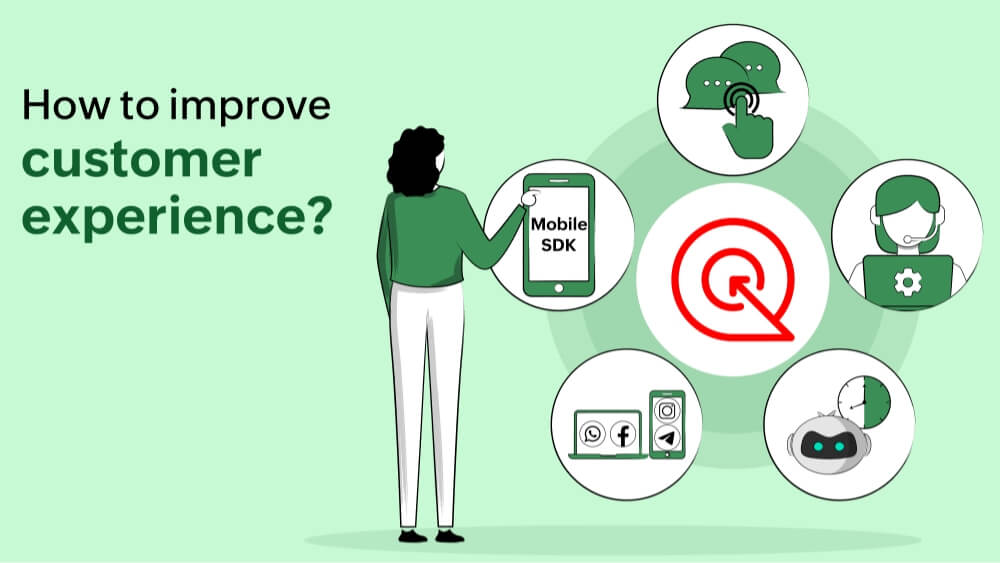
How to improve customer experience?
Obsess over your customers
There is no shortcut to improve customer experience. The first and crucial step is to obsess over your customers. Businesses need to find the needs of their ideal target customers, what they prefer, the pain points they face, and how they'd look for a solution to face their challenges.
By creating ideal customer personas, businesses can address the pain points prospects would face, which would help them provide a better customer experience.
Following customer journey
To improve customer experience, businesses can map their customers' journey with their products. After transitioning from prospects to customers, their maximum engagement will be with the support team. By following their journey, businesses can understand and resolve the pain points they face in approaching support for assistance.
Ask for feedback and implement them
As prospects go through marketing and sales funnels, businesses can ask for feedback at every phase to understand where they could get a better experience. Later, they can implement those suggestions to improve their customer experience.
Can a tool help businesses improve their customer experience? Technically, no, but managing every stage of customer interaction manually is a nightmare. This is where Zoho SalesIQ, the Experience Intelligence, comes to your rescue.
The future of customer experience
Customer experience is undoubtedly a vital requirement for prospects to consider a business and for customers to stay with the business. As competition and technology increase, how will customer experience morph, and what role will it play?
One of the significant discomforts businesses face in providing an excellent and uniform customer experience is personalization at scale. As customer expectations increase, businesses need more resources to meet them.
With AI becoming a democratized tool available for everyone at affordable costs, personalized experience at scale can be possible. Businesses will be able to provide an intelligent assistant that can help every customer answer their queries, troubleshoot their issues, or even connect to a human when they're not able to figure it out.
In short, the future of customer experience should create an environment where people won't know the existence of good and bad experiences as it'd be seamlessly embedded in their journey with the businesses.
Why is Zoho SalesIQ the best tool for boosting your customer experience?
Zoho SalesIQ, the Engagement Intelligence platform, offers abundant features to boost your customer experience at three pillars of customer interaction: marketing, sales, and support and help you provide automated customer service.
Features like Visitor tracking/Live view, Lead scoring, and AI-based profile enrichment for companies help you easily identify your potentials. Using our proactive live chat, you can instantly reach out to them based on their interaction with your website and resolve any queries they have. SalesIQ also offers features like Chat Routing, Departments, and instant messaging channels, to empower your support team to better serve your prospects and customers.
Related resources
Here are some blogs to help you learn about the other facets of customer experience.
Improve CX in the manufacturing industry
Learn more
How customer community helps you improve CX
Learn more
Simplifying hybrid retail customer experiences
Learn more
Go multilingual for a great customer experience
Learn more
3 key strategies to scale your CX
Learn more