

- HOME
- Accounting
- CA in practice vs. CA in industry: All you need to know
CA in practice vs. CA in industry: All you need to know

Introduction
You have just cleared your CA final. The excitement is through the roof, your friends are celebrating, and your phone line is tied up with receiving congratulations calls from family members. Amidst all this, one question is lingering in your mind. What's next—practice or industry?
This situation is not unique to you. Every freshly qualified CA asks themselves the same question. However, one thing that has changed now is that the answer isn't as definitive as it used to be. A few years ago, getting a stable job would have been the smarter choice. Today, with GST advisory, virtual CFOs, and outsourced accounting all opening up, starting a practice is looking to be a more viable option than it used to be.
This article will explore what both the paths look like and compare them with each other, so you can weigh them against your own situation for better clarity.
What "CA in practice" actually means
A CA in practice is a chartered accountant who starts their own practice firm or works as a partner in a CA firm. They need to have a Certificate of Practice (COP) issued by the Institute of Chartered Accountants of India (ICAI). This allows them to offer their services directly to clients. Primarily these services include:
Statutory and tax audits
GST and income tax return filing
Tax advisory and litigation support
Bookkeeping and compliance for SMEs
Virtual CFO services for startups and small businesses
Forensic accounting and due diligence
Here, you have your own firm or partly own a firm and are responsible for growing it by acquiring clients and providing related accounting services.
What "CA in industry" actually means
A CA in industry is a chartered accountant employed by a company. This could be any of the Big 4 firms, corporations, banks, multinational corporations, or even a startup. They are employees who work within the finance, audit, or tax functions of the company. Popular roles include:
Financial Analyst/FP&A
Internal auditor
Tax manager
Compliance and risk head
Controller
CFO
Here, you are part of a defined system with a fixed reporting line and a clear scope of work outlined.
Practice vs. Industry: Side by side comparison
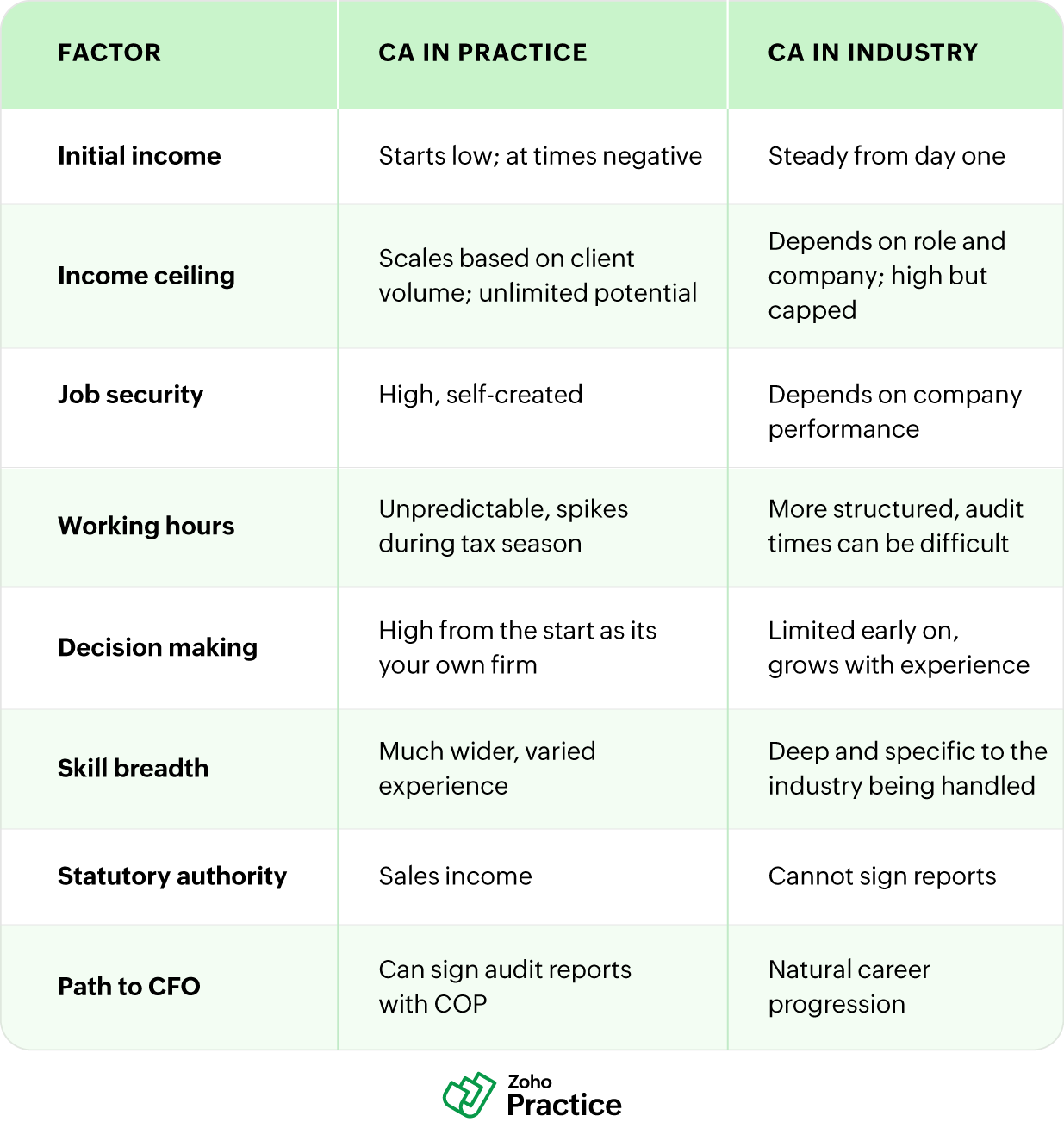
How the initial years look
Be it industry or practice, the initial years play a crucial part in shaping the career course. This is where most people underestimate what they are signing up for.
In industry, work is straightforward. Once you get into a company, you go through a training curriculum that prepares you for the work ahead within a short duration. You start earning immediately, your roles and responsibilities are clearly defined, your learning curve is steep and you get to dive deep on your company's systems and your clients' industry problems.
On the other hand, in practice, if you are starting your own firm, the initial phase is genuinely hard. You spend most of your time setting up your base, meeting potential clients and pitching your services. You may not make much money during the initial few months and may have to depend on your savings until you build a reputation that grows your clientele. This initial risk is worth considering if financial stability is paramount, especially if you have education loans or other responsibilities to take care of.
What happens after the initial years
A CA in industry becomes a subject matter expert. Let's say you work for a manufacturing giant. You will learn everything about that industry, its import duties, and GST implications better than others. This skill is incredibly valuable, and offers room to grow. This is how people become CFO material.
A CA in practice is like a jack of all trades. Handling clients across multiple industries gives you exposure to varied problems, different regulations, and different ways businesses operate. With this, ICAI's CPE (Continuous Professional Education) requirements are stricter for members holding COP. This ensures CAs stay up to date with changes in accounting, auditing, taxation, corporate laws, and the like.
Questions worth asking yourself
Before you decide which way to go, answering the below questions will give a better frame of reference:
Can you go without income during the initial phase or do you need a steady flow of income?
Do you want a diverse experience or want to master a specific domain/industry?
Does client acquisition and relationship building interest you or would you rather focus on pure technical work?
Are you confident in being accountable for your own output without any supervision?
None of these answers have a correct answer. They help bridge the gap between where you are and where you want to be.
You can change your mind later
Once you make a decision, it isn't written in stone. You can always pause and change course during any stage of your career. Many CAs practice for several years and then switch to an industry role and vice-versa. Skills earned in one path often help the other. For example, as part of a practice firm, you might have advised multiple clients within a particular industry and that helps you if you decide to move to an role in that industry in the future.
Beyond a stage, some CAs do both simultaneously. CAs taking full-time industry roles while maintaining a practice as a side hustle are increasingly becoming common. The line that separates industry and practice is becoming thinner with time.
If you choose practice
Getting your first set of clients, earning their trust, and building your reputation is what takes time. Chasing client documents, staying on top of GST deadlines, following up with clients on pending payments, then building and training a team are some of the tasks that demand more effort until they become the drill.
Firms that cross this initial struggle are usually those that focus more on structure and processes early on. Centralizing client records, automating payment reminders, and setting up a training structure are tasks that, when done right, help free up your time so you can focus on advisory and client management.
Zoho Practice is exactly built for this—streamlined client collaboration, seamless task management, workflow automation, and more that saves you time to do the critical work. Irrespective of what tool you use, the underlying point is the earlier you bring structure to your operations, the earlier your practice gets sustainable.
Frequently asked questions
Is CA in practice riskier than CA in industry?
Yes, during the initial few years it is, especially if you are financially dependent. Practice rewards people who persevere and carve a niche for themselves.
Which pays more, practice or industry?
Industry gives a steady flow of income. Practice may pay intermittently in the beginning, but has a higher salary ceiling.
Can a CA in industry sign statutory audit reports?
No, unless you hold a Certificate of Practice issued by ICAI, you can't sign statutory audit reports.
Can I start a practice and later switch to industry?
Yes, this is becoming increasingly common. Many CAs also run a part-time practice while employed, subject to ICAI regulations on the nature of the work involved.
Do I need significant savings before starting practice?
It helps. Most practitioners recommend having enough of a financial cushion to cover 6–12 months of personal expenses, since client billing and cash flow typically take time to stabilize.