

- HOME
- Taxes & compliance
- Turnover Tax (TOT) in Kenya: The complete guide for small businesses
Turnover Tax (TOT) in Kenya: The complete guide for small businesses
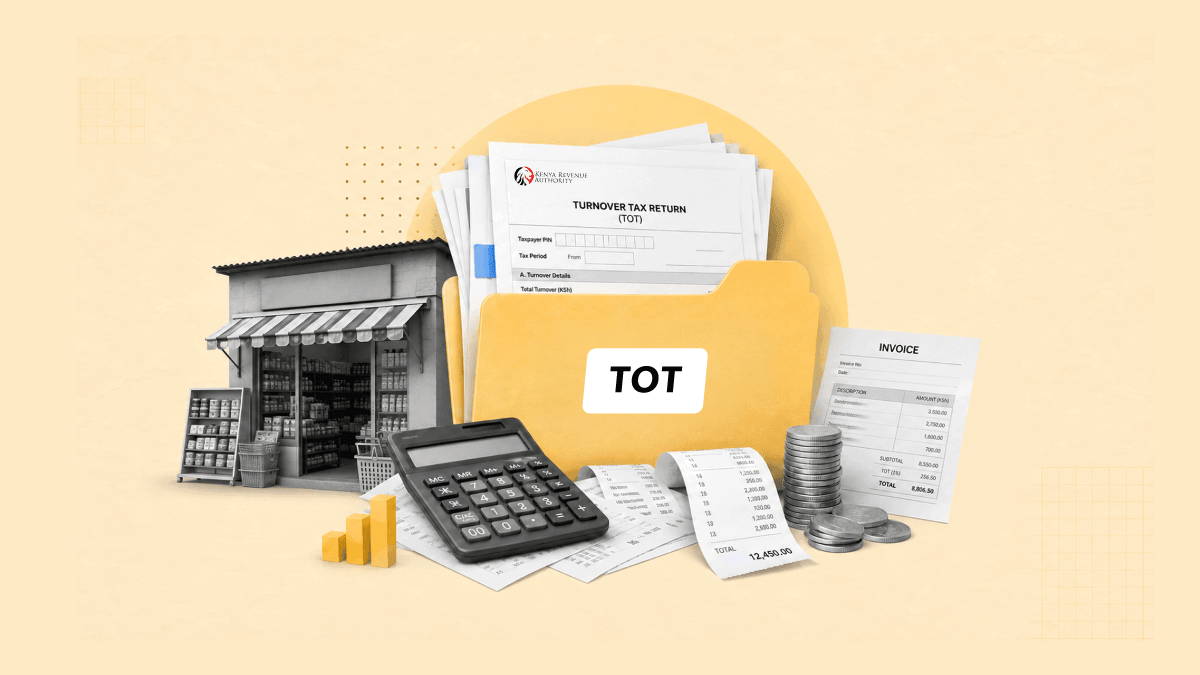
If you run a small business in Kenya with an annual turnover between KES 1 million and KES 25 million, Turnover Tax (TOT) is one of the easiest ways to stay tax compliant.
Unlike the standard income tax system, TOT doesn't require you to calculate profits or maintain complex books of accounts. Instead, you pay 1.5% of your monthly gross sales (excluding VAT), making compliance simpler for growing businesses.
This guide will explain everything you need to know about TO Tin Kenya, from who should register and how to file your returns to payment deadlines, penalties, and how TOT compares with VAT and income tax.
What is Turnover Tax (TOT)?
Turnover Tax (TOT) is a simplified tax regime introduced by the Kenya Revenue Authority (KRA) to help micro and small businesses meet their tax obligations with minimal administrative effort.
Instead of taxing your profits, TOT applies a flat 1.5% tax on your monthly gross sales, excluding VAT. Since it's based on revenue rather than profit, there's no need to calculate deductible expenses or prepare detailed profit-and-loss statements.
For example, if your business records monthly sales of KES 200,000, your TOT would simply be:
KES 200,000 × 1.5% = KES 3,000
If you're VAT registered, remember to exclude VAT from your sales before calculating Turnover Tax.
The goal is to make tax compliance easier for businesses that may not have dedicated accountants or sophisticated accounting systems. With simple sales records and monthly filing, businesses can stay compliant without spending excessive time on tax administration.
Who should register for TOT?
You qualify for TOT if your business meets all of the following conditions:
Requirement | Details |
Annual turnover | Between KES 1 million and KES 25 million |
Residency | You are a Kenyan resident |
Business type | Sole proprietorship, partnership, or company |
VAT registration | VAT registration may still be required if taxable supplies exceed the VAT threshold |
Who isn't eligible?
TOT doesn't apply if:
Your annual turnover is below KES 1 million.
Your annual turnover exceeds KES 25 million.
You're a non-resident taxpayer.
Your income consists solely of:
Rental income
Professional or consultancy services
Management or agency fees
Income subject to final withholding tax
These types of income are taxed under separate provisions and shouldn't be reported under Turnover Tax.
How to register for TOT on iTax
Registration is done online through the KRA iTax portal.
Before you begin, make sure you have:
A valid KRA PIN
A registered business
Updated business and contact information on your iTax profile
Follow these steps:
Log in to your iTax account.
Go to Registration > Amend PIN Details.
Under Basic Information, select Yes for Turnover Tax registration.
Choose the effective date for your Turnover Tax obligation.
Review your business information and update it if necessary.
Submit your application.
Once approved, Turnover Tax will appear as an active tax obligation on your iTax dashboard, and you can start filing monthly returns.
If you don't have a KRA PIN yet, you'll need to register for one before applying for Turnover Tax.
Filing your TOT returns
TOT returns can be filed through two ways:
KRA iTax portal
KRA M-Service App on Android and iOS.
The filing process is straightforward:
Log in to your account.
Select Turnover Tax Return.
Choose the tax period.
Enter your monthly gross sales (excluding VAT).
The system automatically calculates the tax payable.
Submit the return and save the acknowledgment receipt.
Generate a payment slip if tax is due and complete the payment using M-Pesa or an approved bank.
If your business records no sales during a month, you must still file a nil return. Missing a nil return attracts the same penalties as failing to file a regular return.
When is TOT due?
TOT is filed and paid every month. The deadline is the 20th day of the month following the sales period.
For example:
Sales month | Filing & payment deadline |
January | 20 February |
February | 20 March |
March | 20 April |
The same rule applies throughout the year.
To avoid last-minute stress, set a recurring reminder around the 15th of every month. Filing early gives you enough time to correct any errors and make your payment before the deadline.
What happens if you miss the deadline?
Missing your TOT deadline can quickly become expensive. Along with financial penalties, repeated non-compliance can affect your business's credibility with the KRA.
Here's what you may be charged:
Offense | Penalty |
Late filing | KSh 1,000 per month |
Late payment | 5% of the tax due |
Interest on unpaid tax | 1% per month |
Failure to register when required | Up to KES 100,000 |
Example:
Suppose your TOT for March is KES 3,000, but you miss the filing deadline.
You may end up paying:
KES 1,000 as a late filing penalty
KES 150 as a late payment penalty (5%)
KES 30 as monthly interest (1%)
That's KES 1,180 in additional charges on a tax bill of just KES 3,000.
Beyond penalties, continued non-compliance may:
Trigger KRA audits.
Delay or prevent you from obtaining a Tax Compliance Certificate (TCC).
Affect eligibility for government tenders, business contracts, or certain loan applications.
Staying on top of monthly filings helps you avoid unnecessary costs and keeps your business compliant.
TOT vs. VAT: Do you need both?
This is one of the most common questions small business owners ask. The short answer is yes—depending on your business turnover.
If you're registered for TOT and your annual taxable supplies exceed the VAT registration threshold (currently KES 5 million), you'll also need to register for Value Added Tax (VAT).
Here's how it works:
Annual turnover | Tax obligation |
Less than KES 5 million | TOT only |
KES 5 million–25 million (taxable supplies) | TOT + VAT |
Above KES 25 million | Standard Income Tax + VAT |
Being registered for VAT doesn't automatically remove your TOT obligation. If your business qualifies for both, you'll need to comply with the filing requirements for each.
TOT vs. VAT: What's the difference?
Although both are filed monthly, they serve different purposes.
Turnover Tax | VAT |
Charged on gross sales (excluding VAT) | Charged on the value added to goods and services |
Paid by the business | Collected from customers and remitted to KRA |
Flat rate of 1.5% | Standard VAT rate of 16% |
Simple sales records | Detailed invoicing and VAT records required |
Think of TOT as a simplified form of income tax that's calculated on your gross turnover (excluding VAT) instead of your taxable profit. VAT, on the other hand, is a consumption tax that businesses collect from customers and remit to the KRA.
TOT vs. Income tax: Which is right for your business?
TOT simplifies tax compliance, but it isn't always the most cost-effective option. Whether TOT or the standard income tax regime is more suitable depends on factors such as your business's profit margins, deductible expenses, legal structure (for example, whether you're a sole proprietor or company), and overall tax position.
TOT may be suitable if you:
Run a small or growing business
Have relatively high profit margins
Want a simple and predictable tax calculation
Don't maintain detailed expense records
Prefer minimal bookkeeping and compliance
The standard income tax regime may be more suitable if you:
Have significant operating expenses
Run a low-margin business
Want to claim deductible expenses such as salaries, rent, depreciation, or loan interest
Already maintain detailed financial records
Here's a quick comparison:
Feature | Turnover Tax | Standard Income Tax |
Tax calculated on | Gross sales | Net profit |
Tax rate | 1.5% of gross sales | Applicable income tax rates |
Expense deductions | Not allowed | Allowed |
Recordkeeping | Basic sales records | Detailed accounting records |
Annual income tax return | Not required for TOT income | Required |
Example:
Imagine a hardware store generates KES 10 million in annual turnover but earns only KES 500,000 in profit after expenses.
Under TOT, the business would pay KES 150,000 (1.5% of annual turnover).
Under the standard income tax regime, tax would instead be calculated on the KES 500,000 taxable profit. Depending on factors such as whether the business is a sole proprietorship or company, the applicable income tax rates, and the deductions available, the tax liability may be lower, comparable to, or higher than the TOT payable.
Businesses with relatively low profit margins or significant deductible expenses may therefore benefit from evaluating whether the standard income tax regime is more suitable for their circumstances.
Can you opt out of TOT?
Yes. If TOT isn't the right fit for your business, you may apply to the KRA Commissioner to be taxed under the standard income tax regime instead, subject to the applicable tax rules and KRA's approval.
Before making the switch, it's worth evaluating your business's revenue, expenses, and profit margins (or consulting a tax professional) to determine which option is more suitable.
Common TOT mistakes to avoid
Even though TOT is one of the simplest tax regimes in Kenya, small mistakes can still lead to penalties and compliance issues. Here are some of the most common ones and how to avoid them.
Delaying registration after crossing the threshold
If your annual turnover exceeds KES 1 million, registering for TOT isn't optional. Delaying registration could lead to penalties and unnecessary compliance issues. Keep an eye on your sales throughout the year so you're prepared to register as soon as your business becomes eligible.
Missing monthly filing deadlines
TOT returns are due by the 20th of every month. Missing the deadline can result in late filing penalties, interest, and additional charges. A recurring calendar reminder or accounting software with tax reminders can help you stay on track.
Forgetting to file nil returns
No sales for the month? You still need to file a nil return. Many businesses assume they can skip filing when there's no business activity, but KRA treats missing nil returns the same as missing regular returns. If your business didn't generate any revenue during the month, simply submit a nil return before the deadline.
Calculating TOT on VAT-inclusive sales
If your business is VAT registered, remember that TOT is calculated on gross sales excluding VAT. Including VAT in your turnover can result in paying more tax than required.
Remaining on TOT after exceeding the turnover limit
TOT applies only to businesses with annual turnover between KES 1 million and KES 25 million. If your business grows beyond this limit, you'll need to transition to the standard income tax regime and update your tax obligations through iTax. Review your turnover regularly so you're ready when your business reaches the threshold.
Reporting excluded income under TOT
Not every type of income qualifies for TOT. Income from rental properties, professional or consultancy services, management fees, and certain income subject to withholding tax must be reported under their respective tax regimes. Understanding which income falls under TOT helps you avoid incorrect filings.
Not keeping your iTax profile updated
Business details such as your address, contact information, and business activity should always be up to date on your iTax account. Keeping this information current makes communication with KRA easier and helps prevent issues when applying for services such as a Tax Compliance Certificate.
Best practices for staying compliant
A few simple habits can make monthly TOT compliance much easier.
Keep accurate sales records
TOT is based on your monthly gross sales, so maintaining accurate records is essential. You don't necessarily need complex accounting systems—a consistent record of your daily sales is often enough. As your business grows, accounting software can make this process even easier by automatically tracking income and generating reports.
File your returns every month
Whether your business had a busy month or no sales at all, make it a habit to file your return before the deadline. Consistent filing helps you avoid penalties and builds a strong compliance history.
Monitor important turnover thresholds
As your business grows, watch for two important milestones:
KES 5 million, when VAT registration may become mandatory
KES 25 million, when you'll move out of the TOT regime and into the standard income tax system
Planning ahead makes these transitions much smoother.
Save your filing acknowledgments
After every successful filing, download and store your acknowledgment receipt. Keeping these records can be helpful if you need to verify a previous filing or resolve any discrepancies with KRA.
Review your tax position as your business grows
TOT works well for many small businesses, but it may not always remain the most suitable option. As your revenue, expenses, and operations evolve, periodically review your tax obligations to ensure you're using the regime that best fits your business.
Simplify TOT compliance with accounting software
TOT is designed to simplify tax compliance for Kenya's small businesses, but tracking monthly sales, filing returns, and staying compliant can still become challenging as your business grows. Accounting software like Zoho Books can help you record sales, track taxes, generate financial reports, and keep all your business records in one place, making it easier to monitor your turnover, file accurate returns, and avoid penalties. By staying organized and filing consistently (even for nil returns) you can spend less time on tax administration and more time growing your business with confidence.