Alebat Education drives over 5x productivity while scaling customers and revenue using Zoho Flow
About the company
Alebat Education is a Spain-based healthcare training company that offers professional certifications and educational programs across fields such as surgery, oncology, AI and robotics, rehabilitation, and so on.
Their work requires data to be easily accessible for different teams like training, sales, and finance. Certification and training data, contracts, and billing all need to be accurate, timely, and traceable. As the company grew, managing this across disconnected systems became increasingly difficult.
David Mallo, CTO at Alebat Education, leads the IT function that supports the business. His team manages development, their platform's AWS infrastructure, and the Zoho ecosystem that runs day-to-day operations.
The challenge: Disconnected systems and delays
Three years ago, Alebat was dealing with a familiar problem. Leads, purchases, contracts, subscriptions, and academic records were all handled in different tools, often with manual steps in between.
A new lead coming in late on a Friday could sit untouched for hours or even until the next working day. Contracts had to be prepared and sent manually. Subscriptions were created separately in billing systems. Certification and performance-related data from the LMS wasn't synced to their CRM and had to be manually entered periodically.
As volume increased, these delays started to compound while affecting employee productivity. Alebat needed a way to centralize data, reduce manual work, and keep systems connected without building extensive custom integrations.
Using Zoho Flow as their integration engine
Since Alebat already used Zoho CRM, Zoho Books, Zoho Billing, Zoho Sign, Zoho Backstage, Zoho Cliq, and TrainerCentral, it was natural that they'd turn to a Zoho solution. Zoho Flow became the layer that connected all of these tools, which also extended to Alebat’s website and LMS platforms.
Today, Alebat runs 100+ flows, automating over 150,000 tasks every month.
Instead of thinking in terms of individual one-step integrations, the team now focuses on processes and workflows (or flows as we call them). For example, specifying what should happen when a lead comes in, a deal closes, a contract is signed, or a student completes an exam.
"For us, Zoho Flow is very important because it allows us to connect the CRM with different applications, like creating contracts in Zoho Sign, subscriptions in Zoho Billing, or records in our LMS."

David Mallo,CTO,Alebat Education
Automating lead-to-invoice workflows
One of the most impactful workflows they've automated starts the moment a program is purchased from Alebat’s website. At that instant, a webhook triggers a flow. The flow checks whether the customer already exists in Zoho CRM, creates or updates the record if needed, and immediately notifies the sales team through a Zoho Cliq bot.
It also verifies whether the customer exists in Zoho Books, creates the record if required, generates an invoice, and sends it to the customer automatically.
What used to be manually moving data across systems for minutes or even hours now runs end-to-end in seconds. Sales, accounting, and customer records stay consistent without anyone having to chase information.
"The native integrations are not enough for us. With Zoho Flow, we can add logic, notifications, and data handling in the way we actually need the process to work."
David Mallo,CTO,Alebat Education
Automating sales and operations workflows
Contracts and deals
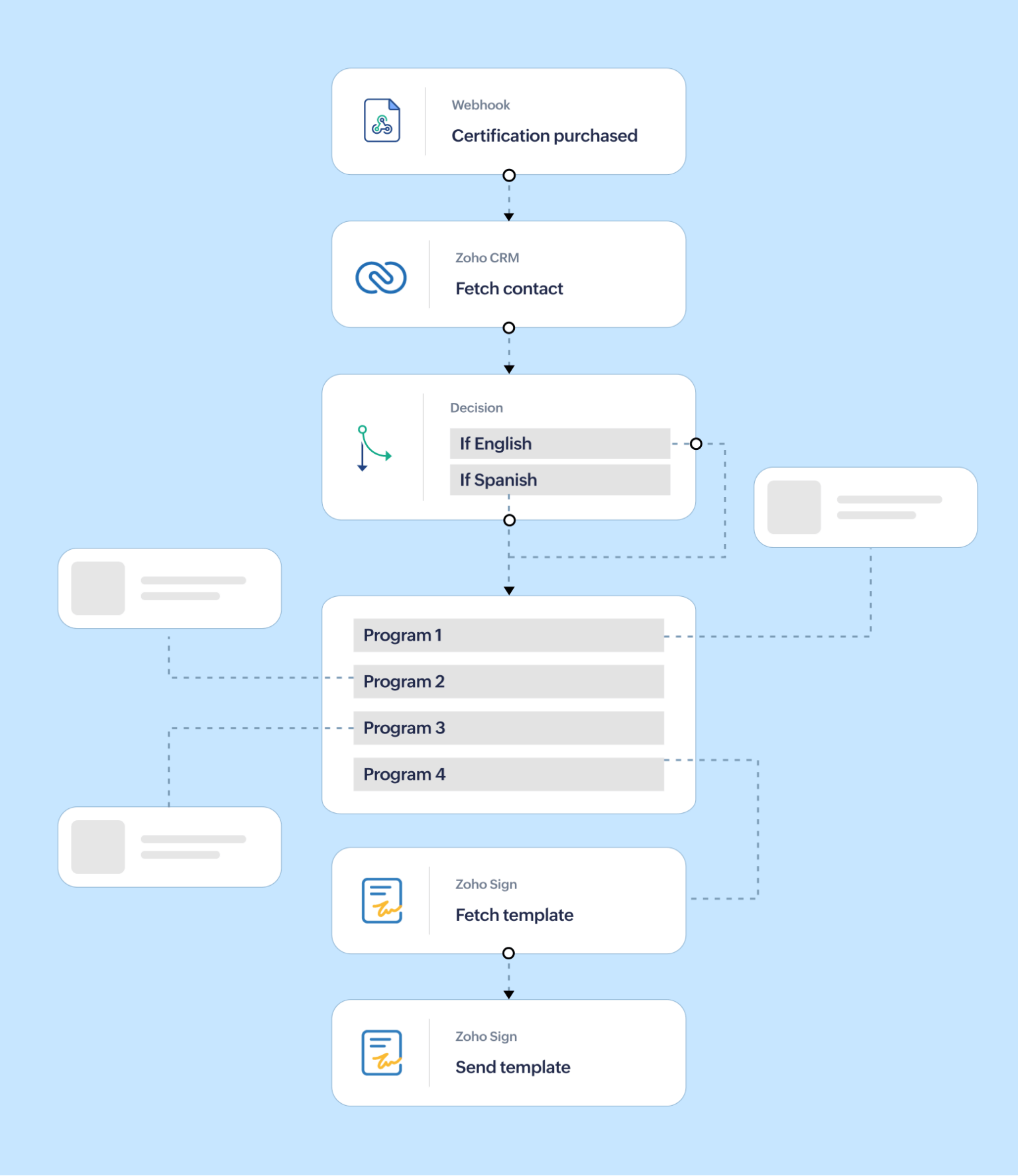
When a deal is closed in Zoho CRM, Zoho Flow selects the right contract template based on program and language, fills in the data, sends it via Zoho Sign, and updates the deal status in the CRM automatically. Alebat also has follow-up flows that track signed and expired contracts and execute actions for each instance.
Subscriptions and billing
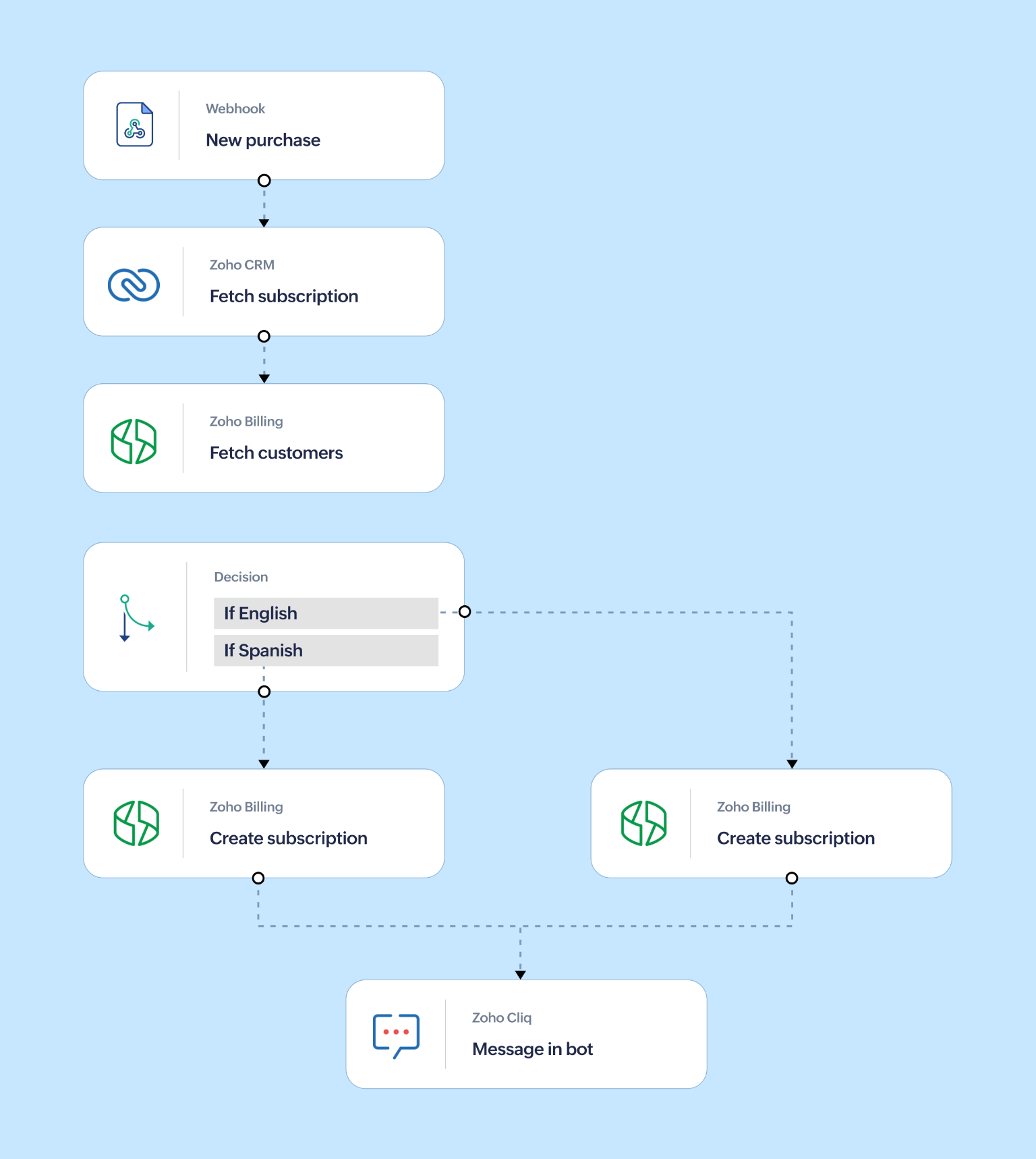
For subscription-based programs, Flow connects Zoho CRM and Zoho Billing. It creates subscriptions using the correct templates and branches based on country and language, as well as adding details around its transaction series and salesperson to keep everything linked to the original deal.
Events and ticketing
When Alebat couldn't find a native integration between Zoho Backstage and Zoho Books for an automation requirement, they simply created a flow wherein when a ticket is sold in Zoho Backstage, Flow automatically creates the corresponding invoice in Zoho Books.
"Before, creating a subscription took three to five minutes. Right now, it takes around 10 seconds."
David Mallo,CTO,Alebat Education
Academic workflows and certifications
Zoho Flow is also heavily used in Alebat’s academic operations.
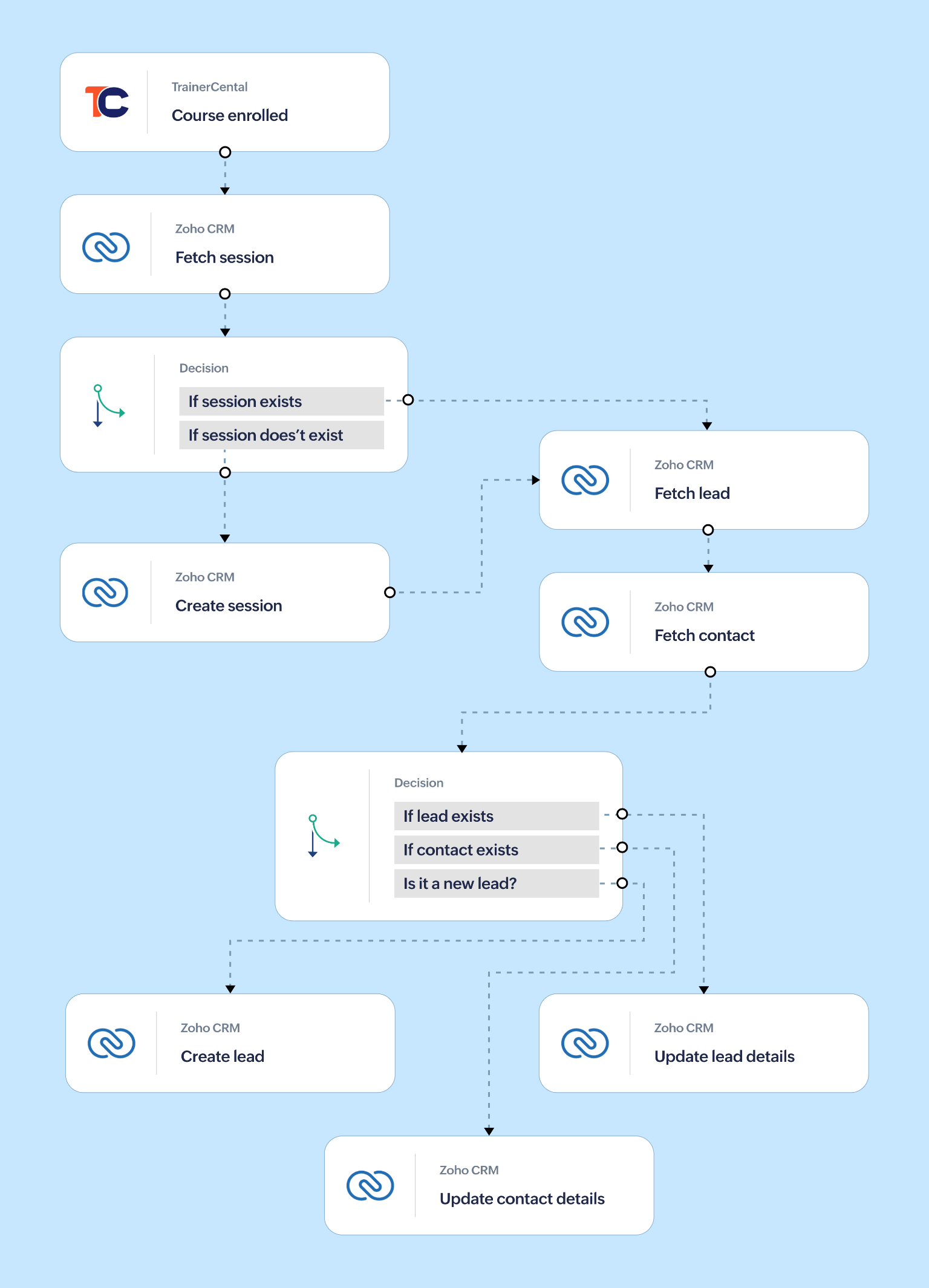
When a learner registers through TrainerCentral, Flow creates and updates session records in Zoho CRM, associates the correct contact, and notifies their teams. Zoho Flow enabled additional logic, notifications, and data handling that Alebat's operations relies on.
Certification workflows are even more structured. Depending on the program and language, Flow selects the right certification contract, sends it via Zoho Sign, tracks signing status, and even handles what happens when a contract has expired. Teams are notified automatically once contracts are sent or completed.
For grading, Alebat uses webhooks from its LMS platforms, including LaabPro and Moodle. Exam results are pushed into Zoho Flow instantly via webhooks, and the workflow performs custom logic to locate the correct student in CRM and update records instantly.
"Three years ago, creating and sending a contract took around seven minutes per contract. Now it takes around seven seconds."
David Mallo,CTO,Alebat Education
Results and impact
The impact of automation became visible quickly, and it compounded over time.
Tasks that once took minutes now take seconds. Sending a contract dropped from around seven minutes to roughly seven seconds. Creating a subscription went from five minutes to a few seconds. Academic workflows such as grading, reporting, and updating CRM records now happen almost instantly.
More importantly, this speed didn’t come at the cost of control or accuracy. Now their data stays consistent across systems, and customers experience fewer delays across sales, billing, and certifications. Their automations have significantly improved their customer as well as employee experience.
Between 2022 and 2025:
- Overall productivity increased by at least 5x, and up to 10x in some departments
- Customer base and revenue grew by around 2.5x
- Team size remained steady at 45–50 employees
"With Zoho Flow as our integration engine, our productivity has increased at least five times. In some departments, it’s closer to ten."
David Mallo,CTO,Alebat Education
Looking ahead
With core workflows running reliably, Alebat is now focused on refining how its LMS platforms and Zoho CRM work together, especially around certifications, grading, and reporting.
Looking forward, David sees strong potential in deeper AI capabilities within Zoho Flow, such as AI-powered steps and agent-based automation, to simplify decision-making and reduce manual effort even further.
For Alebat, Zoho Flow is no longer just a way to automate tasks. It’s become their automation partner that allows the company to grow faster, serve customers better, and keep complexity under control as the business continues to scale.

- INDUSTRYEducation
- REGIONEurope
- TypeB2B, B2C
- APPS INTEGRATED
- Zoho CRM
- Zoho Books

- Zoho Sign
- Zoho Forms

- Zoho Cliq

- Zoho Backstage
- Trainercentral