


Integrate Zoho Inventory with QuickBooks Online

Integrating Zoho Inventory with QuickBooks Online helps businesses keep inventory and accounting data synchronized. It automatically updates sales transactions, customer records, and item details, reducing manual work and improving accuracy. This integration streamlines stock tracking, inventory valuation, reconciliation, and financial reporting for more efficient business operations.
By integrating Zoho Inventory with QuickBooks Online, you can:
- Automatically sync invoices, credit notes, bills, vendor credits, customer and vendor details from Zoho Inventory to QuickBooks Online.
- Match invoices, bills and payments between both platforms effortlessly and ensure accurate financial records and avoid discrepancies.
- Ensure precise tax tracking and create financial reports for seamless tax preparation.
Prerequisite:
- You must have an active account with QuickBooks Online.
- You cannot connect multiple QuickBooks organizations to your Zoho Inventory organization and vice versa.
- Your QuickBooks organization with which you wish to integrate must have the country as the same country as your Zoho Inventory organization.
- Ensure that the base currency of both these organizations is the same.
Set Up the Integration
Here’s how to set up the integration:
- Log in to your Zoho Inventory organization.
- Go to Settings in the top right corner.
- Select Accounting under Integrations & Marketplace.
- Click Connect to QuickBooks next to QuickBooks Online.
- You will be redirected to the QuickBooks Online sign-in page. Enter your credentials to proceed.
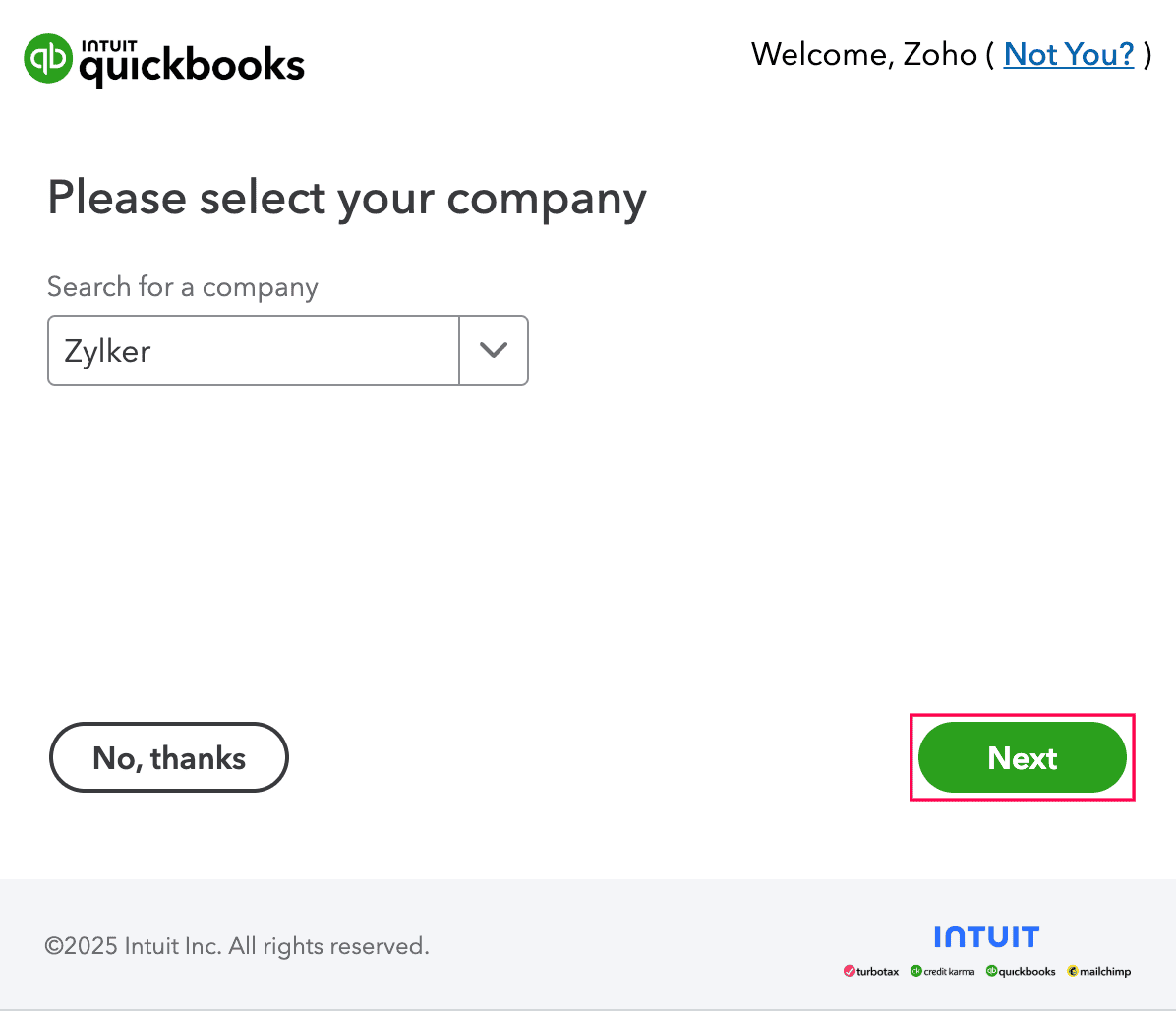
- Once you sign in to QuickBooks, select the organization which you want to integrate from the dropdown and click Next.
- In the next page, click Connect to complete the integration.
You will then be redirected back to your Zoho Inventory account, where you can configure the integration.
Configure the Integration
Now that you’ve connected Zoho Inventory with QuickBooks Online, you can choose what data should be imported from and exported to QuickBooks Online.
Importing from QuickBooks Online
Since you need to account for your transactions in Zoho Inventory, you need to import the accounts and customers (if any) you have in QuickBooks.
To import the data,
- Log in to your Zoho Inventory organization.
- Go to Settings in the top right corner.
- Select Accounting under Integrations & Marketplace.
- Click Show Details in the QuickBooks Online section.
- Configure the following details:
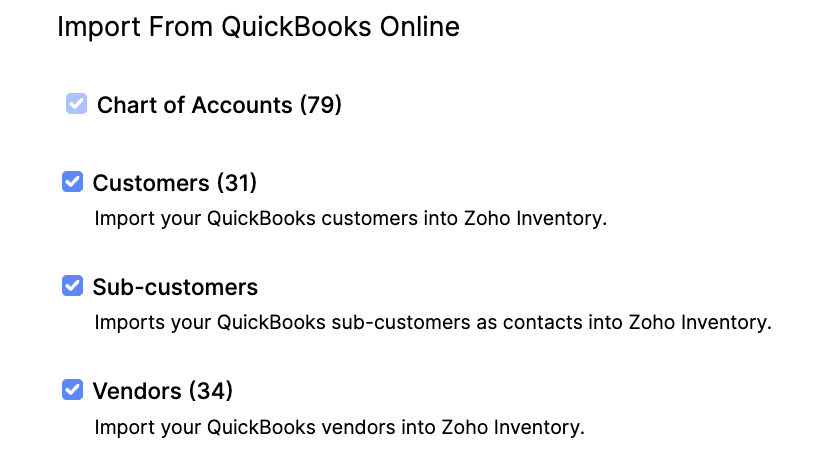
- Chart of Accounts: By default, all your accounts in QuickBooks will be imported into Zoho Inventory. These accounts will be available when you create an item in Zoho Inventory, so that you’ll be able to choose the account under which all sales transactions for that item should be tracked in QuickBooks.
- Customers: Enable this option to import all your customer details from QuickBooks. It will be created as new customers in Zoho Inventory automatically. Once you have enabled you can also import the customer contact details by enabling Sub-Customers.
- Vendors: By enabling this, you can import all your vendor details from QuickBooks. They will be automatically created as new vendors in Zoho Inventory.
Exporting to QuickBooks Online
Export your Zoho Inventory transactions to QuickBooks to ensure they are properly recorded and reflected in your financial accounts.
To export the data,
- Log in to your Zoho Inventory organization.
- Go to Settings in the top right corner.
- Select Accounting under Integrations & Marketplace.
- Click Show Details in the QuickBooks Online section.
- Configure the following details:
- Choose the date from which you want your data from Zoho Inventory to QuickBooks in the Export Data From field.
- Select the Sync Frequency from the dropdown.
- Choose the modules you want to export from Zoho Inventory to QuickBooks:
- Invoices and Payments - Both paid and unpaid invoices will be exported to QuickBooks. Invoices in the Draft status will also be exported.
- Credit Notes - Credit Notes in Zoho Inventory can be exported.
When an invoice is written off in Zoho Inventory, a credit note is automatically created and associated with the corresponding invoice in QuickBooks.
- Select the Bank Charge Account, Write-off Account, Discount Account, Adjustment Account and Retention Account under which you want to record bank charges, write-offs, and adjustments for your invoices. If a payment is recorded with bank charges, the amount paid is initially accounted as Undeposited Funds, and a deposit will be made to the appropriate bank account along with bank charges.
- Bill with Payments - The paid and unpaid bills from Zoho Inventory will be exported to QuickBooks under Expenses.
- Vendor Credits - By enabling this, you can export the vendor credits from Zoho Inventory as Supplier Credits to QuickBooks. Select the Adjustment Account, Discount Account, Reverse Charge Account and Retention Account to ensure the credits are recorded accurately in QuickBooks.
- Journal - Once Invoices with Payments and Bills with Payments sync is enabled, you can enable Journal sync. The corresponding journal entries are exported along with invoices, bills, and other supported transactions to QuickBooks Online. These journal entries update the Inventory Asset and Cost of Goods Sold (COGS) accounts in QuickBooks Online. You can view the exported journal entries in the Journal Report in QuickBooks Online.
Tax Mapping
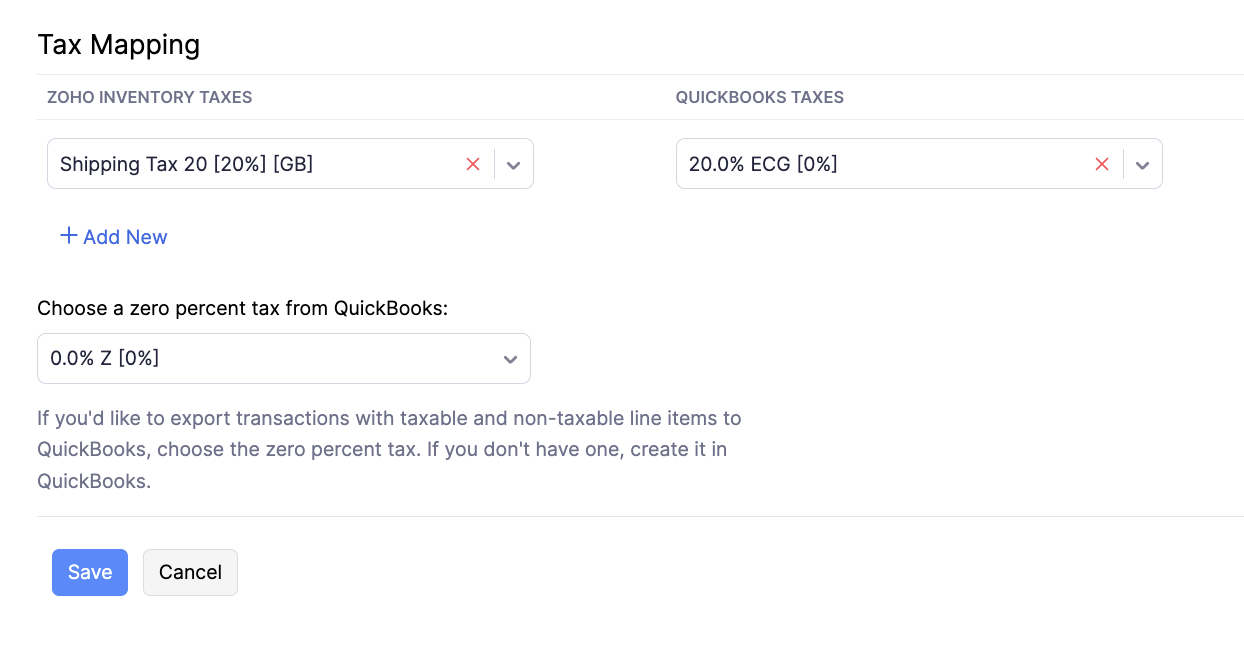
Map the taxes in Zoho Inventory with the corresponding taxes in QuickBooks to ensure that taxes in exported transactions are recorded accurately in QuickBooks.
- To map the taxes, make sure that you have enabled Taxes in both Zoho Inventory and QuickBooks Online accounts.
- Select an existing tax in Zoho Inventory (or create a new one) and map it to the corresponding tax in QuickBooks to ensure accurate tax synchronization between the two applications.
Note: Ensure that the taxes being mapped have matching tax rates.
- To add more taxes, click + Add New.
Note: To export transactions with both taxable and non-taxable line items to QuickBooks, map them to a 0% tax. If a suitable 0% tax does not exist, create it in QuickBooks and then use it for tax mapping.
- Select the percentage from the dropdown under Choose a zero percent tax from QuickBooks.
- Once the initial setup and configuration are done, click Save to return to the details page.
Edit Configuration
After configuring the integration, you can edit its details on the integration details page.
To edit the details,
- Go to Settings in the top right corner
- Select Accounting under Integrations & Marketplace.
- Click Show Details in the QuickBooks Online section.
- Click Configure in the top right corner.
- Edit the required details.
- Click Save.
Add Items from QuickBooks Online
When you export a transaction from Zoho Inventory to QuickBooks, the items included in that transaction will also be synced to QuickBooks. However, other items in your Zoho Inventory account will not be automatically available in QuickBooks.
Similarly, existing items in QuickBooks are not automatically imported into Zoho Inventory. If you want to manage those items in Zoho Inventory, you must import them manually.
To import your existing QuickBooks items into Zoho Inventory:
- Export all your items in QuickBooks.
- Import the same into Zoho Inventory.
- Mark your existing items in QuickBooks as inactive to avoid errors while syncing items from transactions.
Note: The items in each invoice, exported from Zoho Inventory, will be created as Items and Services in QuickBooks.
Sync Data
You can sync data either manually or automatically based on the configuration you have set up.
- Any new addition to the list of customers or accounts in QuickBooks will be automatically reflected in your Zoho Inventory organization through Auto-Sync that occurs once a day.
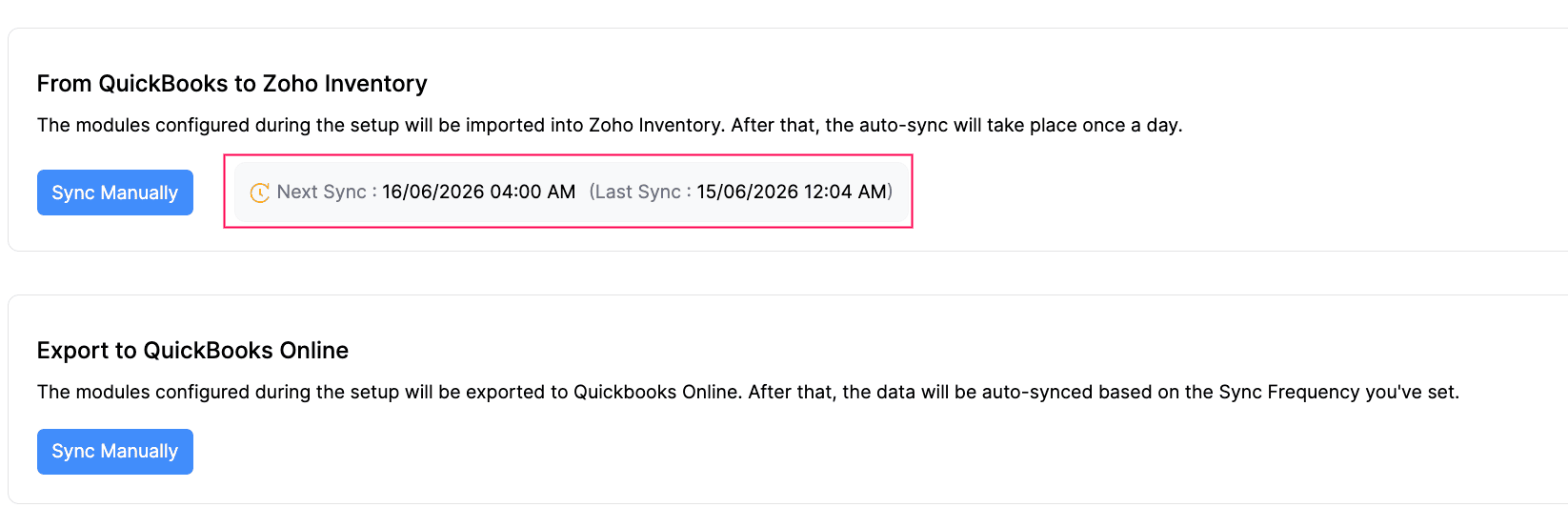
- If you want the change to be reflected in Zoho Inventory immediately, you can click Sync Manually under From QuickBooks to Zoho Inventory.
- Likewise, if you want the changes in Zoho Inventory to be reflected in QuickBooks Online immediately, you can click Sync Manually under Export to QuickBooks Online.
- You can change the sync frequency configurations at any time by clicking Configure at the top.
Sync between Zoho Inventory and QuickBooks Online
The following table lists how the transactions are synced between Zoho Inventory and QuickBooks Online.
| Zoho Inventory | QuickBooks Online | Sync Type |
|---|---|---|
| Chart of Accounts | Chart of Accounts | Two-way sync |
| Create a Customer | Creates a new contact. | Two-way sync |
| Create an invoice | Creates a new invoice. | One-way sync |
| Update an invoice | Updates the corresponding invoice. | One-way sync |
| Delete or void an invoice | The invoice will be voided. | One-way sync |
| Write off an invoice | A credit note will be created, and the credits will be associated with the invoice. | One-way sync |
| Record a payment for an invoice | Creates a payment and associates it with the invoice. | One-way sync |
| Update the payment for an invoice | Updates the payment recorded for the corresponding invoice. | One-way sync |
| Delete the payment associated with an invoice | Deletes payment for the corresponding invoice. | One-way sync |
| Create a credit note | Creates a new credit note. | One-way sync |
| Update a credit note | Updates the corresponding credit note. | One-way sync |
| Allocate credits from a credit note to an invoice | Allocates the credits from the corresponding credit note to the specified invoice. | One-way sync |
| Delete a credit note | Deletes the corresponding credit note. | One-way sync |
| Create a refund for a credit note | Creates a refund for that corresponding credit note. | One-way sync |
| Update a credit note refund | Updates the corresponding credit note refund. | One-way sync |
| Delete a credit note refund | Deletes the corresponding credit note refund. | One-way sync |
| New bill | Creates a new bill | One-way sync |
| Updating bill | Updates the corresponding bill | One-way sync |
| Deleting bill | Deletes the corresponding bill | One-way sync |
| Adding payment for the bill | Creates payment for the corresponding bill | One-way sync |
| Deleting payment for the bill | Deletes payment for the corresponding bill | One-way sync |
Sync Details of Customers
Your customer details will be synced from QuickBooks Online to Zoho Inventory. A contact created in QuickBooks as a Customer will be imported into Zoho Inventory as a new Customer. Whenever a customer is added, edited, or deleted in QuickBooks, it will be reflected in Zoho Inventory through automatic sync that occurs once a day or the manual sync option.
The following table lists how each customer’s details are reflected from QuickBooks Online to Zoho Inventory.
| QuickBooks Online | Zoho Inventory |
|---|---|
| Display name | Display Name |
| Email Address | |
| Phone | Phone |
| Mobile | Mobile |
| Website | Website URL |
| Billing address | Billing Address |
| Shipping Address | Shipping Address |
| Currency Code | Currency |
Sync Details of Invoice
The following table lists the fields in an invoice that are mapped to the one created in QuickBooks.
| Zoho Inventory | QuickBooks Online |
|---|---|
| Invoice# | Invoice no. |
| Invoice Date | Invoice date |
| Currency Code | Currency code |
| Exchange Rate | Currency exchange |
| Item Name | Product/Service |
| Item Description | Description |
| Item Rate | Rate |
| Item Quantity | Qty |
| Discount | Discount (QuickBooks Online doesn’t support line item level discounts. All the item level discounts will be added and displayed as a total discount for the invoice.) |
| Tax | Tax |
| Shipping Charges | Shipping |
| Adjustment | Adjustment (Will be added as a separate line item) |
Sync Details of Bills
The following table lists the fields in Zoho Inventory bills that are mapped to the ones created in QuickBooks.
| Zoho Inventory | QuickBooks Online |
|---|---|
| Bill# | Bill No. |
| Bill Date | Bill date |
| Currency Code | Currency code |
| Exchange Rate | Exchange rate |
| Item Name | Product/Service |
| Item Description | Description |
| Item Rate | Rate |
| Item Quantity | Qty |
| Discount | Discount (Will be added as a separate accounting line item) |
| Adjustment | Adjustment (Will be added as a separate accounting line item) |
Disable Integration
If you want to pause the data sync for some time instead of deleting the integration completely, you can disable the integration. Your integration details will not be deleted, and you can activate the integration at any time.
To disable the integration:
- Log in to your Zoho Inventory organization.
- Go to Settings in the top right corner.
- Select Accounting under Integrations & Marketplace.
- Click Show Details in the QuickBooks Online section.
- Click the dropdown next to Configure at the top and select Disable Integration.

- In the following pop-up, click Disable Integration again to confirm the action. Your integration will now be disabled, and you will not be able to account for your transactions. You can always click Enable Integration to re-activate the integration.
Delete Integration
If you want to stop using QuickBooks Online for accounting and would like to disconnect it from your Zoho Inventory Organization, you can delete the integration. Once you delete it, customers and transactions will no longer be synced between the apps, and the integration details will also be deleted.
To delete the integration with QuickBooks Online:
- Log in to your Zoho Inventory organization.
- Go to Settings from the left sidebar.
- Select Accounting under Integrations & Marketplace.
- Click Show Details next to QuickBooks Online.
- Click the dropdown next to Configure at the top and select Delete Integration.
- In the following pop-up, click Delete Integration again to confirm the action.
The integration will now be deleted, but all your accounts and customers that are already synced from QuickBooks Online will continue to remain active in Zoho Inventory.
Note: If you want to integrate another Zoho Inventory organization with QuickBooks Online, you can delete the current integration and set it up again with the new organization.