





- HOME
- Payroll compliance
- WPS Salary Transfer Deadlines in UAE: Payment Timing Rules for Employers
WPS Salary Transfer Deadlines in UAE: Payment Timing Rules for Employers
Most WPS violations do not happen because an employer decided not to pay. They happen because someone on the payroll team was not sure which deadline applied. The employment contract says one date, the labour law says another, and the WPS enforcement timeline runs on its own clock. When these overlap in the wrong way, a salary that felt like it was paid on time turns out to be 17 days late in MOHRE's system, and by then, permits are already suspended.
This guide puts every salary payment deadline in one place: the contractual due date, the 15-day default threshold, payment frequency rules, and the special deadlines for new hires and terminations. If you process payroll in the UAE, this is the timing reference you check before every cycle. For full WPS background, see the WPS UAE: The Complete Employer Guide.
The Core Deadline Rule
Every salary deadline in the UAE starts from the same anchor: your employment contract. Article 22 of Federal Decree-Law No. 33 of 2021 says employers must pay salaries on the due date specified in the contract. If the contract does not specify a date, you must pay at least once per month.
The second layer is Ministerial Resolution No. 739 of 2016, which defines when a payment becomes officially late. An employer is in default if wages are not paid within 15 days of the contractual due date. That 15-day mark is when MOHRE's enforcement clock starts. Not the day after the due date, but 15 days later.
Here is how these two rules work together in practice. Take a company that pays salaries at the end of each month:
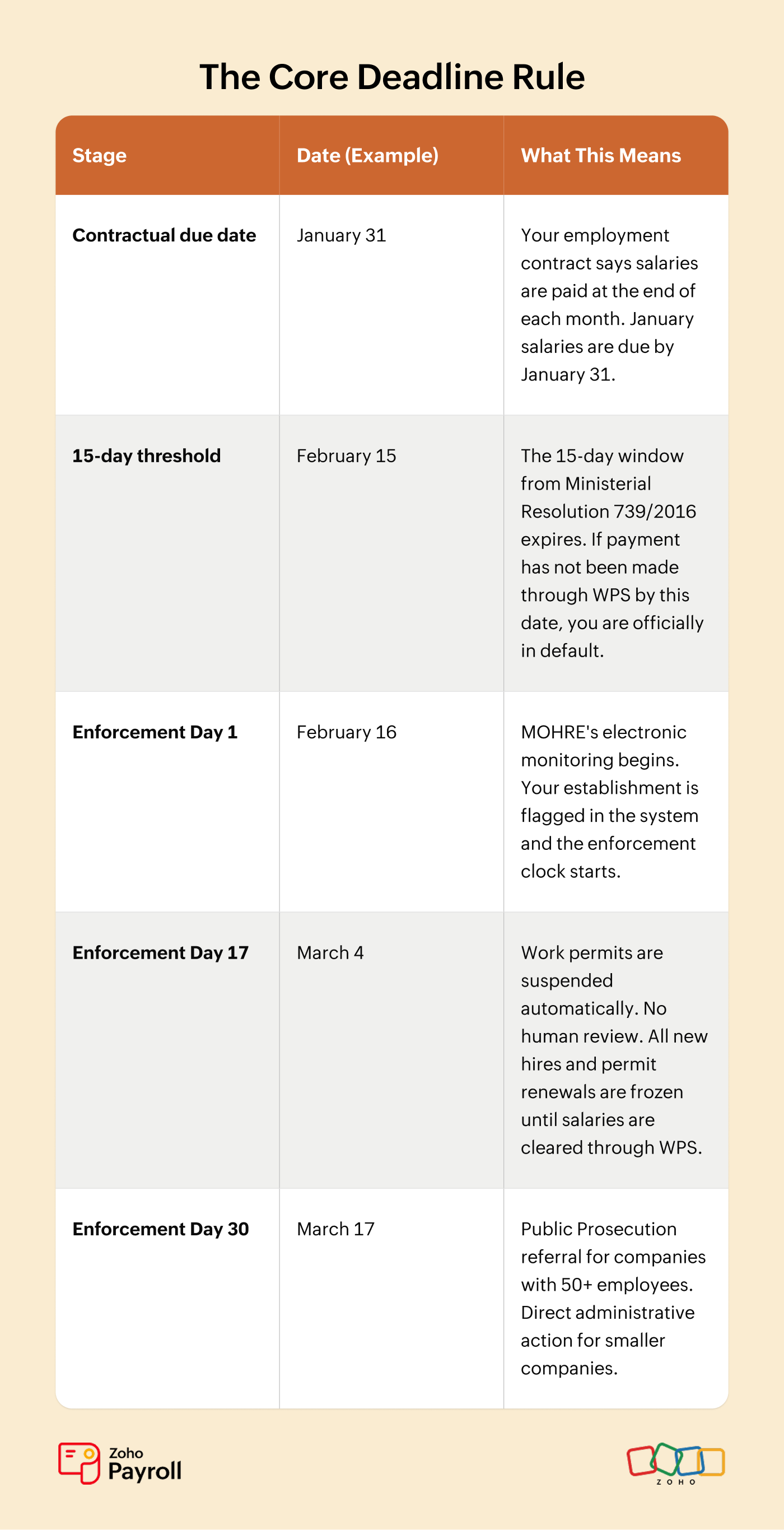
The anchor date matters. If your contract specifies an earlier payment date (say the 25th of each month), the 15-day window runs from that date, not from month-end. The contractual date is always the starting point. This is where many employers get caught: they assume the 15-day window starts at month-end regardless of what the contract says.
Following the December 2025 WPS upgrade (built with Al Etihad Payments), MOHRE monitors payment status in real time. That means the enforcement timeline above is not a theoretical schedule. It is automated. Permits are suspended on Day 17 by the system, not by a person reviewing your file. The safest approach is to have your SIF file ready the moment payroll is approved. Zoho Payroll generates WPS-compliant SIF files directly from your payroll data, so the file can be submitted the same day you finalise your payroll run, well before the 15-day threshold.
Payment Frequency Rules
Not every employee is paid monthly, and the deadline rules adjust accordingly. What does not change is the requirement to pay through WPS. Cash payments, cheques, and non-WPS bank transfers do not count as compliant payment regardless of whether the employee actually received the money. MOHRE only recognises what shows up in the WPS system.
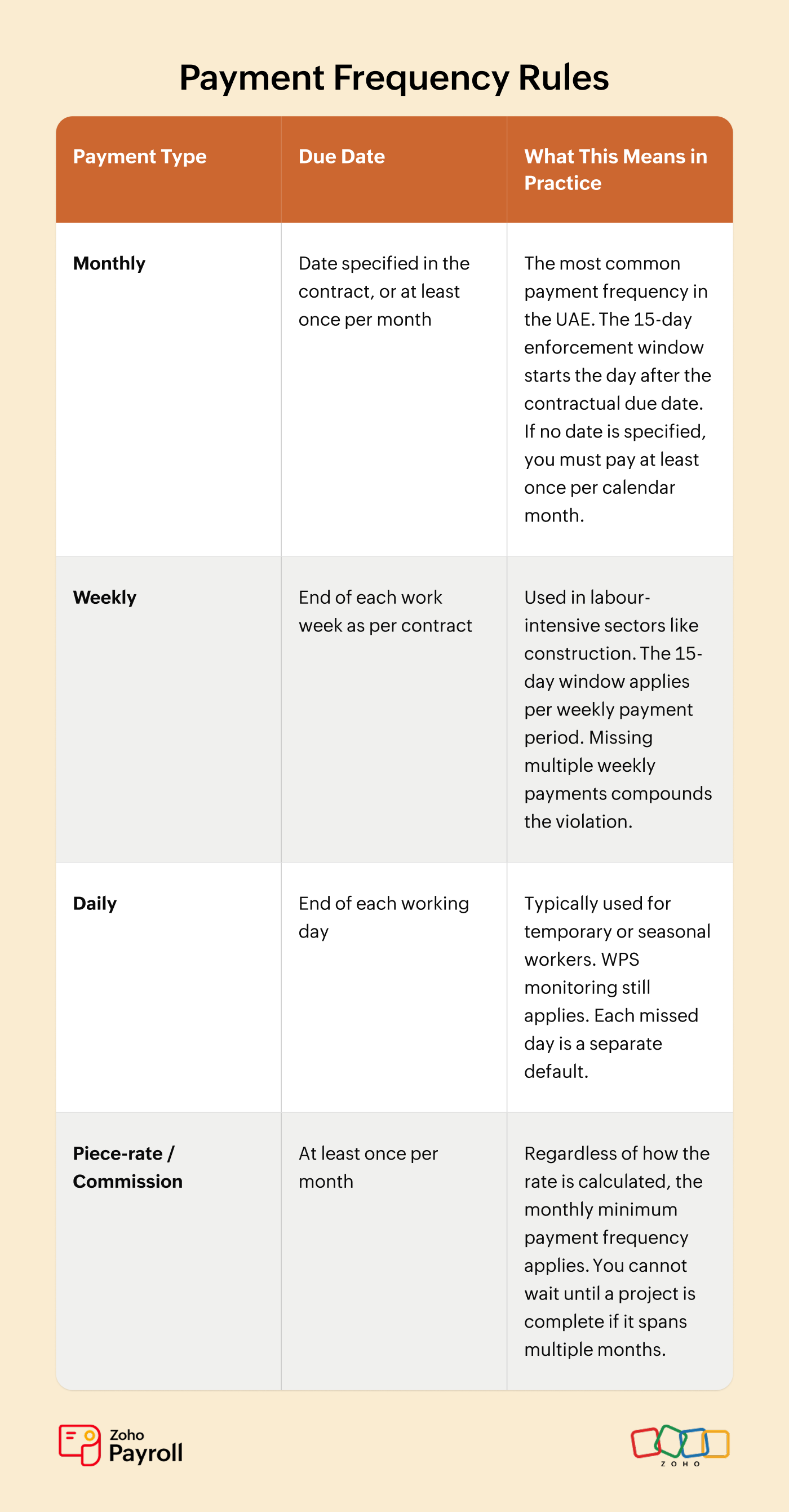
The practical risk here is with weekly and daily workers. If you pay monthly employees and weekly labourers from the same payroll cycle, you need separate WPS submissions on separate schedules. A single monthly SIF file that covers everyone may mean your weekly workers' payments are already late by the time the file is submitted. Zoho Payroll supports multiple payment frequencies within the same payroll setup, so you can generate separate WPS-compliant SIF files for each schedule without running parallel systems.
Salaries must be paid in UAE Dirhams (AED) unless both parties agree to another currency in the employment contract. All WPS transfers are processed in AED.
Special Timing Rules
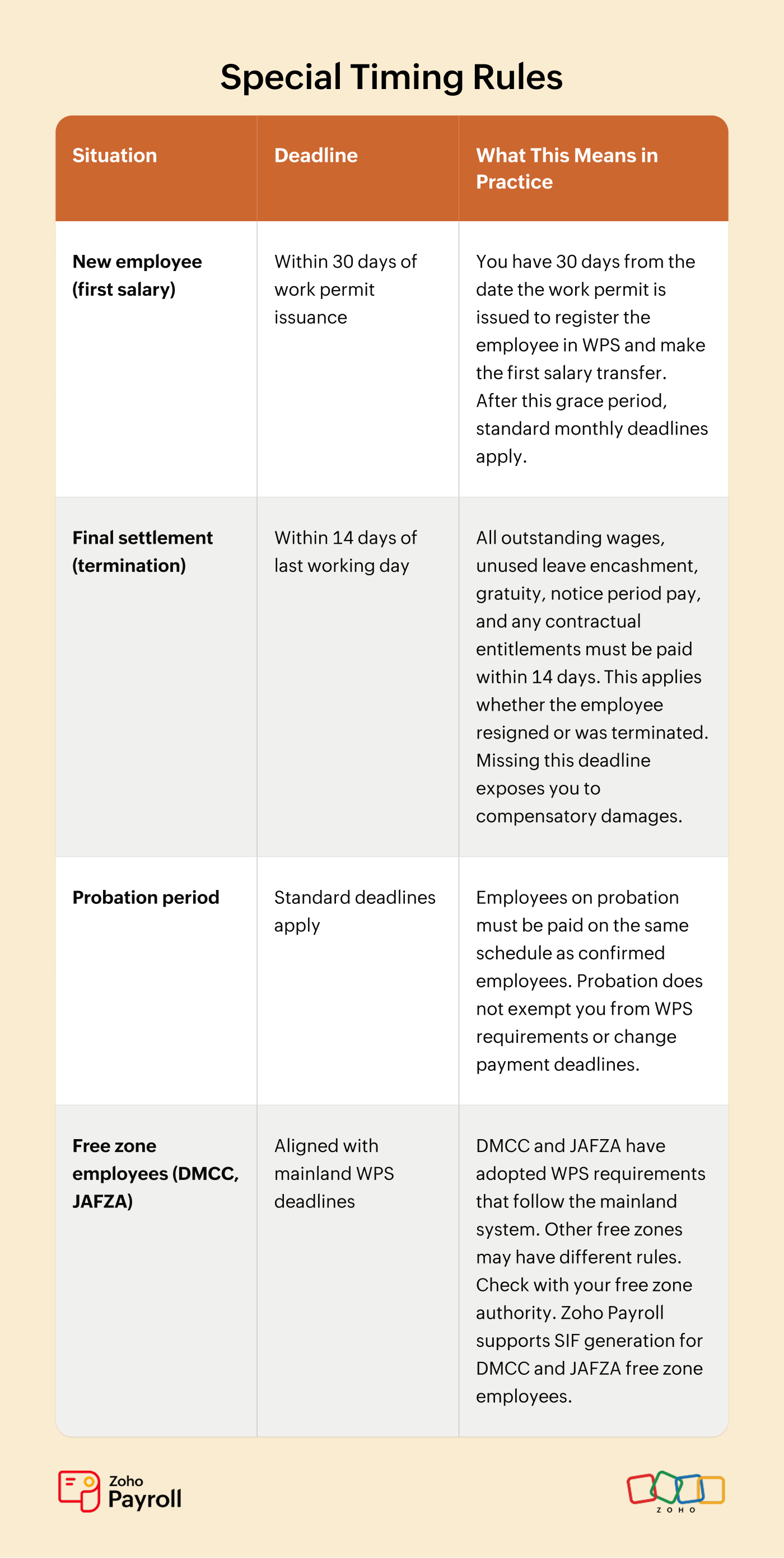
The standard monthly deadline covers most employees. But there are four situations where different rules apply, and these are the ones that catch employers who think they know the system:
When Deadlines Overlap: Amira's Story
Consider Amira, an HR manager at an engineering consultancy with 40 employees. In February, three deadline situations collided in the same payroll cycle.
First, a new project manager joined on February 1 with a work permit issued the same day. Amira had 30 days (until March 3) to register him in WPS and make his first salary transfer. His employment contract specified the 28th as the payment date. So for February, the 30-day new-hire grace period applied. From March onward, his salary would follow the standard cycle: due on the 28th, with the 15-day enforcement window starting on the 29th.
Second, a senior engineer resigned on February 10 with his last working day on February 24. Under Article 53 of Federal Decree-Law No. 33/2021, all outstanding wages, unused leave encashment, and end-of-service gratuity had to be settled within 14 days of his last working day. That put the deadline at March 10. Amira could not batch this with the regular end-of-month payroll; it needed its own SIF submission.
Third, the regular February payroll for the remaining 38 employees was due on February 28. That was the standard monthly deadline from the employment contracts.
Three different deadlines, three different legal bases, all landing within the same two-week window. Amira's previous approach was to run a single monthly SIF file on the 28th and handle everything in one batch. That would have worked for the regular payroll, but it would have missed the terminated engineer's 14-day settlement deadline by four days, and it would have left the new hire's registration until the last possible moment.
What she actually did: Amira used Zoho Payroll to generate two separate SIF files. The first, submitted on February 28, covered the regular monthly payroll for 38 employees plus the new hire's first salary (within the 30-day grace period). The second, submitted on March 8, covered the terminated engineer's full and final settlement (within the 14-day window). Both files processed on the first attempt because the employee IDs, IBANs, and salary amounts were pulled directly from the system.
Without separate submissions, Amira would have either missed the final settlement deadline or had to build an additional SIF file manually. The deadlines themselves are not complicated once you know them. The risk is when multiple deadlines land in the same cycle and you try to handle them all in a single batch.
Quick Reference: Every WPS Salary Deadline
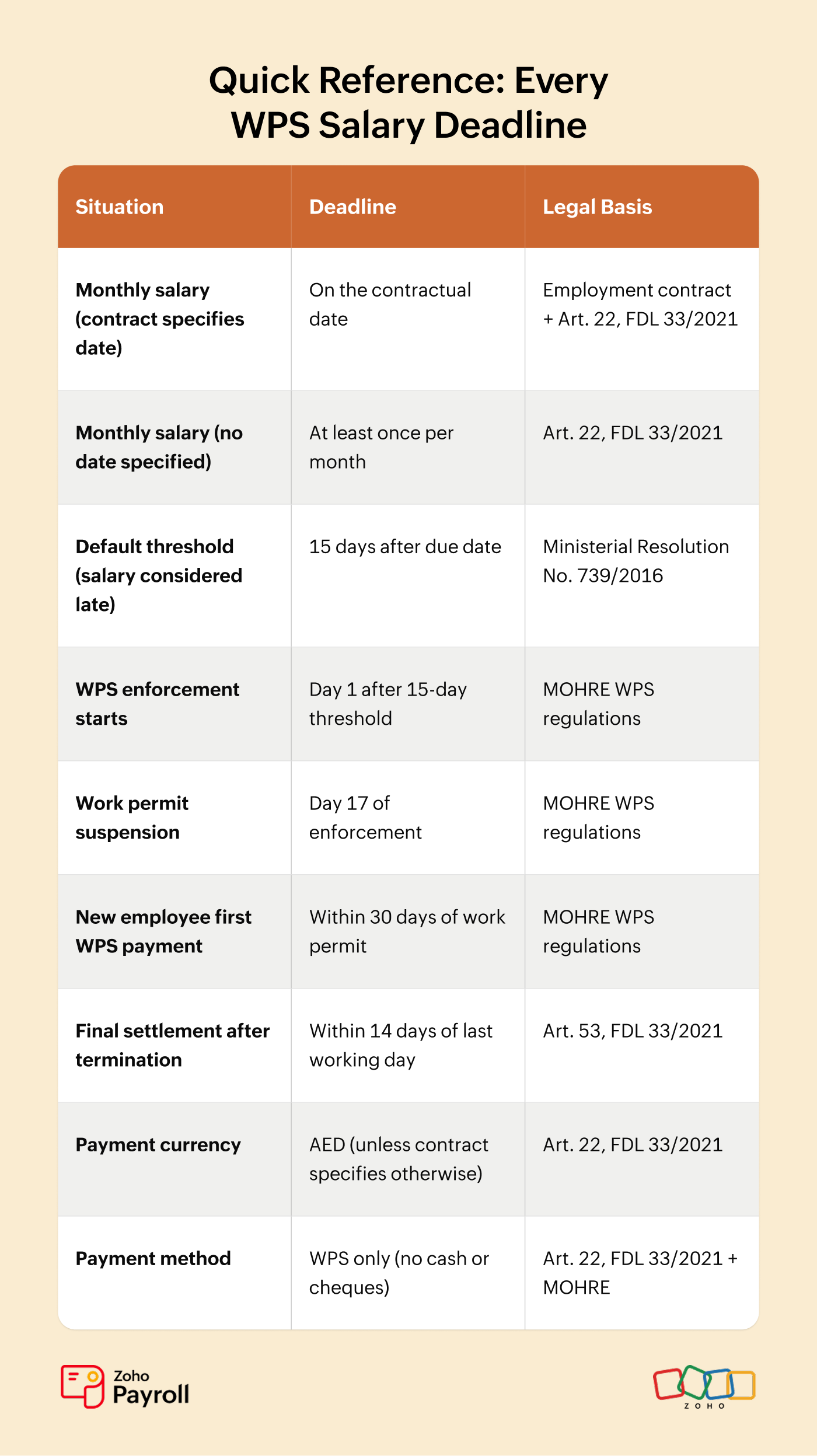
This table covers every deadline in one place. Bookmark it and check it before every payroll cycle.
What Happens If You Miss These Deadlines
Missing any of these deadlines triggers MOHRE's enforcement timeline. The escalation is automated: reminders on Day 3 and Day 10, permit suspension on Day 17, Public Prosecution referral on Day 30 for companies with 50 or more employees. Fines start at AED 1,000 per employee for non-WPS payment and go up to AED 5,000 per employee for false wage data. Repeat violations within six months trigger a Category 3 downgrade, which nearly triples your permit costs. Most of these violations trace back to a delayed or rejected SIF file. Zoho Payroll removes that bottleneck by generating correctly formatted SIF files from your payroll data, so the submission happens on schedule. For the full penalty breakdown, fine amounts, and MOHRE classification impact, see the WPS Fines & Penalties guide.
Frequently Asked Questions
Q1. When is salary considered late under UAE law?
Salary is late when it remains unpaid 15 days after the contractual due date (Ministerial Resolution No. 739/2016). If your contract says salaries are paid on the 28th and payment has not gone through WPS by the 13th of the following month, you are in default. MOHRE's enforcement timeline starts the next day. The 15-day period accounts for legitimate bank processing delays, but it is not a planning buffer. Your contractual due date is your real deadline.
Q2. Can I pay salaries in cash instead of through WPS?
No. All MOHRE-registered establishments must pay through WPS. Cash payments, cheques, and non-WPS bank transfers are treated as non-payment regardless of whether the employee actually received the money. The fine for bypassing WPS is AED 1,000 per employee (Cabinet Resolution No. 21/2020). Even if you can prove the employee was paid, the payment does not count unless it went through a WPS agent bank.
Q3. What is the deadline for a terminated employee's final settlement?
14 days from the effective date of termination (Article 53, Federal Decree-Law No. 33/2021). This includes outstanding salary, unused leave encashment, end-of-service gratuity, notice period pay, and any other contractual entitlements. The 14-day rule applies whether the employee resigned, was terminated, or the contract expired. This often requires a separate SIF submission from your regular monthly payroll, as Amira's scenario above illustrates.
Q4. Does the 15-day window mean I have 15 extra days to pay?
No. The 15-day period is the threshold after which MOHRE considers you in default. It exists to account for legitimate bank processing delays, rejected SIF files, and system errors. It is not extra time for payroll preparation. If you rely on the 15-day window as a buffer, a single SIF rejection pushes you into enforcement territory. The safest approach is to submit your SIF file at least 5 days before the contractual due date.Zoho Payroll generates your SIF file the moment payroll is approved, so the file is ready to submit the same day you finalise your payroll run.
Stay Ahead of Every Deadline with Zoho Payroll
The most common reason employers miss WPS deadlines is not cash flow. It is the time lost to manual SIF file preparation, formatting errors, and resubmissions. A file that gets rejected on Day 12 and takes three days to fix means salaries land on Day 15, right at the enforcement threshold. One more delay and permits are at risk.
Zoho Payroll generates prefilled, WPS-compliant SIF files for multiple UAE bank formats (including CBD, ADCB, HSBC, Sharjah Islamic Bank, and Al Ansari Exchange) directly from your payroll data. The file is ready the moment payroll is approved, so there is nothing standing between your approval and the WPS transfer. It supports multiple payment frequencies, DMCC and JAFZA free zone employees, and separate SIF files for termination settlements.
Start your free trial and generate your first SIF file in minutes.