





- HOME
- Payroll compliance
- WPS Exemptions in UAE: Free Zones, Domestic Workers and Special Cases
WPS Exemptions in UAE: Free Zones, Domestic Workers and Special Cases
The Wage Protection System applies to every private-sector employer registered with MOHRE. But not every employer in the UAE is registered with MOHRE. Free zone companies, domestic worker employers, and government entities all operate under different regulatory frameworks, each with its own rules for how and when employees must be paid. The question is not whether wage protection applies to your employees (it almost certainly does in some form), but which system applies to each one.
This guide maps exactly who must use WPS, who is exempt, and what alternative requirements apply. For full WPS background, see the WPS UAE: The Complete Employer Guide. For the payment timing rules that apply to WPS-covered employees, see the WPS Salary Transfer Deadlines guide.
The Default Rule: Who Must Use WPS
Before getting into exemptions, the baseline is simple. WPS applies to all private-sector employers registered with the Ministry of Human Resources and Emiratisation (MOHRE). That covers every mainland company in the UAE regardless of size, industry, or the nationality of its workforce. All payment frequencies (monthly, weekly, daily) must go through WPS. Cash payments, cheques, and non-WPS bank transfers do not count as compliant payment, even if the employee actually received the money.
Under Ministerial Resolution No. 598 of 2022, MOHRE considers a company compliant if at least 80% of total wage value is transferred on time through WPS.
Falling below this threshold triggers the full enforcement timeline (reminders, permit suspension, prosecution referral). For the detailed penalty breakdown, see the WPS Fines & Penalties guide.
Free Zone Companies
This is where most of the confusion sits. "Free zone" does not automatically mean "exempt from WPS." Some free zones have adopted WPS or WPS-aligned requirements. Others have built their own wage protection systems. And some have not yet mandated a specific mechanism at all. The answer depends entirely on which free zone your company operates in.
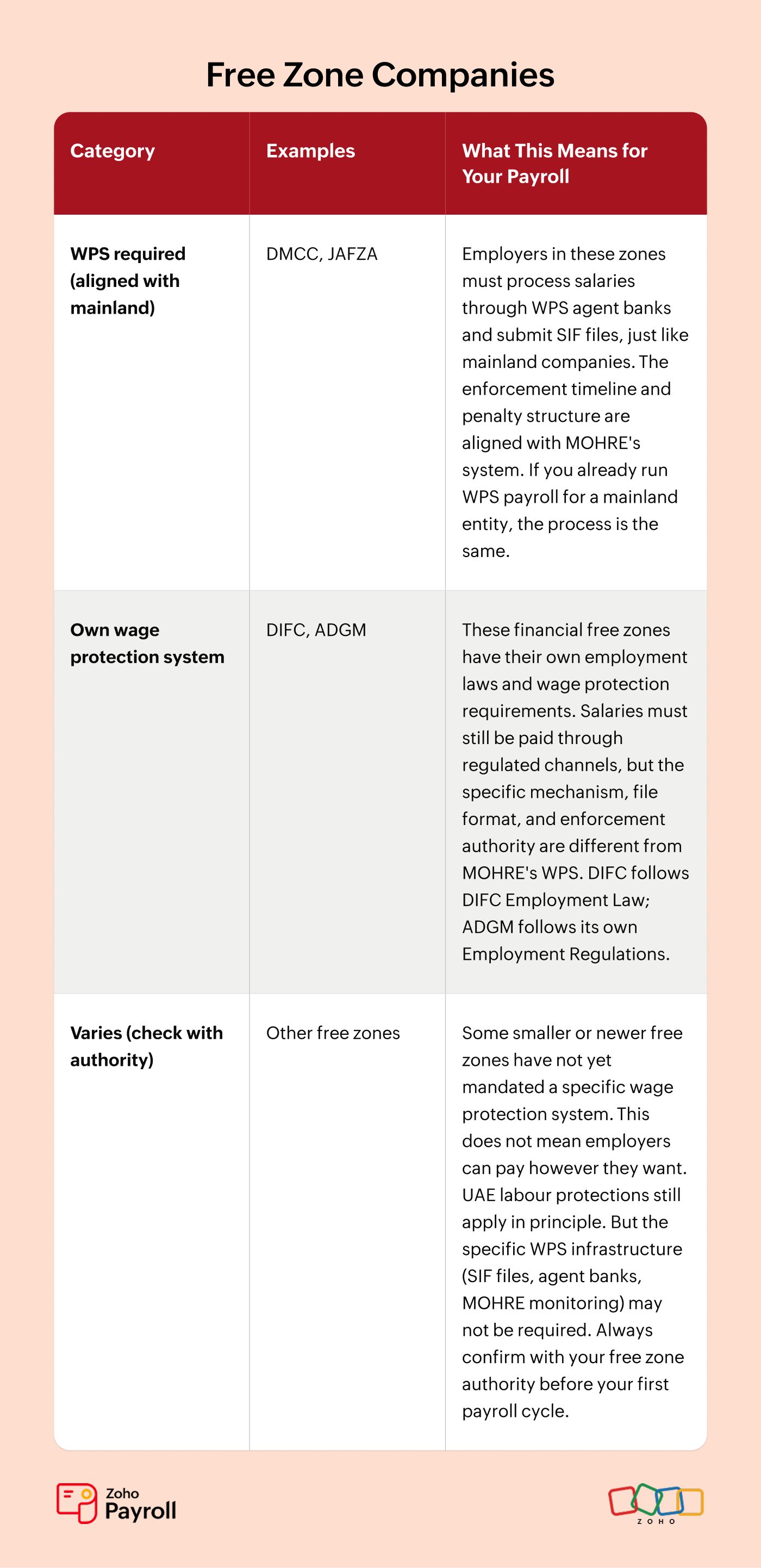
The safe assumption is that wage protection is required everywhere in the UAE. The question is whether it runs through MOHRE's WPS specifically or through your free zone's own system. If you are unsure, check with your free zone authority directly. Getting this wrong in either direction creates problems: processing through WPS when your free zone has its own system may not satisfy local requirements, and skipping WPS when your zone requires it triggers the full MOHRE enforcement timeline.
For companies operating in DMCC or JAFZA, Zoho Payroll supports WPS-compliant SIF file generation for employees in these zones, using the same payroll setup you would use for mainland employees. There is no need to run a separate payroll process for each entity.
Domestic Workers
Domestic workers (household employees such as nannies, drivers, housekeepers, cooks, gardeners, and personal assistants) are not covered by WPS. They are regulated under a completely separate legal framework.
Federal Decree-Law No. 9 of 2022 (the Domestic Workers Law) governs the employment relationship for household staff, not Federal Decree-Law No. 33 of 2021 (the general labour law that mandates WPS). Domestic worker contracts are managed through MOHRE's Tadbeer system, which handles recruitment, contract registration, and dispute resolution for household employees. There is no SIF file requirement, no WPS agent bank involvement, and no MOHRE enforcement timeline.
That said, employers must still pay domestic workers on time according to their contract. Non-payment can result in complaints to MOHRE and legal consequences under FDL 9/2022. The wage protection exists. The mechanism is just different.
If you employ both corporate employees (mainland or WPS-aligned free zone) and domestic workers, they run on entirely different payroll tracks.
Your WPS submissions cover your corporate employees only. Domestic workers are handled separately through their Tadbeer-registered contracts.
Other Exemptions and Special Cases
Beyond free zones and domestic workers, there are several other categories that fall outside the WPS framework:
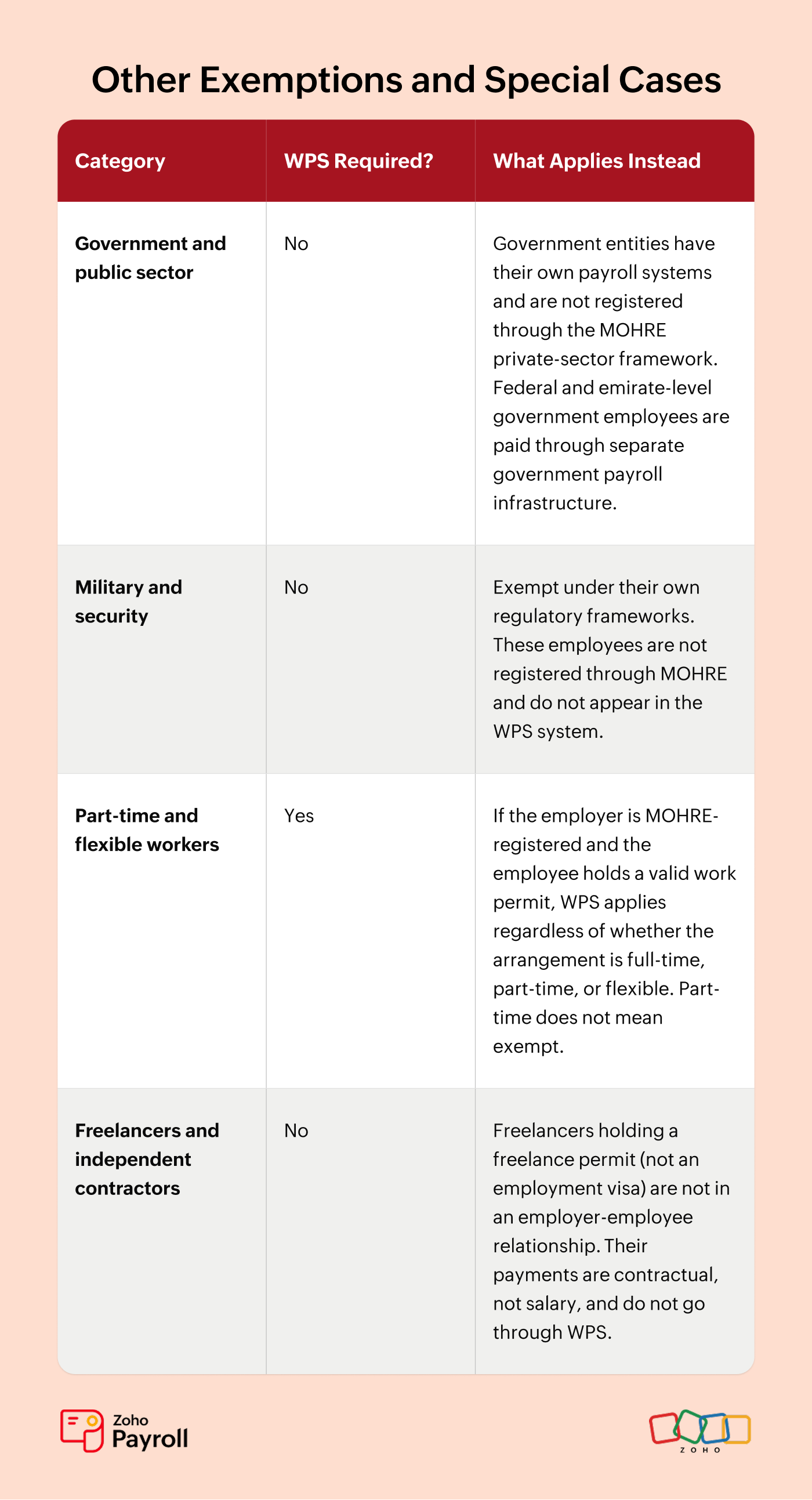
The common thread: WPS applies wherever there is an employer-employee relationship registered with MOHRE. If the relationship is governed by a different authority (Tadbeer for domestic workers, a free zone authority, or a government payroll system), the WPS obligation does not apply, but an equivalent wage protection obligation almost always does.
When Exemptions Get Complicated: Nadia's Story
Nadia runs a mainland logistics company with 25 employees. When she opened a DMCC branch with 8 new hires, she assumed "free zone" meant no WPS. Her PRO flagged the issue: DMCC requires WPS-aligned salary transfers. She also employs a driver and housekeeper on Tadbeer contracts, which sit outside WPS entirely.
That left Nadia with three regulatory tracks: 25 mainland employees and 8 DMCC employees through WPS, and 2 domestic workers through Tadbeer. She added her DMCC employees to the same Zoho Payroll setup she uses for mainland, generating separate SIF files for each entity from one system. Her domestic workers remain on a separate arrangement outside the payroll system.
The takeaway: the exemption question is not "free zone vs mainland." It is "which regulatory framework applies to each employee." Once you map that, the payroll setup follows.
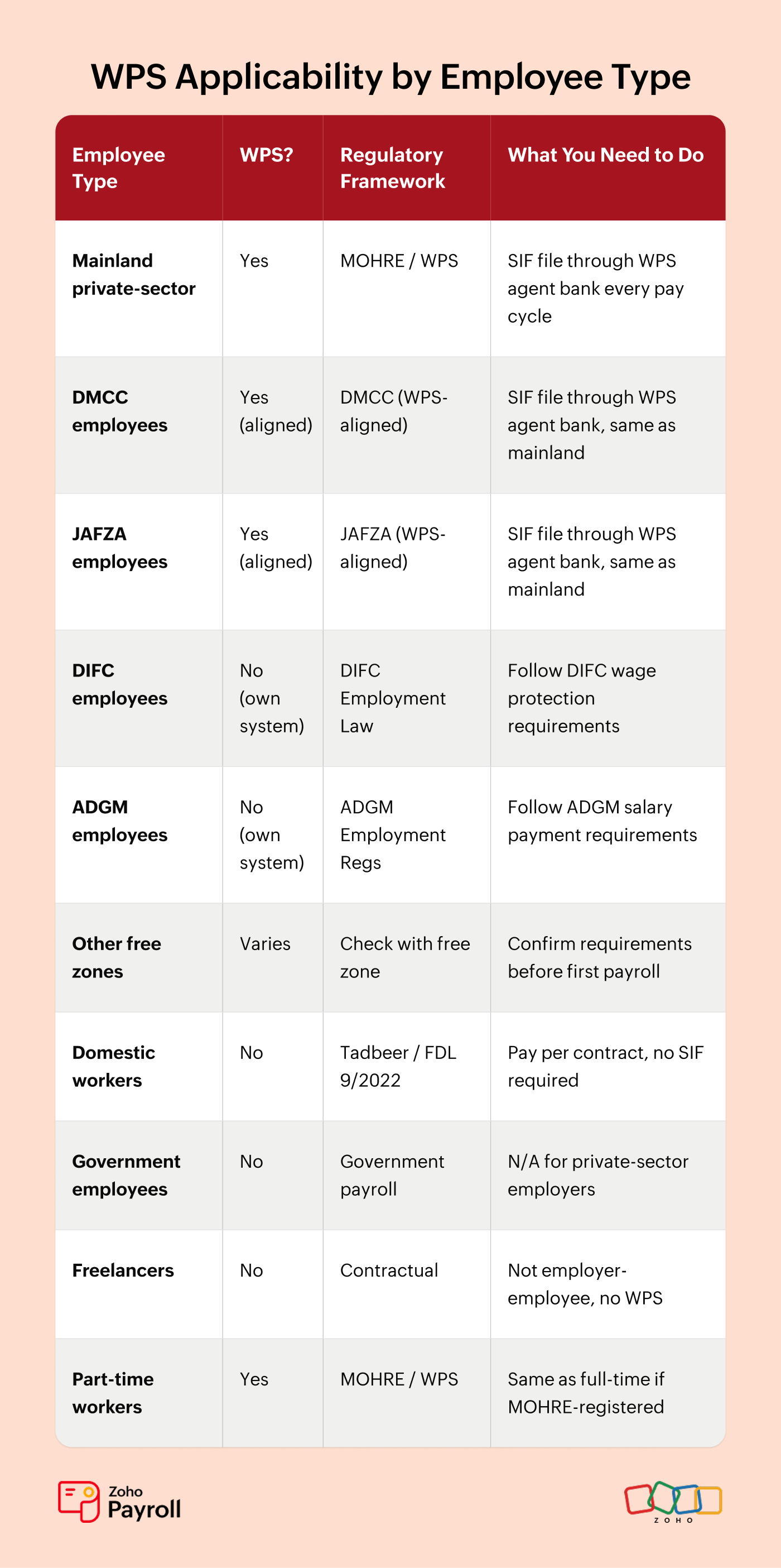
Quick Reference: WPS by Employee Type
Bookmark this table and check it whenever you are onboarding a new employee type or expanding into a new jurisdiction.
Frequently Asked Questions
Q1. Do free zone companies need to comply with WPS?
It depends on the free zone. DMCC and JAFZA require WPS-aligned salary transfers, meaning you submit SIF files through a WPS agent bank just like mainland companies. DIFC and ADGM have their own wage protection systems with different requirements. Other free zones vary. The safest approach is to check directly with your free zone authority before your first payroll cycle. Assuming you are exempt without confirming can trigger enforcement you were not expecting.
Q2. Is WPS mandatory for domestic workers?
No. Domestic workers (nannies, drivers, housekeepers, cooks, gardeners, personal assistants) fall under Federal Decree-Law No. 9 of 2022 and the Tadbeer system, not the WPS framework. There is no SIF file requirement. Employers must still pay on time according to the employment contract, and non-payment can result in complaints and legal action under the Domestic Workers Law.
Q3. What if I have employees on mainland and in a free zone?
You may need to process payroll through WPS for your mainland employees and through a different system for your free zone employees, depending on which free zone. For DMCC and JAFZA, the WPS requirements are the same as mainland, so the process is identical. Zoho Payroll supports SIF generation for mainland, DMCC, and JAFZA employees within the same payroll setup, so you generate separate SIF files for each entity without running parallel systems.
Q4. Does WPS apply to part-time employees?
Yes. If the employer is MOHRE-registered and the employee holds a valid work permit, WPS applies regardless of whether the arrangement is full-time, part-time, or flexible. Payment frequency rules still apply. A part-time employee paid monthly must have their salary processed through WPS on the same schedule as full-time staff.
Simplify Your WPS Payroll with Zoho Payroll
The exemption rules are clear once you map them, but the payroll execution gets complicated when you have mainland employees, DMCC or JAFZA employees, and different regulatory requirements running in parallel. Each entity needs its own SIF file with the correct employer MOHRE ID, bank routing codes, and employee details.
Zoho Payroll handles WPS-compliant SIF generation for mainland, DMCC, and JAFZA employees from one system. You manage all your WPS-covered employees in a single payroll setup and generate the correct SIF files for each entity when payroll is approved. No parallel processes, no duplicate data entry.
Start your free trial and generate your first SIF file in minutes.