





- HOME
- Compliance
- Working Hours, Overtime & Ramadan Rules in UAE: Rates, Calculator & Law
Working Hours, Overtime & Ramadan Rules in UAE: Rates, Calculator & Law
Overtime in the UAE sounds simple: work extra hours, get paid more. But the details matter. The rate changes depending on when the overtime happens, the base salary figure is not always what people expect, and Ramadan brings its own adjustments. With 7.8 million private-sector employees and industries like construction, logistics, retail, and hospitality running extended hours as standard, overtime calculations are one of the most common payroll tasks in the country.
This guide covers the three overtime tiers, the Ramadan shift, and gives you a formula you can apply to your own numbers. For the broader employment law context, see the UAE Labour Law 2026: The Complete Employer Guide.
Standard Working Hours
Under Article 17 of Federal Decree-Law No. 33/2021, the standard working day in the UAE's private sector is 8 hours (or 48 hours per week). For certain sectors (hotels, cafes, security, retail), the working day can extend to 9 hours including breaks.
Ramadan rule: Working hours are reduced by 2 hours per day for all employees, Muslim and non-Muslim, fasting or not. This applies across the private sector. Your salary stays exactly the same. There is no pay reduction during Ramadan.
• Weekly rest day: Every employee is entitled to at least one paid rest day per week. The law no longer mandates that it must be Friday. Most companies in Dubai now follow a Saturday-Sunday weekend, while others (especially in construction, hospitality, and retail) may still designate Friday. If an employee works on their designated rest day, overtime rules apply which is covered in detail in the next section.
• Maximum overtime: Employers can ask employees to work overtime, but the total cannot exceed 2 additional hours per day.
The Overtime Rates
There are three tiers of overtime pay in the UAE. The rate depends on when the overtime happens.
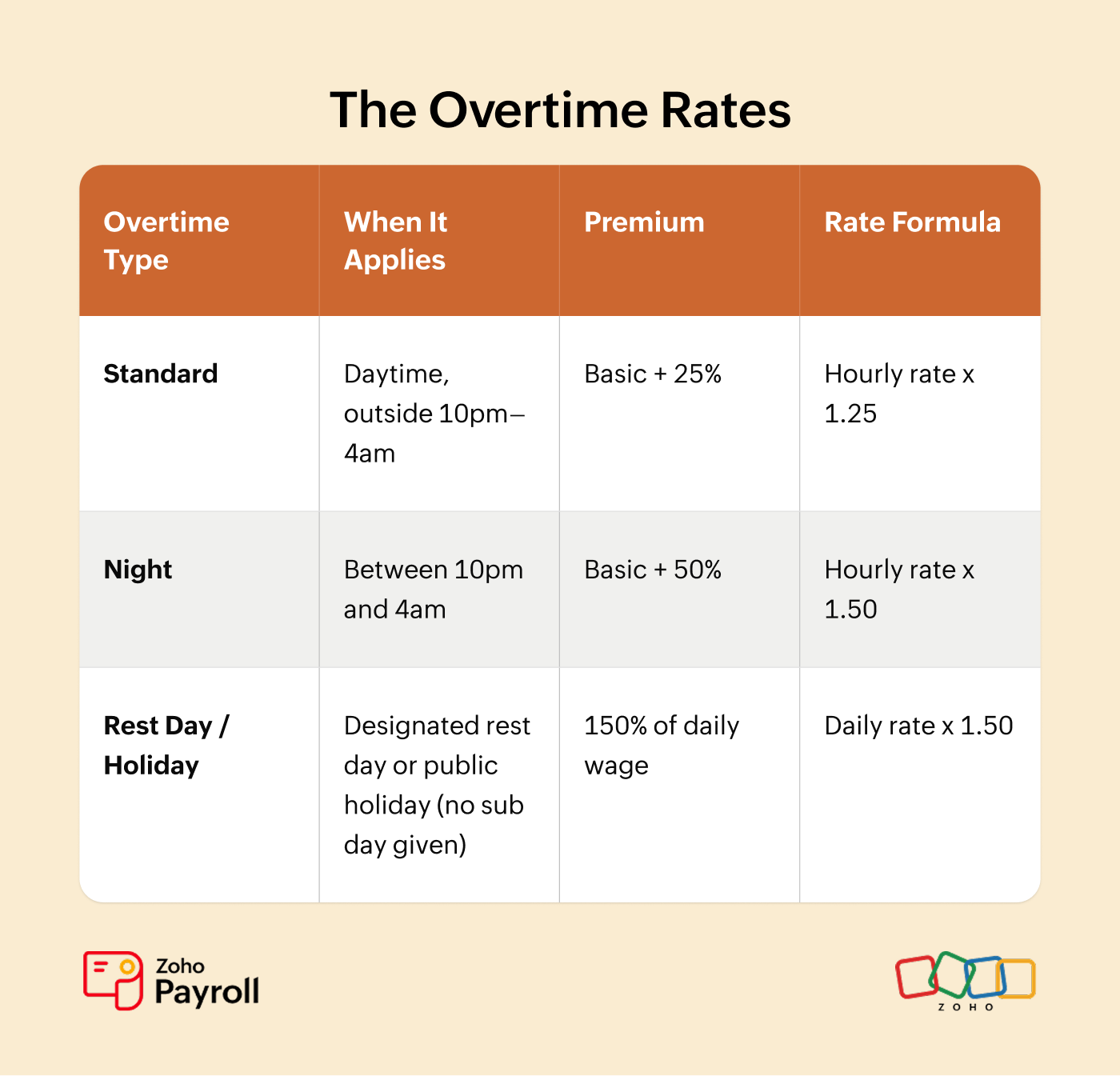
The Base Rate: Basic Salary Only
Overtime is calculated on basic salary only. Allowances (housing, transport, etc.) are not included. This is one of the most common mistakes in overtime pay.
Hourly rate formula: Basic monthly salary / 30 days / standard daily working hours
Worked Example (AED 5,000 Basic Salary)
If your basic salary is AED 5,000/month, here is how each tier works:
• Hourly rate: 5,000 / 30 / 8 = AED 20.83
• Standard overtime (25%): 20.83 x 1.25 = AED 26.04 per hour
• Night overtime (50%): 20.83 x 1.50 = AED 31.25 per hour
• Rest day/holiday (full day, no sub day): (5,000 / 30) x 1.50 = AED 250.00 per day
Ramadan Overtime
During Ramadan, the standard day drops to 6 hours. Any work beyond 6 hours counts as overtime, at the same rates above. So if an employee works 8 hours during Ramadan (a normal day outside Ramadan), those last 2 hours are overtime at the 25% rate.
Use the interactive overtime calculator on this page to check your own numbers across all three tiers, with a Ramadan toggle built in.
What Counts (and What Does Not)
The rates above are clear, but overtime eligibility itself raises a few questions that come up often. Here is what the law says about some of the grey areas.
• Does overtime apply during probation? Yes. Probation does not exempt an employee from overtime entitlements.
• Can an employer refuse to pay overtime? No. If the employee worked the hours with the employer's knowledge or instruction, the overtime must be paid. The employer can limit overtime hours (max 2 hours/day), but cannot refuse to pay for hours already worked.
• Is overtime voluntary? The employer can require overtime (within the 2-hour daily limit). The employee cannot unilaterally refuse reasonable overtime requests, but the employer must compensate at the correct rate.
• Travel time, on-call time? Generally not counted as overtime unless the employee is actively performing work during that time.
• Exempt categories: Senior management and certain roles may be exempt if their contract specifies different terms. Domestic workers and agricultural workers fall under separate regulations.
• Part-time employees: Part-time workers are entitled to overtime if they work beyond the hours stated in their contract. The same rate premiums (25%, 50%, 150%) apply.
If you are processing overtime for multiple employees with different contract hours, Zoho Payroll lets you configure each overtime type as a separate earning component. You can set different formulas for standard, night, and rest day overtime, and the system applies the correct rate based on the hours entered each pay run.
Three Overtime Calculations, One Payroll
Fatima is the payroll manager at a retail company in Abu Dhabi. It is March (Ramadan), and she needs to calculate overtime for three employees who worked extra hours this month.
Tariq: Standard Ramadan Overtime
Tariq, a store supervisor, worked 8 hours on 5 days during Ramadan (instead of the reduced 6). His basic salary is AED 6,000/month.
• Extra hours: 2 overtime hours x 5 days = 10 hours
• Hourly rate: 6,000 / 30 / 8 = AED 25.00
• Overtime rate (25%): 25 x 1.25 = AED 31.25 per hour
• Total overtime: 10 x 31.25 = AED 312.50
Layla: Night Overtime
Layla, a stock manager, worked 3 hours of overtime between 10pm and 2am to manage a late delivery. Her basic salary is AED 5,000/month.
• Hourly rate: 5,000 / 30 / 8 = AED 20.83
• Night rate (50%): 20.83 x 1.50 = AED 31.25 per hour
• Total overtime: 3 x 31.25 = AED 93.75
Omar: Rest Day Work During Ramadan
Omar, a cashier, worked a full 8-hour shift on his designated rest day (Friday, in his case). His basic salary is AED 4,000/month. He did not receive a substitute rest day.
• Daily rate: 4,000 / 30 = AED 133.33
• Rest day pay (150%): 133.33 x 1.50 = AED 200.00
Fatima has each overtime type set up as a separate earning component in Zoho Payrollwith custom formulas. She enters the overtime hours during the pay run, and the system applies the correct rate automatically. No manual percentage calculations, no spreadsheet formulas to maintain.
Frequently Asked Questions
Below are the questions that come up most often around overtime in the UAE.
Q1. How do I calculate my overtime rate in the UAE?
Divide your basic monthly salary by 30, then by your standard daily working hours (usually 8). That gives you your basic hourly rate. For standard daytime overtime, multiply by 1.25. For night overtime (10pm to 4am), multiply by 1.50.
Q2. Is overtime calculated on basic salary or total salary?
Basic salary only. Housing allowance, transport allowance, and other benefits are not included. This is one of the most common errors in overtime pay.
Q3. Do Ramadan reduced hours affect my pay?
No. Your salary stays the same during Ramadan. The 2-hour daily reduction is mandatory for all employees (Muslim and non-Muslim), and there is no pay cut. However, any hours worked beyond the reduced 6-hour day count as overtime.
Q4. What is the maximum overtime allowed per day?
2 hours. The employer can ask you to work up to 2 extra hours per day beyond the standard working hours. During Ramadan, the standard is 6 hours, so the maximum with overtime would be 8 hours.
Q5. Does overtime apply during probation?
Yes. Probation does not exempt employees from overtime rules. If you work beyond normal hours during your probation period, you are entitled to overtime pay at the standard rates.
Q6. Can my employer refuse to pay overtime?
No. If you worked the hours with the employer's knowledge or instruction, the overtime must be paid at the correct rate. If you believe your overtime is not being paid correctly, you can file a complaint with MOHRE.
Set Up Overtime That Calculates Itself
The overtime rates are straightforward once you know them. The challenge is applying the right rate to every employee, every pay run, across standard, night, and rest day shifts, with Ramadan adjustments on top. Zoho Payroll lets you set up each overtime type as a separate earning component with custom formulas, so the correct rate is applied automatically. Overtime hours can also sync directly from Zoho People, so nothing gets missed or manually entered wrong.
Start your free trial to set up overtime calculations that stay accurate through Ramadan and beyond.