





- HOME
- Payroll compliance
- UAE Leave Entitlements: Annual, Sick, Maternity, Paternity & More
UAE Leave Entitlements: Annual, Sick, Maternity, Paternity & More
Leave in the UAE goes well beyond annual leave. The law recognises at least eight distinct leave types, each with its own eligibility rules, pay structure, and payroll implications. Annual leave, sick leave, maternity, paternity, bereavement, study leave, Hajj leave, and public holidays all work differently, and getting any of them wrong has real consequences. With 7.8 million private-sector employees and MOHRE recording over 29,000 labour law violations in 2024 (from 688,000 inspections), leave compliance is not something employers can afford to get casual about. This guide consolidates every leave type into a single reference, with the pay rules and payroll handling for each. For the broader employment law context, see the UAE Labour Law: The Complete Employer Guide.
Annual Leave
Annual leave is the most searched leave entitlement in the UAE, and the rules are more nuanced than most people realise. Under Article 29 of Federal Decree-Law No. 33/2021, every private-sector employee who has completed one year of service is entitled to 30 days of paid annual leave per year.
Before the One-Year Mark
Employees who have completed at least 6 months but less than 1 year accrue 2 days of leave per month. Before the 6-month mark, the law does not guarantee leave, but many employers offer it as part of company policy. The important thing to know is that the 30-day entitlement does not kick in on day one.
Who Decides When You Take Leave
The employer has the right to determine when annual leave is taken, provided they give at least one month's notice. You can request specific dates, and in practice most companies will try to accommodate, but legally the employer has the final say on scheduling. The employer cannot, however, deny the entitlement entirely. The 30 days must be granted within the year.
What Counts as Leave Salary
Annual leave salary is based on the employee's full wage (basic salary plus all regular allowances), not just basic salary. This is different from overtime, which is calculated on basic salary only. If you are an employer, make sure your leave pay calculations include housing, transport, and other fixed allowances.
Carry Forward and Encashment
If annual leave is not used by the end of the year, it can be carried forward or encashed, depending on the employment contract and company policy. On termination (whether resignation or dismissal), any unused annual leave must be paid out as part of the final settlement. For the full final settlement process, see the Notice Period & Termination guide.
Zoho Payroll lets you configure annual leave as a leave type with custom policies. You can set encashment rules (carry forward unused days or encash them on reset), and import existing leave balances when you first set up the system, so nothing is lost in the transition.
Two Rules People Often Miss
• Public holidays during leave: If a public holiday falls during your annual leave, that day does not count as a leave day. Your leave extends by one day.
• Sick days during leave: If you fall sick during annual leave and have a medical certificate from a licensed facility, those sick days can be converted to sick leave. Your annual leave balance is restored for those days.
A Common Scenario
Consider Aisha, an HR manager at a retail company in Dubai. She has been with the company for 8 months and wants to take 10 days off. Under the law, she has accrued 2 days per month since her 6-month mark, giving her 4 days of guaranteed leave. Her employer can choose to grant the additional 6 days as a company benefit, but the law only requires 4 at this stage. Once Aisha completes her first year, her balance resets to the full 30-day annual entitlement.
Sick Leave
Annual leave covers your planned time off. But what happens when illness keeps you away from work? Sick leave in the UAE has a three-tier pay structure that catches many people off guard.
Under Article 31, private-sector employees are entitled to 90 days of sick leave per year, starting after the probation period is completed. The pay structure works in tiers:
• First 15 days: full pay
• Next 30 days: half pay
• Remaining 45 days: no pay (unpaid)
A medical certificate from a licensed medical facility is required for all sick leave. Without it, the employer is not obligated to pay.
During Probation
Sick leave entitlements do not apply during the probation period. Any sick leave during probation is at the employer's discretion. Some employers include sick leave in the probation terms, but the law does not require it.
Extended Absence
If an employee is absent for more than 45 consecutive days or 90 non-consecutive days in a year (after exhausting their sick leave entitlement), the employer may terminate the contract. The employee also cannot use sick leave to work for another employer. Doing so is grounds for immediate termination.
How It Plays Out in Practice
Consider an employee who is diagnosed with a condition requiring two months of recovery. The first 15 days are at full pay. Days 16 through 45 drop to half pay. Days 46 through 60 are unpaid. That is three different salary calculations within a single absence, and the payroll team needs to track where the employee sits in the cycle at each pay run.
Zoho Payroll's Loss of Pay (LOP) tracking handles the deduction automatically as employees move from full pay to half pay to unpaid territory. If an absence is later reclassified (for example, approved retrospectively), the LOP entry can be reversed without having to reprocess the entire pay run.
Maternity Leave
For new and expecting mothers, the UAE provides paid maternity leave with no minimum service requirement, which is worth highlighting because it is not the case in many countries.
Under Article 30, female employees are entitled to 60 days of maternity leave, split into two pay tiers:
• First 45 days: full pay
• Next 15 days: half pay
Eligibility and Timing
There is no minimum service requirement. Maternity leave applies from day one of employment. The leave can start up to 30 days before the expected delivery date, and the employee chooses how to split the time before and after birth.
Extended Leave and Protection
If the mother has a pregnancy-related or childbirth-related illness (confirmed by medical certificate), she can take an additional 45 days of unpaid leave. The employer cannot terminate the employee during this period. This protection applies even in the case of stillbirth.
Nursing Breaks
After returning to work, the mother is entitled to two nursing breaks per day (30 minutes each, or one hour combined) for 6 months from the delivery date. These breaks are paid and count as part of the working day. The employer cannot deduct these breaks from the employee's salary or require her to make up the time.
The Payroll Side
Maternity leave creates the same multi-tier payroll challenge as sick leave: 45 days at full pay followed by 15 days at half pay within a single continuous absence. If the employee takes the additional 45 days of unpaid leave for illness, that adds a third tier (unpaid) to the same absence.
Zoho Payroll's configurable leave types can reflect the 45-day full pay and 15-day half pay split, so the correct salary is processed each pay run without manual adjustments. If the employee extends into unpaid leave, the LOP tracking handles the deduction for those additional days.
Paternity Leave (Parental Leave)
Maternity leave has been part of UAE law for decades, but paid paternity leave is a newer addition. Introduced in the 2021 labour law, it is still not widely known among employers and employees.
Under Article 32, fathers in the private sector are entitled to 5 working days of paid parental leave.
• Timing: Must be taken within 6 months of the child's birth.
• Flexibility: The 5 days can be taken continuously or split across the 6-month window.
• Eligibility: Applies to all employees regardless of length of service.
• Pay: Fully paid.
If you are an employer, make sure your leave policy includes paternity leave as a separate category. Many companies have not updated their policies since the 2021 law took effect. A common mistake is rolling paternity leave into annual leave or offering it informally without a dedicated policy. The law treats it as a distinct entitlement, so your payroll and HR records should reflect that.
Bereavement Leave (Compassionate Leave)
When an employee loses a close family member, the law provides paid time off. The duration depends on the relationship.
• Death of a spouse: 5 days of paid leave.
• Death of a parent, child, sibling, grandchild, or grandparent: 3 days of paid leave.
These are the legal minimums. Many employers offer additional days as part of company policy, particularly for the loss of a parent or child. The leave is fully paid and does not deduct from annual leave.
One thing to note: the law does not cover extended family beyond grandparents and grandchildren. For the loss of an aunt, uncle, or cousin, any leave would be at the employer's discretion or drawn from annual leave. If your company wants to offer broader compassionate leave, you can build that into your internal policy as a separate leave category.
Study Leave
Employees pursuing education alongside their work have a specific leave entitlement, though it comes with conditions.
The law provides 10 working days per year of paid study or exam leave. To qualify, the employee must have completed at least 2 years of service with the employer and must be enrolled in an approved educational institution in the UAE.
The 2-year service requirement means newer employees are not eligible. The leave is paid, and it cannot be deducted from annual leave. If you are an employer, keep in mind that the employee needs to provide proof of enrolment and exam schedules. The leave is specifically for study and exams, not for general personal development or online courses outside of a formal institution.
Hajj Leave
For employees who wish to perform the Hajj pilgrimage, the law provides a dedicated leave entitlement, though it is unpaid.
Employees can take up to 30 days of unpaid leave to perform Hajj. This is a one-time entitlement during the employee's tenure with the same employer. If the employee changes employers, the entitlement resets with the new employer.
Because Hajj leave is unpaid, it affects the employee's monthly salary. The payroll deduction should be handled as a standard unpaid leave or Loss of Pay entry. If the employee takes fewer than 30 days, only the actual days taken are deducted. There is no requirement to take the full 30 days.
Public Holidays
The UAE government declares official public holidays each year, and all private-sector employees are entitled to these as paid days off.
Standard Public Holidays
• New Year's Day (January 1)
• Eid Al Fitr (dates vary, typically 3-4 days)
• Arafat Day (date varies)
• Eid Al Adha (dates vary, typically 3-4 days)
• Islamic New Year (date varies)
• Prophet's Birthday (date varies)
• Commemoration Day and National Day (December 1-3)
Working on a Public Holiday
If an employee works on a public holiday, they are entitled to either a substitute day off plus 50% of the daily wage, or 150% of the daily wage if no substitute day is given. This follows the same formula as rest day overtime, which is covered in the Working Hours, Overtime & Ramadan Rules guide.
The exact dates for Islamic holidays (Eid Al Fitr, Eid Al Adha, Islamic New Year, Prophet's Birthday) are confirmed by the government each year based on the lunar calendar. Employers should plan for approximate dates but wait for the official announcement before finalising schedules. The government typically confirms the dates a few days in advance.
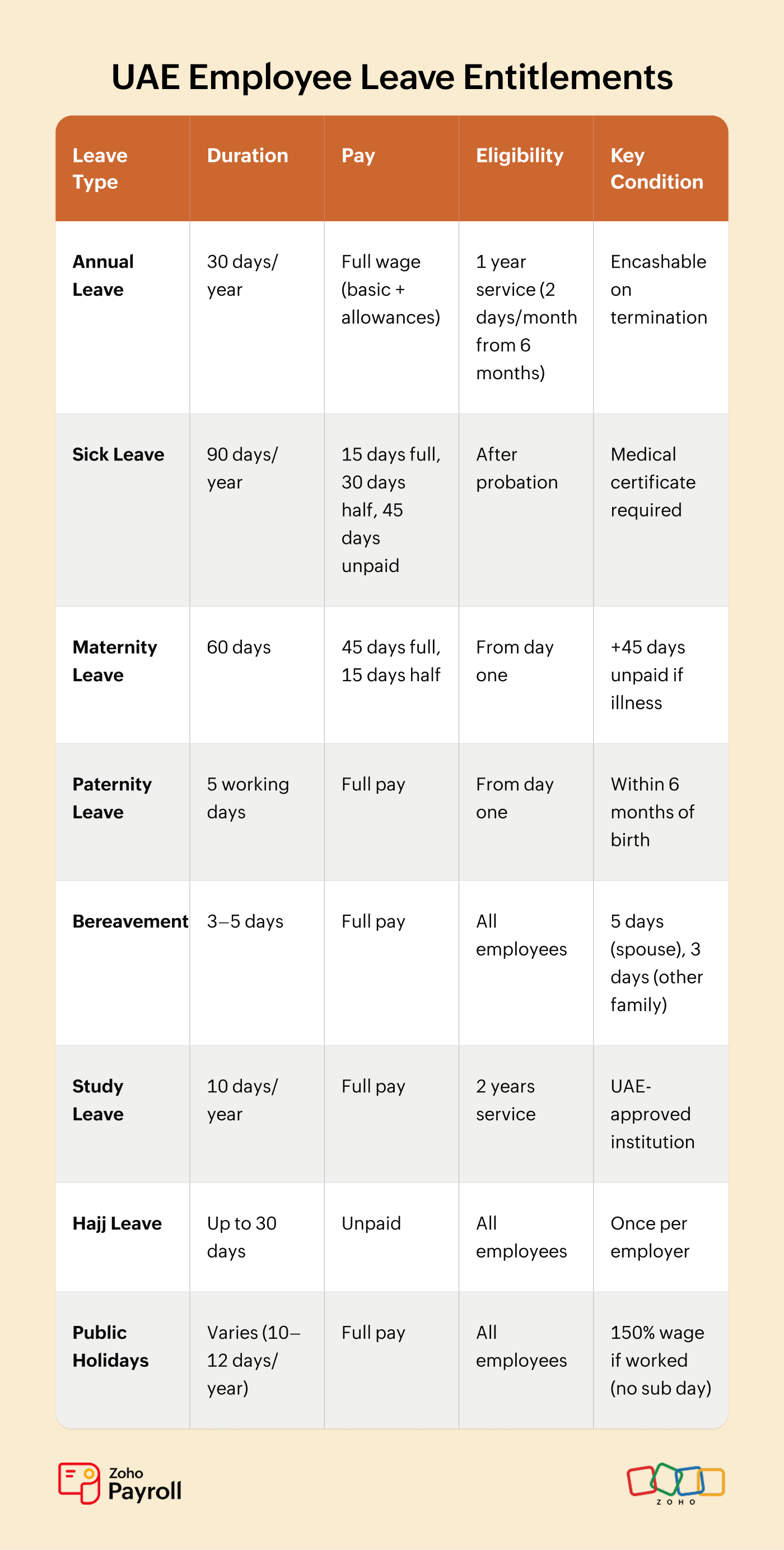
Leave Entitlements at a Glance
The table below brings all eight leave types together for quick reference.
What Happens to Leave When Employment Ends
This is where leave entitlements meet payroll most directly. When an employee resigns, is terminated, or completes a fixed-term contract, not all leave types are treated the same way.
Unused annual leave must be paid out as part of the final settlement. The encashment is calculated on the employee's full wage (basic plus allowances), using the same rate as annual leave salary. If the employee has worked less than one year, the pro-rata balance (2 days per month from the 6-month mark) is paid out.
Sick leave, maternity leave, paternity leave, bereavement leave, and study leave are not encashable. These entitlements exist only while the employment relationship is active. Once it ends, they lapse.
Leave encashment sits alongside gratuity as part of the end-of-service package. For the full final settlement process, see the Notice Period & Termination guide. For gratuity calculations, see the UAE Gratuity: Complete Guide.
A Quick Example
An employee earning a total wage of AED 10,000/month (basic plus allowances) resigns with 12 unused annual leave days. The daily rate is 10,000 / 30 = AED 333.33. The leave encashment is 12 x 333.33 = AED 4,000. This amount is added to the final settlement alongside any gratuity and notice period pay.
When an employee exit is initiated in Zoho Payroll, unused leave balances feed into the final settlement calculation alongside gratuity. The system uses the same full-wage base for leave encashment, so the payout matches what the law requires.
Frequently Asked Questions
Below are the questions that come up most often around leave entitlements in the UAE.
Q1. How many days of annual leave am I entitled to in the UAE?
30 days per year after completing one year of service. From the 6-month mark, you accrue 2 days per month. Before 6 months, any leave is at the employer's discretion.
Q2. Is annual leave salary based on basic salary or total salary?
Total salary (basic plus all regular allowances). This is different from overtime, which is calculated on basic salary only. Make sure your payroll is using the full wage figure for leave pay.
Q3. Can my employer refuse my annual leave request?
The employer can determine the timing of annual leave and must give one month's notice. They cannot deny the entitlement itself, but they can decide when you take it. In practice, most companies work with employees to find mutually convenient dates.
Q4. What happens to unused annual leave when I resign or am terminated?
Unused annual leave must be paid out as part of your final settlement, calculated on your full wage (basic plus allowances). This applies whether you resign or are terminated. For the full settlement process, see the Notice Period & Termination guide.
Q5. How does sick leave pay work in the UAE?
The first 15 days are at full pay, the next 30 days at half pay, and the remaining 45 days are unpaid. You need a medical certificate from a licensed facility. Sick leave entitlements begin only after the probation period ends.
Q6. Does maternity leave require a minimum service period?
No. Maternity leave (60 days: 45 at full pay, 15 at half pay) applies from day one of employment. There is no minimum service requirement, and this applies even in the case of stillbirth.
Q7. Can paternity leave be split across multiple days?
Yes. The 5 working days can be taken continuously or intermittently, as long as they fall within 6 months of the child's birth. This flexibility is built into the law.
Q8. Is Hajj leave paid or unpaid?
Unpaid. You can take up to 30 days to perform Hajj, but it is a one-time entitlement per employer. If you change jobs, the entitlement resets with your new employer.
Configure Leave Policies That Match the Law
Eight leave types, each with different pay rules, eligibility thresholds, and encashment logic. Getting one wrong means either underpaying an employee or overpaying and not recovering it. Zoho Payrolllets you configure each leave type with its own policy, handle encashment and Loss of Pay automatically, and sync leave balances from Zoho People so nothing falls through the cracks.
Start your free trial to set up leave policies that match UAE law from day one.