





- HOME
- Payroll compliance
- UAE Employment Contracts: Limited, Part-Time & Flexible
UAE Employment Contracts: Limited, Part-Time & Flexible
Employment contracts are where every working relationship in the UAE begins. They define pay, working hours, leave, notice periods, and end-of-service rights, and they are not optional. Every private-sector employer in the country must issue one for every employee, regardless of role or seniority.
The rules around contracts have changed significantly since Federal Decree-Law No. 33/2021 took effect in February 2022, and a lot of the information still circulating online is outdated. This guide covers what a UAE employment contract actually is, what it must contain, the only contract type that now exists, and the work arrangements the law formally recognises. For the full employment law context, see the UAE Labour Law: The Complete Employer Guide.
What Is an Employment Contract in the UAE
An employment contract is a legally binding written agreement between an employer and an employee that sets out the terms of their working relationship: the role, the salary, the duration, and the rights and obligations of both parties.
Under Federal Decree-Law No. 33/2021, every private-sector employer in the UAE must issue a written contract for every employee. There are no exceptions based on role, seniority, or salary level. Whether you are hiring a CEO or a part-time store assistant, the contract is mandatory and must be registered with MOHRE.
Who Does This Apply To
The law applies to all private-sector employees working on the UAE mainland and in most free zones. If you operate in the private sector and your company is not in DIFC or ADGM (which have their own employment regulations), this law covers your entire workforce.
The law does not apply to federal and local government employees, military and police personnel, or domestic workers (who fall under a separate law, Federal Decree-Law No. 9/2022). DIFC and ADGM employees are governed by their respective free zone employment regulations.
What Every UAE Employment Contract Must Include
Articles 8 and 54 of the law set out the mandatory elements. Every employment contract must contain:
• Employer name and address, and the employee's full name, nationality, date of birth, and Emirates ID number.
• Job title and description: a clear statement of the role the employee is being hired for.
• Contract start date and duration: including the agreed term (since all contracts are now fixed-term).
• Place of work: where the employee will perform their duties.
• Salary and payment method: the basic wage, any allowances, and how the salary will be paid (bank transfer through WPS for most employees).
• Working hours: the agreed daily or weekly schedule.
• Leave entitlements: including annual leave, sick leave, and any other applicable leave types.
• Notice period: the agreed period for either party to end the contract (minimum 30 days, maximum 90 days).
• Non-compete clause (if applicable): any post-employment restrictions, which must be reasonable in scope, geography, and duration.
MOHRE provides standard contract templates through its eServices portal. Most employers use these templates as the starting point, then add any company-specific terms. The contract must be in Arabic (or bilingual with Arabic as the governing language) and signed by both parties.
Here is what a completed employment contract looks like in practice:
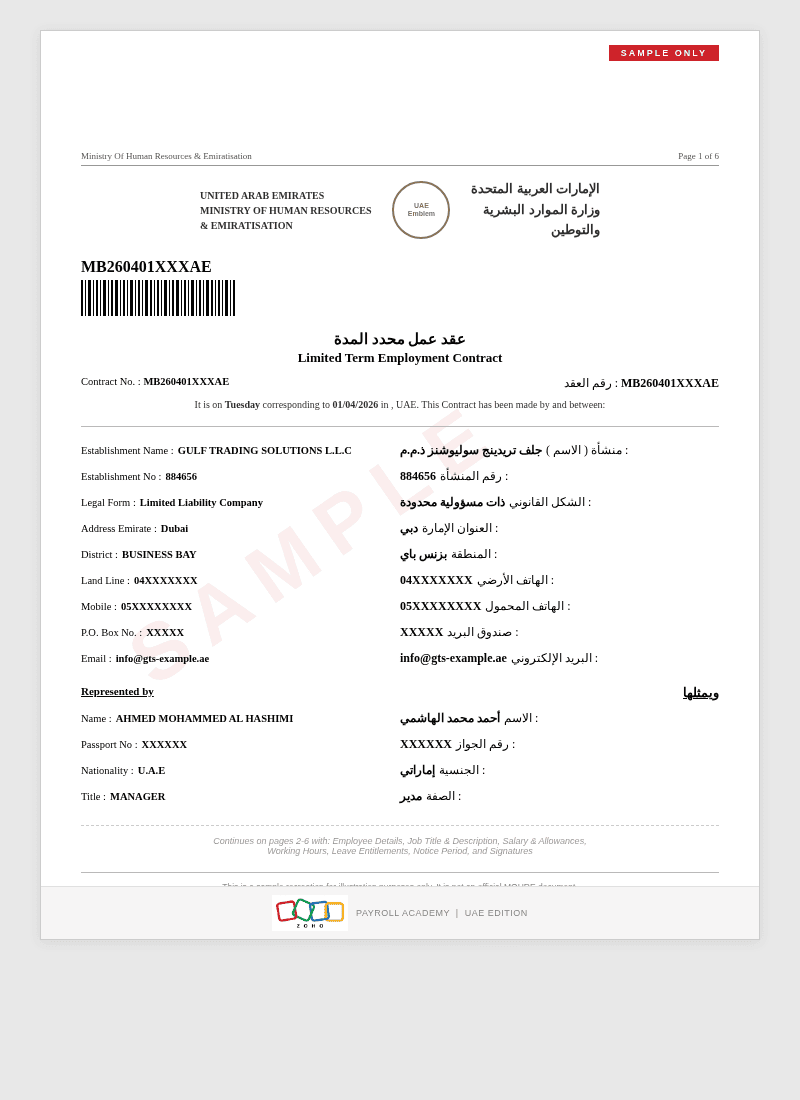
Keeping contracts, visas, and work permits organised across a growing workforce is where things get complicated quickly. Zoho Payroll provides centralised employee document storage where you can keep all of these documents alongside the employee's payroll record, so nothing falls through the cracks during an audit or inspection.
The Fixed-Term (Limited) Contract
Every contract listed above takes one form: fixed-term. Under Article 8 of Federal Decree-Law No. 33/2021, all employment contracts in the UAE are now fixed-term (limited) contracts. The old unlimited contract option was abolished when the law took effect in February 2022, and employers had until 31 December 2023 to convert any remaining unlimited contracts.
No Maximum Duration
When the law first took effect, contracts were capped at 3 years. That cap was removed in September 2022 by Federal Decree No. 14/2022. Employers and employees can now agree on any duration: 1 year, 5 years, 10 years, or longer. The contract must specify the term, and it is renewable by mutual agreement for the same or a different period.
Automatic Renewal
If both parties continue the employment relationship after the contract expires without formally renewing, the contract is considered renewed on the same terms. This means the relationship does not simply lapse. It rolls forward, and the same rights and obligations continue to apply.
What If You Still Have Unlimited Contracts
If you still have employees on unconverted unlimited contracts, those contracts are technically non-compliant. The practical recommendation is to convert them as soon as possible using MOHRE's standard contract templates.
Probation Period
Once the contract is in place, most employment relationships start with a probation period. The rules here changed under the 2021 law, and they are stricter than what many employers are used to.
Under Article 9, the maximum probation period is 6 months. The employer cannot extend it beyond this, regardless of what the contract says.
Notice During Probation
• Employee resigning to join another UAE employer: 14 days' notice.
• Employee resigning to leave the country: 1 month's notice.
• Employer terminating during probation: 14 days' notice.
Other Rules to Know
• No second probation: If the same employer re-hires an employee, there is no second probation period.
• New employer costs: If an employee leaves during probation to join another UAE employer, the new employer must reimburse the original employer for recruitment costs, unless otherwise agreed.
• Sick leave: Sick leave entitlements under the law do not apply during probation. Any sick leave during this period is at the employer's discretion.
For the full picture on what happens when employment ends (whether during or after probation), see the Notice Period & Termination guide.
Work Arrangement Types
The 2021 law did more than change contract duration. It formally recognised several work arrangements that had existed informally for years but never had a clear legal framework. With a 32% increase in private-sector establishments entering the UAE market in 2024 and 12% growth in the overall workforce, these arrangements are not theoretical. They are how companies are actually hiring.
• Full-time: Working for a single employer for the standard 8 hours per day (48 hours per week). This is still the most common arrangement.
• Part-time: Working for one or more employers for a specified number of hours or days. The minimum is 20 hours per week. You can hold a part-time work permit for multiple employers without needing approval from your original employer.
• Temporary: Employment for a specific task or a defined period. The contract ends when the task is completed or the period expires.
• Flexible: Working hours that change based on the employer's operational needs. The employee and employer agree on the framework, but the hours are not fixed week to week.
• Remote: Work performed fully or partially outside the traditional workplace. The law recognises this as a legitimate work model with the same protections.
• Job sharing: Two or more employees share the responsibilities of a single role, splitting the hours and duties between them.
The key point: part-time, flexible, and remote workers are entitled to the same protections as full-time employees. Annual leave, public holidays, end-of-service gratuity, and overtime rules all apply, calculated proportionally based on their working hours or days. For leave specifics, see the UAE Leave Entitlements guide.
What This Means for Payroll
Contract type shapes how payroll runs in several ways. Here are the areas where it matters most.
Salary Structures
Full-time employees typically have a standard monthly salary with fixed allowances. Part-time employees may be paid hourly, daily, or per task. Flexible workers might have variable pay that changes month to month. Your payroll system needs to handle all of these without requiring a separate process for each.
Zoho Payroll lets you customise salary structures based on role, location, or contract type. Full-time and part-time employees can run through the same payroll with different configurations, so you do not need separate systems or manual workarounds.
Gratuity
End-of-service gratuity depends on the contract type and the nature of the separation (resignation vs termination). Under fixed-term contracts, if an employee resigns before the contract ends, the gratuity calculation may differ from a termination scenario. For the full breakdown, see the UAE Gratuity: Complete Guide. When you initiate an employee exit in Zoho Payroll, gratuity is calculated automatically based on the contract type, separation type, and free zone (if applicable).
Notice Periods
Fixed-term contracts follow the notice period specified in the contract, with a minimum of 30 days and a maximum of 90 days. During probation, different notice rules apply (14 days to 1 month, as outlined above). For the complete notice period framework, see the Notice Period & Termination guide.
Frequently Asked Questions
Below are the questions that come up most often around employment contracts in the UAE.
Q1. Is there still an unlimited contract in the UAE?
No. Unlimited contracts were abolished by Federal Decree-Law No. 33/2021, effective February 2022. All employment contracts are now fixed-term (limited). The deadline to convert existing unlimited contracts was 31 December 2023.
Q2. What is the maximum duration of a fixed-term contract?
There is no maximum. The original 3-year cap was removed by Federal Decree No. 14/2022 in September 2022. Employers and employees can agree on any duration.
Q3. Can I work part-time for two employers?
Yes. The law allows part-time work permits for multiple employers. You do not need approval from your original employer. The minimum working hours for a part-time arrangement is 20 hours per week.
Q4. What is the maximum probation period in the UAE?
6 months. The employer cannot extend it beyond this. If the employee is re-hired by the same employer, there is no second probation period.
Q5. Do part-time employees get gratuity?
Yes. Part-time employees are entitled to end-of-service gratuity, calculated proportionally based on their working hours or days. The same formula applies, adjusted for the reduced schedule. For the calculation details, see the UAE Gratuity: Complete Guide.
Set Up Contracts and Payroll That Match the Current Law
Whether you are onboarding a full-time employee on a 3-year contract, a part-time hire with flexible hours, or processing an exit with gratuity, the contract type shapes how payroll runs. Zoho Payroll lets you configure salary structures by contract type, automate gratuity calculations based on contract and separation type, and store all employment documents in one centralised platform.
Start your free trial to set up contracts and payroll that match the current law.